In the journey of navigating a marital separation, clarity and mutual understanding become essential for both partners. The Vermont Marital Separation Agreement form serves as a vital tool in this process, providing a structured framework for couples to outline their rights and responsibilities during a separation. This agreement addresses key aspects such as the division of property, spousal support, and child custody arrangements, ensuring that both parties have a clear understanding of their obligations and entitlements. By detailing financial responsibilities and living arrangements, the form aims to minimize conflicts and foster cooperation. Furthermore, it can serve as a foundation for future negotiations, should the couple choose to reconcile or pursue divorce. Understanding the nuances of this form is crucial for anyone considering separation, as it lays the groundwork for a smoother transition into a new chapter of life.
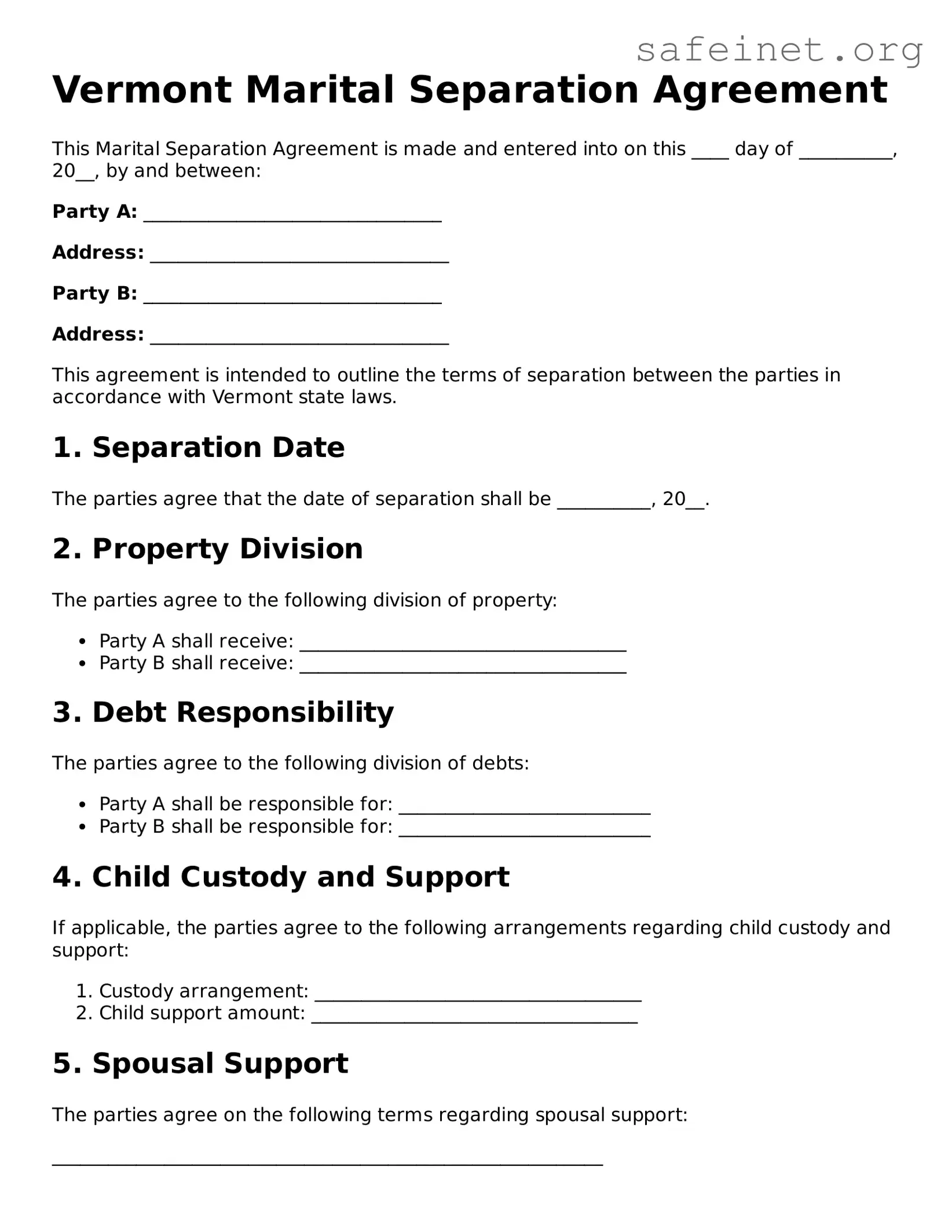
Vermont Marital Separation Agreement
This Marital Separation Agreement is made and entered into on this ____ day of __________, 20__, by and between:
Party A: ________________________________
Address: ________________________________
Party B: ________________________________
Address: ________________________________
This agreement is intended to outline the terms of separation between the parties in accordance with Vermont state laws.
1. Separation Date
The parties agree that the date of separation shall be __________, 20__.
2. Property Division
The parties agree to the following division of property:
3. Debt Responsibility
The parties agree to the following division of debts:
4. Child Custody and Support
If applicable, the parties agree to the following arrangements regarding child custody and support:
5. Spousal Support
The parties agree on the following terms regarding spousal support:
___________________________________________________________
6. Miscellaneous Provisions
The parties agree to the following additional terms:
This agreement represents the entire understanding between the parties regarding their separation. Any modifications must be in writing and signed by both parties.
IN WITNESS WHEREOF, the parties have executed this Marital Separation Agreement as of the date first above written.
Party A Signature: ___________________________ Date: ____________
Party B Signature: ___________________________ Date: ____________
| Fact Name | Description |
|---|---|
| Definition | A Vermont Marital Separation Agreement is a legal document that outlines the terms of separation between spouses. |
| Governing Laws | The agreement is governed by Vermont state laws, particularly Title 15 of the Vermont Statutes Annotated. |
| Purpose | This form helps to clarify issues such as property division, child custody, and support obligations. |
| Voluntary Nature | Both parties must voluntarily agree to the terms outlined in the agreement for it to be valid. |
| Filing Requirements | The agreement must be filed with the court if either party seeks a divorce or legal separation. |
| Modification | Changes to the agreement can be made if both parties consent and document those changes properly. |
Completing the Vermont Marital Separation Agreement form requires careful attention to detail. After filling out the form, you will need to review it thoroughly to ensure that all information is accurate and complete. Once finalized, the next steps typically involve filing the agreement with the appropriate court and ensuring both parties have copies for their records.
What is a Vermont Marital Separation Agreement?
A Vermont Marital Separation Agreement is a legal document that outlines the terms of separation between spouses. It addresses various aspects such as property division, spousal support, child custody, and visitation rights. This agreement helps both parties understand their rights and responsibilities while they live separately. It is important to have this document in writing to avoid misunderstandings in the future.
Do I need an attorney to create a Marital Separation Agreement in Vermont?
Can I modify the Marital Separation Agreement after it is signed?
Yes, a Marital Separation Agreement can be modified after it is signed, but both parties must agree to the changes. It is best to document any modifications in writing and have both parties sign the revised agreement. This helps to maintain clarity and avoid future disputes. If significant changes occur in circumstances, such as a change in income or living arrangements, updating the agreement may be necessary.
How does a Marital Separation Agreement affect child custody and support?
A Marital Separation Agreement can specify arrangements for child custody and support. It outlines where the children will live, visitation schedules, and how much child support will be paid. This agreement is crucial for ensuring that both parents understand their roles and responsibilities regarding their children. Courts generally encourage parents to reach an agreement that is in the best interest of the child, and the court may enforce the terms outlined in the agreement.
Is a Marital Separation Agreement legally binding in Vermont?
Yes, a Marital Separation Agreement is legally binding in Vermont once both parties sign it. However, the agreement must be fair and reasonable to be enforceable in court. If either party believes that the agreement is unfair or was signed under duress, they may contest its validity. It is important to approach the creation of this agreement with care to ensure that it reflects both parties' intentions and is compliant with state laws.
Incomplete Information: Many individuals fail to provide all required details. This includes missing names, addresses, or dates. Ensure that every section is filled out completely.
Incorrect Signatures: Signatures must be from both parties involved. Some people forget to sign or have only one party sign the document. Always check that both parties have signed.
Not Reviewing Terms: It’s common to overlook the terms of separation. Individuals may agree to terms verbally but fail to document them accurately. Review all terms carefully before submission.
Missing Notarization: Some people neglect to have the agreement notarized. Notarization is essential for the document to be legally binding. Make sure to include this step.
Failure to Understand Legal Implications: Many do not fully grasp the legal consequences of their agreement. This can lead to issues down the line. Consider consulting a professional to clarify any uncertainties.
When navigating a marital separation in Vermont, several important documents often accompany the Marital Separation Agreement. Each of these forms serves a specific purpose and helps ensure that both parties understand their rights and obligations. Here’s a list of commonly used documents:
Understanding these documents can help both parties navigate the separation process more smoothly. Each form plays a crucial role in ensuring that the rights and responsibilities of both spouses are clearly defined and agreed upon.
The Vermont Marital Separation Agreement is similar to a Divorce Settlement Agreement. Both documents outline the terms of a couple's separation, including property division, child custody, and support obligations. While a separation agreement is used when a couple decides to live apart without officially ending the marriage, a divorce settlement finalizes the terms after the marriage is legally dissolved. Each document aims to ensure both parties understand their rights and responsibilities.
An Uncontested Divorce Agreement is another document that shares similarities with the Vermont Marital Separation Agreement. This type of agreement is used when both spouses agree on all terms of the divorce, including asset division and child custody. Like a separation agreement, it helps facilitate a smoother process by reducing conflicts and providing clear guidelines for both parties.
The Child Custody Agreement is closely related as well. This document specifically focuses on the arrangements for children following a separation or divorce. It details custody arrangements, visitation schedules, and child support obligations. Both the Marital Separation Agreement and the Child Custody Agreement prioritize the well-being of children and aim to create a stable environment for them.
A Property Settlement Agreement is similar in that it addresses the division of marital assets and debts. This document is often part of a divorce proceeding but can also be included in a separation agreement. Both documents ensure that each spouse understands their share of the property and how debts will be handled, promoting fairness and clarity.
The Cohabitation Agreement can also be compared to the Vermont Marital Separation Agreement. This document is used by couples who live together but are not married. It outlines the rights and responsibilities of each partner regarding property, finances, and other shared aspects of their lives. While the context differs, both agreements aim to protect individual interests and clarify expectations.
A Postnuptial Agreement shares similarities as well. This document is created after a couple is married and outlines how assets will be divided in the event of separation or divorce. Like a separation agreement, it helps couples establish clear terms and can reduce disputes later on. Both documents serve as a proactive measure to manage potential conflicts.
The Prenuptial Agreement is another document that relates closely to the Marital Separation Agreement. This agreement is made before marriage and outlines how assets will be divided in case of divorce or separation. While the prenuptial agreement is preventative, the marital separation agreement addresses the realities of separation, making both important for managing financial and legal expectations.
Finally, the Separation Agreement for Legal Separation is similar in purpose and function. This document is specifically for couples who wish to remain legally married while living apart. It covers similar topics as the Vermont Marital Separation Agreement, such as child custody and property division, but maintains the marriage status. Both agreements serve to clarify the terms of the separation and protect the interests of both parties.
When filling out the Vermont Marital Separation Agreement form, it's important to follow certain guidelines to ensure accuracy and completeness. Here’s a list of what you should and shouldn’t do:
Understanding the Vermont Marital Separation Agreement form is crucial for those navigating a separation. However, several misconceptions can lead to confusion. Here are six common misunderstandings:
A marital separation agreement is not a divorce. It outlines the terms of a couple's separation but does not legally dissolve the marriage. Couples remain married until they file for divorce.
While a marital separation agreement can be submitted to the court, it is not mandatory. Couples may choose to keep it private and use it as a guideline for their separation.
Many people believe that these agreements only cover financial matters. In reality, they can also address child custody, visitation rights, and other personal matters.
A marital separation agreement is not permanent. Couples can modify the terms as circumstances change, or they can choose to proceed with a divorce.
While it is advisable for each party to have legal representation, it is not a requirement. Couples can agree on the terms and draft the document together.
Many assume that creating a marital separation agreement is a time-consuming process. However, with clear communication and mutual agreement, it can often be completed relatively quickly.
By addressing these misconceptions, individuals can better understand the Vermont Marital Separation Agreement and its role in the separation process.
When completing and utilizing the Vermont Marital Separation Agreement form, keep these essential points in mind: