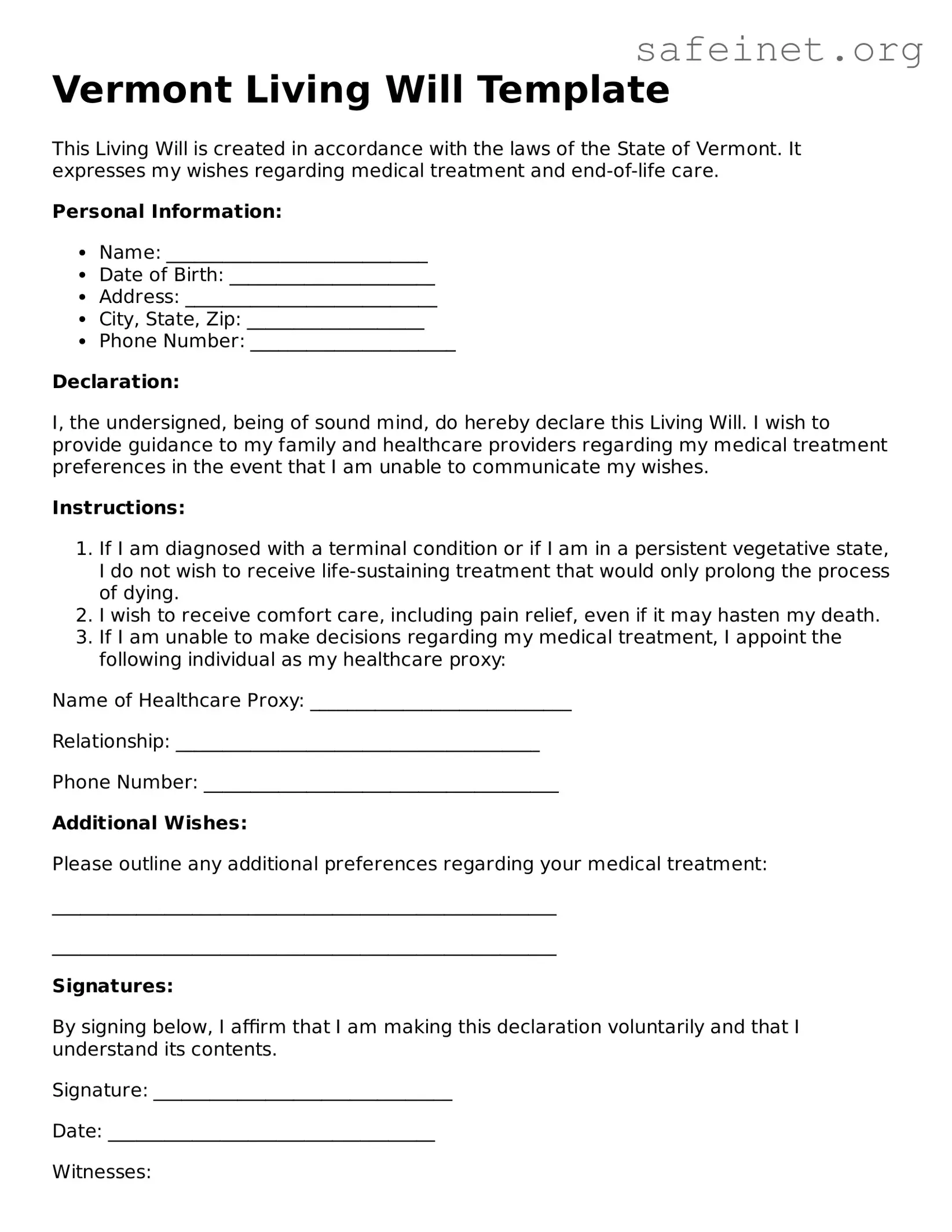
In the beautiful state of Vermont, individuals have the opportunity to express their healthcare preferences through a Living Will, a vital document that ensures your wishes are respected when you are unable to communicate them yourself. This form allows you to specify your desires regarding medical treatment in the event of a terminal illness or incapacitating condition. Key aspects of the Vermont Living Will include the ability to indicate your preferences for life-sustaining treatments, such as resuscitation efforts and artificial nutrition or hydration. It also empowers you to appoint a healthcare agent, someone you trust to make medical decisions on your behalf if you are unable to do so. By completing this form, you not only provide clarity to your loved ones during difficult times but also give yourself peace of mind, knowing that your values and wishes will guide your care. Understanding how to properly fill out and execute this document can make all the difference in ensuring that your healthcare choices are honored, reflecting your personal beliefs and desires even when you cannot voice them directly.
Vermont Living Will Template
This Living Will is created in accordance with the laws of the State of Vermont. It expresses my wishes regarding medical treatment and end-of-life care.
Personal Information:
Declaration:
I, the undersigned, being of sound mind, do hereby declare this Living Will. I wish to provide guidance to my family and healthcare providers regarding my medical treatment preferences in the event that I am unable to communicate my wishes.
Instructions:
Name of Healthcare Proxy: ____________________________
Relationship: _______________________________________
Phone Number: ______________________________________
Additional Wishes:
Please outline any additional preferences regarding your medical treatment:
______________________________________________________
______________________________________________________
Signatures:
By signing below, I affirm that I am making this declaration voluntarily and that I understand its contents.
Signature: ________________________________
Date: ___________________________________
Witnesses:
Two witnesses are required to sign below. Witnesses must not be related to me by blood or marriage and must not be entitled to any portion of my estate.
This Living Will is intended to provide clear guidance and should be kept in a safe place. It is advisable to discuss your wishes with your healthcare proxy and loved ones.
| Fact Name | Description |
|---|---|
| Governing Law | The Vermont Living Will is governed by 18 V.S.A. § 9701 et seq. |
| Purpose | A Living Will allows individuals to express their wishes regarding medical treatment in case they become unable to communicate. |
| Eligibility | Any adult resident of Vermont can create a Living Will. |
| Witness Requirement | The document must be signed in the presence of two witnesses who are not related to the individual. |
| Revocation | Individuals can revoke their Living Will at any time, as long as they are competent. |
| Durable Nature | A Living Will remains effective until revoked or until the individual passes away. |
| Additional Considerations | It is advisable to discuss your wishes with family and healthcare providers to ensure understanding and compliance. |
Completing the Vermont Living Will form is an important step in expressing your healthcare preferences. Once you have filled out the form, you will need to ensure it is properly signed and witnessed to be valid.
What is a Living Will in Vermont?
A Living Will is a legal document that allows individuals to express their wishes regarding medical treatment in the event they become unable to communicate their preferences. In Vermont, this document specifically addresses end-of-life care and can guide healthcare providers and loved ones in making decisions that align with your values and desires.
Who should create a Living Will?
Anyone aged 18 or older can create a Living Will. It is especially important for individuals with chronic illnesses, those undergoing major surgeries, or anyone who wishes to ensure their healthcare preferences are known. Having a Living Will can provide peace of mind for both you and your family.
What should be included in a Vermont Living Will?
A Vermont Living Will should clearly outline your preferences regarding medical treatments such as resuscitation, mechanical ventilation, and feeding tubes. You may also include specific instructions about pain management and other end-of-life care options. The more detailed you are, the easier it will be for your loved ones and healthcare providers to honor your wishes.
How do I create a Living Will in Vermont?
To create a Living Will in Vermont, you can either use a template or draft your own document. It is advisable to consult with a legal professional to ensure that your Living Will complies with state laws. Once completed, you should sign the document in the presence of two witnesses who are not related to you or beneficiaries of your estate.
Can I change or revoke my Living Will?
Yes, you can change or revoke your Living Will at any time, as long as you are mentally competent. To do this, you can create a new Living Will that explicitly states your updated wishes or simply destroy the old document. It is important to inform your healthcare providers and family members about any changes you make.
Is a Living Will the same as a Durable Power of Attorney for Healthcare?
No, a Living Will and a Durable Power of Attorney for Healthcare serve different purposes. A Living Will specifies your wishes regarding medical treatment, while a Durable Power of Attorney for Healthcare allows you to appoint someone to make healthcare decisions on your behalf if you are unable to do so. Many people choose to have both documents for comprehensive healthcare planning.
What happens if I don’t have a Living Will?
If you do not have a Living Will, your healthcare providers will make decisions based on your best interests, but they may not know your personal preferences. This can lead to confusion and potential disagreements among family members. Without clear guidance, loved ones may be left to make difficult choices during an already stressful time.
How can I ensure my Living Will is honored?
To ensure that your Living Will is honored, share copies of the document with your healthcare providers, family members, and anyone involved in your care. Discuss your wishes openly with them, so they understand your preferences. Keeping your Living Will in a readily accessible place can also help ensure that it is consulted when needed.
Can I use a Living Will created in another state in Vermont?
Vermont generally recognizes Living Wills created in other states, provided they comply with the laws of the state where they were created. However, it is wise to consult with a legal professional to confirm that your out-of-state Living Will meets Vermont's requirements and adequately reflects your wishes.
Not specifying treatment preferences clearly. Individuals often leave sections of the form vague, which can lead to confusion for healthcare providers.
Failing to sign and date the document. A Living Will is not valid unless it is properly signed and dated by the individual making the declaration.
Neglecting to have witnesses. Vermont law requires that the Living Will be signed in the presence of two witnesses to ensure its validity.
Using outdated forms. Individuals sometimes use older versions of the Living Will form, which may not comply with current legal standards.
Overlooking the importance of discussing wishes with family. Failing to communicate intentions can lead to misunderstandings and disputes among family members during critical moments.
Not reviewing the form regularly. People often forget to update their Living Will as their health status or personal beliefs change.
Assuming the form will automatically be honored. Some individuals do not confirm that their healthcare providers are aware of and respect their Living Will.
Ignoring state-specific requirements. Each state has unique regulations regarding Living Wills, and individuals may overlook these when completing the form.
Relying solely on the Living Will without additional planning. Many individuals fail to consider other important documents, such as a healthcare proxy or power of attorney, which can complement their Living Will.
When preparing a Vermont Living Will, it is essential to consider additional documents that complement its purpose. These forms help ensure that an individual’s healthcare wishes are clearly communicated and respected. Below is a list of commonly used documents alongside the Living Will.
Incorporating these documents with a Vermont Living Will can provide a comprehensive approach to healthcare planning. Each form plays a unique role in ensuring that an individual's wishes are respected, especially during critical moments.
The Vermont Living Will form is similar to the Advance Directive, which encompasses both living wills and durable powers of attorney for health care. An Advance Directive allows individuals to outline their preferences for medical treatment and appoint someone to make decisions on their behalf if they become unable to communicate. This comprehensive approach ensures that a person’s wishes are respected in various medical situations, providing clarity and reducing stress for family members during critical times.
Another document akin to the Vermont Living Will is the Health Care Proxy. This document specifically designates an individual to make health care decisions for someone if they are incapacitated. Unlike a living will, which details specific medical preferences, a Health Care Proxy focuses on appointing a trusted person to interpret and make decisions based on the individual’s values and wishes. This can be particularly valuable in complex medical situations where the exact course of action may not be clear.
The Do Not Resuscitate (DNR) order is also similar in its intent to guide medical professionals. A DNR order instructs medical personnel not to perform cardiopulmonary resuscitation (CPR) if a patient’s heart stops beating or they stop breathing. This document is crucial for individuals who wish to avoid aggressive life-saving measures, emphasizing their preference for a natural death. It complements the living will by focusing on a specific medical intervention.
The Physician Orders for Life-Sustaining Treatment (POLST) form shares similarities with the Vermont Living Will in that it translates a patient's wishes regarding life-sustaining treatments into actionable medical orders. Unlike a living will, which is often more general, a POLST form provides specific instructions for emergency medical personnel, ensuring that an individual’s treatment preferences are honored at all times, especially in emergencies.
In addition, the Durable Power of Attorney for Health Care is closely related to the Vermont Living Will. This document allows individuals to appoint someone to make health care decisions on their behalf if they are unable to do so. While a living will outlines specific preferences for treatment, a Durable Power of Attorney can address broader issues and provides the designated person with the authority to make decisions based on the individual's best interests.
The Health Care Declaration is another document that aligns with the Vermont Living Will. This declaration allows individuals to express their wishes regarding medical treatment in the event they become unable to communicate. It serves a similar purpose by ensuring that medical professionals and family members understand the individual’s preferences, thus reducing confusion and potential conflict during challenging times.
The Mental Health Advance Directive is a document that focuses specifically on mental health treatment preferences. It allows individuals to outline their wishes regarding mental health care in the event they cannot make decisions due to a mental health crisis. This is particularly important for those who may have previously experienced mental health challenges, ensuring their preferences are respected and understood during vulnerable moments.
Lastly, the Organ Donation Consent form is similar in that it addresses end-of-life decisions. This document allows individuals to express their wishes regarding organ donation after death. While it does not provide specific medical treatment preferences, it plays a crucial role in ensuring that an individual’s wishes regarding organ donation are clearly communicated and respected, complementing the broader goals of a living will.
When filling out the Vermont Living Will form, it's essential to approach the process carefully. Here are some key things to keep in mind:
Taking these steps can help ensure that your Living Will accurately reflects your wishes and provides guidance to your loved ones and healthcare providers.
Understanding the Vermont Living Will form is essential for making informed decisions about healthcare preferences. However, several misconceptions may lead to confusion. Below are nine common misconceptions and clarifications regarding the Vermont Living Will form.
A Living Will specifically addresses healthcare decisions, while a Power of Attorney can cover a broader range of legal and financial matters.
You can update or revoke your Living Will at any time, as long as you are mentally competent to do so.
This form can also provide guidance for medical decisions in other serious health situations, not just at the end of life.
While healthcare providers should respect your wishes, some may have personal or institutional policies that affect their compliance.
While legal advice can be helpful, you can create a Living Will on your own using state-provided forms.
Anyone over the age of 18 can benefit from having a Living Will, regardless of age or health status.
While many states recognize Living Wills, it's important to check the specific laws in other states to ensure validity.
A Living Will outlines your preferences but does not automatically deny you life-saving treatment unless specified.
You can change your preferences or revoke the Living Will whenever you wish, as long as you are mentally competent.
Clarifying these misconceptions can empower individuals to make informed decisions about their healthcare preferences. Understanding the Vermont Living Will form ensures that your wishes are honored when it matters most.
Filling out a Vermont Living Will form is an important step in ensuring your healthcare wishes are respected. Here are some key takeaways to consider:
By following these guidelines, you can create a Living Will that effectively communicates your healthcare preferences and provides peace of mind for you and your loved ones.