Creating a Last Will and Testament is an essential step for anyone wishing to ensure their wishes are honored after their passing. In Vermont, this legal document serves as a formal declaration of how a person's assets and responsibilities should be handled. The Vermont Last Will and Testament form outlines key components, including the appointment of an executor, who will be responsible for managing the estate, as well as the distribution of property among beneficiaries. It also allows individuals to specify guardianship for minor children, providing peace of mind for parents. Furthermore, the form must meet certain requirements to be considered valid, such as being signed by the testator and witnessed by at least two individuals. Understanding these aspects is crucial for anyone looking to create a comprehensive will that reflects their personal wishes and protects their loved ones.
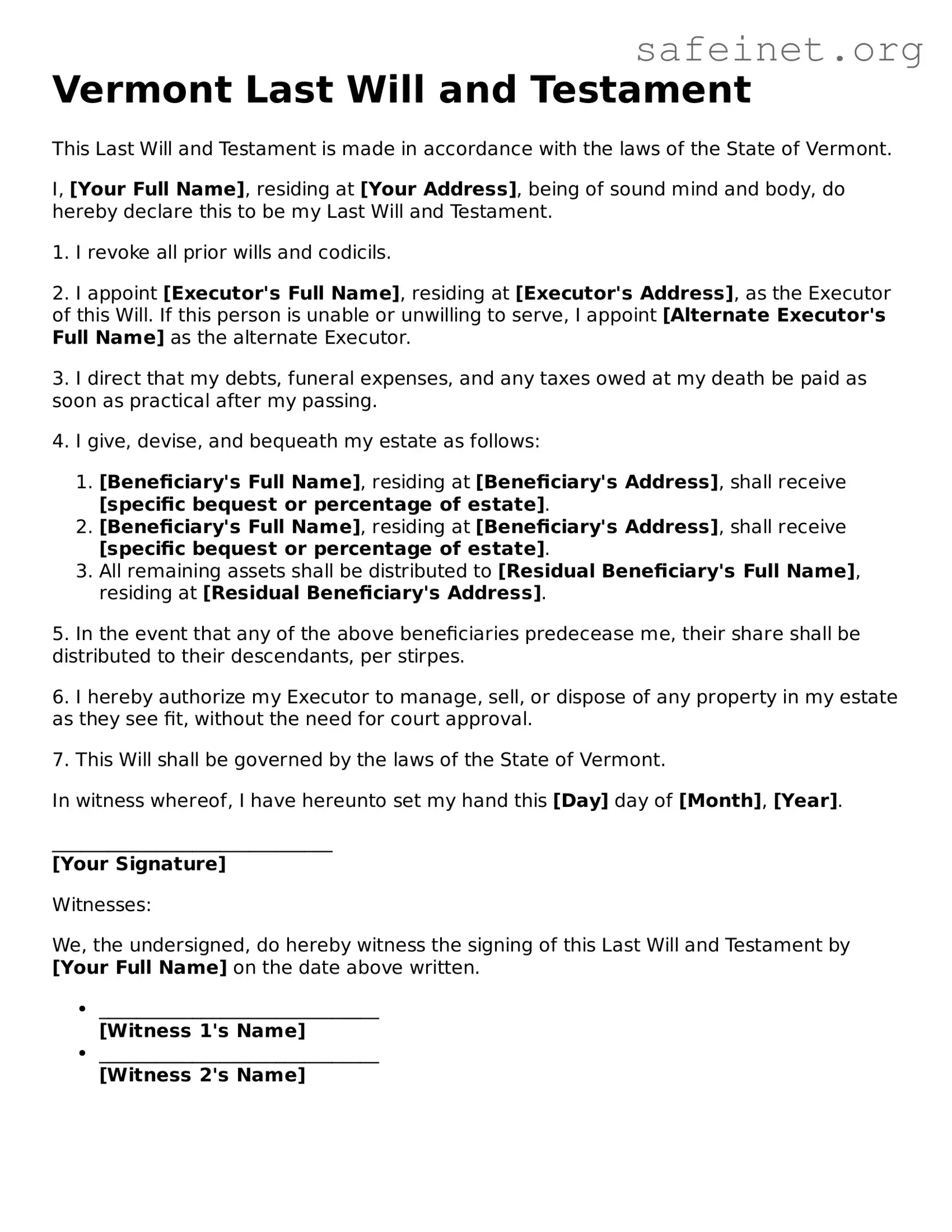
Vermont Last Will and Testament
This Last Will and Testament is made in accordance with the laws of the State of Vermont.
I, [Your Full Name], residing at [Your Address], being of sound mind and body, do hereby declare this to be my Last Will and Testament.
1. I revoke all prior wills and codicils.
2. I appoint [Executor's Full Name], residing at [Executor's Address], as the Executor of this Will. If this person is unable or unwilling to serve, I appoint [Alternate Executor's Full Name] as the alternate Executor.
3. I direct that my debts, funeral expenses, and any taxes owed at my death be paid as soon as practical after my passing.
4. I give, devise, and bequeath my estate as follows:
5. In the event that any of the above beneficiaries predecease me, their share shall be distributed to their descendants, per stirpes.
6. I hereby authorize my Executor to manage, sell, or dispose of any property in my estate as they see fit, without the need for court approval.
7. This Will shall be governed by the laws of the State of Vermont.
In witness whereof, I have hereunto set my hand this [Day] day of [Month], [Year].
______________________________
[Your Signature]
Witnesses:
We, the undersigned, do hereby witness the signing of this Last Will and Testament by [Your Full Name] on the date above written.
| Fact Name | Description |
|---|---|
| Governing Law | The Vermont Last Will and Testament is governed by Title 14, Chapter 112 of the Vermont Statutes Annotated. |
| Age Requirement | In Vermont, individuals must be at least 18 years old to create a valid will. |
| Witness Requirement | A will in Vermont must be signed by at least two witnesses who are present at the same time. |
| Revocation | A will can be revoked by a subsequent will or by destroying the original document with the intent to revoke. |
| Holographic Wills | Vermont recognizes holographic wills, which are handwritten and signed by the testator, without the need for witnesses. |
Once you have the Vermont Last Will and Testament form ready, you will need to fill it out carefully. Make sure to have all necessary information at hand. Follow the steps below to complete the form accurately.
After filling out the form, review it carefully to ensure all information is correct. Keep the completed will in a safe place and inform your executor about its location. This will help ensure your wishes are honored when the time comes.
What is a Last Will and Testament?
A Last Will and Testament is a legal document that outlines how a person's assets and affairs should be handled after their death. It allows individuals to specify beneficiaries, appoint guardians for minor children, and designate an executor to manage the estate. This document ensures that a person's wishes are honored and can help avoid disputes among family members.
Is a Last Will and Testament required in Vermont?
No, a Last Will and Testament is not legally required in Vermont. However, having one is highly recommended. Without a will, the state will determine how your assets are distributed according to intestacy laws, which may not align with your personal wishes.
Who can create a Last Will and Testament in Vermont?
In Vermont, any individual who is at least 18 years old and of sound mind can create a Last Will and Testament. It is important that the person understands the nature of their assets and the implications of the decisions made in the will.
What are the requirements for a valid Last Will and Testament in Vermont?
For a Last Will and Testament to be considered valid in Vermont, it must be in writing and signed by the testator (the person making the will) in the presence of two witnesses. The witnesses must also sign the document. It is advisable that the witnesses are not beneficiaries of the will to avoid potential conflicts of interest.
Can I change or revoke my Last Will and Testament in Vermont?
Yes, you can change or revoke your Last Will and Testament at any time while you are still alive and of sound mind. Changes can be made through a codicil, which is an amendment to the will, or by creating an entirely new will that explicitly revokes the previous one. It is important to follow proper legal procedures to ensure that the changes are valid.
What happens if I die without a Last Will and Testament in Vermont?
If you die without a Last Will and Testament, your estate will be distributed according to Vermont's intestacy laws. This means that the state will determine how your assets are divided, typically prioritizing spouses, children, and other close relatives. This process may not reflect your personal wishes and can lead to disputes among family members.
How can I ensure my Last Will and Testament is properly executed?
To ensure that your Last Will and Testament is properly executed, it is advisable to consult with a legal professional who specializes in estate planning. They can guide you through the process, help you meet all legal requirements, and ensure that your wishes are clearly articulated and enforceable.
Can I include specific bequests in my Last Will and Testament?
Yes, you can include specific bequests in your Last Will and Testament. This means you can designate particular assets or amounts of money to specific individuals or organizations. Clearly identifying these bequests can help ensure that your intentions are understood and honored after your passing.
What role does an executor play in a Last Will and Testament?
The executor is the individual appointed in the Last Will and Testament to manage the estate after the testator's death. Their responsibilities include gathering assets, paying debts and taxes, and distributing the remaining assets to beneficiaries according to the terms of the will. Choosing a trustworthy and organized executor is crucial for a smooth estate administration process.
Failing to properly identify beneficiaries. It is crucial to clearly state who will inherit your assets. Ambiguities can lead to disputes and delays.
Not signing the document in the presence of witnesses. In Vermont, a will must be signed by the testator and at least two witnesses. Without this, the will may be deemed invalid.
Neglecting to update the will after major life events. Changes such as marriage, divorce, or the birth of a child should prompt a review and possible revision of the will.
Overlooking the importance of a self-proving affidavit. Including this affidavit can simplify the probate process by affirming the validity of the will without needing witness testimony.
Using vague language when describing assets. Clearly detailing each asset and its intended beneficiary can prevent confusion and potential legal challenges.
When preparing a Last Will and Testament in Vermont, there are several other important documents that can help ensure your wishes are carried out effectively. These documents work together to provide clarity and support for your estate planning needs. Here’s a brief overview of five common forms and documents that often accompany a will.
Having these documents in place alongside your Last Will and Testament can provide peace of mind. They help ensure that your wishes are respected and that your loved ones are taken care of according to your preferences.
The Vermont Last Will and Testament form shares similarities with a Living Will, a document that outlines an individual's preferences regarding medical treatment in the event they become incapacitated. While a Last Will primarily deals with the distribution of assets after death, a Living Will focuses on healthcare decisions during a person's lifetime. Both documents allow individuals to express their wishes clearly, ensuring that their intentions are respected. By having both a Last Will and a Living Will, individuals can cover both their financial and healthcare preferences, providing peace of mind to themselves and their loved ones.
Another document akin to the Vermont Last Will is the Durable Power of Attorney. This legal instrument grants someone the authority to make financial or legal decisions on behalf of another person if they become unable to do so themselves. Like a Last Will, a Durable Power of Attorney is a proactive measure that ensures an individual’s wishes are honored. While a Last Will takes effect after death, the Durable Power of Attorney is effective during a person’s lifetime, creating a comprehensive plan for both financial management and asset distribution.
A Trust Agreement also parallels the Vermont Last Will and Testament in its purpose of asset distribution. A Trust allows individuals to place their assets into a legal entity that can manage and distribute those assets according to specific terms. Unlike a Last Will, which goes through probate, a Trust can help avoid this lengthy process, allowing for quicker access to assets for beneficiaries. Both documents aim to ensure that an individual’s wishes regarding their estate are carried out, but they do so in different ways and at different times.
Lastly, a Codicil is similar to a Last Will in that it serves to modify or clarify an existing will. This document allows individuals to make changes to their Last Will without having to create an entirely new one. Whether it’s updating beneficiaries or changing asset distributions, a Codicil provides flexibility in estate planning. Both documents work together to ensure that a person’s wishes are accurately reflected, enabling adjustments as life circumstances change.
When filling out the Vermont Last Will and Testament form, it is important to approach the task with care. Here are some guidelines to help ensure that the process goes smoothly.
When it comes to creating a Last Will and Testament in Vermont, many people hold misconceptions that can lead to confusion or even legal issues. Here are six common misconceptions:
Understanding these misconceptions can help individuals navigate the process of creating a Last Will and Testament in Vermont more effectively. It is always wise to seek accurate information and consider consulting a legal professional if there are any uncertainties.
When it comes to creating a Last Will and Testament in Vermont, there are several important points to keep in mind. Understanding these can help ensure that your wishes are honored and that the process goes smoothly for your loved ones.
Taking the time to understand these key aspects can make a significant difference in how your wishes are honored after you’re gone. A well-prepared will can provide peace of mind for both you and your loved ones.