The Vermont Lady Bird Deed is a valuable estate planning tool that allows property owners to transfer real estate to their beneficiaries while retaining certain rights during their lifetime. This unique deed enables individuals to maintain control over their property, including the right to live in and manage the property, even after the transfer has been executed. One of the significant advantages of the Lady Bird Deed is that it helps avoid the lengthy and often costly probate process, as the property automatically transfers to the designated beneficiaries upon the owner's passing. Additionally, this deed can provide certain tax benefits, as it may help in reducing potential capital gains taxes for heirs. Understanding the intricacies of the Vermont Lady Bird Deed can empower individuals to make informed decisions regarding their estate planning, ensuring that their wishes are honored while providing peace of mind for both the property owner and their loved ones.
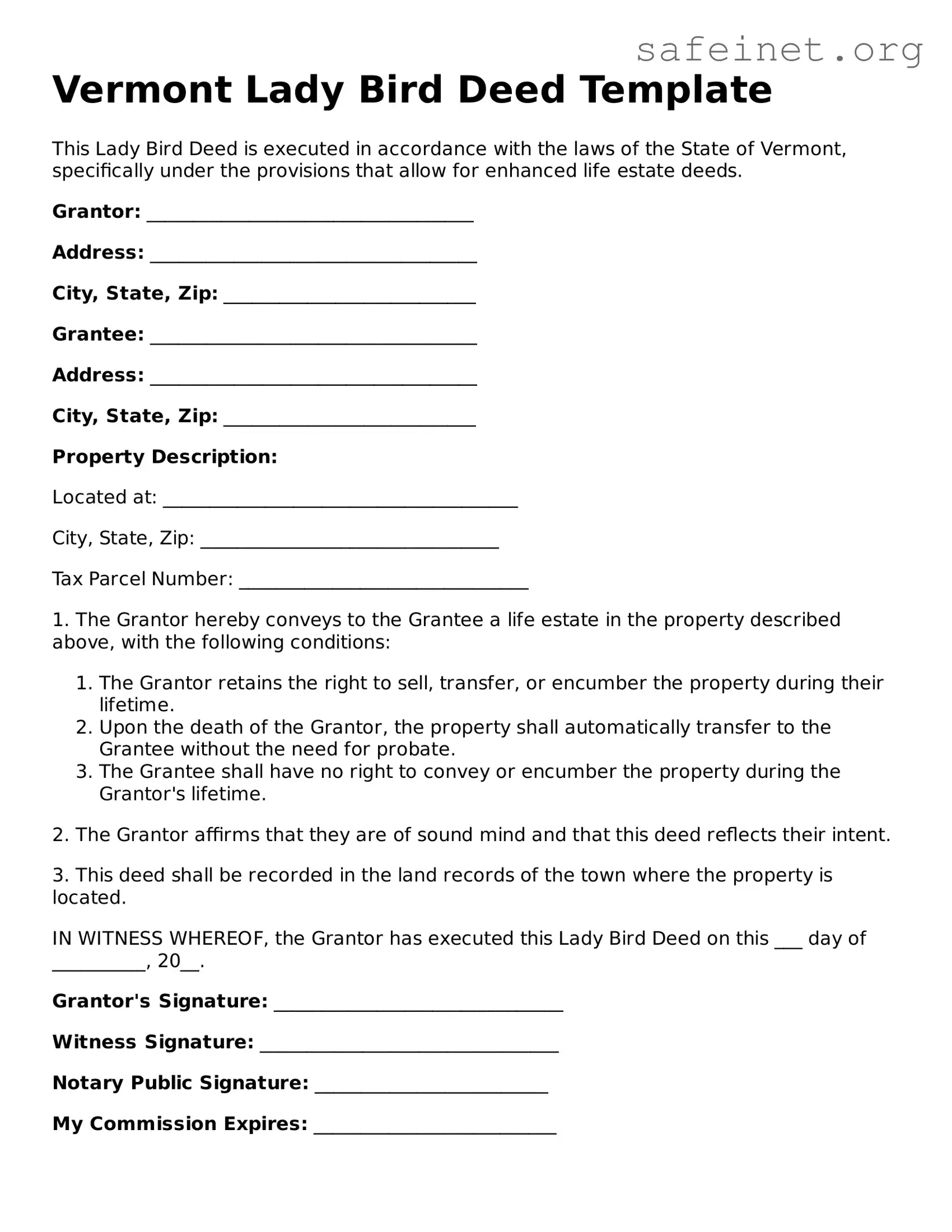
Vermont Lady Bird Deed Template
This Lady Bird Deed is executed in accordance with the laws of the State of Vermont, specifically under the provisions that allow for enhanced life estate deeds.
Grantor: ___________________________________
Address: ___________________________________
City, State, Zip: ___________________________
Grantee: ___________________________________
Address: ___________________________________
City, State, Zip: ___________________________
Property Description:
Located at: ______________________________________
City, State, Zip: ________________________________
Tax Parcel Number: _______________________________
1. The Grantor hereby conveys to the Grantee a life estate in the property described above, with the following conditions:
2. The Grantor affirms that they are of sound mind and that this deed reflects their intent.
3. This deed shall be recorded in the land records of the town where the property is located.
IN WITNESS WHEREOF, the Grantor has executed this Lady Bird Deed on this ___ day of __________, 20__.
Grantor's Signature: _______________________________
Witness Signature: ________________________________
Notary Public Signature: _________________________
My Commission Expires: __________________________
| Fact Name | Detail |
|---|---|
| Definition | The Vermont Lady Bird Deed allows property owners to transfer real estate to beneficiaries while retaining control during their lifetime. |
| Governing Law | The deed is governed by Vermont Statutes Title 27, Chapter 1, Subchapter 2. |
| Retained Rights | Property owners maintain the right to sell, mortgage, or alter the property without beneficiary consent. |
| Beneficiary Designation | Property owners can designate one or more beneficiaries to receive the property upon their death. |
| Avoiding Probate | The Lady Bird Deed allows the property to pass directly to beneficiaries, avoiding the probate process. |
| Tax Implications | There may be tax advantages, as the property retains a stepped-up basis upon the owner's death. |
| Revocation | The deed can be revoked or modified at any time before the owner's death. |
| Eligibility | Only real property can be transferred using a Lady Bird Deed; personal property is excluded. |
| Execution Requirements | The deed must be signed by the property owner and notarized to be valid. |
Once you have the Vermont Lady Bird Deed form ready, it is essential to fill it out accurately to ensure it reflects your intentions clearly. Follow these steps carefully to complete the form without any issues.
After filling out the form, ensure you follow through with the filing process promptly. This step is crucial to finalize the transfer and protect your interests.
What is a Vermont Lady Bird Deed?
A Vermont Lady Bird Deed is a legal document that allows property owners to transfer their real estate to beneficiaries while retaining certain rights during their lifetime. This type of deed enables the property owner to maintain control over the property, including the right to live in it, sell it, or mortgage it, without needing the beneficiaries' consent. Upon the owner's death, the property automatically transfers to the named beneficiaries, avoiding probate and simplifying the transfer process.
Who can benefit from using a Lady Bird Deed?
Individuals looking to ensure a smooth transition of property ownership after their death can benefit significantly from a Lady Bird Deed. This is particularly useful for homeowners who want to avoid the lengthy and often costly probate process. Additionally, it can provide peace of mind to the property owner, knowing that their loved ones will receive the property without complications. It is especially advantageous for those who wish to retain control over their property while still planning for future transfers.
Are there any tax implications associated with a Lady Bird Deed?
While a Lady Bird Deed can help avoid probate, it is important to consider potential tax implications. Generally, the property will receive a step-up in basis upon the owner's death, which can help reduce capital gains taxes for the beneficiaries if they decide to sell the property later. However, it is advisable to consult with a tax professional or estate planner to understand how this deed may affect individual tax situations and to ensure compliance with current tax laws.
How do I create a Vermont Lady Bird Deed?
Creating a Vermont Lady Bird Deed involves several steps. First, the property owner should gather necessary information, including the legal description of the property and the names of the beneficiaries. Next, it is recommended to consult with an attorney to ensure the deed is properly drafted and complies with Vermont laws. Once the deed is prepared, it must be signed by the property owner in the presence of a notary public. Finally, the completed deed should be recorded with the local land records office to make it legally effective.
Not including all property owners: One common mistake is failing to list all current owners of the property. If there are multiple owners, each must be named on the deed to ensure proper transfer of rights.
Incorrectly identifying the property: It’s crucial to accurately describe the property being transferred. This includes providing the correct address and legal description. Omitting or misidentifying this information can lead to complications.
Forgetting to sign the deed: A Lady Bird Deed is not valid unless it is signed by the grantor. Neglecting to sign the form can render the entire process ineffective.
Not having witnesses or notarization: In Vermont, the deed must be signed in front of a notary public. Some people overlook this step, which can invalidate the deed.
Failing to understand the implications: Many individuals do not fully grasp the legal consequences of executing a Lady Bird Deed. It's essential to understand how it affects estate planning and tax implications.
Neglecting to record the deed: After filling out the form, it must be recorded with the local land records office. Failing to do so means the deed may not be enforceable against third parties.
Using outdated forms: Laws and forms can change. Using an outdated version of the Lady Bird Deed form can lead to errors or omissions that affect the validity of the deed.
Not consulting a professional: Many people attempt to fill out the form without seeking advice. Consulting with a legal expert can help avoid mistakes and ensure that the deed meets all legal requirements.
The Vermont Lady Bird Deed is a unique estate planning tool that allows property owners to transfer their real estate to beneficiaries while retaining certain rights during their lifetime. When using this deed, several other forms and documents may also be necessary to ensure a comprehensive estate plan. Below are some commonly used documents that complement the Lady Bird Deed.
Incorporating these documents into an estate plan can provide clarity and ensure that an individual's wishes are honored. Each document serves a distinct purpose, working together to create a well-rounded approach to managing assets and health care decisions.
The Vermont Lady Bird Deed is similar to a traditional life estate deed. Both documents allow a property owner to transfer their property to another person while retaining certain rights during their lifetime. However, a life estate deed typically restricts the owner’s ability to sell or mortgage the property without the consent of the remainderman. In contrast, the Lady Bird Deed provides more flexibility, allowing the owner to sell, mortgage, or change beneficiaries without needing approval from the remainderman.
Another document similar to the Lady Bird Deed is the transfer-on-death (TOD) deed. Like the Lady Bird Deed, a TOD deed allows property owners to designate beneficiaries who will inherit the property upon their death. The key difference lies in the rights retained by the owner. With a TOD deed, the owner has no control over the property after death, while the Lady Bird Deed allows for continued management and use of the property during the owner's lifetime.
The joint tenancy deed shares similarities with the Lady Bird Deed in that both involve transferring property to another party. Joint tenancy allows two or more individuals to own property together, with rights of survivorship. This means that when one owner passes away, their share automatically transfers to the surviving owner(s). The Lady Bird Deed, on the other hand, allows for a single owner to retain control while still ensuring that the property passes to a designated beneficiary after death.
A revocable living trust is another estate planning tool that resembles the Lady Bird Deed. Both instruments allow property owners to manage their assets during their lifetime and dictate how those assets are distributed after death. However, a revocable living trust requires more formalities, including the transfer of property into the trust, while the Lady Bird Deed is a straightforward deed that remains effective without ongoing management.
The warranty deed is also comparable to the Lady Bird Deed. Both documents serve to transfer ownership of property. A warranty deed guarantees that the seller has clear title to the property and protects the buyer against future claims. In contrast, the Lady Bird Deed focuses on retaining rights for the grantor while ensuring a smooth transition of property upon death, without the same level of guarantees typically associated with a warranty deed.
A quitclaim deed bears some resemblance to the Lady Bird Deed in that it transfers interest in a property without warranties. This type of deed is often used between family members or in situations where the grantor does not want to make any guarantees about the title. While both deeds facilitate the transfer of property, the Lady Bird Deed provides the added benefit of retaining rights and flexibility during the grantor's lifetime.
The special warranty deed is another document that shares features with the Lady Bird Deed. Both types of deeds transfer property ownership, but a special warranty deed only guarantees that the grantor has not encumbered the property during their ownership. The Lady Bird Deed, however, allows the grantor to retain rights while ensuring a seamless transfer of property upon death, without the limitations imposed by a special warranty deed.
A family settlement agreement can also be likened to the Lady Bird Deed. Both documents serve to clarify the distribution of property among family members. A family settlement agreement is typically used to resolve disputes or outline intentions regarding property distribution. The Lady Bird Deed simplifies the process by designating a beneficiary, thus avoiding potential conflicts after the owner's passing.
The power of attorney document is another legal instrument that bears similarities to the Lady Bird Deed. Both allow individuals to designate authority over their property. A power of attorney grants someone the ability to manage the owner’s affairs, including real estate transactions. However, the Lady Bird Deed specifically addresses the transfer of property upon death, while a power of attorney is effective during the owner’s lifetime and can be revoked at any time.
Finally, the beneficiary designation form is comparable to the Lady Bird Deed in that it allows property owners to specify who will receive their assets upon death. This form is often used for financial accounts and insurance policies. The Lady Bird Deed, however, applies specifically to real estate and provides the grantor with greater control over the property during their lifetime, ensuring a smoother transition to the designated beneficiary after death.
When filling out the Vermont Lady Bird Deed form, it's important to navigate the process carefully. Here are some essential dos and don'ts to keep in mind:
By following these guidelines, you can help ensure that your Lady Bird Deed is filled out correctly and serves its intended purpose.
The Vermont Lady Bird Deed form is often misunderstood. Here are eight common misconceptions, along with clarifications to help you understand its true nature.
While the Lady Bird Deed is named after Vermont, it can be utilized by residents in various states. Each state has its own regulations, so it’s essential to check local laws.
The Lady Bird Deed does not replace a will. It is a tool for transferring property but should be part of a comprehensive estate plan that includes a will.
This deed can be used by individuals, married couples, or even domestic partners. It is not limited to any specific relationship status.
While the Lady Bird Deed can simplify the transfer of property, it does not guarantee that all assets will avoid probate. Other assets may still require probate proceedings.
The Lady Bird Deed specifically pertains to real property. However, it does not cover personal property, which may need separate considerations in an estate plan.
This deed can be revoked or modified as long as the grantor is alive and competent. Flexibility is a key feature of the Lady Bird Deed.
While the Lady Bird Deed has specific requirements, it is generally straightforward. Many find it easier to understand compared to other estate planning documents.
Tax implications can arise from the use of a Lady Bird Deed. Understanding potential gift tax or capital gains tax consequences is crucial for effective planning.
When considering the Vermont Lady Bird Deed form, there are several important points to keep in mind. This deed can be a powerful tool for estate planning. Here are key takeaways to help you navigate the process:
Taking these points into account can help ensure that your estate planning is effective and aligns with your wishes. Properly utilizing the Vermont Lady Bird Deed can simplify the transfer of your property and provide peace of mind for you and your loved ones.