In Vermont, families who choose to homeschool their children must navigate specific requirements to ensure compliance with state regulations. One crucial step in this process is the submission of the Homeschool Letter of Intent form. This form serves as an official notification to the local school district that a parent or guardian intends to provide home-based education for their child. It typically includes essential information such as the student's name, age, and the educational curriculum planned for the upcoming school year. Additionally, the form may require details regarding the educational philosophy and methods that will be employed. By completing and submitting this form, parents not only fulfill a legal obligation but also lay the groundwork for an organized and effective homeschooling experience. Understanding the nuances of this form can help families ensure that they are meeting all necessary guidelines while fostering an enriching learning environment for their children.
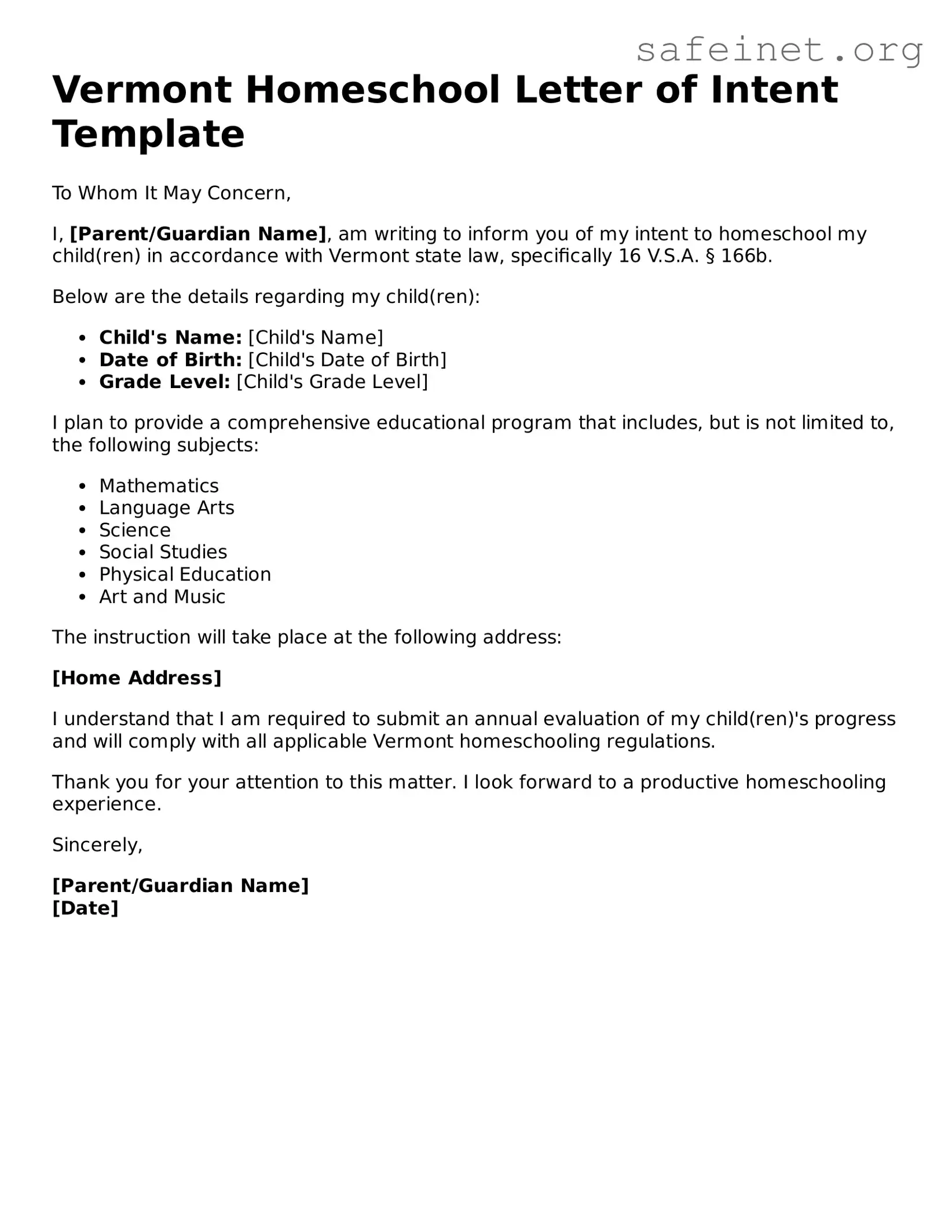
Vermont Homeschool Letter of Intent Template
To Whom It May Concern,
I, [Parent/Guardian Name], am writing to inform you of my intent to homeschool my child(ren) in accordance with Vermont state law, specifically 16 V.S.A. § 166b.
Below are the details regarding my child(ren):
I plan to provide a comprehensive educational program that includes, but is not limited to, the following subjects:
The instruction will take place at the following address:
[Home Address]
I understand that I am required to submit an annual evaluation of my child(ren)'s progress and will comply with all applicable Vermont homeschooling regulations.
Thank you for your attention to this matter. I look forward to a productive homeschooling experience.
Sincerely,
[Parent/Guardian Name]
[Date]
| Fact Name | Description |
|---|---|
| Governing Law | The Vermont Homeschool Letter of Intent is governed by 16 V.S.A. § 166b, which outlines the requirements for homeschooling in the state. |
| Submission Deadline | The Letter of Intent must be submitted to the local school district within 14 days of the start of the homeschooling program. |
| Required Information | The form requires basic information, including the names and ages of the children being homeschooled and the educational plan being followed. |
| Annual Review | Parents must submit an annual assessment of the child's progress to the local school district, as mandated by Vermont law. |
Once you have the Vermont Homeschool Letter of Intent form in front of you, it’s time to fill it out accurately. This form is essential for notifying the state of your intent to homeschool your child. Make sure to have all necessary information at hand before you begin.
After completing the form, review it for accuracy. Once you’re satisfied, submit it to the appropriate school district office. Keep a copy for your records, as it’s important to have documentation of your intent to homeschool.
What is the Vermont Homeschool Letter of Intent?
The Vermont Homeschool Letter of Intent is a formal notification submitted to the local school district, indicating that a parent or guardian intends to homeschool their child. This document is essential for establishing the educational plan for the student and ensuring compliance with state regulations regarding homeschooling.
Who needs to submit the Letter of Intent?
Any parent or guardian who wishes to homeschool a child in Vermont must submit the Letter of Intent. This requirement applies to children of compulsory school age, which is typically from age 6 to 16. It’s important to notify the local school district to ensure that all legal obligations are met.
When should the Letter of Intent be submitted?
The Letter of Intent should be submitted at the beginning of the school year or as soon as a decision to homeschool is made. Vermont law requires that the letter be filed within the first week of the school year or within 14 days of beginning homeschooling if the family is starting mid-year.
What information is required in the Letter of Intent?
The Letter of Intent must include the child’s name, age, and address, as well as the name of the parent or guardian who will be responsible for the homeschooling. Additionally, a brief description of the educational plan, including the curriculum or subjects to be taught, is typically included. This helps the school district understand the educational approach being taken.
Is there a specific format for the Letter of Intent?
While there is no strict format mandated by the state, it’s advisable to keep the letter clear and concise. Including all required information in a straightforward manner is key. Many families choose to use a template or example letter to ensure they cover all necessary points.
What happens after submitting the Letter of Intent?
After the Letter of Intent is submitted, the local school district will acknowledge receipt of the document. They may provide guidance on any additional requirements or resources available for homeschooling families. It’s essential to keep communication open and to follow any instructions provided by the district.
Can I change my mind after submitting the Letter of Intent?
Yes, families can change their minds about homeschooling at any time. If you decide to enroll your child in a public or private school after submitting the Letter of Intent, it’s a good idea to inform the local school district. This keeps your child’s educational record up to date and ensures compliance with state laws.
When filling out the Vermont Homeschool Letter of Intent form, it is crucial to avoid common mistakes that can delay or complicate the approval process. Here are five frequent errors:
Incomplete Information: Many applicants fail to provide all required details. Ensure that every section of the form is filled out completely, including the names and ages of all children being homeschooled.
Incorrect Dates: Some individuals mistakenly enter the wrong school year or start date. Double-check the calendar to confirm that the dates align with your homeschooling plans.
Missing Signatures: A common oversight is neglecting to sign the form. Remember that an unsigned form may be considered invalid, which can lead to delays.
Failure to Submit on Time: Timeliness is essential. Be aware of submission deadlines to avoid any issues with your homeschooling status.
Not Keeping Copies: Some people forget to retain a copy of the submitted form for their records. Keeping a copy is important for reference and future correspondence.
By avoiding these mistakes, you can ensure a smoother process for your homeschooling journey in Vermont.
When families in Vermont decide to homeschool their children, they must submit a Homeschool Letter of Intent. However, this form is often accompanied by several other important documents that help ensure a smooth homeschooling experience. Below is a list of common forms and documents that may be used alongside the Homeschool Letter of Intent.
By preparing these documents alongside the Homeschool Letter of Intent, families can better navigate the requirements of homeschooling in Vermont. Each form plays a significant role in ensuring that the educational needs of the child are met and that the homeschooling process remains compliant with state regulations.
The Vermont Homeschool Letter of Intent form is similar to the Notice of Intent form used in various states for families wishing to homeschool their children. This document serves as an official notification to the local school district that parents have chosen to take on the responsibility of educating their children at home. Like the Vermont form, the Notice of Intent typically requires basic information about the student, the educational plan, and the parents’ contact details. This ensures that the school district is informed and can provide any necessary resources or support.
Another document that parallels the Vermont Homeschool Letter of Intent is the Home Education Program Registration form found in many states. This form often requires parents to outline their educational philosophy and curriculum choices. Similar to Vermont's requirements, it ensures that parents have a structured plan in place for their children's education. The registration process may also include submitting proof of educational materials or assessments, reinforcing the commitment to provide a quality education at home.
The Individualized Education Program (IEP) is another document that shares similarities with the Vermont Homeschool Letter of Intent. An IEP is designed for students with special needs and outlines specific educational goals and services. While the Vermont form does not specifically cater to special needs students, both documents emphasize the importance of tailored educational plans. Parents of homeschooled children may still choose to create an IEP to ensure their child receives appropriate support and resources, reflecting a commitment to individualized education.
In some states, the Affidavit of Intent to Homeschool is a required document that resembles the Vermont Homeschool Letter of Intent. This affidavit is a sworn statement by parents declaring their intention to homeschool their children. Like the Vermont form, it typically includes essential details about the student and the educational approach. By submitting this affidavit, parents affirm their dedication to providing an educational experience outside of traditional schooling.
The Declaration of Intent to Homeschool is another comparable document. This declaration is often required by school districts to confirm that parents are choosing to homeschool their children. Similar to the Vermont form, it usually requests information about the child and the educational plan. This document serves as a formal acknowledgment of the parents’ decision and helps maintain communication with local education authorities.
Some states utilize a Homeschool Notification form, which functions similarly to the Vermont Homeschool Letter of Intent. This notification informs the local school district of the parents' decision to homeschool their children. It typically requires details about the educational approach and any curriculum choices. The purpose is to establish a record of the homeschooling decision and ensure that the school district is aware of the child’s educational status.
The Educational Plan form is another document that aligns with the Vermont Homeschool Letter of Intent. This form often requires parents to outline their educational strategies, goals, and resources. While the Vermont form serves as a notice of intent, the Educational Plan focuses more on the specifics of how education will be delivered. Both documents emphasize the importance of planning and structure in a homeschooling environment.
Lastly, the Home Schooling Notification and Curriculum Plan is similar to the Vermont Homeschool Letter of Intent. This document combines the notification aspect with a detailed curriculum outline. Parents must provide information about the subjects they plan to teach and the resources they will use. Like the Vermont form, it seeks to ensure that families are prepared and organized in their homeschooling efforts, fostering a sense of accountability and commitment to education.
When filling out the Vermont Homeschool Letter of Intent form, it is important to follow specific guidelines to ensure that the process goes smoothly. Here is a list of things you should and shouldn't do:
Following these guidelines can help streamline the process of filing your Homeschool Letter of Intent in Vermont.
Many people have misconceptions about the Vermont Homeschool Letter of Intent form. Understanding the facts can help clarify the process for families considering homeschooling. Here are five common misconceptions:
By addressing these misconceptions, families can navigate the homeschooling process in Vermont with greater confidence and clarity.
The Vermont Homeschool Letter of Intent form is an important document for families choosing to homeschool their children. Here are some key takeaways regarding its completion and use: