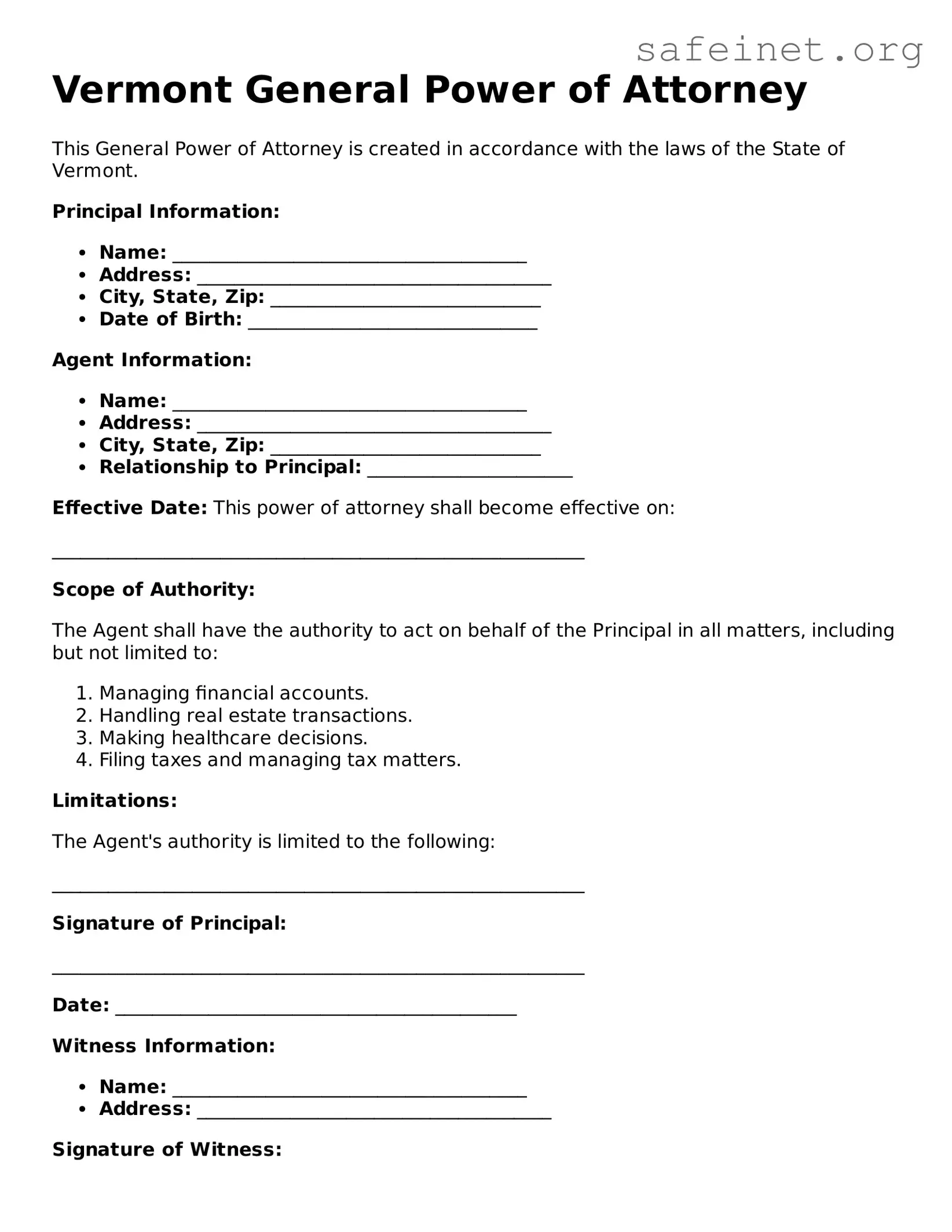
In Vermont, the General Power of Attorney form serves as a crucial legal document that allows individuals to designate someone they trust to make decisions on their behalf. This form can cover a wide range of financial and legal matters, from managing bank accounts to handling real estate transactions. It’s essential for those who want to ensure their affairs are taken care of, especially in situations where they may be unable to act for themselves due to illness or absence. The document grants the appointed agent significant authority, which can include paying bills, filing taxes, and managing investments. However, it’s important to note that this power can be limited or broad, depending on the individual's preferences. Understanding the implications and responsibilities associated with this form is vital for both the person granting the power and the agent receiving it. By carefully considering the choices made in this document, individuals can achieve peace of mind, knowing that their interests are protected even when they cannot be present to manage them directly.
Vermont General Power of Attorney
This General Power of Attorney is created in accordance with the laws of the State of Vermont.
Principal Information:
Agent Information:
Effective Date: This power of attorney shall become effective on:
_________________________________________________________
Scope of Authority:
The Agent shall have the authority to act on behalf of the Principal in all matters, including but not limited to:
Limitations:
The Agent's authority is limited to the following:
_________________________________________________________
Signature of Principal:
_________________________________________________________
Date: ___________________________________________
Witness Information:
Signature of Witness:
_________________________________________________________
Date: ___________________________________________
This document must be signed in the presence of a notary public for it to be valid.
| Fact Name | Description |
|---|---|
| Definition | The Vermont General Power of Attorney form allows an individual (the principal) to grant authority to another person (the agent) to act on their behalf in financial and legal matters. |
| Governing Law | This form is governed by the Vermont Statutes Annotated, Title 14, Chapter 31. |
| Durability | The General Power of Attorney can be made durable, meaning it remains effective even if the principal becomes incapacitated. |
| Execution Requirements | The form must be signed by the principal in the presence of a notary public or two witnesses to be valid. |
| Revocation | The principal can revoke the General Power of Attorney at any time, as long as they are competent to do so. |
Filling out the Vermont General Power of Attorney form is a straightforward process. Once completed, the form will allow you to designate someone to act on your behalf in various matters. This can be crucial for managing financial affairs or making decisions when you are unable to do so.
What is a General Power of Attorney in Vermont?
A General Power of Attorney in Vermont allows one person, known as the principal, to designate another person, called the agent, to make decisions and act on their behalf. This can include managing finances, handling real estate transactions, and making legal decisions. The authority granted can be broad or limited, depending on the principal's wishes.
How do I create a General Power of Attorney in Vermont?
To create a General Power of Attorney in Vermont, you must complete a form that outlines the powers you wish to grant to your agent. It is important to sign the document in the presence of a notary public to ensure its validity. You may also want to consult with a legal professional to ensure that the document meets your specific needs.
Can I revoke a General Power of Attorney?
Yes, you can revoke a General Power of Attorney at any time as long as you are mentally competent. To revoke it, you should create a written notice stating your intention to revoke and provide copies to your agent and any institutions or individuals who may have relied on the original document.
What happens if I become incapacitated?
If you become incapacitated, your General Power of Attorney remains in effect unless it is revoked. Your agent will then have the authority to make decisions on your behalf as specified in the document. It is crucial to choose a trustworthy agent, as they will have significant control over your affairs.
Can I limit the powers granted to my agent?
Yes, you can limit the powers granted in a General Power of Attorney. You can specify particular actions that your agent can or cannot take. Clearly outlining these limitations in the document will help ensure that your wishes are followed.
Is a General Power of Attorney effective immediately?
A General Power of Attorney can be effective immediately upon signing, or it can be set to activate only upon a certain event, such as your incapacity. If you choose the latter, it is called a "springing" power of attorney. Make sure to specify your preference in the document.
Do I need a lawyer to create a General Power of Attorney?
While it is not legally required to have a lawyer assist you in creating a General Power of Attorney, consulting with one can provide valuable guidance. A legal professional can help ensure that your document is properly drafted and meets all legal requirements.
What should I do with the General Power of Attorney once it is completed?
Once your General Power of Attorney is completed and signed, keep the original document in a safe place. Provide copies to your agent, financial institutions, and anyone else who may need to reference it. It’s also wise to inform your family members about its existence and contents.
Can I use a General Power of Attorney in other states?
A General Power of Attorney created in Vermont may be recognized in other states, but it is advisable to check the laws of those states. Some states have specific requirements for powers of attorney, so it may be beneficial to consult with a legal professional in the state where you intend to use it.
Failing to specify the powers granted. It is crucial to clearly outline what powers the agent will have. Without this clarity, the document may not serve its intended purpose.
Not naming a successor agent. If the primary agent cannot act, having a backup is important. Otherwise, the principal may face difficulties in managing their affairs.
Ignoring state-specific requirements. Each state, including Vermont, has specific rules for power of attorney forms. Not adhering to these can lead to invalidation.
Not signing the form in front of a notary. Vermont requires that the General Power of Attorney be notarized. Without this step, the document may not be legally recognized.
Overlooking the need for witnesses. In addition to notarization, some situations may require witnesses. Failing to include them can create issues later.
Using outdated forms. Laws can change, and using an old version of the form may not comply with current legal standards.
Not reviewing the document after completion. It is important to carefully review the filled-out form for any errors or omissions before finalizing it.
Assuming the agent will always act in the principal's best interest. While trust is essential, it is wise to choose someone who is not only trusted but also understands the responsibilities involved.
A General Power of Attorney (POA) in Vermont allows an individual, known as the principal, to appoint someone else, called the agent, to make decisions on their behalf. While the POA is a powerful tool for managing affairs, it is often accompanied by other important documents that can enhance its effectiveness. Here are five commonly used forms and documents that work well with a General Power of Attorney:
Using these documents in conjunction with a General Power of Attorney can create a comprehensive plan for managing both financial and healthcare decisions. Each document plays a unique role in ensuring that your wishes are respected and that your affairs are handled according to your preferences. It is advisable to consult with a legal professional to tailor these documents to your specific needs and circumstances.
A Durable Power of Attorney is similar to the Vermont General Power of Attorney in that it allows an individual to appoint someone else to manage their financial and legal affairs. The key difference lies in its durability; this document remains effective even if the person who created it becomes incapacitated. Therefore, if you want to ensure that your chosen agent can continue to act on your behalf during times of incapacity, a Durable Power of Attorney is a suitable option.
A Healthcare Power of Attorney specifically focuses on medical decisions. Like the General Power of Attorney, it enables you to designate someone to make decisions on your behalf. However, this document is limited to healthcare matters. If you want someone to manage both your financial affairs and medical decisions, you might need both types of documents to cover all bases.
A Living Will is another document that complements a General Power of Attorney. While the General Power of Attorney allows someone to manage your affairs, a Living Will outlines your preferences for medical treatment in case you are unable to communicate your wishes. This document is particularly important for end-of-life care decisions, providing guidance to your healthcare agent and medical providers.
A Revocable Trust can also be compared to the Vermont General Power of Attorney. While a General Power of Attorney grants authority to act on your behalf, a Revocable Trust allows you to transfer your assets into a trust, which can be managed by a trustee. This can help avoid probate and ensure that your assets are distributed according to your wishes upon your death. Both documents can work together to provide comprehensive estate planning.
A Limited Power of Attorney is another variant. This document allows you to grant specific powers to someone for a particular purpose or for a limited time. Unlike the General Power of Attorney, which typically grants broad authority, a Limited Power of Attorney is more focused and can be useful for tasks like signing documents while you are unavailable.
A Financial Power of Attorney is closely related to the General Power of Attorney but emphasizes financial matters. It allows your agent to handle banking, investments, and other financial transactions. While the General Power of Attorney can cover a wider range of issues, the Financial Power of Attorney is specifically tailored for managing your financial affairs.
An Advance Directive combines elements of a Living Will and a Healthcare Power of Attorney. It allows you to outline your wishes regarding medical treatment and appoint someone to make healthcare decisions for you. This document serves a dual purpose, ensuring that your medical preferences are known while also designating a trusted person to advocate for you.
A Medical Power of Attorney is another document that focuses solely on healthcare decisions. Similar to a Healthcare Power of Attorney, it allows you to appoint someone to make medical decisions on your behalf. The distinction is often in terminology, but both documents serve the same essential function: ensuring that your healthcare preferences are respected when you cannot speak for yourself.
Finally, a Guardianship document is relevant in situations where a person is unable to make decisions for themselves due to incapacity. While a General Power of Attorney allows you to appoint an agent to act on your behalf, a Guardianship involves a court appointing someone to manage the personal and financial affairs of an incapacitated individual. This process can be more complex and may involve ongoing court oversight, unlike the more straightforward nature of a General Power of Attorney.
When filling out the Vermont General Power of Attorney form, it’s essential to approach the task with care. This document grants someone the authority to act on your behalf in various matters. Here’s a list of things you should and shouldn’t do:
Many individuals have questions and misunderstandings about the Vermont General Power of Attorney form. Below are five common misconceptions, along with clarifications to help you better understand this important legal document.
Understanding these misconceptions can empower you to make informed decisions regarding the Vermont General Power of Attorney form. Always consider consulting a legal professional to ensure your documents meet your specific needs.
When filling out and using the Vermont General Power of Attorney form, consider the following key takeaways: