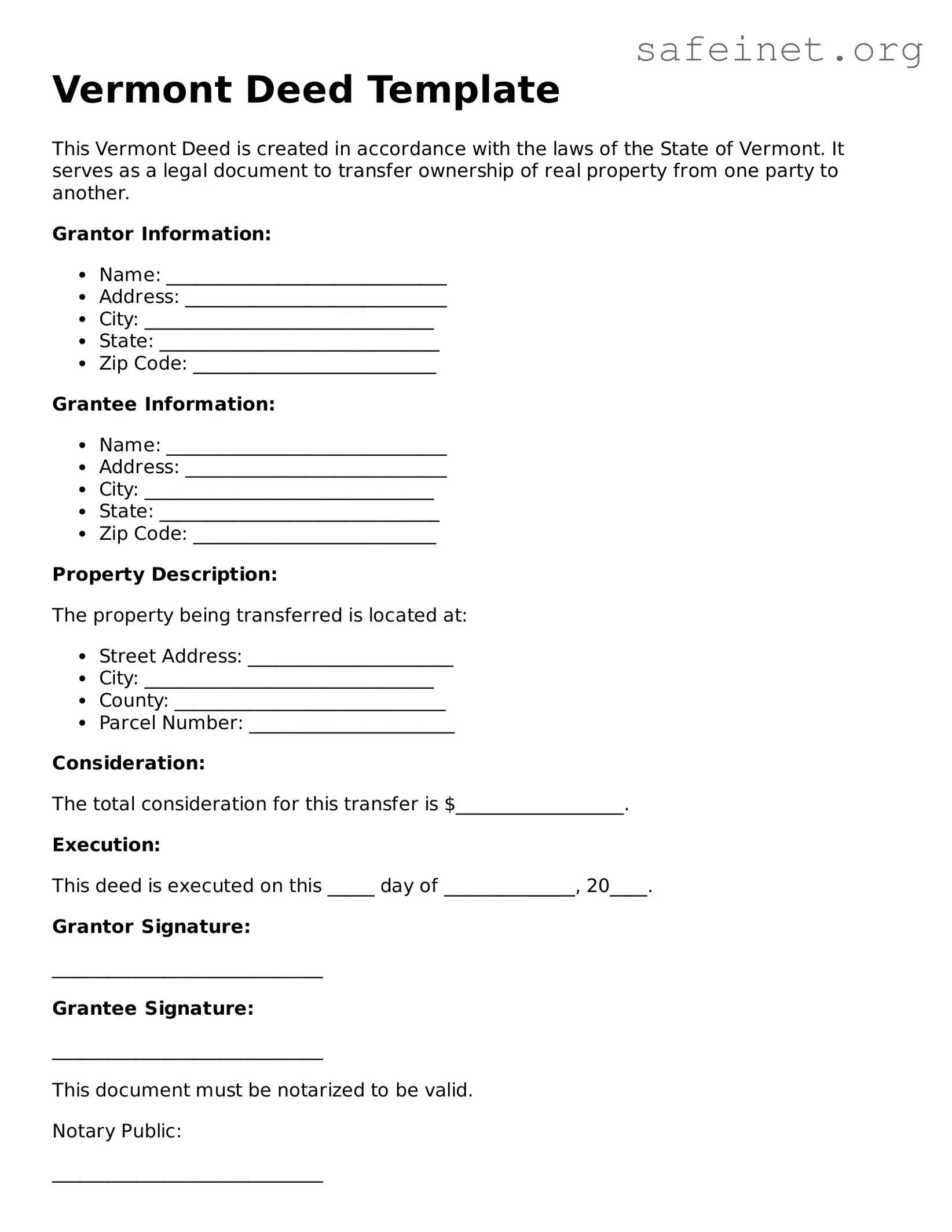
The Vermont Deed form is an essential legal document that plays a pivotal role in the transfer of property ownership within the state. Designed to ensure clarity and legality in real estate transactions, this form outlines key details such as the names of the parties involved, the property description, and the terms of the transfer. It serves as a formal declaration of the grantor's intent to convey the property to the grantee. Additionally, the Vermont Deed form may include important information about any encumbrances, such as mortgages or liens, that could affect the property. Properly completing this form is crucial, as it helps protect both the buyer and seller during the transaction process. Understanding the various components and requirements of the Vermont Deed can simplify what might otherwise be a complex process, making it easier for individuals to navigate their real estate dealings with confidence.
Vermont Deed Template
This Vermont Deed is created in accordance with the laws of the State of Vermont. It serves as a legal document to transfer ownership of real property from one party to another.
Grantor Information:
Grantee Information:
Property Description:
The property being transferred is located at:
Consideration:
The total consideration for this transfer is $__________________.
Execution:
This deed is executed on this _____ day of ______________, 20____.
Grantor Signature:
_____________________________
Grantee Signature:
_____________________________
This document must be notarized to be valid.
Notary Public:
_____________________________
My commission expires: _______________
| Fact Name | Description |
|---|---|
| Purpose | The Vermont Deed form is used to transfer ownership of real property from one party to another. |
| Types of Deeds | Vermont recognizes several types of deeds, including warranty deeds and quitclaim deeds. |
| Governing Law | The Vermont Deed form is governed by Title 27 of the Vermont Statutes Annotated. |
| Requirements | The deed must be signed by the grantor and acknowledged by a notary public to be valid. |
Once you have the Vermont Deed form, you will need to complete it carefully. This form is essential for transferring property ownership. After filling it out, you will need to sign it and file it with the appropriate local office.
What is a Vermont Deed form?
A Vermont Deed form is a legal document used to transfer ownership of real estate in the state of Vermont. It serves as proof of the transfer and includes essential details such as the names of the parties involved, a description of the property, and the terms of the transfer. There are different types of deeds, including warranty deeds and quitclaim deeds, each serving specific purposes in property transactions.
What types of deeds are available in Vermont?
In Vermont, the most common types of deeds are warranty deeds and quitclaim deeds. A warranty deed provides a guarantee that the seller has the legal right to transfer the property and that there are no undisclosed claims against it. A quitclaim deed, on the other hand, transfers whatever interest the seller has in the property without making any guarantees. This type is often used in situations such as transferring property between family members.
How do I complete a Vermont Deed form?
Completing a Vermont Deed form involves several steps. First, identify the type of deed you need based on your situation. Then, fill in the required information, including the names of the grantor (seller) and grantee (buyer), the property description, and any relevant terms. After completing the form, it must be signed by the grantor in the presence of a notary public. Finally, the deed should be recorded with the local town clerk's office to make the transfer official.
Do I need a lawyer to prepare a Vermont Deed form?
While it is not legally required to hire a lawyer to prepare a Vermont Deed form, it is often advisable, especially for complex transactions. A legal professional can ensure that the deed is properly drafted, that all necessary information is included, and that the transfer complies with state laws. This can help prevent potential disputes or issues in the future.
What is the cost to record a Vermont Deed?
The cost to record a Vermont Deed varies by town and is generally based on the number of pages in the document. Typically, recording fees can range from $10 to $25 for the first page, with additional fees for extra pages. It's important to check with your local town clerk’s office for the exact fee structure in your area.
Can I transfer property using a Vermont Deed form if there is a mortgage on it?
Yes, you can transfer property using a Vermont Deed form even if there is a mortgage on it. However, the mortgage does not automatically transfer to the new owner. The original borrower remains responsible for the mortgage unless the lender agrees to transfer the loan to the new owner. It is advisable to consult with the lender to understand any implications of the transfer.
What happens if I don’t record my Vermont Deed?
If you do not record your Vermont Deed, the transfer of ownership may not be recognized by third parties. This could lead to complications, such as disputes over property rights or difficulties in selling the property in the future. Recording the deed protects your ownership rights and provides public notice of the transfer.
Are there any tax implications when using a Vermont Deed form?
Yes, there may be tax implications when transferring property using a Vermont Deed form. Generally, the transfer of real estate may be subject to property transfer tax, which is calculated based on the sale price or the fair market value of the property. It is advisable to consult a tax professional or local authorities to understand any applicable taxes and ensure compliance.
Failing to include the correct names of all parties involved. Ensure that all grantors and grantees are accurately listed.
Omitting the legal description of the property. This description should be precise and match public records.
Not signing the deed in the presence of a notary. A notary’s signature is essential for the deed to be legally binding.
Using outdated or incorrect forms. Always check for the latest version of the Vermont Deed form to avoid issues.
Neglecting to include the date of the transaction. This date is crucial for establishing the timeline of ownership.
Incorrectly stating the type of deed being used. Different types of deeds serve different purposes and have specific legal implications.
Failing to pay the required transfer tax. This tax must be calculated and included to ensure compliance with state laws.
Not retaining copies of the completed deed. Keeping a copy is important for future reference and potential disputes.
When completing a property transaction in Vermont, several forms and documents are often utilized alongside the Vermont Deed form. These documents serve various purposes, from establishing ownership to ensuring compliance with local regulations. Below is a list of commonly used forms in conjunction with the Vermont Deed.
Each of these documents plays a crucial role in ensuring a smooth and legally compliant property transaction in Vermont. Properly preparing and understanding these forms can help facilitate the transfer of ownership and protect the interests of all parties involved.
The Vermont Deed form shares similarities with a Quitclaim Deed. A Quitclaim Deed transfers whatever interest the grantor has in a property without making any promises about the quality of that interest. Like the Vermont Deed, it is often used in situations where the parties know each other well, such as between family members or in divorce settlements. Both documents serve to convey ownership but do not guarantee that the title is free from claims or encumbrances.
Another document akin to the Vermont Deed is the Warranty Deed. This type of deed provides a stronger guarantee to the grantee, assuring that the grantor holds clear title to the property and has the right to sell it. While the Vermont Deed may not include such warranties, both documents facilitate the transfer of property ownership and are recorded to provide public notice of that transfer.
The Special Warranty Deed also shares characteristics with the Vermont Deed. It offers some assurances about the title, but only for the period during which the grantor owned the property. In contrast, the Vermont Deed may not include these assurances at all. Both documents are used to convey real estate and are recorded to ensure transparency in property ownership.
A Bargain and Sale Deed is another document that resembles the Vermont Deed. This type of deed implies that the grantor has the right to sell the property but does not guarantee a clear title. Similar to the Vermont Deed, it is often used in transactions where the buyer is aware of the property’s history and is willing to accept the risks associated with it.
The Grant Deed is also comparable to the Vermont Deed. A Grant Deed conveys ownership and implies that the property has not been sold to anyone else and is free from undisclosed encumbrances. While the Vermont Deed may lack these specific assurances, both documents effectively transfer property ownership and are essential in real estate transactions.
The Trust Deed, or Deed of Trust, is another document that bears resemblance to the Vermont Deed. It is commonly used in real estate financing. In a Trust Deed, the property is transferred to a trustee who holds it as security for a loan. While the Vermont Deed is focused on ownership transfer, both documents play crucial roles in property transactions and can affect ownership rights.
A Leasehold Deed is also similar to the Vermont Deed in that it conveys an interest in real property. However, a Leasehold Deed grants a temporary interest, typically for a specified period. While the Vermont Deed transfers full ownership, both documents are essential in defining property rights and interests.
The Easement Deed is another document that shares some similarities with the Vermont Deed. An Easement Deed grants permission for one party to use a portion of another party’s property for a specific purpose, such as access to a road. While the Vermont Deed transfers ownership, both documents are vital in clarifying property rights and ensuring that all parties understand their rights and responsibilities.
Finally, the Affidavit of Title is akin to the Vermont Deed in that it provides information about the ownership of a property. This document is often used in conjunction with other deeds to confirm that the seller has the right to sell the property. While it does not transfer ownership itself, it supports the transaction process in a similar way to the Vermont Deed.
When filling out the Vermont Deed form, it is important to approach the task with care. Here are five essential do's and don'ts to keep in mind:
Understanding the Vermont Deed form is essential for anyone involved in real estate transactions in the state. However, several misconceptions can lead to confusion. Here are seven common misconceptions:
All deeds are the same. Many people believe that all deeds function identically. In reality, there are different types of deeds, such as warranty deeds and quitclaim deeds, each serving distinct purposes and offering varying levels of protection.
A deed must be notarized to be valid. While notarization is important for many legal documents, in Vermont, a deed is valid as long as it is signed by the grantor and delivered to the grantee, even if it is not notarized.
Once a deed is signed, it cannot be changed. Some believe that a deed is set in stone once executed. However, deeds can be amended or revoked through proper legal channels, depending on the circumstances.
Only lawyers can prepare a deed. While it is advisable to consult a lawyer for complex transactions, individuals can prepare their own deeds in Vermont, provided they follow the correct legal format and requirements.
Deeds do not need to be recorded. Many assume that recording a deed is optional. In Vermont, recording a deed is crucial for establishing public notice of ownership and protecting the grantee’s rights against future claims.
All deeds transfer the same rights. This misconception overlooks that different deeds can transfer different rights. For example, a warranty deed provides guarantees about the title, while a quitclaim deed transfers whatever interest the grantor has without warranties.
Once recorded, a deed cannot be challenged. Some think that recording a deed protects it from all challenges. However, recorded deeds can still be contested in court, especially if there are claims of fraud or other legal issues.
Being aware of these misconceptions can help individuals navigate the complexities of property transactions in Vermont more effectively.
Filling out and using the Vermont Deed form is an important step in transferring property ownership. Here are some key takeaways to consider: