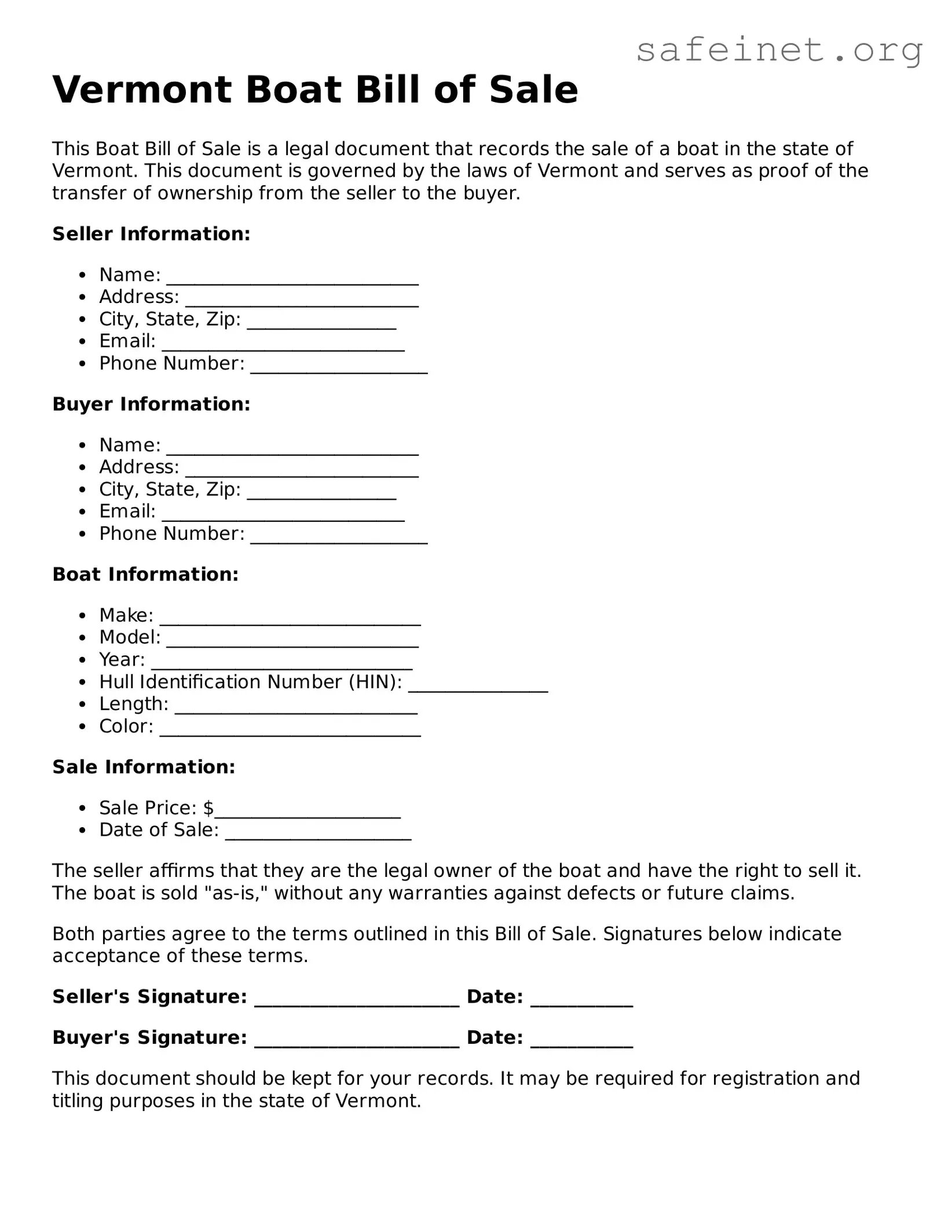
The Vermont Boat Bill of Sale form serves as a crucial document for individuals engaged in the buying or selling of boats within the state. This form outlines essential details such as the names and addresses of both the seller and buyer, the boat's identification number, and its make, model, and year. It also specifies the purchase price and the date of the transaction, ensuring that all parties are clear about the terms of the sale. By providing a record of the transaction, this form helps protect both the seller's and buyer's interests, offering proof of ownership transfer and aiding in future registration processes. Additionally, the form may include sections for any warranties or representations made by the seller regarding the boat's condition, further clarifying the expectations of both parties involved. Understanding the importance of this document can facilitate smoother transactions and foster trust in the boating community.
Vermont Boat Bill of Sale
This Boat Bill of Sale is a legal document that records the sale of a boat in the state of Vermont. This document is governed by the laws of Vermont and serves as proof of the transfer of ownership from the seller to the buyer.
Seller Information:
Buyer Information:
Boat Information:
Sale Information:
The seller affirms that they are the legal owner of the boat and have the right to sell it. The boat is sold "as-is," without any warranties against defects or future claims.
Both parties agree to the terms outlined in this Bill of Sale. Signatures below indicate acceptance of these terms.
Seller's Signature: ______________________ Date: ___________
Buyer's Signature: ______________________ Date: ___________
This document should be kept for your records. It may be required for registration and titling purposes in the state of Vermont.
| Fact Name | Details |
|---|---|
| Purpose | The Vermont Boat Bill of Sale form is used to document the sale of a boat between a buyer and a seller. |
| Governing Law | This form is governed by Vermont state laws regarding the sale and transfer of watercraft. |
| Information Required | Both parties must provide their names, addresses, and signatures, along with details about the boat. |
| Boat Details | Important information about the boat includes the make, model, year, and hull identification number (HIN). |
| Consideration | The form should specify the sale price or other consideration for the boat. |
| Notarization | While notarization is not required, it can add an extra layer of authenticity to the document. |
| Transfer of Ownership | The Bill of Sale serves as proof of ownership transfer from the seller to the buyer. |
| Usage | This document is often needed for registration purposes with the Vermont Department of Motor Vehicles. |
Once you have the Vermont Boat Bill of Sale form in hand, you’re ready to fill it out. This document will require specific information about the boat, the seller, and the buyer. Completing it accurately ensures a smooth transaction and proper transfer of ownership.
What is the Vermont Boat Bill of Sale form?
The Vermont Boat Bill of Sale form is a legal document used to record the sale of a boat in the state of Vermont. This form serves as proof of the transaction between the seller and the buyer. It includes essential details such as the names and addresses of both parties, a description of the boat, the sale price, and the date of the transaction. Having this document helps protect both parties by providing a clear record of the sale.
Why is a Bill of Sale important when buying or selling a boat?
A Bill of Sale is crucial because it acts as a receipt for the transaction. It provides evidence that the buyer has purchased the boat and that the seller has received payment. This document can be particularly important if any disputes arise later regarding ownership or the condition of the boat. Additionally, some states require a Bill of Sale for registration purposes, making it an essential step in the buying and selling process.
What information should be included in the Vermont Boat Bill of Sale?
The Vermont Boat Bill of Sale should include several key pieces of information. First, it should list the full names and addresses of both the seller and the buyer. Next, a detailed description of the boat is necessary, including the make, model, year, and hull identification number (HIN). The sale price should also be clearly stated, along with the date of the transaction. It is advisable to include a statement regarding the condition of the boat and any warranties or guarantees, if applicable.
Do I need to have the Bill of Sale notarized?
In Vermont, notarization of the Bill of Sale is not typically required. However, having the document notarized can add an extra layer of protection for both parties. A notary public verifies the identities of the individuals signing the document, which can help prevent fraud. If you plan to register the boat or if the buyer requests it, notarization may be a good idea.
Where can I obtain a Vermont Boat Bill of Sale form?
You can obtain a Vermont Boat Bill of Sale form from various sources. Many online legal document providers offer templates that you can fill out. Additionally, the Vermont Department of Motor Vehicles (DMV) may have resources available on their website or in person. It is important to ensure that the form you use complies with Vermont state laws and includes all necessary information for your specific transaction.
Failing to include all required information. It is essential to provide complete details about the vessel, including the make, model, year, and hull identification number.
Not signing the document. Both the seller and buyer must sign the Boat Bill of Sale for it to be valid. Without signatures, the document holds no legal weight.
Using incorrect or outdated forms. Always ensure that you are using the most current version of the Vermont Boat Bill of Sale form to avoid any complications.
Leaving out the purchase price. It is crucial to specify the amount paid for the boat. This information is necessary for tax purposes and future reference.
Not including the date of the transaction. The date provides a clear record of when the sale took place, which can be important for both parties.
Failing to provide identification information. Both parties should include their full names and contact information to ensure clear communication and proper identification.
Neglecting to mention any liens or encumbrances. If there are any outstanding loans or claims against the boat, they must be disclosed to avoid future disputes.
Not keeping a copy of the completed form. Both the buyer and seller should retain a copy of the Boat Bill of Sale for their records. This serves as proof of the transaction.
Overlooking the importance of a witness signature. While not always required, having a witness can add an extra layer of validation to the sale.
When completing a transaction involving a boat in Vermont, several documents may accompany the Boat Bill of Sale form. Each of these documents serves a specific purpose and helps ensure a smooth transfer of ownership.
Having these documents ready can simplify the process and help avoid potential issues down the line. Each form plays a vital role in ensuring that both parties are protected during the sale.
The Vermont Boat Bill of Sale form is similar to the Vehicle Bill of Sale. Both documents serve as proof of ownership transfer for personal property. A Vehicle Bill of Sale typically includes details such as the buyer's and seller's names, vehicle identification number (VIN), and sale price. Like the Boat Bill of Sale, it may also require signatures from both parties to validate the transaction.
An additional document that shares similarities is the Motorcycle Bill of Sale. This form is specifically designed for the sale of motorcycles, but it follows the same basic structure as the Boat Bill of Sale. Key elements include the identification of the motorcycle, the sale price, and the signatures of both the buyer and seller. Both documents help establish legal ownership and protect the interests of both parties involved in the transaction.
The ATV Bill of Sale is another related document. It is used for the sale of all-terrain vehicles and contains similar components to the Boat Bill of Sale. This includes the names of the buyer and seller, a description of the ATV, and the sale price. Both documents facilitate the transfer of ownership and may be required for registration purposes in some states.
The Snowmobile Bill of Sale also resembles the Boat Bill of Sale. This document is used for transferring ownership of snowmobiles. Like the Boat Bill of Sale, it includes pertinent details such as the buyer's and seller's information, a description of the snowmobile, and the agreed-upon sale price. Both forms serve to document the transaction and may be necessary for registration with state authorities.
The Trailer Bill of Sale is another document that functions similarly to the Boat Bill of Sale. It is specifically intended for the sale of trailers, whether for boats or other purposes. The key elements, such as buyer and seller information, trailer description, and sale price, are present in both forms. This documentation aids in establishing ownership and may be required for registration or titling.
The Firearm Bill of Sale is also comparable to the Boat Bill of Sale, though it pertains to the sale of firearms. Both documents serve to document the transfer of ownership and include similar information such as buyer and seller details, a description of the item, and the sale price. They help ensure that the transaction is recorded properly and may be required for legal compliance in certain jurisdictions.
The Pet Bill of Sale is another relevant document. This form is used when selling pets and shares similarities with the Boat Bill of Sale in terms of structure. It includes the names of the buyer and seller, a description of the pet, and the sale price. Both documents serve to formalize the transfer of ownership and can provide legal protection for both parties involved in the transaction.
Lastly, the Business Bill of Sale is similar in purpose to the Boat Bill of Sale, but it pertains to the sale of a business or business assets. This document outlines the details of the transaction, including buyer and seller information, a description of the business, and the sale price. Both forms aim to provide a clear record of ownership transfer and protect the rights of the involved parties.
When filling out the Vermont Boat Bill of Sale form, it’s important to ensure that the process goes smoothly. Here are some key dos and don’ts to keep in mind:
The Vermont Boat Bill of Sale form is a crucial document for anyone involved in the buying or selling of a boat in the state of Vermont. However, several misconceptions surround this form that can lead to confusion. Below is a list of eight common misconceptions about the Vermont Boat Bill of Sale, along with clarifications for each.
In Vermont, a Bill of Sale is essential for documenting the transfer of ownership. It serves as proof of the transaction and can be required for registration purposes.
Both the buyer and seller must sign the Bill of Sale to validate the transaction. This signature confirms that both parties agree to the terms outlined in the document.
While verbal agreements may be legally binding in some contexts, they are not advisable for boat transactions. A written Bill of Sale provides clear evidence of the agreement.
It is important for the Bill of Sale to contain a detailed description of the boat, including its make, model, year, and hull identification number. This information helps avoid disputes over ownership.
The Bill of Sale is required for both new and used boats. Regardless of the boat's age, this document is vital for establishing ownership.
While generic forms exist, it is advisable to use the Vermont-specific Bill of Sale to ensure compliance with state regulations and requirements.
Notarization is not a requirement for the Vermont Boat Bill of Sale, but having the document notarized can add an extra layer of security and legitimacy to the transaction.
The Bill of Sale can be important for tax purposes, as it provides documentation of the sale price, which may be relevant for calculating sales tax or for future tax assessments.
Filling out and using the Vermont Boat Bill of Sale form is an important process for both buyers and sellers. Here are some key takeaways to keep in mind: