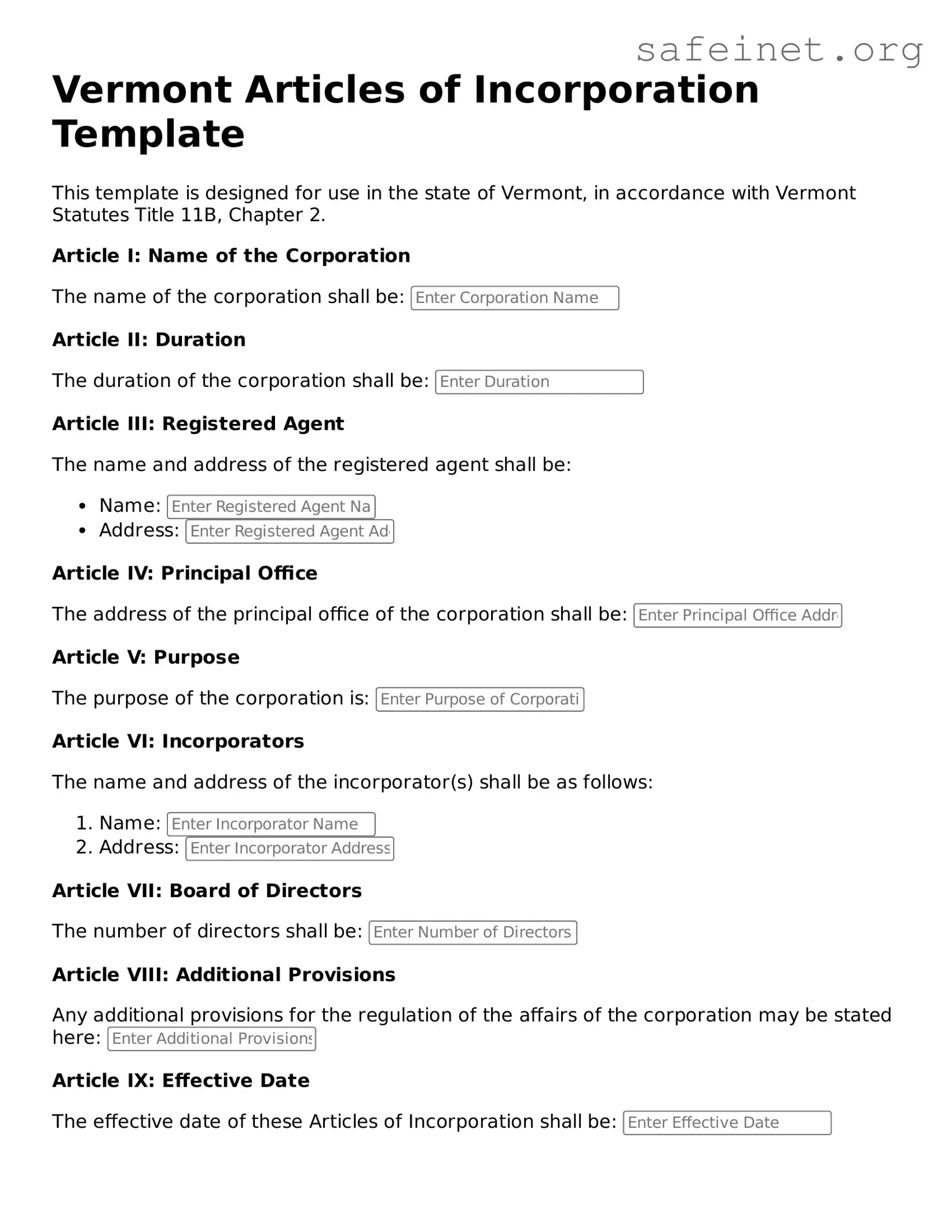
The Vermont Articles of Incorporation form is a crucial document for anyone looking to establish a corporation in the state. It serves as the official declaration that a business entity is being formed and outlines key information necessary for legal recognition. Among the major aspects included in this form are the corporation's name, which must be unique and compliant with state regulations, and the purpose of the corporation, which describes the business activities it intends to engage in. Additionally, the form requires details about the registered agent, who will serve as the point of contact for legal documents, and the number of shares the corporation is authorized to issue. This document also necessitates the names and addresses of the incorporators, ensuring that the individuals responsible for creating the corporation are clearly identified. Completing this form accurately is vital, as it lays the foundation for compliance with Vermont's corporate laws and facilitates smooth operations moving forward.
Vermont Articles of Incorporation Template
This template is designed for use in the state of Vermont, in accordance with Vermont Statutes Title 11B, Chapter 2.
Article I: Name of the Corporation
The name of the corporation shall be:
Article II: Duration
The duration of the corporation shall be:
Article III: Registered Agent
The name and address of the registered agent shall be:
Article IV: Principal Office
The address of the principal office of the corporation shall be:
Article V: Purpose
The purpose of the corporation is:
Article VI: Incorporators
The name and address of the incorporator(s) shall be as follows:
Article VII: Board of Directors
The number of directors shall be:
Article VIII: Additional Provisions
Any additional provisions for the regulation of the affairs of the corporation may be stated here:
Article IX: Effective Date
The effective date of these Articles of Incorporation shall be:
In witness whereof, the incorporator(s) have executed these Articles of Incorporation on this .
Signature of Incorporator(s):
| Fact Name | Details |
|---|---|
| Governing Law | The Vermont Articles of Incorporation are governed by Title 11 of the Vermont Statutes Annotated. |
| Purpose | This form is used to officially create a corporation in the state of Vermont. |
| Filing Requirement | Filing the Articles of Incorporation is a mandatory step for establishing a corporation. |
| Information Required | The form requires basic information such as the corporation's name, purpose, and registered agent. |
| Registered Agent | A registered agent must be designated to receive legal documents on behalf of the corporation. |
| Effective Date | The Articles of Incorporation can specify an effective date for the corporation's formation. |
| Filing Fee | A filing fee is required when submitting the Articles of Incorporation to the state. |
| Public Record | Once filed, the Articles of Incorporation become part of the public record. |
| Amendments | Corporations may amend their Articles of Incorporation in the future if needed. |
| Compliance | Corporations must comply with ongoing state requirements after filing the Articles of Incorporation. |
Filling out the Vermont Articles of Incorporation form is an essential step in establishing a corporation in the state. Once you have completed the form, you will submit it to the Secretary of State's office along with the required filing fee. This process marks the beginning of your corporate journey, allowing you to operate legally and protect your personal assets.
What are the Vermont Articles of Incorporation?
The Vermont Articles of Incorporation is a legal document required to establish a corporation in the state of Vermont. This form outlines essential information about the corporation, including its name, purpose, registered agent, and the number of shares it is authorized to issue. Filing this document with the Vermont Secretary of State is a crucial step in the incorporation process.
Who needs to file Articles of Incorporation in Vermont?
Any individual or group wishing to form a corporation in Vermont must file Articles of Incorporation. This applies to both for-profit and nonprofit organizations. By completing this form, the founders formally create a legal entity that can operate independently of its owners.
What information is required on the Articles of Incorporation form?
The form typically requires the corporation's name, the principal office address, the registered agent's name and address, the purpose of the corporation, and details about the stock structure, including the number of shares authorized. Additional information may be needed depending on the specific type of corporation being formed.
How much does it cost to file the Articles of Incorporation in Vermont?
The filing fee for the Articles of Incorporation in Vermont varies based on the type of corporation. As of October 2023, the fee for a for-profit corporation is generally higher than that for a nonprofit. It is advisable to check the Vermont Secretary of State's website for the most current fee schedule before submitting the form.
Where should the Articles of Incorporation be filed?
The completed Articles of Incorporation must be filed with the Vermont Secretary of State's office. This can often be done online, by mail, or in person. Ensuring that the form is submitted to the correct office is essential for the incorporation process to proceed smoothly.
How long does it take for the Articles of Incorporation to be processed?
Processing times can vary based on the volume of submissions received by the Vermont Secretary of State's office. Typically, it may take several business days to a few weeks for the Articles of Incorporation to be processed. Applicants may request expedited processing for an additional fee, which can significantly reduce wait times.
What happens after the Articles of Incorporation are filed?
Once the Articles of Incorporation are approved and filed, the corporation becomes a legal entity. The founders will receive a certificate of incorporation, which serves as official proof of the corporation's existence. The corporation must then comply with ongoing requirements, such as obtaining necessary licenses and permits, holding regular meetings, and filing annual reports.
Can the Articles of Incorporation be amended?
Yes, the Articles of Incorporation can be amended. If changes are needed, such as modifications to the corporation's name or purpose, an amendment must be filed with the Vermont Secretary of State. This process requires submitting a specific form and may involve additional fees.
Are there any restrictions on the name of the corporation?
Yes, the name of the corporation must comply with Vermont's naming requirements. It must be unique and distinguishable from other registered entities in the state. Additionally, certain words may be restricted or require special approval, such as "bank" or "insurance." Conducting a name search prior to filing is recommended to avoid potential conflicts.
Do I need a lawyer to file the Articles of Incorporation?
While it is not legally required to hire a lawyer to file the Articles of Incorporation, seeking legal advice can be beneficial. A lawyer can provide guidance on the incorporation process, ensure compliance with state laws, and help draft the necessary documents. However, many individuals successfully complete the filing independently.
Not providing a clear business name. Make sure the name is unique and not already in use. It should reflect your business purpose.
Failing to include the correct registered agent information. The registered agent must have a physical address in Vermont and be available during business hours.
Omitting the business purpose. Clearly state what your business will do. A vague description can lead to delays.
Incorrectly listing the number of shares. Ensure that the number of shares and their value are accurately stated. This affects ownership and investment.
Not including the incorporators' names and addresses. All incorporators must be listed with complete and correct information.
Neglecting to sign the form. All necessary parties must sign the Articles of Incorporation for it to be valid.
Forgetting to check for any additional local requirements. Some municipalities may have specific rules that need to be followed.
Using outdated forms. Always use the most recent version of the Articles of Incorporation to avoid any issues.
Not double-checking for typos or errors. Simple mistakes can cause delays or rejections, so review everything carefully.
When forming a corporation in Vermont, it's essential to understand that the Articles of Incorporation are just one piece of the puzzle. Several other documents and forms are often required to ensure compliance with state regulations and to facilitate smooth business operations. Here are five important forms and documents that you may encounter:
Understanding these documents is crucial for establishing a solid foundation for your corporation. By ensuring that all necessary forms are completed and filed correctly, you can set your business on a path to success.
The Vermont Articles of Incorporation form is similar to the Certificate of Incorporation, commonly used in many states. This document serves the same purpose: to formally establish a corporation as a legal entity. Both documents require basic information such as the corporation's name, address, and purpose. The Certificate of Incorporation also outlines the number of shares the corporation is authorized to issue, which is a common requirement in both forms.
Another document akin to the Vermont Articles of Incorporation is the Articles of Organization, which is used for forming limited liability companies (LLCs). While the Articles of Incorporation is focused on corporations, the Articles of Organization serves a similar function for LLCs. Both documents require information about the business structure, the registered agent, and the purpose of the entity, thereby providing a legal foundation for the respective business forms.
The Bylaws of a corporation closely relate to the Articles of Incorporation. While the Articles establish the corporation's existence, the Bylaws detail the internal rules and procedures for managing the corporation. Both documents are essential for corporate governance, but they serve different purposes. The Bylaws outline how decisions are made, how meetings are conducted, and how officers are appointed, complementing the foundational information in the Articles of Incorporation.
Similarly, the Operating Agreement for an LLC is comparable to the Bylaws for a corporation. This document outlines the management structure and operational procedures of the LLC. Like the Bylaws, the Operating Agreement is not filed with the state but is crucial for defining the roles of members and managers, as well as the distribution of profits and losses. Both documents serve to clarify the internal workings of the business entity.
The Statement of Information is another document that shares similarities with the Articles of Incorporation. Required in some states, this document provides updated information about the corporation after it has been formed. While the Articles of Incorporation provide initial details, the Statement of Information often includes updates on the corporation’s officers, address, and business activities, ensuring that the state has current information about the corporation.
In addition, the Corporate Resolution is akin to the Articles of Incorporation in that it formalizes decisions made by the corporation's board of directors. While the Articles establish the corporation's existence, Corporate Resolutions document specific actions taken, such as the approval of contracts or the appointment of officers. Both documents are essential for maintaining proper records and ensuring compliance with corporate governance requirements.
The Partnership Agreement can also be compared to the Articles of Incorporation, though it pertains to partnerships rather than corporations. This agreement outlines the roles, responsibilities, and profit-sharing arrangements among partners. While the Articles of Incorporation lay the groundwork for a corporation, the Partnership Agreement serves a similar function for partnerships, establishing the legal framework for the business relationship.
The Business License, while not a formation document, bears similarities in that it is often required for operating a business legally. Both the Articles of Incorporation and a Business License signify compliance with state regulations. The Business License permits the entity to conduct business in a specific jurisdiction, just as the Articles of Incorporation establish the entity's legal status.
Furthermore, the Employer Identification Number (EIN) application is closely related to the Articles of Incorporation. While the Articles establish the corporation, the EIN application is necessary for tax purposes. Both documents are essential for the functioning of a corporation, as the EIN is used for tax reporting and to identify the business entity in financial transactions.
Lastly, the Annual Report can be seen as a companion to the Articles of Incorporation. After a corporation is established, the Annual Report provides a snapshot of the corporation’s activities and financial status. While the Articles of Incorporation lay the foundation for the corporation, the Annual Report ensures ongoing compliance with state requirements and provides transparency to stakeholders about the corporation’s operations.
When filling out the Vermont Articles of Incorporation form, it is essential to approach the task with care and attention to detail. Below is a list of things you should and shouldn't do to ensure a smooth and successful filing process.
By following these guidelines, you can help ensure that your Articles of Incorporation are filed correctly, paving the way for your new corporation to operate smoothly in Vermont.
Many people have misunderstandings about the Vermont Articles of Incorporation form. Here are ten common misconceptions:
Understanding these misconceptions can help ensure a smoother process when forming a corporation in Vermont.
When filling out and using the Vermont Articles of Incorporation form, keep the following key takeaways in mind:
Following these steps will help ensure a smoother incorporation process in Vermont.