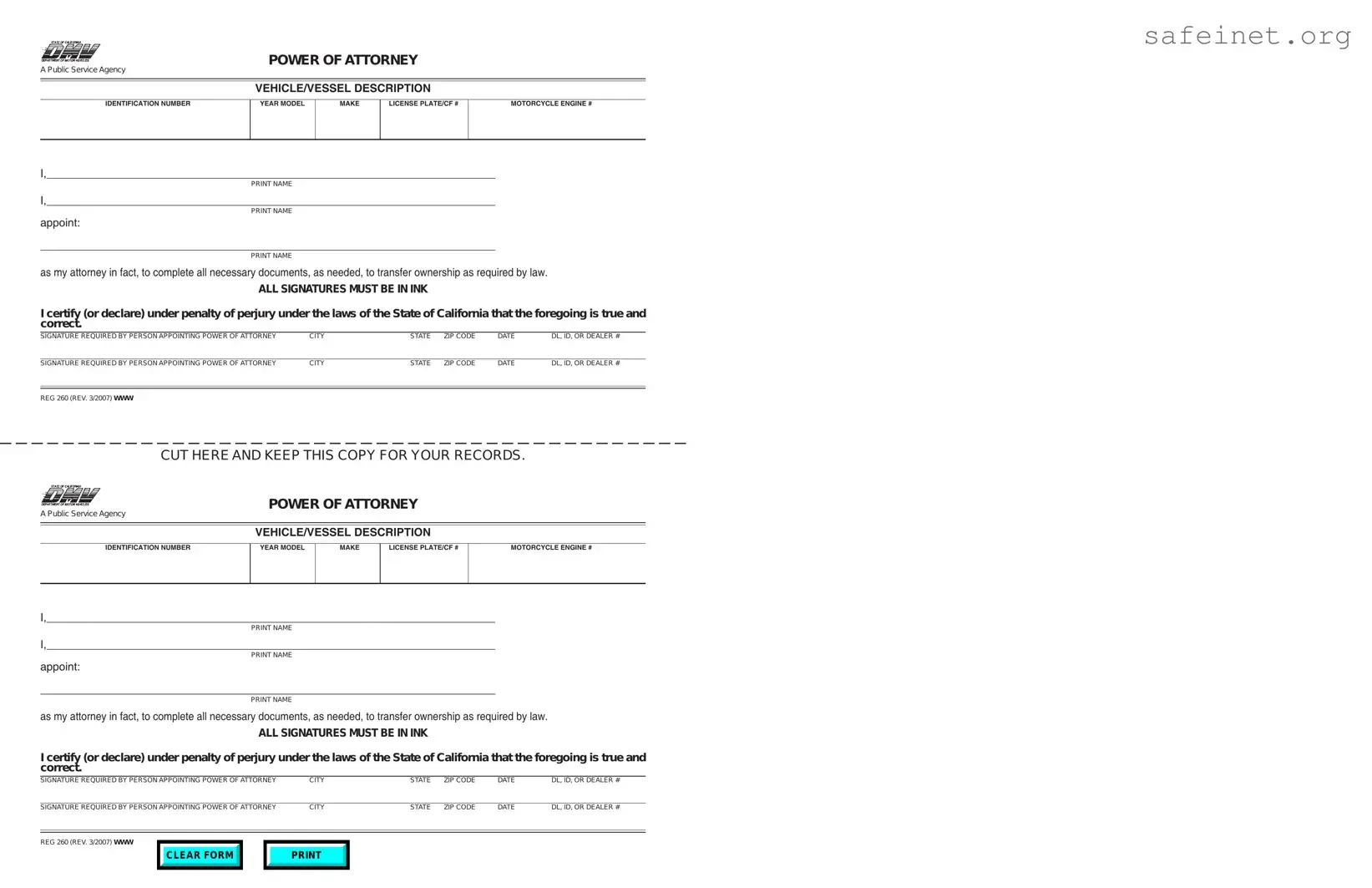
The Vehicle Power of Attorney (POA) REG 260 form is an essential document for anyone looking to delegate authority regarding their vehicle. This form allows an individual, known as the principal, to grant another person, referred to as the agent, the power to act on their behalf in matters related to vehicle ownership and registration. Whether you're unable to attend to these tasks due to time constraints or personal circumstances, the REG 260 provides a straightforward solution. Key aspects of the form include the specific powers being granted, which can range from signing documents to transferring ownership, as well as the identification details of both the principal and the agent. It also requires notarization to ensure authenticity and prevent fraud. By completing this form, vehicle owners can ensure that their interests are protected while allowing trusted individuals to manage necessary transactions efficiently.
POWER OF ATTORNEY
A Public Service Agency
VEHICLE/VESSEL DESCRIPTION
IDENTIFICATION NUMBER
YEAR MODEL
MAKE
LICENSE PLATE/CF #
MOTORCYCLE ENGINE #
I,________________________________________________________________________
PRINT NAME
I,________________________________________________________________________
PRINT NAME
appoint:
_________________________________________________________________________
PRINT NAME
as my attorney in fact, to complete all necessary documents, as needed, to transfer ownership as required by law.
ALL SIGNATURES MUST BE IN INK
I certify (or declare) under penalty of perjury under the laws of the State of California that the foregoing is true and correct.
SIGNATURE REQUIRED BY PERSON APPOINTING POWER OF ATTORNEY |
CITY |
STATE |
ZIP CODE |
DATE |
DL, ID, OR DEALER # |
|
|
|
|
|
|
SIGNATURE REQUIRED BY PERSON APPOINTING POWER OF ATTORNEY |
CITY |
STATE |
ZIP CODE |
DATE |
DL, ID, OR DEALER # |
|
|
|
|
|
|
|
|
|
|
|
|
REG 260 (REV. 3/2007) WWW |
|
|
|
|
|
CUT HERE AND KEEP THIS COPY FOR YOUR RECORDS.
POWER OF ATTORNEY
A Public Service Agency
VEHICLE/VESSEL DESCRIPTION
IDENTIFICATION NUMBER
YEAR MODEL
MAKE
LICENSE PLATE/CF #
MOTORCYCLE ENGINE #
I,________________________________________________________________________
PRINT NAME
I,________________________________________________________________________
PRINT NAME
appoint:
_________________________________________________________________________
PRINT NAME
as my attorney in fact, to complete all necessary documents, as needed, to transfer ownership as required by law.
ALL SIGNATURES MUST BE IN INK
I certify (or declare) under penalty of perjury under the laws of the State of California that the foregoing is true and correct.
SIGNATURE REQUIRED BY PERSON APPOINTING POWER OF ATTORNEY |
CITY |
STATE |
ZIP CODE |
DATE |
DL, ID, OR DEALER # |
|
|
|
|
|
|
SIGNATURE REQUIRED BY PERSON APPOINTING POWER OF ATTORNEY |
CITY |
STATE |
ZIP CODE |
DATE |
DL, ID, OR DEALER # |
REG 260 (REV. 3/2007) WWW
CLEAR FORM
| Fact Name | Description |
|---|---|
| Purpose | The Vehicle POA REG 260 form allows an individual to grant another person the authority to act on their behalf regarding vehicle-related matters. |
| Governing Law | This form is governed by the laws of the state where it is filed, typically under state vehicle codes. |
| Eligibility | Any vehicle owner can complete this form to designate a representative for vehicle transactions. |
| Submission | The completed form must be submitted to the appropriate state motor vehicle department for processing. |
| Revocation | The vehicle owner can revoke the POA at any time by notifying the designated representative and the motor vehicle department. |
| Validity | The Vehicle POA REG 260 form remains valid until revoked or until the specific tasks authorized are completed. |
After obtaining the Vehicle POA REG 260 form, individuals will need to complete it accurately to ensure proper processing. This form allows for the delegation of authority regarding a vehicle. Follow the steps below to fill out the form correctly.
What is the Vehicle POA REG 260 form?
The Vehicle POA REG 260 form, also known as the Vehicle Power of Attorney, is a document that allows one person to authorize another person to act on their behalf regarding vehicle-related matters. This can include tasks such as registering a vehicle, transferring ownership, or obtaining a duplicate title. The form ensures that the person designated has the legal authority to handle these transactions without needing the vehicle owner present.
Who can use the Vehicle POA REG 260 form?
Any vehicle owner in the United States can use the Vehicle POA REG 260 form. This includes individuals who may be unable to attend to their vehicle transactions due to various reasons, such as being out of state, having health issues, or simply being too busy. The form is especially useful for those who wish to delegate authority to a trusted friend, family member, or professional agent to manage their vehicle-related affairs.
How do I fill out the Vehicle POA REG 260 form?
Filling out the Vehicle POA REG 260 form is straightforward. Begin by providing your personal information as the vehicle owner, including your name, address, and contact details. Next, clearly identify the person you are granting power of attorney to by including their name and contact information. Specify the exact powers you are granting, such as the ability to sign documents or complete transactions on your behalf. Finally, sign and date the form. It's a good idea to keep a copy for your records once it’s completed.
Is the Vehicle POA REG 260 form legally binding?
Yes, the Vehicle POA REG 260 form is legally binding once it is properly filled out and signed. However, it’s important to ensure that both parties understand the terms outlined in the document. Additionally, some states may have specific requirements regarding notarization or witness signatures. Checking your state’s regulations can help ensure that the form is valid and accepted by the relevant authorities when used for vehicle transactions.
Failing to provide accurate vehicle information. Ensure the VIN, make, model, and year are correct.
Not signing the form. The form requires a signature from the person granting power of attorney.
Omitting the date. Always include the date when the form is completed.
Using incorrect names. The names on the form must match the identification documents.
Not specifying the scope of authority. Clearly state what the agent can do on your behalf.
Failing to provide the agent's contact information. Include a phone number and address for the agent.
Not keeping a copy. Always retain a copy of the completed form for your records.
Ignoring state-specific requirements. Check if your state has additional requirements for the form.
Not having witnesses or notarization when required. Some states may require this for validity.
Submitting the form to the wrong agency. Ensure you know where to send the completed form.
The Vehicle Power of Attorney (POA) REG 260 form is an important document that allows one person to authorize another to act on their behalf regarding vehicle-related matters. In addition to this form, several other documents may be needed to complete various transactions related to vehicle ownership and registration. Below is a list of commonly used forms and documents that often accompany the Vehicle POA REG 260.
Each of these documents plays a crucial role in ensuring that vehicle transactions are completed smoothly and legally. Understanding their purposes can help individuals navigate the process more effectively.
The Vehicle Power of Attorney (POA) REG 260 form is similar to the General Power of Attorney. Both documents allow an individual to designate another person to act on their behalf. The General POA grants broad authority, which can include managing financial matters, making legal decisions, and handling various personal affairs. Like the REG 260, the General POA must be signed by the principal and often requires notarization to be legally binding.
The Durable Power of Attorney is another document that shares similarities with the Vehicle POA REG 260. This document remains effective even if the principal becomes incapacitated. Both forms allow an agent to make decisions regarding the principal's assets, including vehicles. The Durable POA provides a broader scope of authority, while the REG 260 is specifically tailored to vehicle-related transactions.
The Medical Power of Attorney also parallels the Vehicle POA REG 260 in that it allows one person to make decisions on behalf of another. However, this document specifically pertains to healthcare decisions. While the REG 260 focuses on vehicle matters, both documents require the principal to grant authority to the agent through a formal process, often involving signatures and possibly notarization.
The Limited Power of Attorney is similar in that it grants specific powers to an agent for a defined purpose, much like the Vehicle POA REG 260, which is limited to vehicle transactions. The Limited POA can be used for various tasks, such as real estate transactions or financial matters, but it does not extend beyond the specified authority. Both documents must clearly outline the scope of the agent's powers.
Finally, the Bill of Sale can be compared to the Vehicle POA REG 260 in terms of facilitating vehicle transactions. While the REG 260 authorizes an agent to act on behalf of the vehicle owner, the Bill of Sale serves as a record of the transaction between the buyer and seller. Both documents are essential for transferring ownership and ensuring that all parties understand their rights and responsibilities in the transaction.
When filling out the Vehicle POA REG 260 form, it's important to keep a few key points in mind. Here are five things you should and shouldn't do:
Misconception 1: The Vehicle POA REG 260 form can only be used for transferring ownership.
This is not true. While the form is often associated with ownership transfers, it can also be used for other purposes, such as allowing someone to handle vehicle registration or title matters on your behalf.
Misconception 2: You must be present in person to complete the Vehicle POA REG 260 form.
Many people believe that personal presence is required. However, you can fill out the form and have it signed by a notary, allowing someone else to act on your behalf without your physical presence.
Misconception 3: The Vehicle POA REG 260 form is only valid for a limited time.
Some think that the authority granted by this form expires quickly. In reality, the validity of the POA depends on the terms you specify. You can set it to last until a specific event occurs or until you revoke it.
Misconception 4: Anyone can act as a representative with the Vehicle POA REG 260 form.
While it is true that you can choose your representative, not everyone is suitable. It’s important to select someone trustworthy, as they will have significant control over your vehicle-related matters.
The Vehicle Power of Attorney (POA) REG 260 form is an important document for vehicle owners in the United States. Here are six key takeaways about filling out and using this form: