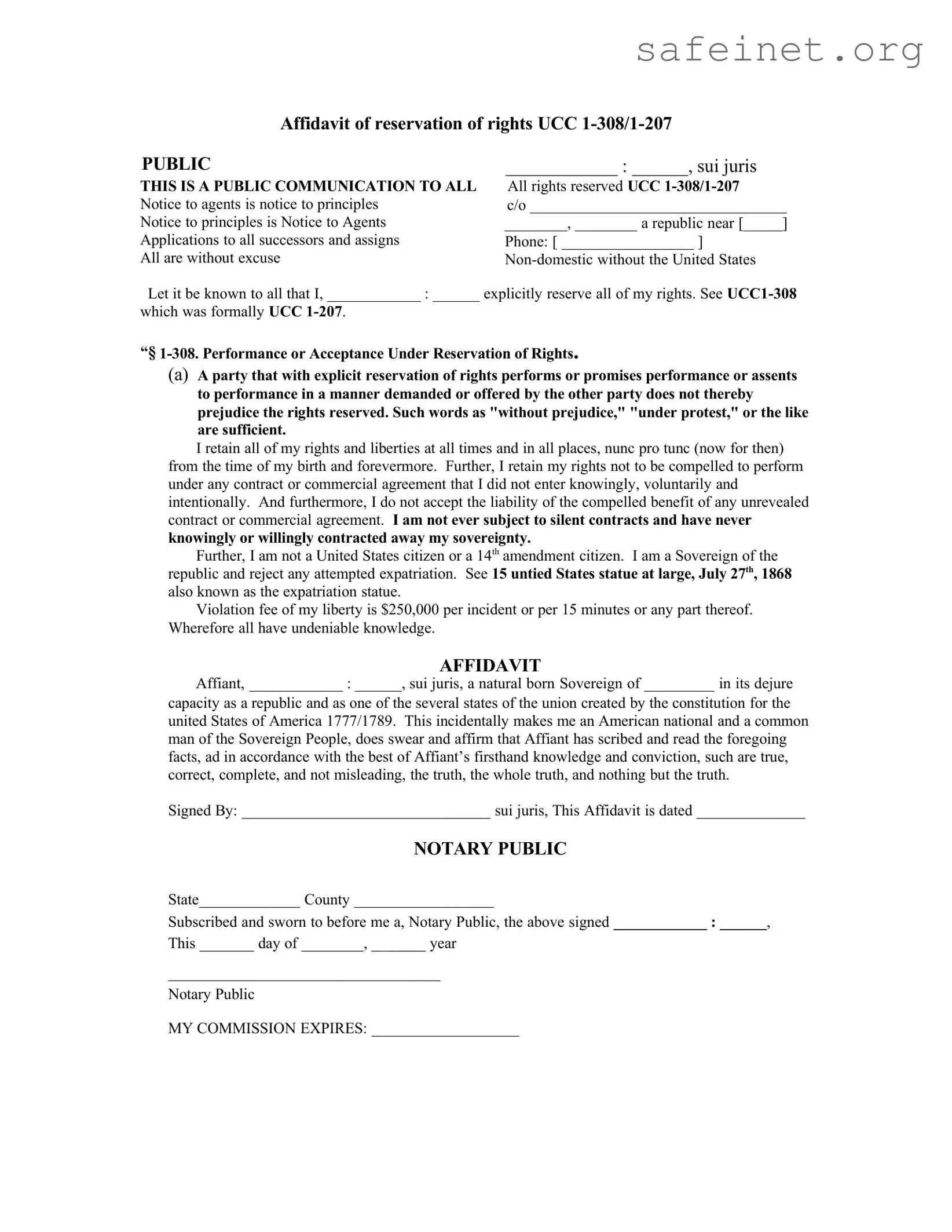
The UCC 1-308 form, also known as the Affidavit of Reservation of Rights, serves as a powerful tool for individuals who wish to explicitly reserve their rights in various legal contexts. This form is rooted in the Uniform Commercial Code, which aims to standardize commercial transactions across states. By utilizing UCC 1-308, a person can assert that they do not waive any rights or claims when entering into agreements or performing obligations. The form emphasizes the importance of clear communication, stating that notice to agents is also notice to principals, ensuring that all parties are aware of the rights being reserved. It allows individuals to declare their status as sovereign entities, distinguishing themselves from U.S. citizens and asserting their autonomy. The language of the form includes phrases such as "without prejudice" and "under protest," which are essential for maintaining the reserved rights. Additionally, it outlines the consequences for violations of these rights, including potential financial penalties. Through a formal affidavit, the individual swears to the truth of the statements made, reinforcing the seriousness of their declaration. This form is not merely a legal document; it is a declaration of one's rights and a safeguard against being bound by undisclosed agreements or obligations.
Affidavit of reservation of rights UCC
PUBLIC
THIS IS A PUBLIC COMMUNICATION TO ALL Notice to agents is notice to principles
Notice to principles is Notice to Agents Applications to all successors and assigns All are without excuse
____________ : ______, sui juris
All rights reserved UCC
c/o _________________________________
________, ________ a republic near [_____]
Phone: [ _________________ ]
Let it be known to all that I, ____________ : ______ explicitly reserve all of my rights. See
which was formally UCC
Ҥ
(a)A party that with explicit reservation of rights performs or promises performance or assents to performance in a manner demanded or offered by the other party does not thereby prejudice the rights reserved. Such words as "without prejudice," "under protest," or the like are sufficient.
I retain all of my rights and liberties at all times and in all places, nunc pro tunc (now for then) from the time of my birth and forevermore. Further, I retain my rights not to be compelled to perform under any contract or commercial agreement that I did not enter knowingly, voluntarily and intentionally. And furthermore, I do not accept the liability of the compelled benefit of any unrevealed contract or commercial agreement. I am not ever subject to silent contracts and have never knowingly or willingly contracted away my sovereignty.
Further, I am not a United States citizen or a 14th amendment citizen. I am a Sovereign of the republic and reject any attempted expatriation. See 15 untied States statue at large, July 27th, 1868 also known as the expatriation statue.
Violation fee of my liberty is $250,000 per incident or per 15 minutes or any part thereof. Wherefore all have undeniable knowledge.
AFFIDAVIT
Affiant, ____________ : ______, sui juris, a natural born Sovereign of _________ in its dejure
capacity as a republic and as one of the several states of the union created by the constitution for the united States of America 1777/1789. This incidentally makes me an American national and a common man of the Sovereign People, does swear and affirm that Affiant has scribed and read the foregoing facts, ad in accordance with the best of Affiant’s firsthand knowledge and conviction, such are true, correct, complete, and not misleading, the truth, the whole truth, and nothing but the truth.
Signed By: ________________________________ sui juris, This Affidavit is dated ______________
NOTARY PUBLIC
State_____________ County __________________
Subscribed and sworn to before me a, Notary Public, the above signed ____________ : ______,
This _______ day of ________, _______ year
___________________________________
Notary Public
MY COMMISSION EXPIRES: ___________________
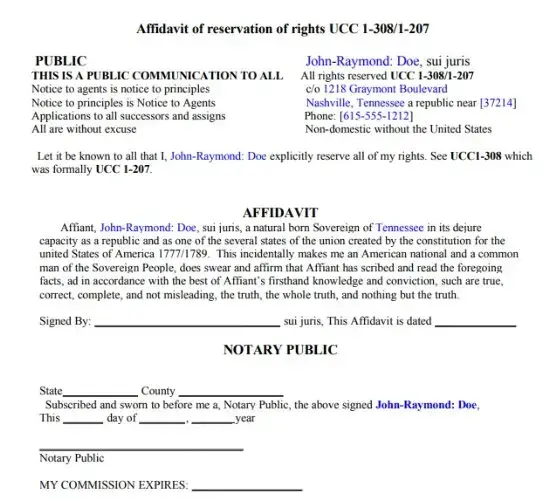
FILLED OUT EXAMPLE
Affidavit of reservation of rights UCC
PUBLIC |
|
THIS IS A PUBLIC COMM UNICATION TO ALL |
All rights reserved UCC |
Notice to agents is notice to principles |
c/o 1218 Graymont Boulevard |
Notice to principles is Notice to Agents |
Nashville, Tennessee a republic near (372 14] |
Applications to all successors and as.signs |
Phone: [6 |
All are without excuse |
Let it be known to all that I,
AFFIDAVIT
Affiant.
capacity as a republic and as one of the several states of the union created by the constitution for the united States of America 1777/1 789. This incidentally makes me an American national and a common man of the Sovereign People, does swear and affirm that Affiant has scribed and read the fo regoing
facts. ad in accordance with the best ofAffiant's firsthand knowledge and conviction. such arc true,
correc~ complete, and not misleading, the truth, the whole truth, and nothing but the truth.
Signed By: _____________ sui juris, This Affidavit is dated ______
NOTARY PUBLIC
State______ County ________
Subscribed and sworn to before me a, Notary Public, the above
Notary Public
MY COMMISSION EXPIRES: _______
| Fact Name | Description |
|---|---|
| Purpose | The UCC 1-308 form serves as an Affidavit of Reservation of Rights, allowing individuals to explicitly reserve their rights in various legal contexts. |
| Legal Basis | This form is based on the Uniform Commercial Code (UCC) § 1-308, which outlines the performance or acceptance under reservation of rights. |
| State-Specific Laws | Different states may have specific requirements or variations of the UCC 1-308 form. For example, in California, the governing law is the California Commercial Code. |
| Public Communication | The form is intended as a public communication, meaning it is meant to be shared with all parties involved, including agents and principals. |
| Sovereignty Declaration | By using this form, individuals assert their status as sovereign entities, rejecting certain classifications like U.S. citizenship. |
| Liability Clause | The form includes a clause stating a violation of the individual's rights may incur a fee of $250,000 per incident, emphasizing the seriousness of their claims. |
Completing the UCC 1-308 form is a straightforward process. Follow these steps carefully to ensure that all necessary information is included. After filling out the form, it will need to be signed and possibly notarized before submission.
What is the purpose of the UCC 1-308 form?
The UCC 1-308 form, also known as the Affidavit of Reservation of Rights, serves to explicitly reserve a person's rights under the Uniform Commercial Code (UCC). By filing this form, an individual asserts that they do not waive any rights or liberties when entering into agreements or contracts. This declaration aims to protect the individual from being bound by terms they did not knowingly or voluntarily accept.
Who can use the UCC 1-308 form?
Any individual who wishes to reserve their rights in a legal or commercial context can use the UCC 1-308 form. This includes those who identify as sovereign citizens or individuals who want to ensure that their rights are explicitly stated and protected in any dealings with others, especially in contracts or agreements.
What does "sui juris" mean in the context of this form?
"Sui juris" is a Latin term that means "of one's own right." When used in the UCC 1-308 form, it indicates that the individual is acting independently and is competent to manage their own affairs. This designation emphasizes the person's autonomy and legal standing in the eyes of the law.
What rights are reserved by filing the UCC 1-308 form?
By filing the UCC 1-308 form, an individual reserves all rights and liberties, ensuring they are not compelled to perform under any contract or agreement they did not enter into knowingly and voluntarily. This includes rejecting liability for any undisclosed contracts and asserting their sovereignty, particularly in relation to citizenship status.
Is the UCC 1-308 form legally binding?
The UCC 1-308 form is a declaration of rights and does not create new legal rights. However, it can serve as evidence of a person's intent to reserve their rights in legal matters. While it may not hold the same weight as a contract, it can be influential in disputes or negotiations by clearly stating the individual's position.
How should the UCC 1-308 form be filled out?
The UCC 1-308 form should be filled out with accurate personal information, including the individual's name, address, and any relevant details about the rights being reserved. It is essential to sign the form and have it notarized to ensure its authenticity and legal recognition. Each section must be completed carefully to avoid any misunderstandings.
Can the UCC 1-308 form be used in all states?
Yes, the UCC 1-308 form is based on the Uniform Commercial Code, which has been adopted in some form by all states. However, the specific application and interpretation may vary by jurisdiction. It is advisable to consult local laws or seek legal guidance to ensure proper use in your state.
What happens if my rights are violated after filing the UCC 1-308 form?
If your rights are violated after filing the UCC 1-308 form, you may have grounds to pursue legal action based on the declaration you made. The form serves as a record of your intent to reserve your rights, which can be referenced in any legal disputes. It is essential to document any violations and seek legal advice to determine the best course of action.
Failing to include all necessary personal information. Ensure your name, address, and contact details are complete and accurate.
Not clearly stating your intent to reserve rights. Use explicit language such as "I reserve all my rights" to avoid ambiguity.
Neglecting to sign the affidavit. A signature is crucial for the document to be valid.
Using incorrect or inconsistent names. Always use the same name format throughout the document to maintain clarity.
Leaving out the notary section. A notary public must witness the signing to authenticate the document.
Failing to date the affidavit. An undated affidavit may lead to questions about its validity.
Not understanding the implications of the UCC. Familiarize yourself with UCC 1-308 and its requirements to ensure compliance.
Ignoring the importance of clear language. Avoid jargon or overly complex phrasing to ensure the document is easily understood.
The UCC 1-308 form is often used alongside several other documents to ensure that rights are clearly reserved and to establish the legal standing of individuals. Below is a list of documents that may be relevant in conjunction with the UCC 1-308 form.
Each of these documents plays a role in protecting rights and clarifying legal standing. It is essential to understand how they interact with the UCC 1-308 form to effectively navigate legal matters.
The UCC-1 Financing Statement serves a similar purpose to the UCC-1-308 form by establishing a public record of a secured party's interest in a debtor's collateral. This document is filed with a state authority to provide notice to other creditors and interested parties. By filing a UCC-1, the secured party aims to protect their rights in the collateral against claims from other creditors. Like the UCC-1-308, it emphasizes the importance of public notice and the preservation of rights, ensuring that the secured party's interests are recognized and prioritized in the event of bankruptcy or default.
The Affidavit of Truth is another document that shares similarities with the UCC-1-308 form. This affidavit is often used to declare facts or beliefs that the affiant wishes to be recognized legally. It serves as a formal declaration of one's position or rights, much like the UCC-1-308, which explicitly reserves rights. Both documents are designed to assert personal rights and clarify an individual's stance in legal matters, reinforcing the importance of having a clear record of one’s assertions.
The Notice of Claim is a document that also resembles the UCC-1-308 form. This notice is typically filed to assert a legal claim against a party or property. By filing a Notice of Claim, an individual aims to protect their rights and interests in a situation where they believe they have a legal entitlement. Similar to the UCC-1-308, it serves to inform other parties of one’s claims and intentions, thereby establishing a public record of the individual’s position.
The Declaration of Rights is akin to the UCC-1-308 form in that it is used to formally outline and reserve specific rights. This document often serves to clarify an individual's legal status or rights in a given situation. By declaring rights, individuals aim to protect themselves from potential infringement or misunderstanding. Like the UCC-1-308, this declaration emphasizes the importance of making one’s rights known to prevent any future disputes.
The Power of Attorney (POA) document is similar to the UCC-1-308 form in that it grants authority to another individual to act on one’s behalf. While the UCC-1-308 focuses on reserving rights, a POA allows an individual to delegate specific rights and responsibilities. Both documents serve to clarify legal relationships and intentions, though they operate in different contexts. The POA can be used to ensure that an individual's interests are managed according to their wishes, similar to how the UCC-1-308 asserts personal rights.
The Living Will is another document that shares similarities with the UCC-1-308 form. This legal document outlines an individual's preferences regarding medical treatment in situations where they cannot communicate their wishes. While it primarily addresses health care decisions, it serves to preserve the rights of the individual, much like the UCC-1-308. Both documents emphasize the importance of having one’s rights and wishes clearly stated to avoid potential conflicts or misunderstandings in the future.
The Certificate of Assumed Name, also known as a DBA (Doing Business As), is similar to the UCC-1-308 form as it serves to notify the public of the name under which a business operates. By filing this certificate, a business owner protects their rights to that name and informs others of their business identity. Just as the UCC-1-308 asserts and reserves rights, the DBA certificate ensures that the business's identity is legally recognized and protected.
The Bill of Sale is another document that resembles the UCC-1-308 form in that it serves as a record of the transfer of ownership of personal property. This document provides evidence of the transaction and protects the rights of both the buyer and seller. Like the UCC-1-308, a Bill of Sale emphasizes the importance of documenting agreements to ensure that rights are preserved and recognized by all parties involved.
Lastly, the Release of Liability is a document that shares similarities with the UCC-1-308 form by allowing individuals to formally waive certain rights or claims against another party. This document is often used in situations where one party agrees not to hold another party responsible for specific actions. While the UCC-1-308 is focused on reserving rights, both documents serve to clarify the intentions and agreements between parties, ensuring that their respective rights are clearly understood and documented.
When filling out the UCC 1-308 form, it is important to follow certain guidelines to ensure accuracy and compliance. Here are some things you should and shouldn't do:
Misconceptions about the UCC 1-308 form often lead to confusion regarding its purpose and implications. Below is a list of nine common misconceptions, along with clarifications for each.
Understanding these misconceptions can help individuals navigate their rights and responsibilities more effectively. It is essential to consult legal professionals for advice tailored to specific situations.
When filling out and using the UCC 1-308 form, consider the following key takeaways: