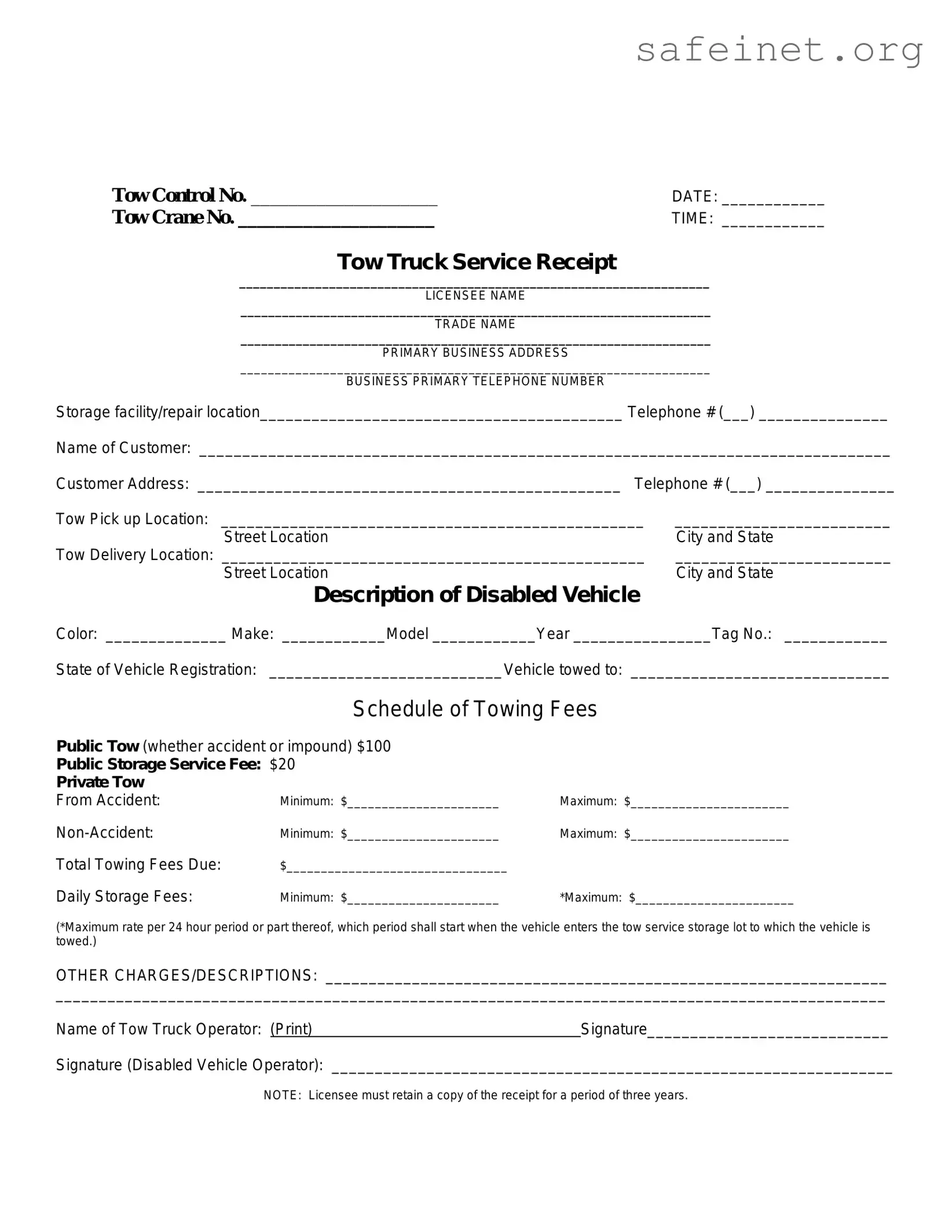
When a vehicle is towed, it can be a stressful experience for the owner. To help ease this process, the Tow Truck Receipt form plays a crucial role in documenting the transaction between the towing service and the vehicle owner. This form captures essential information, such as the date and time of the tow, the details of the vehicle being towed—including its make, model, and registration—and the locations involved in the pickup and delivery. It also outlines the fees associated with the towing service, which may vary depending on whether the tow is public or private, and includes daily storage fees if applicable. Additionally, the form requires the names and signatures of both the tow truck operator and the disabled vehicle operator, ensuring accountability and transparency in the service provided. Notably, the towing company must retain a copy of the receipt for three years, emphasizing the importance of record-keeping in this industry. Understanding the components of this receipt is vital for both service providers and customers, as it lays the groundwork for a clear and fair transaction.

Tow Control No. ____________________ |
DATE: ____________ |
Tow Crane No. _____________________ |
TIME: ____________ |
Tow Truck Service Receipt
____________________________________________________________________
LICENSEE NAME
____________________________________________________________________
TRADE NAME
____________________________________________________________________
PRIMARY BUSINESS ADDRESS
____________________________________________________________________
BUSINESS PRIMARY TELEPHONE NUMBER
Storage facility/repair location__________________________________________ Telephone # (___) _______________
Name of Customer: ________________________________________________________________________________
Customer Address: _________________________________________________ Telephone # (___) _______________
Tow Pick up Location: _________________________________________________ |
_________________________ |
Street Location |
City and State |
Tow Delivery Location: _________________________________________________ |
_________________________ |
Street Location |
City and State |
Description of Disabled Vehicle |
|
Color: ______________ Make: ____________Model ____________Year ________________Tag No.: ____________
State of Vehicle Registration: ___________________________Vehicle towed to: ______________________________
Schedule of Towing Fees
Public Tow (whether accident or impound) $100
Public Storage Service Fee: $20
Private Tow
From Accident:
Total Towing Fees Due:
Maximum: $_______________________
Maximum: $_______________________
Daily Storage Fees:Minimum: $______________________ *Maximum: $_______________________
(*Maximum rate per 24 hour period or part thereof, which period shall start when the vehicle enters the tow service storage lot to which the vehicle is towed.)
OTHER CHARGES/DESCRIPTIONS: _________________________________________________________________
________________________________________________________________________________________________
Name of Tow Truck Operator: (Print)Signature____________________________
Signature (Disabled Vehicle Operator): _________________________________________________________________
NOTE: Licensee must retain a copy of the receipt for a period of three years.
| Fact Name | Description |
|---|---|
| Minimum Charges | The receipt must indicate minimum charges for towing and storage services. |
| Tow Control Number | A unique Tow Control Number is required for tracking the towing service. |
| Licensee Information | The form must include the name, trade name, and contact details of the towing company. |
| Customer Details | Customer name, address, and contact information must be clearly stated on the receipt. |
| Vehicle Description | Details such as color, make, model, year, and tag number of the towed vehicle are necessary. |
| Fee Schedule | The receipt must outline the schedule of towing fees, including public and private tow rates. |
| Record Retention | The licensee is required to keep a copy of the receipt for three years. |
After you have gathered all necessary information, you can begin filling out the Tow Truck Receipt form. This form will help document the towing service provided and ensure all details are recorded accurately.
What is a Tow Truck Receipt form?
The Tow Truck Receipt form is a document that provides a detailed record of the towing service provided. It includes information about the vehicle being towed, the service provider, and the fees associated with the tow. This form serves as proof of the transaction for both the service provider and the customer.
What information is required on the Tow Truck Receipt?
The form requires several key pieces of information, including the date and time of the tow, the licensee's name and contact information, the customer's name and address, and details about the vehicle being towed. It also includes the pickup and delivery locations, along with a breakdown of the towing fees and any additional charges.
What are the typical fees associated with towing?
Typical fees can vary based on the type of tow. For public tows, the standard fee is $100. Additional charges may apply for storage services, which typically cost $20 per day. Private tows may have different rates depending on the circumstances of the tow.
How long should I keep the Tow Truck Receipt?
It is important to retain a copy of the Tow Truck Receipt for a minimum of three years. This ensures you have proof of the transaction in case of any disputes or questions that may arise later.
What should I do if I lose my Tow Truck Receipt?
If you lose your Tow Truck Receipt, contact the towing company as soon as possible. They may be able to provide a duplicate or another form of verification for the service rendered. Keep in mind that having a receipt is crucial for resolving any potential issues.
Can I dispute the charges listed on the Tow Truck Receipt?
If you believe the charges on the Tow Truck Receipt are incorrect, you can dispute them with the towing company. Provide any evidence you have to support your claim. It is advisable to do this promptly to ensure a smooth resolution process.
What information do I need to provide when filling out the form?
You will need to provide your name, address, and phone number, as well as details about the vehicle being towed, including its make, model, year, color, and license plate number. Additionally, you will need to specify the pickup and delivery locations.
What happens if my vehicle is towed?
If your vehicle is towed, you should contact the towing company listed on the Tow Truck Receipt for information on retrieving your vehicle. Be prepared to provide your vehicle's details and possibly pay the required fees before your vehicle can be released.
Is there a maximum fee for towing services?
Yes, the Tow Truck Receipt will indicate a maximum fee for towing services. This maximum amount can vary based on the type of tow and any additional services provided, such as storage. Always review the receipt for specific details.
Who needs to sign the Tow Truck Receipt?
The Tow Truck Receipt must be signed by the tow truck operator and the operator of the disabled vehicle. This ensures that both parties acknowledge the transaction and the details contained within the receipt.
Inaccurate Information: Failing to provide correct details about the vehicle, such as the make, model, or year, can lead to confusion and disputes later on.
Missing Contact Information: Omitting the customer’s address or telephone number can complicate communication regarding the towing service.
Incorrect Fees: Miscalculating the total towing fees or daily storage fees can result in financial discrepancies and potential legal issues.
Neglecting Signatures: Not obtaining the required signatures from both the tow truck operator and the disabled vehicle operator may invalidate the receipt.
Omitting Tow Control Number: Failing to include the tow control number makes it difficult to track the transaction and can hinder any follow-up actions.
Not Retaining a Copy: Forgetting to keep a copy of the receipt for three years, as required, can lead to complications if the transaction is questioned in the future.
The Tow Truck Receipt form is often accompanied by various other documents that facilitate the towing process and ensure compliance with regulations. Below is a list of six commonly used forms and documents that may accompany the Tow Truck Receipt.
These documents play a vital role in ensuring transparency and accountability in the towing process. Proper documentation helps protect the rights of vehicle owners and towing companies alike.
The first document similar to the Tow Truck Receipt form is the Invoice. An invoice is a detailed bill sent to a customer after goods or services have been provided. Like the tow truck receipt, an invoice includes essential information such as the date, services rendered, and total amount due. Both documents serve as proof of transaction and can be used for record-keeping and tax purposes. Customers rely on invoices to understand their charges, just as they do with tow truck receipts.
Another document that resembles the Tow Truck Receipt is the Bill of Sale. A bill of sale is used when transferring ownership of personal property, like a vehicle. It provides details about the item being sold, including its description and sale price. Similar to the tow truck receipt, it includes information about the buyer and seller. Both documents are important for legal and financial records, serving as evidence of the transaction and the terms agreed upon by both parties.
The Repair Order is also comparable to the Tow Truck Receipt. This document is used by auto repair shops to outline the services performed on a vehicle. It includes details such as the customer’s information, the vehicle’s description, and the costs associated with the repairs. Just like the tow truck receipt, a repair order provides transparency about the services rendered and the charges incurred. Both documents help customers understand what they are paying for and can be used for warranty claims or disputes.
Next, we have the Service Agreement, which shares similarities with the Tow Truck Receipt. A service agreement outlines the terms and conditions under which services will be provided. It includes details such as the scope of work, payment terms, and responsibilities of both parties. Like the tow truck receipt, it serves as a record of the transaction and can help prevent misunderstandings. Both documents ensure that the customer knows what to expect and what they are obligated to pay.
Finally, the Payment Receipt is another document akin to the Tow Truck Receipt. A payment receipt is issued after a payment has been made, confirming that the transaction has been completed. It typically includes information such as the date of payment, amount paid, and the services or goods received. Both the payment receipt and the tow truck receipt provide proof of financial transactions, helping customers keep track of their expenses and ensuring that businesses have accurate records for accounting purposes.
When filling out the Tow Truck Receipt form, there are important steps to follow to ensure accuracy and compliance. Here’s a list of things you should and shouldn't do:
By following these guidelines, you can ensure a smooth process when completing the Tow Truck Receipt form.
This is not true. While the form is commonly used in accident scenarios, it also applies to non-accident tows, such as impounds or voluntary tows. Understanding this can help customers know their rights in various towing situations.
In fact, it is essential. The receipt serves as proof of service and payment, which can be crucial for disputes or claims. Without it, customers may face challenges in recovering their vehicles or disputing charges.
Towing fees can vary significantly based on the type of tow, the distance towed, and other factors. The receipt provides a breakdown of these fees, ensuring transparency for the customer.
This is a common misunderstanding. The receipt is equally important for the customer, as it details the services rendered and the associated costs. Keeping a copy is vital for personal records.
Actually, customers must fill in their details, including name, address, and contact information. This information helps ensure proper communication and record-keeping between the towing company and the customer.
This is misleading. Towing companies must adhere to state regulations regarding maximum fees. The receipt outlines these fees, providing customers with clarity on what they are being charged.
When filling out and using the Tow Truck Receipt form, consider the following key takeaways: