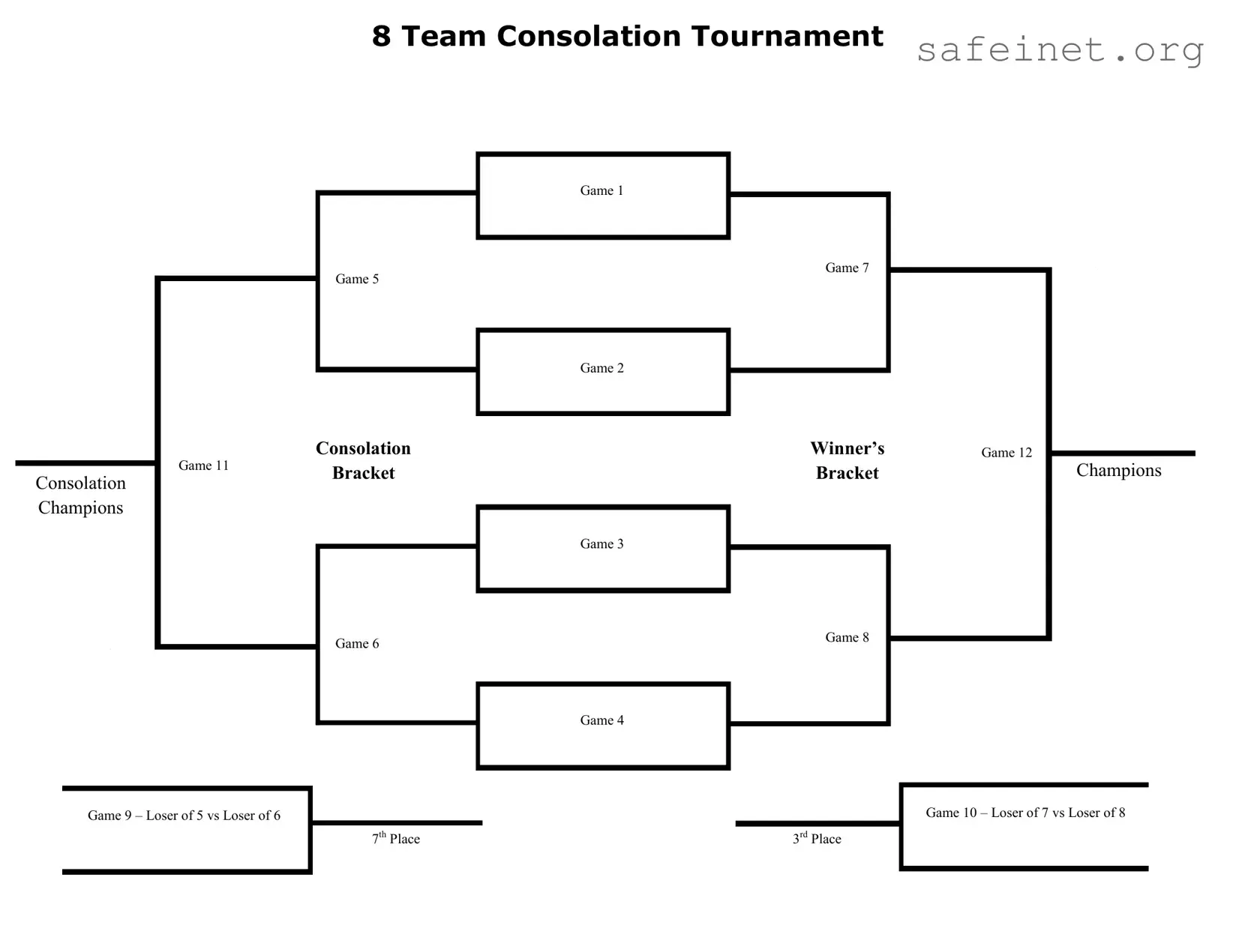
The Tournament Consolation Bracket form is an essential tool for organizing and managing the flow of a competitive tournament, especially when dealing with eight teams. It provides a structured layout that ensures every team has a chance to compete, even after losing initial matches. The form outlines the progression of games, starting from Game 1, where teams face off in the early rounds, leading up to the final games that determine the consolation champions. Key matchups are highlighted, including Games 9 and 10, which pit the losers of previous matches against each other, ensuring that every participant has the opportunity to earn a final placement. The bracket also clearly indicates the path to securing 3rd and 7th places, making it easy for organizers and spectators to follow the tournament's progression. This organized approach not only enhances the competitive spirit but also fosters a sense of fairness and inclusivity among all teams involved.
8 Team Consolation Tournament
Game 1
Game 7
Game 5
Game 2
Game 11
Consolation
Champions
Consolation |
Winner’s |
Bracket |
Bracket |
Game 12
Champions
Game 3
Game 6 |
Game 8 |
|
Game 4
Game 9 – Loser of 5 vs Loser of 6 |
|
Game 10 – Loser of 7 vs Loser of 8 |
|
7th Place |
3rd Place |
||
|
|
|
|
|
|
|
|
| Fact Name | Description |
|---|---|
| Format | The tournament follows an 8-team consolation format, allowing teams that lose in the early rounds to continue competing for placement. |
| Games Structure | There are a total of 12 games played, including the final matches for 3rd place and the consolation championship. |
| Placement Matches | Teams compete for various placements, including 7th place, 3rd place, and the title of Consolation Champion. |
| Loser Matches | Specific games are designated for losers of earlier rounds, such as Game 9 (Loser of Game 5 vs. Loser of Game 6) and Game 10 (Loser of Game 7 vs. Loser of Game 8). |
| Governing Law | State-specific laws govern tournament operations, including regulations on youth sports and competition fairness. |
After gathering the necessary information, you are ready to fill out the Tournament Consolation Bracket form. This process ensures that each team's progress is accurately recorded throughout the tournament. Follow these steps to complete the form efficiently.
What is the purpose of the Tournament Consolation Bracket?
The Tournament Consolation Bracket is designed to provide teams that do not advance in the main tournament an opportunity to continue competing. This format allows teams to play additional games, ensuring that every participant has the chance to improve their skills and gain valuable experience, even if they are eliminated from championship contention.
How is the Consolation Bracket structured?
The Consolation Bracket typically includes all teams that lost in the first round of the main tournament. For an 8-team setup, the bracket will feature several games, including matchups such as Game 9 (Loser of Game 5 vs. Loser of Game 6) and Game 10 (Loser of Game 7 vs. Loser of Game 8). This structure ensures that teams have a clear path to compete for positions such as 7th and 3rd place.
What are the benefits of participating in the Consolation Bracket?
Participating in the Consolation Bracket offers several benefits. Teams gain additional playing time, which is crucial for skill development. Players can work on teamwork, strategy, and game tactics in a competitive environment. Moreover, it fosters sportsmanship, as teams continue to support each other and strive for improvement, regardless of their earlier losses.
How are the Consolation Champions determined?
The Consolation Champions are determined based on the outcomes of the games played within the bracket. The team that wins the final game in the Consolation Bracket is declared the Consolation Champion. This title recognizes their success in overcoming earlier setbacks and demonstrates their resilience throughout the tournament.
Can teams that lose in the Consolation Bracket still earn a place in the rankings?
Yes, teams that participate in the Consolation Bracket can still earn a place in the rankings. The structure allows for a clear determination of final standings, with teams competing for positions such as 3rd and 7th place. This ensures that even teams eliminated from the main tournament can finish with a competitive ranking based on their performance in the consolation games.
Overlooking Game Sequences: One common mistake is failing to follow the correct order of games. Each game has a designated sequence, and skipping or misnumbering them can lead to confusion in the tournament flow.
Incorrect Team Placement: Participants often place teams in the wrong brackets. It’s crucial to ensure that teams are matched up correctly according to their performance in previous games.
Neglecting to Update Results: After each game, it’s essential to update the results promptly. Leaving outdated information can mislead participants and affect future matchups.
Misunderstanding the Consolation Format: Many people confuse the consolation bracket with the main tournament bracket. Understanding that the consolation bracket is for teams that did not advance is vital for proper completion.
Ignoring Placement Details: Finally, failing to fill in placement details such as 7th place or 3rd place can create ambiguity. Every position matters, and accurately recording these placements is key to a successful tournament.
When organizing a tournament, various forms and documents play a crucial role in ensuring smooth operations and effective communication among participants. Below is a list of common forms that are often used alongside the Tournament Consolation Bracket form. Each document serves a specific purpose, contributing to the overall management of the event.
Each of these documents plays a vital role in the successful execution of a tournament. By utilizing them effectively, organizers can enhance the experience for participants and ensure that everything runs smoothly from start to finish.
The Tournament Consolation Bracket form shares similarities with a standard tournament bracket form. Both documents outline the structure of matches in a competitive setting. They include information on the teams or players involved, the sequence of games, and the progression of winners and losers. Each bracket serves to clarify the path to victory, ensuring that all participants understand their potential matchups and the overall tournament flow.
Another document akin to the Tournament Consolation Bracket is the Single Elimination Bracket. This type of bracket highlights a straightforward format where teams are eliminated after a single loss. Like the consolation bracket, it delineates matchups and the progression of teams through the tournament. However, it does not provide a pathway for teams to continue competing after a loss, which is a key feature of the consolation format.
The Double Elimination Bracket is also comparable. This document allows teams to lose once and still have a chance to compete for the championship. Similar to the consolation bracket, it includes a structure for both winners and losers, ensuring that teams have multiple opportunities to advance. The main distinction lies in the fact that the double elimination format can be more complex, with separate brackets for winners and losers.
A Round Robin schedule bears resemblance to the Tournament Consolation Bracket in its organization of matches. In a round robin format, each team plays against every other team, allowing for a comprehensive assessment of performance. While the consolation bracket focuses on elimination and progression, the round robin emphasizes equal opportunity for all participants to compete against one another.
The Pool Play format is another document that shares characteristics with the Tournament Consolation Bracket. In pool play, teams are divided into groups where they compete in a series of matches. The results from these matches determine which teams advance to the next round. Like the consolation bracket, pool play allows for multiple matches, but it is generally used in larger tournaments to narrow down competitors before a knockout stage.
The League Table is similar in that it tracks team performance over a series of games. It provides standings based on wins, losses, and other metrics. While it does not follow a knockout format like the consolation bracket, it serves to rank teams based on their overall performance. Both documents aim to provide clarity on team positions and potential outcomes in their respective formats.
Finally, the Challenge Ladder is comparable as it allows participants to challenge one another in a structured format. Players can move up or down the ladder based on the outcomes of their matches. Similar to the consolation bracket, it creates opportunities for players to compete and improve their standings. However, the challenge ladder focuses more on individual matchups rather than a tournament structure.
When filling out the Tournament Consolation Bracket form, it is important to follow certain guidelines to ensure accuracy and clarity. Here are four things you should and shouldn't do:
Misconceptions about the Tournament Consolation Bracket form can lead to confusion for participants and organizers alike. Below are ten common misunderstandings, clarified for better understanding.
Understanding these misconceptions can enhance the experience of all participants involved in the tournament. Accurate information fosters a more competitive and enjoyable environment.
When filling out and using the Tournament Consolation Bracket form, consider the following key takeaways: