In Texas, managing the estate of a loved one can be a daunting task, especially during a time of grief. The Texas Small Estate Affidavit provides a streamlined process for settling the affairs of those who have passed away, allowing heirs to access assets without the lengthy and costly probate process. This form is particularly useful for estates valued at $75,000 or less, excluding certain exempt property. By completing the affidavit, heirs can claim property, such as bank accounts and personal belongings, directly from institutions without the need for court intervention. It is essential to ensure that all required information is accurately provided, including details about the deceased, the heirs, and the assets involved. Additionally, the affidavit must be signed in front of a notary public, adding a layer of authenticity to the document. This approach not only simplifies the process but also helps families navigate their loss with a bit more ease, allowing them to focus on healing while ensuring that their loved one's wishes are honored.
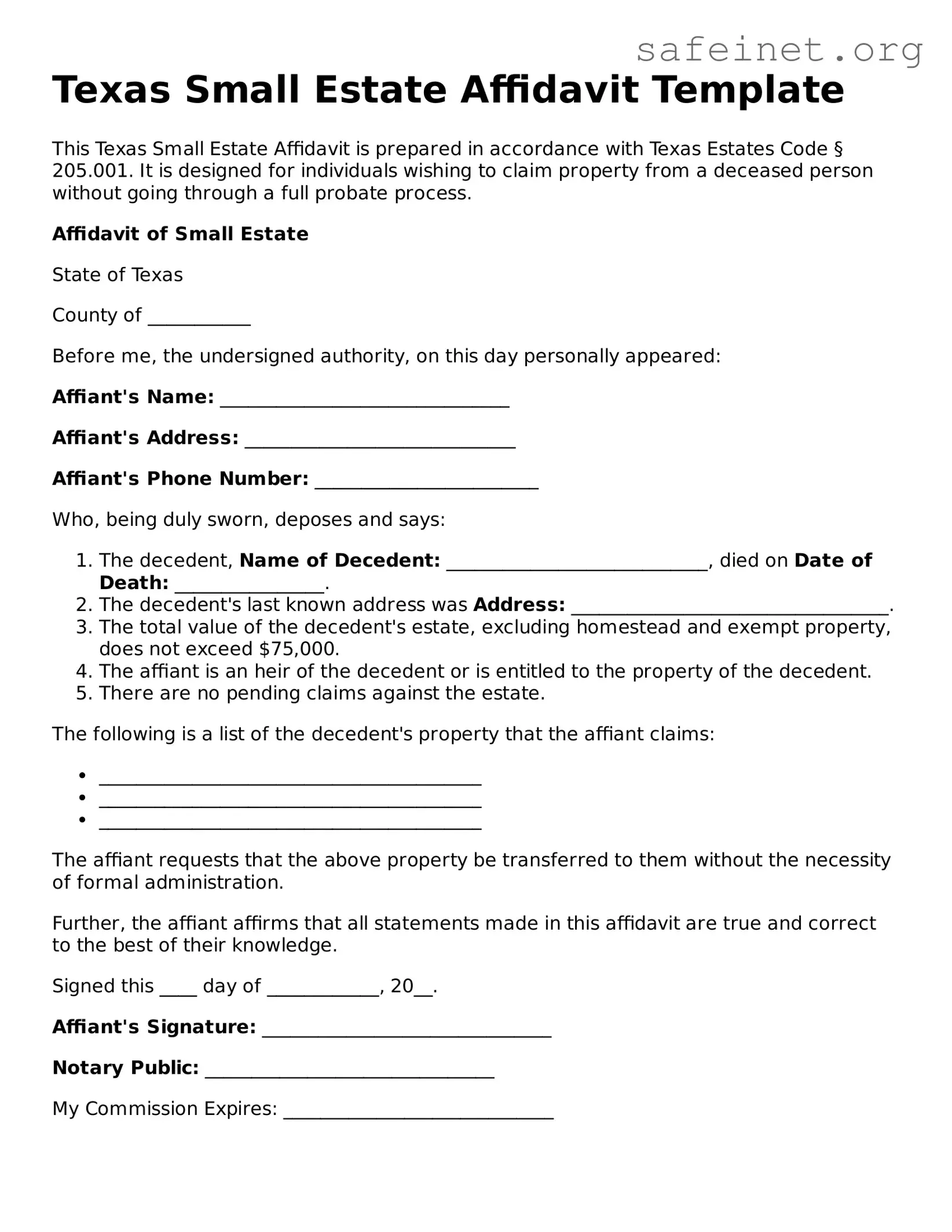
Texas Small Estate Affidavit Template
This Texas Small Estate Affidavit is prepared in accordance with Texas Estates Code § 205.001. It is designed for individuals wishing to claim property from a deceased person without going through a full probate process.
Affidavit of Small Estate
State of Texas
County of ___________
Before me, the undersigned authority, on this day personally appeared:
Affiant's Name: _______________________________
Affiant's Address: _____________________________
Affiant's Phone Number: ________________________
Who, being duly sworn, deposes and says:
The following is a list of the decedent's property that the affiant claims:
The affiant requests that the above property be transferred to them without the necessity of formal administration.
Further, the affiant affirms that all statements made in this affidavit are true and correct to the best of their knowledge.
Signed this ____ day of ____________, 20__.
Affiant's Signature: _______________________________
Notary Public: _______________________________
My Commission Expires: _____________________________
| Fact Name | Description |
|---|---|
| Purpose | The Texas Small Estate Affidavit allows heirs to claim assets without going through formal probate, simplifying the process for small estates. |
| Eligibility | To qualify, the total value of the estate must be less than $75,000, excluding certain exempt property. |
| Governing Law | This form is governed by Texas Estates Code, Section 205. |
| Required Signatures | The affidavit must be signed by all heirs and must be notarized to be valid. |
| Filing Location | Once completed, the affidavit is filed with the county clerk in the county where the deceased resided. |
| Use of Form | The form can be used to transfer titles of property, bank accounts, and other assets directly to heirs. |
Filling out the Texas Small Estate Affidavit form requires careful attention to detail. After completing the form, you will need to file it with the appropriate court. This process will help facilitate the transfer of assets without going through a lengthy probate process.
What is a Texas Small Estate Affidavit?
A Texas Small Estate Affidavit is a legal document that allows heirs to claim the assets of a deceased person without going through the lengthy probate process. This form is typically used when the total value of the estate is below a certain threshold, which is currently set at $75,000, excluding the value of the homestead and certain exempt property. It simplifies the transfer of assets and can expedite the distribution process for families during a difficult time.
Who can use the Small Estate Affidavit?
The Small Estate Affidavit can be utilized by heirs of a deceased person who meet specific criteria. Typically, the heirs must be individuals who are entitled to inherit under Texas law, such as children, spouses, or other close relatives. The estate must also qualify as a small estate, meaning its total value falls below the established limit. It is essential for the heirs to be aware of their rights and responsibilities when using this form.
What assets can be claimed using the Small Estate Affidavit?
Heirs can claim various types of assets using the Small Estate Affidavit, including bank accounts, personal property, and other tangible assets. However, real estate, such as a home, may not be included unless it is specifically exempt. The affidavit allows heirs to transfer ownership of these assets directly, avoiding the need for formal probate proceedings.
How do I complete the Small Estate Affidavit?
Completing the Small Estate Affidavit involves gathering necessary information about the deceased, the heirs, and the assets involved. The form must be filled out accurately, providing details such as the date of death, a list of assets, and the names of all heirs. After completing the affidavit, it should be signed in front of a notary public. Once notarized, the affidavit can be filed with the appropriate court or used to claim assets directly from financial institutions.
Is there a filing fee for the Small Estate Affidavit?
Generally, there is no filing fee associated with submitting a Small Estate Affidavit, as it is not filed with the court like a traditional probate case. However, some institutions may require a copy of the notarized affidavit to release assets, and there could be fees associated with obtaining certified copies of the document. It’s advisable to check with specific institutions for their requirements and any potential costs.
What happens if the estate exceeds the small estate limit?
If the total value of the estate exceeds the small estate limit of $75,000, heirs will need to pursue formal probate proceedings. This process can be more complex and time-consuming, involving the appointment of an executor and the court’s oversight. Heirs should consider consulting with a legal professional to navigate the probate process if the estate does not qualify for the Small Estate Affidavit.
Can the Small Estate Affidavit be contested?
Not Including All Heirs: One common mistake is failing to list all legal heirs. Every individual entitled to a share of the estate must be included. Omitting even one heir can lead to complications and potential legal disputes.
Incorrect Value Estimation: Some individuals underestimate or overestimate the value of the estate. It's crucial to provide an accurate assessment of all assets. This includes real estate, personal property, and financial accounts.
Inadequate Signature Verification: The affidavit requires signatures from all heirs. Failing to obtain the necessary signatures can invalidate the document. Ensure that each heir has signed and that their signatures are properly witnessed.
Missing Required Documentation: Applicants often forget to attach necessary documents, such as death certificates or proof of ownership. These documents are essential to support the claims made in the affidavit.
Ignoring Local Laws: Each county in Texas may have specific requirements for the Small Estate Affidavit. Ignoring these local regulations can lead to delays or rejections. Always check with the local court for any additional requirements.
Filing in the Wrong Court: It’s important to file the affidavit in the correct court. Filing in the wrong jurisdiction can cause significant delays. Be sure to determine the proper venue based on the decedent's residence.
When dealing with the Texas Small Estate Affidavit, it is essential to understand that several other forms and documents may be required or beneficial in the process of settling an estate. Each document serves a specific purpose and can help ensure that the estate is administered smoothly and in accordance with Texas law.
Understanding these documents can significantly aid in the administration of a small estate in Texas. Each form plays a vital role in ensuring that the wishes of the deceased are honored and that the legal requirements are met, providing peace of mind to the heirs during a challenging time.
The Texas Small Estate Affidavit is similar to the Affidavit of Heirship, which is often used to establish the heirs of a deceased person. This document helps clarify who is entitled to inherit property when there is no will. By outlining the family relationships, the Affidavit of Heirship can provide a clear path for transferring assets without the need for lengthy probate proceedings.
Another document that shares similarities is the Will. While the Small Estate Affidavit is used when someone dies without a will, a Will outlines the deceased's wishes regarding asset distribution. Both documents aim to facilitate the transfer of assets after death, but they serve different purposes based on whether or not a will exists.
The Declaration of Trust is another relevant document. This legal tool allows individuals to manage their assets during their lifetime and specify how they should be distributed after death. Like the Small Estate Affidavit, it helps avoid probate, but it requires more complex planning and management of assets while the individual is alive.
The Transfer on Death Deed (TOD) also bears resemblance to the Small Estate Affidavit. A TOD allows property owners to designate beneficiaries who will inherit the property upon their death. This document bypasses probate, similar to the Small Estate Affidavit, but is specifically for real estate and requires proper filing to be effective.
In some cases, a Living Trust can be compared to the Small Estate Affidavit. A Living Trust allows individuals to place their assets into a trust during their lifetime, with instructions for distribution after death. This approach can simplify the transfer process and avoid probate, much like the Small Estate Affidavit does for small estates.
The Affidavit of Surviving Spouse is another document that serves a similar purpose. This affidavit can help a surviving spouse claim property and assets without going through probate. It provides a straightforward way to assert rights to community property, making it easier for the surviving spouse to manage their deceased partner's estate.
The Probate Waiver is also akin to the Small Estate Affidavit. This document allows heirs to waive the right to probate proceedings, making it easier to settle the estate informally. Both documents aim to streamline the process of asset distribution, though the Probate Waiver is typically used in conjunction with a will.
Lastly, the Small Estate Affidavit can be compared to the Affidavit of Debt. This document is used to declare debts owed by the deceased and can help heirs understand the financial obligations before distributing assets. While it focuses on debts rather than asset distribution, both documents are essential for settling an estate efficiently and responsibly.
When filling out the Texas Small Estate Affidavit form, it's essential to approach the process with care. Here are some important dos and don'ts to keep in mind:
By following these guidelines, you can navigate the process more smoothly and ensure that you meet all necessary requirements. Remember, careful attention to detail can make a significant difference in the outcome.
The Texas Small Estate Affidavit is a useful tool for settling estates with limited assets. However, several misconceptions exist about this form. Below are ten common misunderstandings, along with explanations.
Many believe that only heirs or beneficiaries can file this affidavit. In reality, any person who has a legitimate interest in the estate can file it.
This form is specifically for estates valued under a certain limit, which is currently $75,000 in Texas. Larger estates cannot use this process.
While it simplifies the process, some legal steps are still necessary. The affidavit must be filed with the court and may require additional documentation.
This is not accurate. A Small Estate Affidavit is a tool for settling an estate, while a will is a document that outlines how a person's assets should be distributed after death.
It is not necessary to pay all debts before filing the affidavit. However, the affidavit does require a statement about the debts of the deceased.
While individuals can fill out the form themselves, it is often beneficial to seek help from a legal professional to ensure accuracy and compliance with state laws.
This form must be filed within a specific time frame, usually within four years of the person's death.
Although the process is less formal than probate, the court must still approve the affidavit for it to be valid.
While the form is specific to Texas law, individuals who own property in Texas but reside elsewhere may also use it for that property.
While it can expedite the process, there may still be delays due to court schedules or additional requirements.
When dealing with the Texas Small Estate Affidavit, it is essential to understand its purpose and proper usage. Here are some key takeaways to guide you through the process: