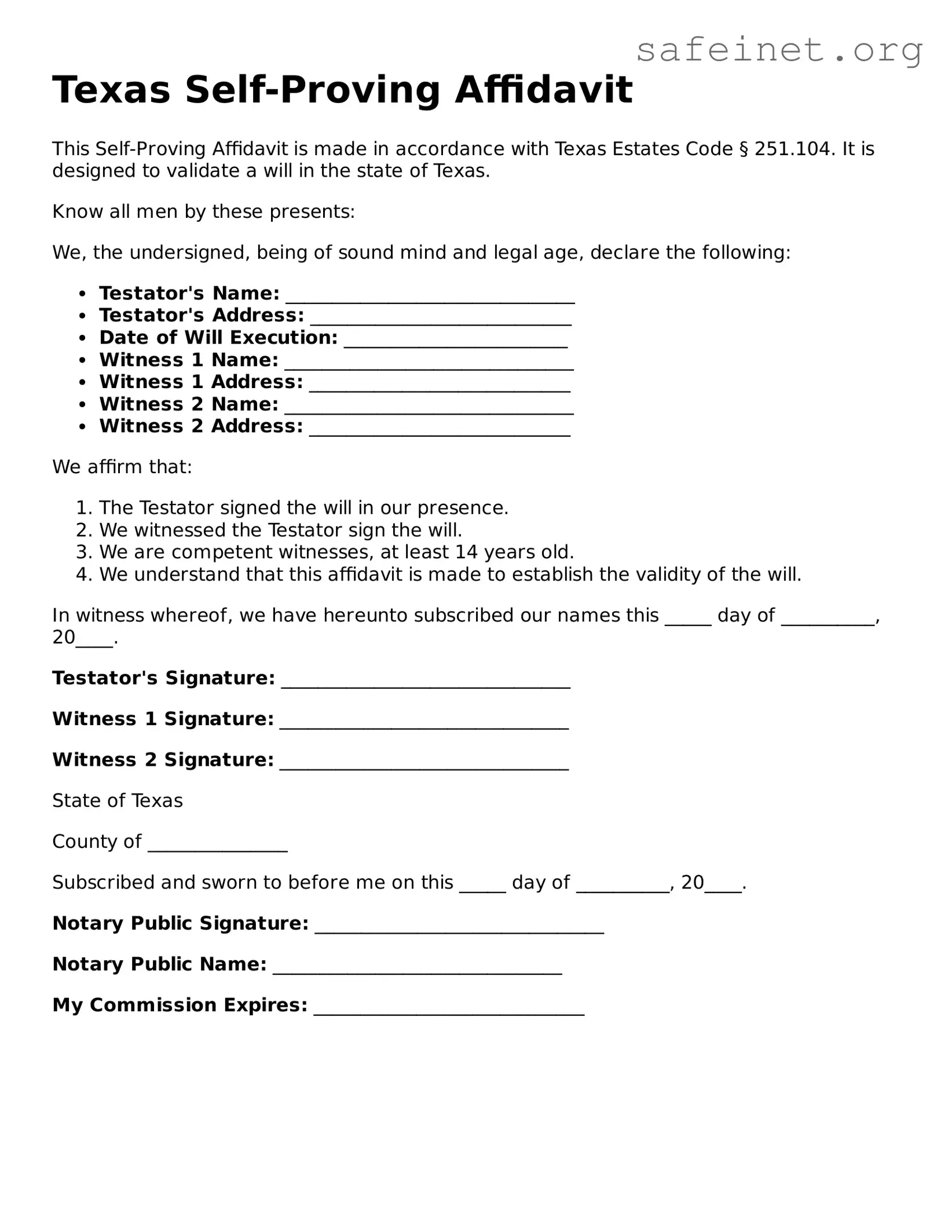
The Texas Self-Proving Affidavit is an essential legal document designed to streamline the probate process for wills in Texas. This form allows a testator—the person who created the will—and their witnesses to affirm the validity of the will, reducing the need for witnesses to appear in court after the testator's death. By completing this affidavit, individuals can provide a clear statement confirming that the will was executed in accordance with Texas law, which helps to prevent disputes and challenges to the will’s authenticity. The form must be signed by the testator and at least two witnesses, all of whom must be present at the same time. This affidavit, when properly executed, serves as compelling evidence of the will's legitimacy, making it easier for the executor to carry out the deceased’s wishes. Understanding the importance of this document is crucial for anyone involved in estate planning or the administration of an estate in Texas.
Texas Self-Proving Affidavit
This Self-Proving Affidavit is made in accordance with Texas Estates Code § 251.104. It is designed to validate a will in the state of Texas.
Know all men by these presents:
We, the undersigned, being of sound mind and legal age, declare the following:
We affirm that:
In witness whereof, we have hereunto subscribed our names this _____ day of __________, 20____.
Testator's Signature: _______________________________
Witness 1 Signature: _______________________________
Witness 2 Signature: _______________________________
State of Texas
County of _______________
Subscribed and sworn to before me on this _____ day of __________, 20____.
Notary Public Signature: _______________________________
Notary Public Name: _______________________________
My Commission Expires: _____________________________
| Fact Name | Details |
|---|---|
| Definition | The Texas Self-Proving Affidavit is a legal document that allows a will to be validated without the need for witnesses to testify in court. |
| Governing Law | This form is governed by Texas Estates Code, Section 251.104. |
| Purpose | The primary purpose is to simplify the probate process by affirming the authenticity of the will. |
| Requirements | The affidavit must be signed by the testator and two witnesses in the presence of a notary public. |
| Effectiveness | The self-proving affidavit allows for the will to be accepted in probate court without further witness testimony. |
| Format | The affidavit must be in writing and should follow the prescribed format to ensure validity. |
| Revocation | A self-proving affidavit can be revoked if the will is revoked or modified, following Texas law. |
| Filing | The affidavit should be filed with the will during the probate process to ensure its acceptance. |
Filling out the Texas Self-Proving Affidavit is a straightforward process that helps streamline the probate of a will. Once you have completed the form, it will need to be signed in the presence of a notary. This ensures that the affidavit is legally recognized and can be used in court when necessary.
What is a Texas Self-Proving Affidavit?
A Texas Self-Proving Affidavit is a legal document that allows a will to be validated without the need for witnesses to testify in court. This affidavit is signed by the testator (the person making the will) and the witnesses in front of a notary public. It simplifies the probate process and helps ensure that the testator's wishes are honored.
Why should I use a Self-Proving Affidavit?
Using a Self-Proving Affidavit can expedite the probate process. It eliminates the need for witnesses to appear in court to affirm the will's authenticity. This can save time and reduce complications, especially if witnesses are unavailable or cannot be located.
Who can sign a Self-Proving Affidavit?
The testator and at least two witnesses must sign the Self-Proving Affidavit. All parties must be of sound mind and at least 14 years old. Additionally, a notary public must witness the signing of the affidavit to ensure its legality.
How do I create a Self-Proving Affidavit?
To create a Self-Proving Affidavit, you can use a template or form that complies with Texas law. Ensure that the document includes the necessary information, such as the names of the testator and witnesses, and is signed in front of a notary. It is advisable to consult a legal professional to ensure the affidavit meets all requirements.
Can I amend a Self-Proving Affidavit?
Yes, you can amend a Self-Proving Affidavit, but it must be done correctly. If you make changes to your will, you should also update the Self-Proving Affidavit to reflect those changes. This ensures that the affidavit remains valid and aligns with your current wishes.
Is a Self-Proving Affidavit required in Texas?
No, a Self-Proving Affidavit is not required, but it is highly recommended. While a will can still be valid without it, having a Self-Proving Affidavit can streamline the probate process and reduce potential disputes.
What happens if my Self-Proving Affidavit is not properly executed?
If a Self-Proving Affidavit is not executed properly, it may not be accepted in probate court. This could lead to delays or complications in the probate process. To avoid issues, ensure that all signatures are obtained and that the document is notarized correctly.
Can I use a Self-Proving Affidavit for a handwritten will?
Yes, a Self-Proving Affidavit can be used with a handwritten will, also known as a holographic will, as long as it meets the legal requirements. The affidavit should be executed in the same manner as with a formal will, with the testator and witnesses signing in front of a notary.
Where should I keep my Self-Proving Affidavit?
It is important to keep your Self-Proving Affidavit in a safe place, such as a safe deposit box or with your attorney. Ensure that your loved ones know where to find it. This will help facilitate the probate process when the time comes.
Can I revoke a Self-Proving Affidavit?
Yes, you can revoke a Self-Proving Affidavit by creating a new will or by explicitly stating your intent to revoke the previous will and affidavit. It is crucial to follow the proper legal procedures to ensure that your new wishes are recognized.
Incorrect Signatures: One common mistake is not having the required signatures. The testator and witnesses must sign the affidavit in the presence of each other. If this step is overlooked, the affidavit may not be valid.
Not Including Necessary Information: Failing to provide all requested information can lead to issues. Essential details such as the date of execution and the names of the witnesses must be clearly stated.
Improper Notarization: The affidavit must be notarized to be legally binding. Some individuals forget to have the document notarized, which can invalidate the affidavit.
Using Outdated Forms: Utilizing an outdated version of the affidavit can cause problems. It is important to ensure that the most current form is being used, as laws and requirements may change.
Neglecting to Review the Document: Many people fail to carefully review the affidavit before submission. Errors in spelling, dates, or other critical information can lead to complications later on.
The Texas Self-Proving Affidavit is a valuable document used in the estate planning process, particularly in relation to wills. To ensure the validity of a will and facilitate its acceptance in probate court, several other forms and documents are often utilized alongside it. Below is a list of commonly associated documents.
Incorporating these documents into an estate plan can enhance its effectiveness and ensure that an individual's wishes are honored. Each plays a distinct role in the overall process, contributing to a comprehensive approach to managing one's affairs.
The Texas Self-Proving Affidavit is similar to the standard will, as both documents serve to establish the intentions of the deceased regarding the distribution of their assets. A will outlines how a person's property should be distributed after their death, while a self-proving affidavit serves as a verification tool to confirm the validity of the will. This affidavit, when signed by witnesses and notarized, helps streamline the probate process by eliminating the need for witnesses to testify about the will's authenticity in court.
An additional document that shares similarities with the Texas Self-Proving Affidavit is the Durable Power of Attorney. This document allows an individual to designate someone else to make financial or medical decisions on their behalf if they become incapacitated. Like the self-proving affidavit, it requires signatures and notarization to ensure that the document is legally binding. Both documents aim to provide clarity and protect the individual's wishes, whether in terms of asset distribution or decision-making authority.
Lastly, the Revocable Trust shares characteristics with the Texas Self-Proving Affidavit. A revocable trust allows an individual to manage their assets during their lifetime and dictate how those assets should be distributed upon their death. Like the self-proving affidavit, the trust can help avoid probate, making the transfer of assets smoother for beneficiaries. Both documents serve to clarify intentions and protect the individual's wishes, providing peace of mind for the individual and their loved ones.
When filling out the Texas Self-Proving Affidavit form, it’s important to follow certain guidelines to ensure that the process goes smoothly. Here are five key things you should and shouldn’t do:
Understanding the Texas Self-Proving Affidavit form is essential for ensuring that your will is accepted in probate without the need for witnesses to testify. However, several misconceptions surround this important legal document. Here are six common misunderstandings:
This is incorrect. A self-proving affidavit does not replace a will; it merely simplifies the process of proving the will's validity during probate.
In Texas, any will can include a self-proving affidavit, as long as it meets the necessary legal requirements. This includes both handwritten and typed wills.
While a notary is required, the affidavit must also be signed by the testator and witnesses in each other's presence. The notary's role is to verify the identities of those signing the document.
This is a misconception. A self-proving affidavit can benefit any estate, regardless of size, by streamlining the probate process and reducing potential disputes.
This is not true. If circumstances change, the self-proving affidavit can be updated or replaced, provided that the changes adhere to legal requirements.
While it does make the probate process smoother, a self-proving affidavit does not prevent someone from contesting the will. It simply provides a stronger foundation for the will's validity.
By clarifying these misconceptions, individuals can better navigate the complexities of estate planning in Texas and ensure their wishes are honored.
Filling out and using the Texas Self-Proving Affidavit form is an important step in ensuring that your will is executed smoothly and according to your wishes. Here are some key takeaways to keep in mind:
By understanding these key aspects, you can help ensure that your estate planning process is as smooth and effective as possible.