The Texas Release of Liability form serves as a crucial document for individuals and organizations seeking to protect themselves from potential legal claims arising from activities that may involve risk. This form is often utilized in various settings, such as recreational events, sports activities, and even certain business operations. By signing this document, participants acknowledge the inherent risks associated with the activity and agree to relinquish their right to hold the organizer or provider responsible for any injuries or damages that may occur. It typically includes essential elements like a clear description of the activity, a statement of understanding regarding the risks involved, and a signature line for the participant, which signifies their consent. Furthermore, the form may also outline any specific terms or conditions that apply, ensuring that all parties are aware of their rights and responsibilities. Understanding the importance of this form can help individuals make informed decisions about their participation in various activities while providing a layer of legal protection for organizers.
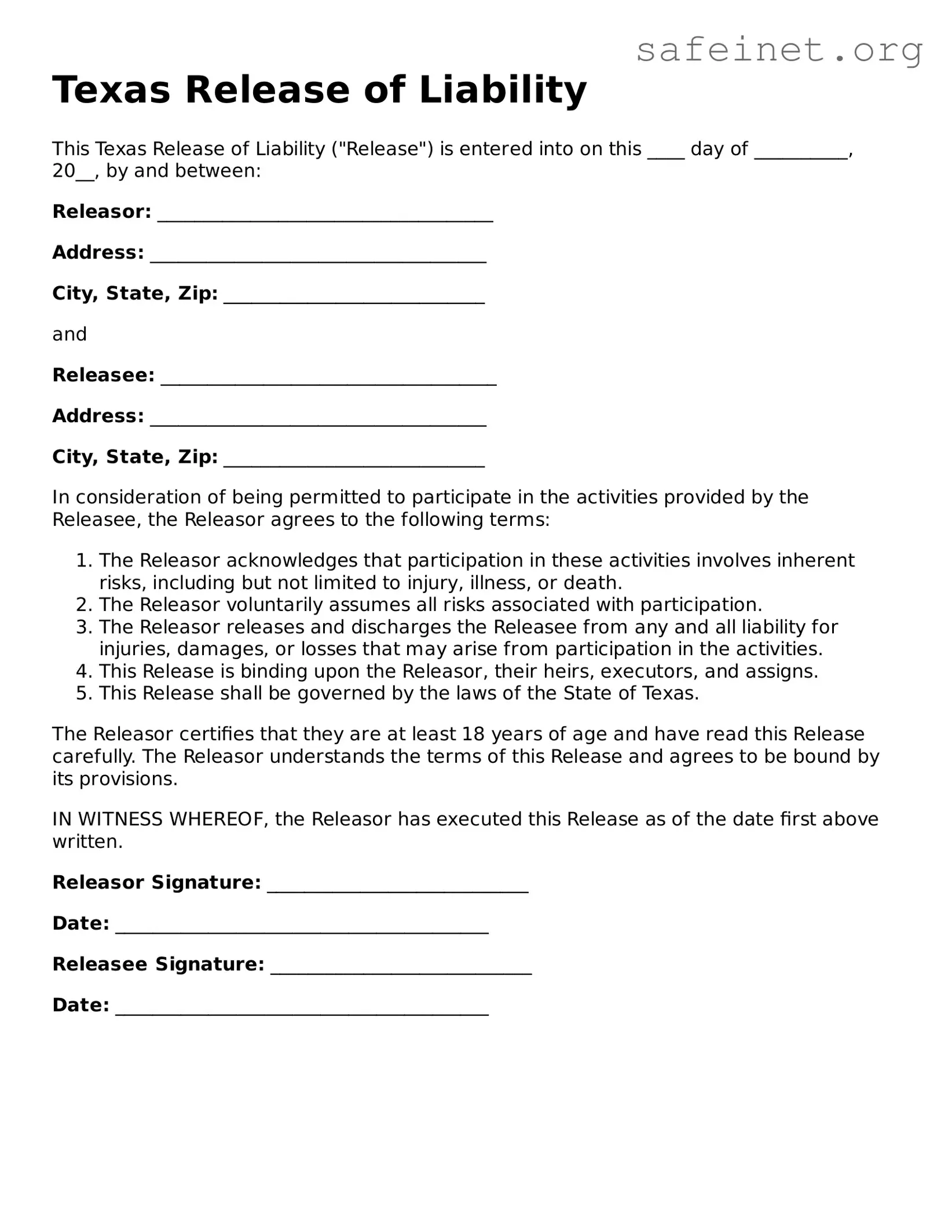
Texas Release of Liability
This Texas Release of Liability ("Release") is entered into on this ____ day of __________, 20__, by and between:
Releasor: ____________________________________
Address: ____________________________________
City, State, Zip: ____________________________
and
Releasee: ____________________________________
Address: ____________________________________
City, State, Zip: ____________________________
In consideration of being permitted to participate in the activities provided by the Releasee, the Releasor agrees to the following terms:
The Releasor certifies that they are at least 18 years of age and have read this Release carefully. The Releasor understands the terms of this Release and agrees to be bound by its provisions.
IN WITNESS WHEREOF, the Releasor has executed this Release as of the date first above written.
Releasor Signature: ____________________________
Date: ________________________________________
Releasee Signature: ____________________________
Date: ________________________________________
| Fact Name | Description |
|---|---|
| Purpose | The Texas Release of Liability form is designed to protect businesses and individuals from legal claims arising from injuries or damages that may occur during an activity. |
| Governing Law | This form is governed by Texas state law, specifically under the Texas Civil Practice and Remedies Code. |
| Voluntary Agreement | Participants must voluntarily agree to the terms of the release, indicating their understanding of the risks involved. |
| Enforceability | For the release to be enforceable, it must be clear, specific, and signed by all parties involved. |
| Limitations | The form does not protect against gross negligence or intentional misconduct; it only covers ordinary negligence. |
Completing the Texas Release of Liability form is a straightforward process. Once the form is filled out correctly, it can be submitted as needed. Below are the steps to ensure accurate completion of the form.
What is a Texas Release of Liability form?
The Texas Release of Liability form is a legal document designed to protect individuals and organizations from being held liable for injuries or damages that may occur during certain activities. By signing this form, participants acknowledge the risks involved and agree not to hold the organizer responsible for any potential harm. This form is commonly used in recreational activities, events, and sports, where the risk of injury is inherent.
Who should use a Texas Release of Liability form?
This form is beneficial for anyone organizing an event or activity where participants may face risks. This includes sports leagues, recreational facilities, event planners, and even individuals hosting private gatherings. By having participants sign the form, organizers can mitigate the risk of legal claims resulting from accidents or injuries that occur during the event.
Is the Texas Release of Liability form legally binding?
Yes, when properly executed, the Texas Release of Liability form is legally binding. However, its enforceability can depend on several factors, including the clarity of the language used, the context of the activity, and whether the participant was fully informed of the risks involved. Courts may scrutinize the form to ensure it does not contain any unfair or ambiguous terms.
Can a minor sign a Texas Release of Liability form?
Minors cannot legally sign contracts, including a Release of Liability form. Instead, a parent or legal guardian must sign on behalf of the minor. This ensures that the responsible adult acknowledges the risks and agrees to the terms of the release for the minor participant. It is essential to include the minor's name and age on the form for clarity.
What should be included in a Texas Release of Liability form?
A comprehensive Texas Release of Liability form should include several key elements. These typically encompass a clear description of the activity, an acknowledgment of the risks involved, a statement releasing the organizer from liability, and the signatures of the participants or their guardians. It is also wise to include a date and contact information for the organizer to ensure all parties are informed and accountable.
Can a participant revoke their consent after signing the form?
Once a participant has signed the Texas Release of Liability form, they generally cannot revoke their consent retroactively. However, if new information arises or if the terms of the agreement are significantly altered, participants may have grounds to contest the release. It is advisable for individuals to fully understand the implications of the form before signing, as it is meant to be a final agreement regarding liability.
Failing to provide complete personal information. Individuals often neglect to fill in their full name, address, or contact information. This omission can lead to issues in identifying the parties involved.
Not reading the entire form thoroughly. Many people rush through the document without understanding the implications of the release. This can result in unintended waivers of rights.
Inaccurate date entries. Entering the wrong date can cause confusion regarding the timeline of the activities covered by the release. This mistake may invalidate the document.
Missing signatures. Some individuals forget to sign the form or do not obtain the necessary signatures from all required parties. A missing signature can render the release unenforceable.
Failing to initial or acknowledge specific sections. Certain parts of the form may require initials or explicit acknowledgment. Neglecting this can lead to misunderstandings regarding the terms.
Using incorrect or unclear language. When people attempt to modify the form or add their own language, it can create ambiguity. Clarity is essential for the document's enforceability.
Not keeping a copy of the signed form. After filling out the release, individuals often forget to retain a copy for their records. This can be problematic if disputes arise later.
The Texas Release of Liability form is an important document used to protect individuals and organizations from legal claims related to injuries or damages that may occur during specific activities. However, there are several other forms and documents that are often used in conjunction with this release. Each of these documents serves a unique purpose and helps to further clarify the rights and responsibilities of the parties involved.
In conclusion, utilizing these additional forms alongside the Texas Release of Liability can enhance protection for both participants and organizers. Each document plays a crucial role in ensuring that all parties are informed and agree to the terms, helping to create a safer environment for everyone involved.
The Texas Release of Liability form shares similarities with the Waiver of Liability form. Both documents aim to protect an individual or organization from legal claims arising from injuries or damages. By signing a waiver, participants acknowledge the risks involved in an activity and agree not to hold the provider responsible. This mutual understanding is crucial in sports, recreational activities, and other potentially risky environments.
The Indemnity Agreement is another document closely related to the Texas Release of Liability form. While a release of liability limits future claims, an indemnity agreement goes a step further. It requires one party to compensate the other for any losses or damages incurred. This means that if someone is sued due to an incident, the indemnitor will cover the legal costs and any settlements, providing an extra layer of protection.
When filling out the Texas Release of Liability form, it’s essential to approach the process with care. Here’s a list of things you should and shouldn’t do to ensure that your form is completed correctly and effectively.
Following these guidelines will help ensure that your Texas Release of Liability form is completed properly and serves its intended purpose.
Understanding the Texas Release of Liability form is essential for both individuals and organizations. However, several misconceptions exist regarding its purpose and effectiveness. Below are nine common misconceptions:
Addressing these misconceptions can help individuals and organizations make informed decisions about using a Release of Liability form in Texas.
When filling out and using the Texas Release of Liability form, keep the following key takeaways in mind: