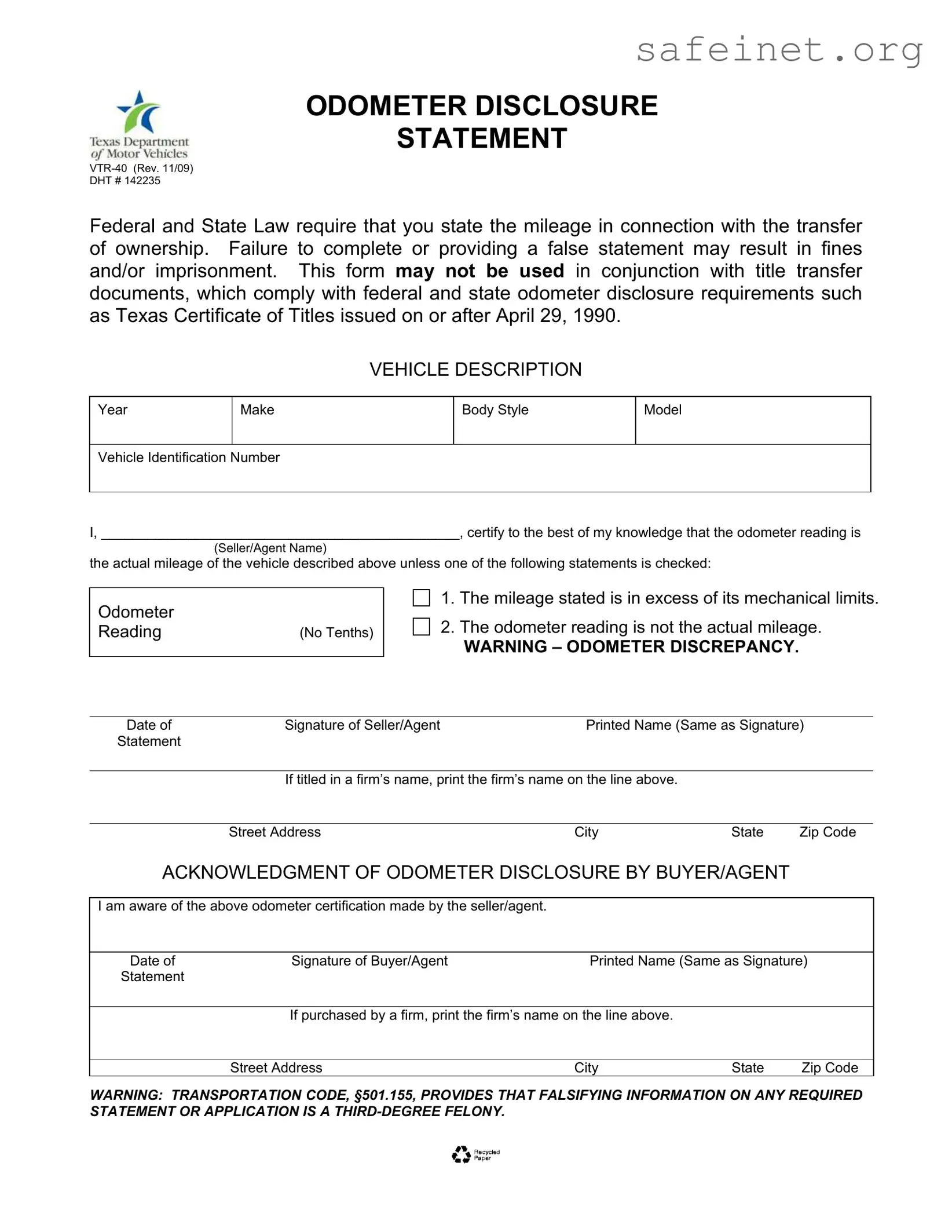
The Texas Odometer Statement form, officially known as VTR-40, plays a crucial role in the transfer of vehicle ownership within the state. This document is essential for both sellers and buyers, ensuring that the mileage reported during a sale is accurate and legally compliant. Under federal and state law, the form mandates the disclosure of the vehicle's mileage at the time of transfer, and any inaccuracies or omissions can lead to severe penalties, including fines or imprisonment. The form requires specific details such as the vehicle's year, make, model, body style, and Vehicle Identification Number (VIN). Sellers must certify that the odometer reading reflects the actual mileage unless they check certain statements indicating discrepancies. Buyers also acknowledge the seller's odometer certification, confirming their awareness of the mileage disclosure. It is important to note that this form cannot be used alongside title transfer documents that already meet odometer disclosure requirements, specifically for titles issued after April 29, 1990. Understanding the implications of this form is vital for anyone involved in vehicle transactions in Texas.
ODOMETER DISCLOSURE
STATEMENT
DHT # 142235
Federal and State Law require that you state the mileage in connection with the transfer of ownership. Failure to complete or providing a false statement may result in fines and/or imprisonment. This form may not be used in conjunction with title transfer documents, which comply with federal and state odometer disclosure requirements such as Texas Certificate of Titles issued on or after April 29, 1990.
VEHICLE DESCRIPTION
Year
Make
Body Style
Model
Vehicle Identification Number
I, ______________________________________________, certify to the best of my knowledge that the odometer reading is
the actual mileage of the vehicle described above unless one of the following statements is checked:
Odometer
Reading |
(No Tenths) |
1.The mileage stated is in excess of its mechanical limits.
2.The odometer reading is not the actual mileage.
WARNING – ODOMETER DISCREPANCY.
Date ofSignature of Seller/AgentPrinted Name (Same as Signature) Statement
If titled in a firm’s name, print the firm’s name on the line above.
Street Address |
City |
State |
Zip Code |
ACKNOWLEDGMENT OF ODOMETER DISCLOSURE BY BUYER/AGENT
I am aware of the above odometer certification made by the seller/agent.
Date of |
Signature of Buyer/Agent |
Printed Name (Same as Signature) |
Statement |
|
|
If purchased by a firm, print the firm’s name on the line above.
Street Address |
City |
State |
Zip Code |
WARNING: TRANSPORTATION CODE, §501.155, PROVIDES THAT FALSIFYING INFORMATION ON ANY REQUIRED STATEMENT OR APPLICATION IS A
| Fact Name | Details |
|---|---|
| Purpose | The Texas Odometer Statement form is used to disclose the mileage of a vehicle during ownership transfer. |
| Legal Requirement | Federal and state laws mandate that the odometer reading must be accurately reported to avoid penalties. |
| Form Version | The current version of the form is VTR-40, revised in November 2009. |
| Odometer Discrepancy Warning | There are warnings regarding odometer discrepancies, which must be acknowledged by both the seller and buyer. |
| Governing Law | Transportation Code, §501.155 governs the penalties for falsifying information on the Odometer Statement. |
After obtaining the Texas Odometer Statement form, you will need to provide specific information about the vehicle and the parties involved in the transaction. Follow the steps below to complete the form accurately.
What is the Texas Odometer Statement form?
The Texas Odometer Statement form, also known as VTR-40, is a document required by federal and state law that must be completed during the transfer of vehicle ownership. This form certifies the mileage of the vehicle being sold, ensuring that the buyer is informed about the actual odometer reading. It helps prevent fraud and protects both the seller and the buyer in the transaction.
Who needs to complete the Texas Odometer Statement form?
Both the seller and the buyer of the vehicle must complete the Texas Odometer Statement form. The seller is responsible for providing accurate mileage information, while the buyer acknowledges receipt of this information. This process is essential for any vehicle transfer that requires a title change.
What information is required on the form?
The form requires several pieces of information, including the year, make, body style, model, and Vehicle Identification Number (VIN) of the vehicle. Additionally, the seller must provide their name, signature, and address, along with the odometer reading at the time of sale. The buyer must also sign and provide their name and address to acknowledge the odometer disclosure.
What happens if the odometer reading is inaccurate?
If the odometer reading is inaccurate, the seller must check one of the specified statements on the form. They can indicate that the mileage is in excess of its mechanical limits or that the odometer reading is not the actual mileage. It is crucial to be truthful, as providing false information can lead to serious legal consequences.
Is the Texas Odometer Statement form necessary for all vehicle transfers?
The form is necessary for most vehicle transfers, especially when a title is being issued. However, it may not be used in conjunction with title transfer documents that already comply with federal and state odometer disclosure requirements, such as Texas Certificates of Title issued on or after April 29, 1990. Always check the specific requirements for your situation.
What are the penalties for falsifying information on the form?
Falsifying information on the Texas Odometer Statement form is a serious offense. According to Texas Transportation Code, it is classified as a third-degree felony. This means that individuals who knowingly provide false information could face significant fines and possible imprisonment. It is essential to provide accurate and truthful information to avoid these penalties.
Can I use this form if the vehicle is titled in a firm’s name?
Yes, if the vehicle is titled in a firm’s name, the form can still be used. The seller should print the firm’s name on the designated line above their signature. The same applies to the buyer if the purchase is made by a firm. It is important to ensure that all information is filled out correctly to maintain compliance with the law.
Where can I obtain the Texas Odometer Statement form?
The Texas Odometer Statement form can be obtained from the Texas Department of Motor Vehicles (TxDMV) website or at local DMV offices. It is advisable to download or request the most current version of the form to ensure compliance with any updates or changes in regulations.
Neglecting to Provide Accurate Mileage: One of the most common mistakes is failing to accurately report the odometer reading. It's essential to ensure that the mileage is correct, as inaccuracies can lead to legal issues.
Forgetting to Sign: Both the seller and buyer must sign the form. Omitting signatures can delay the transfer process and create complications.
Using Tenths of a Mile: The form specifically asks for the odometer reading without tenths. Including tenths can render the form invalid.
Not Checking the Appropriate Box: If the odometer reading is not the actual mileage or is in excess of mechanical limits, it is crucial to check the correct box. Failing to do so can lead to misunderstandings.
Incorrect Vehicle Identification Number (VIN): Double-checking the VIN is vital. An incorrect VIN can create significant issues with vehicle registration and ownership.
Ignoring the Acknowledgment Section: Buyers must acknowledge the odometer disclosure. Skipping this step can lead to disputes later on.
Not Including Full Names: The printed names must match the signatures. Using nicknames or initials can cause confusion and delays.
Failing to Provide Complete Address Information: Including the full street address, city, state, and zip code is essential. Incomplete information can hinder the processing of the form.
Using Outdated Forms: Ensure that the most current version of the Texas Odometer Statement form is being used. Using an outdated form may not comply with current regulations.
Overlooking Legal Consequences: Many people underestimate the seriousness of falsifying information. Understanding that this can lead to severe penalties is crucial.
The Texas Odometer Statement form is an important document used during the sale of a vehicle. It ensures that both the seller and buyer are aware of the vehicle's mileage. However, there are other forms and documents that may also be needed in conjunction with this statement. Here’s a list of some commonly used documents.
Using the correct forms ensures a smooth transaction and helps avoid potential issues down the line. Always check the requirements specific to your situation to ensure compliance with Texas laws.
The Vehicle History Report (VHR) is a document that provides a comprehensive overview of a vehicle's past, including its odometer readings. Similar to the Texas Odometer Statement, the VHR includes crucial information about mileage, helping potential buyers make informed decisions. While the Texas Odometer Statement focuses specifically on the current mileage at the time of sale, the VHR may contain historical odometer readings, accident reports, and service history, thus offering a broader context for the vehicle's condition and value.
The Bill of Sale is another important document that shares similarities with the Texas Odometer Statement. This document serves as proof of the transaction between the buyer and seller. It typically includes the vehicle's description and the agreed-upon sale price. Like the Odometer Statement, the Bill of Sale may require the seller to disclose the mileage at the time of sale. Both documents are essential for ensuring transparency and protecting the interests of both parties involved in the transaction.
The Title Application is a formal request to obtain a vehicle title, which includes information about the vehicle's ownership and mileage. Much like the Texas Odometer Statement, the Title Application requires accurate odometer readings to prevent fraud. It serves as a legal record that helps establish the rightful owner of the vehicle. Both documents are vital in the process of transferring ownership and ensuring compliance with state regulations.
The Manufacturer's Certificate of Origin (MCO) is issued by the manufacturer and provides essential details about a new vehicle, including its odometer reading at the time of sale. Similar to the Texas Odometer Statement, the MCO ensures that the mileage is accurately reported, which is crucial for future sales and registrations. This document establishes the vehicle's authenticity and is often used when a vehicle is first sold to a consumer.
The DMV's Odometer Disclosure Statement is a form required in many states, including Texas, for the transfer of vehicle ownership. This document serves a similar purpose to the Texas Odometer Statement by documenting the odometer reading at the time of sale. It helps prevent odometer fraud and ensures that both parties are aware of the vehicle's mileage. Compliance with this requirement is essential for a legal transfer of ownership.
The Used Vehicle Purchase Agreement is another document that parallels the Texas Odometer Statement. This agreement outlines the terms of the sale and includes the vehicle's details, including its mileage. Like the Odometer Statement, it requires the seller to certify that the mileage is accurate. This document serves to protect both the buyer and seller by ensuring that all aspects of the sale are clearly defined and agreed upon.
When filling out the Texas Odometer Statement form, it’s important to be thorough and accurate. Here’s a list of what to do and what to avoid:
Here are ten common misconceptions about the Texas Odometer Statement form, along with clarifications to help you understand its purpose and requirements.
When filling out and using the Texas Odometer Statement form, it's essential to understand several key points to ensure compliance and avoid potential legal issues. Here are five important takeaways: