In the business world, protecting sensitive information is crucial, and the Texas Non-disclosure Agreement (NDA) form serves as an essential tool for safeguarding confidential data. This legal document establishes a formal understanding between parties regarding the handling of proprietary information. It outlines the obligations of each party to keep shared information private and specifies the types of information considered confidential. The NDA also details the duration of the confidentiality obligations, ensuring that the commitment to protect sensitive data is clearly defined. Additionally, it may include provisions for the consequences of breaches, which can help deter unauthorized disclosures. By using the Texas Non-disclosure Agreement, individuals and businesses can foster trust while minimizing the risks associated with sharing sensitive information.
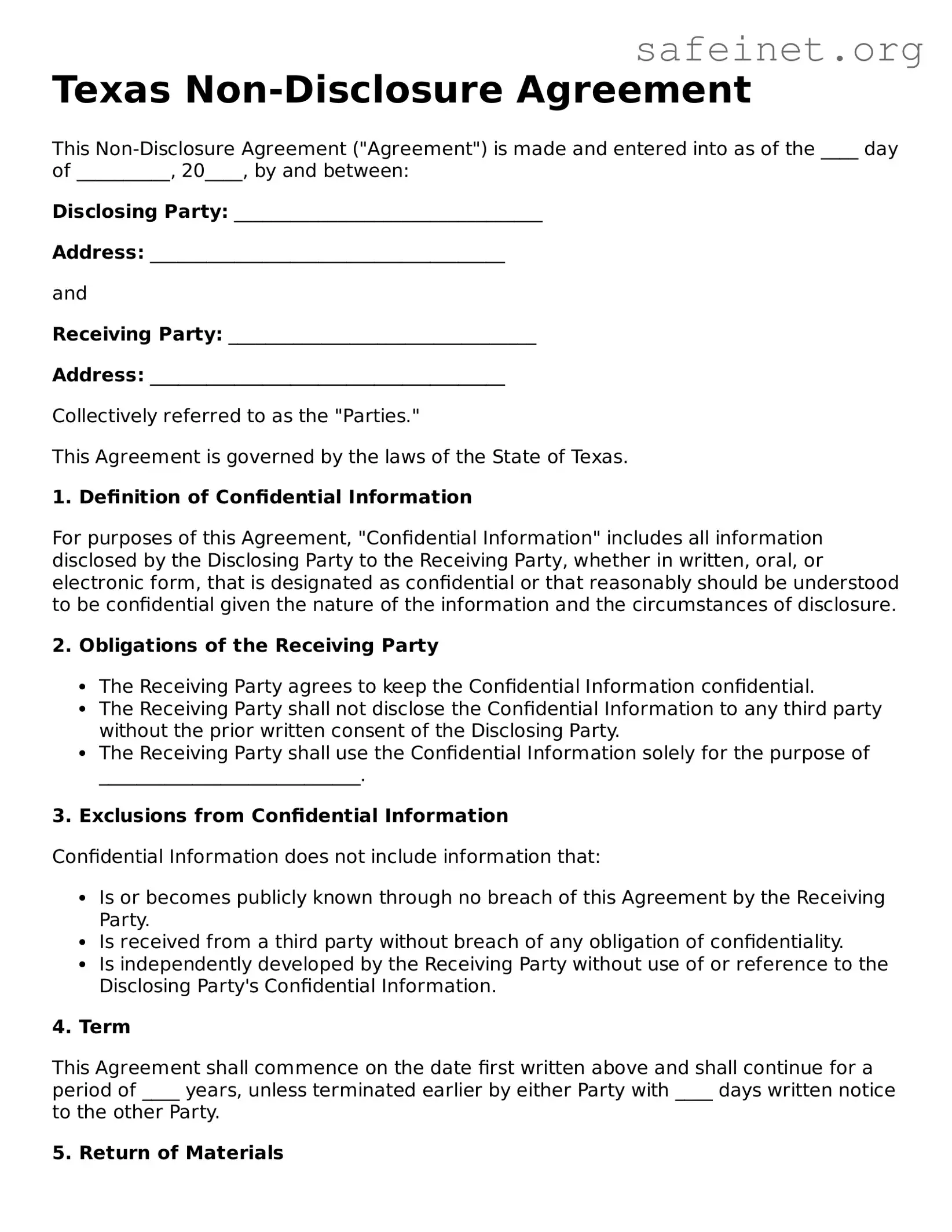
Texas Non-Disclosure Agreement
This Non-Disclosure Agreement ("Agreement") is made and entered into as of the ____ day of __________, 20____, by and between:
Disclosing Party: _________________________________
Address: ______________________________________
and
Receiving Party: _________________________________
Address: ______________________________________
Collectively referred to as the "Parties."
This Agreement is governed by the laws of the State of Texas.
1. Definition of Confidential Information
For purposes of this Agreement, "Confidential Information" includes all information disclosed by the Disclosing Party to the Receiving Party, whether in written, oral, or electronic form, that is designated as confidential or that reasonably should be understood to be confidential given the nature of the information and the circumstances of disclosure.
2. Obligations of the Receiving Party
3. Exclusions from Confidential Information
Confidential Information does not include information that:
4. Term
This Agreement shall commence on the date first written above and shall continue for a period of ____ years, unless terminated earlier by either Party with ____ days written notice to the other Party.
5. Return of Materials
Upon termination of this Agreement, the Receiving Party agrees to return or destroy all materials containing Confidential Information, including copies thereof, upon the Disclosing Party's request.
6. No License
This Agreement does not grant any rights to the Receiving Party in or to the Confidential Information, except as expressly set forth herein.
7. Governing Law
This Agreement shall be governed by and construed in accordance with the laws of the State of Texas.
IN WITNESS WHEREOF, the Parties have executed this Non-Disclosure Agreement as of the date first above written.
Disclosing Party:
_____________________________
Signature: _____________________________
Date: _____________________________
Receiving Party:
_____________________________
Signature: _____________________________
Date: _____________________________
| Fact Name | Description |
|---|---|
| Purpose | The Texas Non-disclosure Agreement (NDA) protects confidential information shared between parties. |
| Governing Law | The NDA is governed by the laws of the State of Texas. |
| Parties Involved | The agreement typically involves a disclosing party and a receiving party. |
| Duration | The NDA can specify a duration for which the confidentiality obligation lasts. |
| Scope of Information | The NDA defines what constitutes confidential information, which can include trade secrets, business plans, and more. |
| Permitted Disclosures | Certain disclosures may be allowed, such as those required by law or court order. |
| Consequences of Breach | Breaching the NDA can result in legal action, including potential damages. |
| Enforceability | Texas courts generally uphold NDAs as long as they are reasonable and not overly broad. |
Once you have the Texas Non-disclosure Agreement form ready, it's time to fill it out carefully. This form is essential for protecting sensitive information, and completing it accurately will help ensure that both parties are on the same page regarding confidentiality. Follow these steps to fill out the form correctly.
After completing the form, make sure to keep copies for both parties. It’s also wise to store the signed agreement in a safe place, as it may be needed for reference in the future.
What is a Texas Non-disclosure Agreement (NDA)?
A Texas Non-disclosure Agreement is a legal document that protects confidential information shared between parties. It ensures that sensitive information remains private and is not disclosed to unauthorized individuals or entities. NDAs are commonly used in business settings to safeguard trade secrets, proprietary information, and other confidential data.
Who typically uses a Non-disclosure Agreement in Texas?
Businesses, entrepreneurs, and individuals often use NDAs. They are especially useful when companies share sensitive information with potential partners, employees, or contractors. By signing an NDA, all parties agree to keep the information confidential.
What types of information are protected by an NDA?
An NDA can protect a wide range of information, including trade secrets, business plans, customer lists, financial data, and technical specifications. Essentially, any information that is not publicly available and provides a competitive advantage can be covered under an NDA.
How long does the confidentiality obligation last?
The duration of confidentiality obligations can vary. Typically, NDAs specify a time period during which the information must remain confidential. This period can range from a few years to indefinitely, depending on the nature of the information and the agreement between the parties.
What happens if someone breaches an NDA?
If a party breaches the NDA, the affected party may seek legal remedies. This can include monetary damages or injunctive relief, which is a court order to stop the breach. The specific consequences will depend on the terms outlined in the NDA and the severity of the breach.
Do NDAs need to be in writing?
While verbal agreements can be binding, it is highly advisable to have a written NDA. A written document clearly outlines the terms and conditions, making it easier to enforce if a dispute arises. A well-drafted NDA helps prevent misunderstandings and provides a clear record of the agreement.
Can an NDA be modified after it is signed?
Yes, an NDA can be modified, but both parties must agree to the changes. Modifications should be documented in writing and signed by all parties involved. This ensures that everyone is aware of the new terms and maintains the integrity of the agreement.
Is it possible to have a mutual NDA?
Yes, a mutual NDA is an agreement where both parties share confidential information with each other and agree to protect it. This type of NDA is common in situations where both parties need to disclose sensitive information to facilitate a business relationship.
What should I include in a Texas NDA?
A Texas NDA should include key elements such as the definition of confidential information, obligations of the parties, duration of confidentiality, and any exclusions (like information already in the public domain). It’s also important to specify the consequences of a breach and the governing law.
Where can I find a Texas Non-disclosure Agreement template?
Many legal websites offer templates for Texas NDAs. However, it’s advisable to consult with a legal professional to ensure that the NDA meets your specific needs and complies with Texas law. Customizing a template can help address unique circumstances and provide better protection.
Not clearly identifying the parties involved. It's crucial to specify who is sharing information and who is receiving it.
Failing to define what constitutes confidential information. Be specific about what information is protected under the agreement.
Overlooking the duration of the agreement. Specify how long the confidentiality obligation lasts.
Not including the purpose of sharing the information. Explain why the information is being shared in the first place.
Using vague language. Clear and precise language helps avoid misunderstandings.
Neglecting to include exceptions to confidentiality. There should be clarity on what information is not covered by the agreement.
Forgetting to outline the consequences of a breach. State what happens if someone violates the terms of the agreement.
Not having the agreement signed by all parties. An unsigned agreement is not enforceable.
Failing to keep a copy of the signed agreement. Always retain a copy for your records.
When entering into a Texas Non-disclosure Agreement (NDA), it is essential to consider several other documents that can support and clarify the terms of the agreement. These documents help establish a clear understanding between the parties involved and ensure that sensitive information is adequately protected. Below are five commonly used forms and documents associated with NDAs.
Utilizing these documents alongside a Texas Non-disclosure Agreement can enhance the protection of sensitive information and clarify the responsibilities of all parties involved. It is advisable to carefully review each document to ensure that they align with your specific needs and legal requirements.
A Confidentiality Agreement serves a similar purpose to a Non-disclosure Agreement (NDA) in Texas. Both documents aim to protect sensitive information shared between parties. A Confidentiality Agreement typically outlines the specific types of information that must remain confidential and the obligations of the receiving party to safeguard that information. The focus is often on preventing unauthorized disclosure and ensuring that the information is used only for its intended purpose.
A Proprietary Information Agreement is another document closely related to an NDA. This agreement emphasizes the protection of proprietary information, which can include trade secrets, formulas, or processes unique to a business. Like an NDA, it defines the scope of information covered and the responsibilities of the parties involved. The goal is to prevent competitors from gaining access to valuable business information that could harm the disclosing party.
An Employment Agreement may also contain elements similar to a Non-disclosure Agreement. Many employment contracts include confidentiality clauses that restrict employees from sharing sensitive information gained during their employment. These clauses serve to protect the employer's trade secrets and proprietary information, ensuring that employees do not disclose this information to competitors or the public.
A Non-compete Agreement, while primarily focused on restricting an individual's ability to work in a competing business, often includes confidentiality provisions similar to those in an NDA. This agreement can prevent former employees from sharing sensitive business information with competitors, thereby protecting the company's trade secrets and strategic advantages.
A Non-solicitation Agreement also shares characteristics with a Non-disclosure Agreement. This document restricts a party from soliciting clients or employees from the other party, often to protect confidential client lists or proprietary business relationships. While its primary focus is on preventing solicitation, it can also serve to safeguard sensitive information that could be misused if shared with competitors.
When filling out the Texas Non-disclosure Agreement (NDA) form, it's important to approach the process with care. Here are seven things you should and shouldn't do:
Following these guidelines can help ensure that your NDA is completed correctly and effectively protects your confidential information.
Non-disclosure agreements (NDAs) are important legal tools used to protect sensitive information. However, there are several misconceptions surrounding the Texas Non-disclosure Agreement form that can lead to confusion. Here’s a closer look at some of these misunderstandings:
Understanding these misconceptions can help individuals and businesses navigate the complexities of NDAs more effectively. Always consider seeking legal advice when dealing with sensitive agreements to ensure that your interests are fully protected.
When considering the Texas Non-disclosure Agreement (NDA) form, there are several important points to keep in mind. These key takeaways will help you navigate the process more effectively.
Using the Texas NDA form effectively can help protect your interests and maintain the confidentiality of sensitive information. Always consider consulting with a legal professional if you have specific questions or concerns.