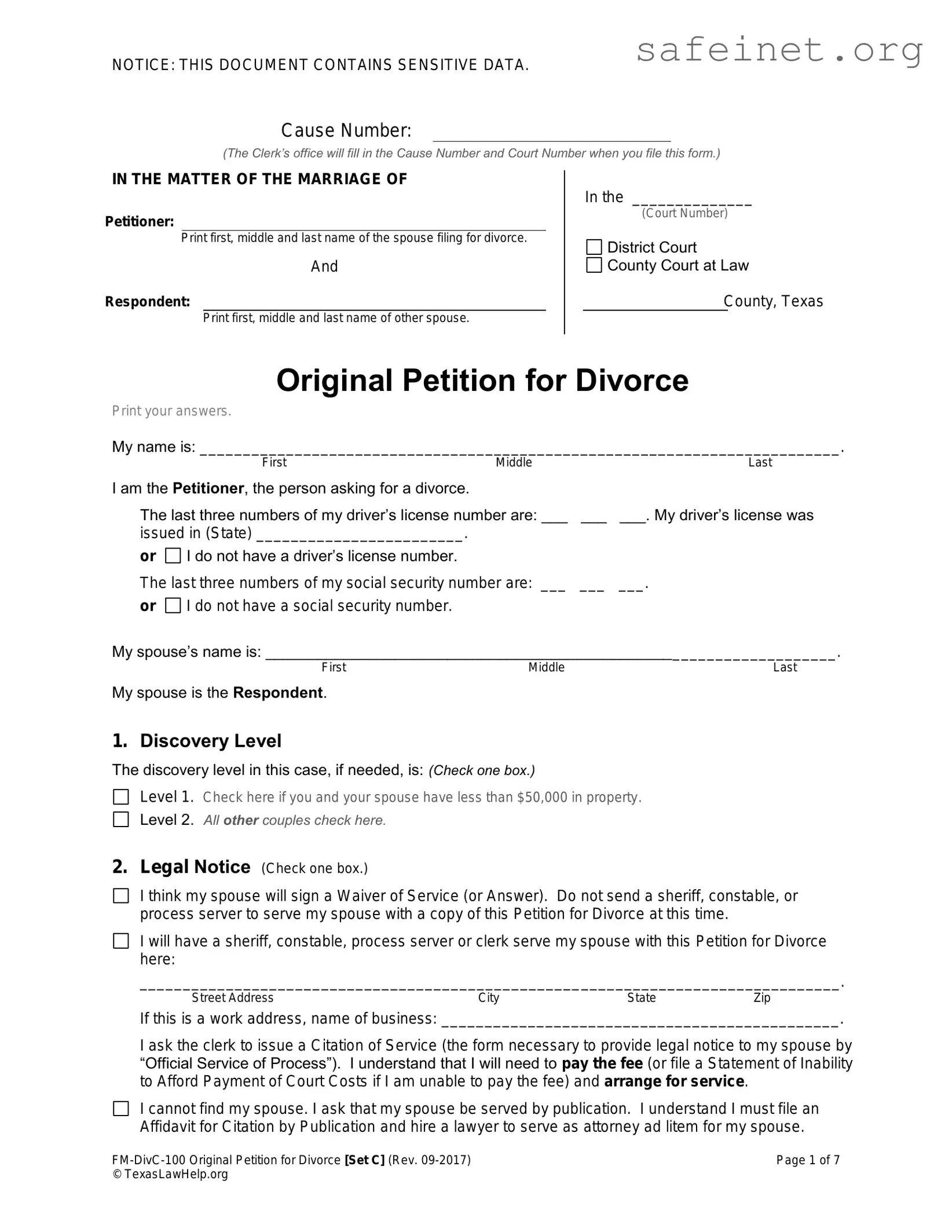
When navigating the complexities of divorce in Texas, the FM-DivC-100 Original Petition for Divorce Set C form plays a crucial role in initiating the legal process. This form is specifically designed for individuals seeking to file for divorce in a manner that meets the state's legal requirements. It serves as the formal request to the court, outlining essential information such as the names of the parties involved, the grounds for divorce, and any children from the marriage. Completing this form accurately is vital, as it sets the stage for subsequent legal proceedings. Additionally, the form addresses issues related to property division, child custody, and support, ensuring that all pertinent matters are considered. Understanding the components of this petition can significantly impact the outcome of the divorce process, making it essential for individuals to approach it with care and attention.

NOTICE: THIS DOCUMENT CONTAINS SENSITIVE DATA.
Cause Number:
(The Clerk’s office will fill in the Cause Number and Court Number when you file this form.)
IN THE MATTER OF THE MARRIAGE OF
Petitioner:
Print first, middle and last name of the spouse filing for divorce.
And
Respondent:
Print first, middle and last name of other spouse.
In the ______________
(Court Number)
District Court
County Court at Law
County, Texas
Original Petition for Divorce
Print your answers.
My name is: __________________________________________________________________________.
|
First |
Middle |
|
Last |
I am the Petitioner, the person asking for a divorce. |
|
|
|
|
The last three numbers of my driver’s license number are: ___ |
___ |
___. My driver’s license was |
||
issued in (State) ________________________. |
|
|
|
|
or |
I do not have a driver’s license number. |
|
|
|
The last three numbers of my social security number are: ___ |
___ |
___. |
||
or |
I do not have a social security number. |
|
|
|
My spouse’s name is: __________________________________________________________________.
First |
Middle |
Last |
My spouse is the Respondent.
1.Discovery Level
The discovery level in this case, if needed, is: (Check one box.)
Level 1. Check here if you and your spouse have less than $50,000 in property.
Level 2. All other couples check here.
2. Legal Notice (Check one box.)
I think my spouse will sign a Waiver of Service (or Answer). Do not send a sheriff, constable, or process server to serve my spouse with a copy of this Petition for Divorce at this time.
I will have a sheriff, constable, process server or clerk serve my spouse with this Petition for Divorce here:
_________________________________________________________________________________.
Street AddressCityStateZip
If this is a work address, name of business: ______________________________________________.
I ask the clerk to issue a Citation of Service (the form necessary to provide legal notice to my spouse by “Official Service of Process”). I understand that I will need to pay the fee (or file a Statement of Inability to Afford Payment of Court Costs if I am unable to pay the fee) and arrange for service.
I cannot find my spouse. I ask that my spouse be served by publication. I understand I must file an Affidavit for Citation by Publication and hire a lawyer to serve as attorney ad litem for my spouse.
Page 1 of 7 |
|
© TexasLawHelp.org |
|

3. Jurisdiction
3A.County Residence Requirement
(Check all boxes that apply.)
I have lived in this county for the last 90 days.
My spouse has lived in this county for the last 90 days.
I am serving in the armed forces or other government service outside of Texas, but this county has been the home county of either my spouse or me for at least 90 days.
I have accompanied my spouse who is serving in
the armed forces or other government service outside of Texas, but this county has been the home county of either my spouse or me for at least 90 days.
Note: You cannot file for divorce in Texas until you or your spouse has lived in the county where you are asking for a divorce for at least the last 90 days and
in Texas for at least the
last six months.
There are special rules for military families and others who are absent from the state due to government service. Get more information at www.TexasLawHelp.org.
3B.Texas Residence Requirement
(Check all boxes that apply.)
I have lived in Texas for the last six months.
My spouse has lived in Texas for the last six months.
I am serving in the armed forces or other government service outside of Texas, but Texas is the home state of either my spouse or me and has been for at least 6 months.
I have accompanied my spouse who is serving in the armed forces or other government service outside of Texas, but Texas is the home state of either my spouse or me and has been for at least 6 months.
3C.Personal Jurisdiction over Spouse
(Check one box.)
My spouse lives in Texas.
My spouse does not live in Texas.
(If your spouse does not live in Texas, check any boxes that apply below.)
My spouse agrees that a Texas court can make orders in this divorce, including orders dividing our property and debts. My spouse will file a Waiver of Service (or Answer).
Texas is the last state where we lived together as a married couple. This Petition for Divorce is filed less than two years after we separated.
4. Dates of Marriage and Separation
My spouse and I got married on or about: __________________________________________________.
MonthDayYear
We stopped living together as spouses on or about: __________________________________________.
Month |
Day |
Year |
5. Grounds for Divorce
I ask the Court to grant me a divorce. The marriage has become insupportable due to discord or conflict of personalities that destroys the legitimate ends of the marital relationship and prevents any reasonable expectation of reconciliation.
Page 2 of 7 |
|
© TexasLawHelp.org |
|

6. Children Together
My spouse and I do have children together who are under the age of 18 or still in high school. All of our children who are under the age of 18 or still in high school are listed below. However, there is a final court order for custody (conservatorship), visitation, child support and medical support of all the children listed below and I am not asking to change that order at this time.
The order was made in ____________________________ County and ____________________ State.
The cause number for the order is __________________________________.
I understand I must attach a
Child’s name |
Age |
Date of Birth |
Sex |
1.
2.
3.
4.
5.
6.
Note: Do not use this form if you have a court order about your children but:
1)the order does not include all the children you and your spouse have together, or
2)the order is a temporary order, or
3)you are asking the court to make changes to the order.
If one of these situations applies, you must ask a lawyer to draft the appropriate form for your case.
7. Is the Wife Pregnant?
(Check one box.)
The wife in this marriage is not pregnant.
The wife in this marriage is pregnant. I understand that I cannot finish the divorce until after the child is born.
(If the wife is pregnant, also check one box below.)
The husband is the father of this child. I ask the court to include orders for custody, visitation, child support and medical support for the child in the Final Decree of Divorce.
The husband is not the father of this child. I understand that paternity of the child must be established before I can finish my divorce. (Get information about establishing paternity at www.TexasLawHelp.org.)
Page 3 of 7 |
|
© TexasLawHelp.org |
|

8. Did the Wife have a Child with Another Man while Married to the Husband?
(Check one box. Fill in the requested information, if applicable.)
The wife did not have a child with another man while married to the husband.
The wife did have a child with another man while married to the husband. All of the children born during the marriage that are not the husband’s adopted or biological children are named below:
Child’s name |
Age |
Date of Birth |
Sex |
1.
2.
3.
4.
5.
6.
(If the wife had a child or children with another man during the marriage, check one box below,)
Paternity of the child/ren named above has not been established. I understand that paternity of the child/ren must be established before I can finish my divorce. (Get information about establishing paternity at www.TexasLawHelp.org.)
Paternity of the child/ren named above has been established:
(Check one box.)
A court order has established that another man is the biological father and/or the Husband is not the biological father of the child/ren listed above. I understand I must attach a
An Acknowledgement of Paternity was signed by the biological father and a Denial of Paternity was signed by the Husband for the child/ren listed above. I understand I must attach a copy of these documents to my Final Decree of Divorce.
Page 4 of 7 |
|
© TexasLawHelp.org |
|

9.Protective Order Statement (Check the appropriate boxes below. Fill in the requested information.)
Note: You must provide information about any protective order or pending application for protective order
involving you and your spouse or a child of either you or your spouse. This includes information about any: (1) family violence protective order, (2) sexual assault, sexual abuse, trafficking or stalking protective order and/or
(3) emergency protective order issued after an arrest.
You must also attach to this petition a copy of any protective order (even if it’s expired) in which one spouse or child of either spouse was the applicant or victim and the other spouse was the respondent or defendant.
9A. No Protective Order
I do not have a protective order against my spouse and I have not asked for one.
My spouse does not have a protective order against me and has not asked for one.
9B. Pending Protective Order
I have filed paperwork at the courthouse asking for a protective order against my spouse, but a judge has not decided if I should get it. I asked for a protective order on ____________________
Date Filed
in ______________ County, ___________. The cause number is _________________________.
County |
State |
Cause Number |
If I get a protective order, I will file a copy of it before any hearings in this divorce.
My spouse has filed paperwork asking for a protective order against me, but a judge has not decided if my spouse will get it. My spouse asked for a protective order on _________________
Date Filed
in _______________ County, ___________. The cause number is ________________________.
County |
State |
Cause Number |
If my spouse gets a protective order, I will file a copy of it before any hearings in this divorce.
9C. Protective Order in Place
I do have a protective order against my spouse. I got the protective order in
____________________________ County, ______________________ on _________________.
CountyStateDate Ordered
The cause number for the protective order is _________________________________________.
Cause Number
Either I have attached a copy of the protective order to this petition or I will file a copy of it with the court before any hearings in this divorce.
My spouse does have a protective order against me. The protective order was made in
_____________________________ County, _____________________ on __________________.
CountyStateDate Ordered
The cause number for the protective order is __________________________________________.
Cause Number
Either I have attached a copy of the protective order to this petition or I will file a copy of it with the court before any hearings in this divorce.
10. Waiver of Waiting Period Based on Family Violence (Check only if applicable.)
I ask the Court to waive the
My spouse has been convicted of or received deferred adjudication for a crime involving family violence against me or a member of my household.
I have an active protective order or an active magistrate’s order for emergency protection against my spouse because of family violence during our marriage. The order includes a finding that my spouse committed family violence.
Page 5 of 7 |
|
© TexasLawHelp.org |
|

11. Property and Debt
Note: It is important to talk with lawyer if you or your spouse has a house, land, business, retirement funds, other valuable property or debt. Getting advice from a lawyer now can save you time and money in the long run.
About community property: Texas is a community property state. This means that any new property that either spouse gets from the minute they are married until the minute the judge grants the divorce is probably community property, even if the property is only in one spouse’s name.
About separate property: Property owned by a spouse before the marriage is that spouse’s separate property. In addition, if either spouse receives a gift, an inheritance, or a recovery for personal injuries that occurred during the marriage (not including a recovery for lost wages or medical expenses); it is that spouse’s separate property. There are exceptions to these general rules. If you have questions talk to a lawyer.
About retirement: Retirement funds (such as 401k, pension, profit sharing, stock option plans and IRAs) earned by either spouse during the marriage are usually considered to be community property that can be divided by the court. This is true even if you or your spouse has not yet retired. If you want the Court to divide retirement funds (other than an IRA), you will need to have the Court sign an additional form, usually called a “Qualified Domestic Relations Order” (QDRO), to make the division effective. You should have the QDRO prepared before you go to court, so the judge can sign it when you finish your divorce. A QDRO form is not included with this divorce set. You may be able to get a sample QDRO form from the employer or retirement fund administrator. If not, you should hire a lawyer to draft the QDRO form. If you use the employer or retirement fund administrator’s QDRO form, you should still have a lawyer review it to make sure you are not giving up important benefits. Note: If you and your spouse plan to keep your own retirement funds or do not have retirement funds, you do not need a QDRO.
About debt: A creditor’s right to collect a debt is not affected by a divorce decree. So, if the Court orders your spouse to pay a debt (such as a mortgage) that is in both of your names but your spouse doesn’t pay it, the creditor can still seek payment from you. Ask a lawyer how to protect yourself in this situation.
11A. Community Property and Debt
If my spouse and I can agree about how to divide the property and debts we got during our marriage, I ask the Court to approve our agreement. If we cannot agree, I ask the Court to divide our community property and debts according to Texas law.
11B. Separate Property
I own the following separate property. I owned this property before I was married or I received this property as a gift or inheritance during my marriage or I received this property as recovery for personal injuries that occurred during the marriage (not including any recovery for lost wages or medical expenses). I ask the Court to confirm this property as my separate property.
(Fill in all lines. If you have no property to list in a particular category, write “none.”)
House or land located ___________________________________________________________________
|
|
Street Address |
|
|
City |
State |
Zip |
|
Cars, trucks, motorcycles or other vehicles |
|
|
|
|
|
|||
Year |
|
Make |
Model |
|
Vehicle Identification No. [VIN]- |
|
||
|
|
|
|
|
|
|
|
|
|
|
|
|
|
|
|
|
|
Other money or personal property I owned before I was married, received as a gift or inheritance during my marriage or property I purchased during my marriage with separate property funds:
Money I received as recovery for personal injuries that occurred during the marriage that was not for lost wages or medical expenses:
Page 6 of 7 |
|
© TexasLawHelp.org |
|

12. Name Change
(Check one box.)
Note: You cannot use this form to change your name to anything other
than a name you used before you got married.
I am NOT asking the Court to change my name.
I ask the Court to change my name back to a name I used before my marriage. I am not asking the court to change my name to avoid criminal prosecution or creditors. I ask that my name be changed to:
_________________________________________________________________________________.
First |
Middle |
Last |
13. Request for Judgment
I ask the Court to grant my divorce. I also ask the Court to make the other orders I have asked for in this Petition and any other orders to which I am entitled.
Petitioner’s NameDate
Petitioner’s Signature |
|
|
Phone |
|
||
|
|
|
|
|
|
|
Mailing Address |
City |
|
State |
Zip |
||
|
|
|
|
Fax # |
|
|
Email Address: |
|
|
|
(if any) |
|
|
I understand that I must notify the Court and my spouse’s attorney (or my spouse if my spouse does not have an attorney) in writing if my mailing address or email address changes during these divorce proceedings. If I don’t, any notices about this case including the dates and times of hearings will be sent to me at the mailing address or email address above.
Note: For a referral to a lawyer call your local lawyer referral service
or the State Bar of Texas Lawyer Referral Information Service at
For information about free and
or call the Legal Aid office serving your area:
Legal Aid of Northwest Texas
Lone Star Legal Aid
Texas Rio Grande Legal Aid
If you have been the victim of family violence, or if at any time you feel unsafe, get help by calling the:
National Domestic Violence Hotline at
Texas Family Violence Legal Line at
Advocates for Victims of Crime (AVOICE): at
Page 7 of 7 |
|
© TexasLawHelp.org |
|
| Fact Name | Details |
|---|---|
| Purpose | The FM-DivC-100 form is used to initiate a divorce proceeding in Texas. |
| Governing Law | This form is governed by the Texas Family Code. |
| Eligibility | Either spouse must have been a resident of Texas for at least six months before filing. |
| Filing Location | The form must be filed in the district court of the county where either spouse resides. |
| Information Required | Basic information about both spouses, including names, addresses, and marriage details, is needed. |
| Additional Forms | Other forms may be required, such as the citation and the notice of service. |
| Filing Fee | A filing fee is typically required, which varies by county. |
| Service of Process | The respondent must be served with the petition after filing. |
| Response Time | The respondent has 20 days to file an answer after being served. |
| Finalization | A final decree of divorce must be issued by the court to finalize the divorce. |
Filling out the Texas Law Help FM-DivC-100 Original Petition for Divorce Set C form is an important step in the divorce process. After completing the form, you will need to file it with the appropriate court and follow any additional procedures required by Texas law.
What is the FM-DivC-100 Original Petition for Divorce Set C form?
The FM-DivC-100 form is a legal document used in Texas to initiate a divorce proceeding. This form is specifically designed for individuals who are seeking a divorce without children and who do not have complex property issues. It serves as the official request to the court to dissolve the marriage.
Who should use this form?
This form is appropriate for individuals who are filing for divorce and meet certain criteria. It is intended for couples without minor children and where there are no significant disputes regarding property division. If children or complicated financial matters are involved, a different form may be required.
How do I fill out the FM-DivC-100 form?
To fill out the FM-DivC-100 form, you will need to provide basic information about yourself and your spouse, including names, addresses, and the date of marriage. Additionally, you will need to state the grounds for divorce, which in Texas can include insupportability or other legal reasons. Clear and accurate information is essential to ensure the form is processed correctly.
Where do I file the FM-DivC-100 form?
The completed FM-DivC-100 form must be filed with the district clerk in the county where you or your spouse resides. It is advisable to check with the local court for any specific filing procedures or requirements that may apply.
Is there a filing fee for the FM-DivC-100 form?
Yes, there is typically a filing fee associated with submitting the FM-DivC-100 form. The amount can vary by county, so it is important to confirm the fee with the district clerk’s office. In some cases, individuals may qualify for a fee waiver based on financial hardship.
What happens after I file the FM-DivC-100 form?
Once the FM-DivC-100 form is filed, the court will issue a citation, which is a legal document that notifies your spouse of the divorce proceedings. Your spouse will need to be formally served with this citation. After service, there may be a waiting period before the court can finalize the divorce.
Can I represent myself when filing the FM-DivC-100 form?
Yes, individuals have the right to represent themselves in divorce proceedings. This is known as proceeding pro se. However, it is important to understand the legal process and requirements. Seeking legal advice or assistance can help ensure that your rights are protected and that the process goes smoothly.
What if my spouse does not agree to the divorce?
If your spouse does not agree to the divorce, you can still proceed with the filing of the FM-DivC-100 form. Texas law allows for a divorce to be granted even if one spouse does not consent, as long as the appropriate legal grounds are met. The court will handle any disputes that arise during the process.
How long does it take to finalize a divorce using the FM-DivC-100 form?
The timeline for finalizing a divorce can vary based on several factors, including the court's schedule and whether any disputes arise. In Texas, there is a mandatory waiting period of 60 days from the date of filing before a divorce can be finalized. However, the process may take longer if complications occur.
Where can I find additional resources or assistance regarding the FM-DivC-100 form?
Additional resources and assistance can be found through local legal aid organizations, the Texas Law Help website, or the Texas State Bar. These resources can provide guidance on completing the form, understanding the divorce process, and finding legal representation if needed.
Inaccurate Personal Information: Many individuals fail to provide correct names, addresses, or dates of birth. Ensure all personal details are accurate to avoid delays.
Missing Signature: Some forget to sign the petition. A missing signature can lead to the rejection of the entire document.
Incorrect Filing Fee: It’s common to overlook the required filing fee. Double-check the amount to ensure it matches the current fee schedule.
Failure to Include Children’s Information: If there are children involved, people often neglect to provide their names and birthdates. This information is crucial for custody considerations.
Not Specifying Grounds for Divorce: Some individuals do not clearly state the grounds for divorce. This omission can lead to confusion and complications in the process.
Ignoring Required Attachments: Certain documents must accompany the petition. Failing to include these can stall the case.
Incomplete Financial Information: Many forget to provide a full disclosure of assets and debts. Complete financial transparency is essential for fair proceedings.
When filing for divorce in Texas, several forms and documents accompany the FM-DivC-100 Original Petition for Divorce Set C. Each of these documents serves a specific purpose in the legal process, ensuring that all necessary information is presented to the court. Below is a list of commonly used forms that may be required alongside the petition.
Each of these forms plays a crucial role in the divorce process in Texas. Understanding their purposes can help individuals navigate the complexities of family law more effectively, ensuring that their rights and interests are adequately represented in court.
The Texas Law Help FM-DivC-100 Original Petition for Divorce Set C form is similar to the FM-DivC-101 Respondent's Original Answer. This document is filed by the spouse who receives the petition for divorce. While the Original Petition outlines the initiating spouse's requests and reasons for the divorce, the Respondent's Original Answer allows the other spouse to respond to those claims. It is essential for the respondent to address the issues raised in the petition, such as child custody, property division, and support obligations, thus facilitating a fair dialogue between both parties in the divorce process.
Another document comparable to the FM-DivC-100 is the FM-DivC-102 Motion for Temporary Orders. This form is utilized when one spouse seeks immediate relief from the court while the divorce proceedings are ongoing. It often addresses urgent matters such as temporary child custody arrangements, child support, and spousal support. Similar to the Original Petition, the Motion for Temporary Orders aims to protect the interests of both parties and any children involved during the divorce process, ensuring that immediate needs are met as the case unfolds.
The FM-DivC-103 Final Decree of Divorce is also akin to the FM-DivC-100. This document represents the culmination of the divorce process, outlining the court's final decisions regarding the marriage dissolution. While the Original Petition initiates the divorce proceedings, the Final Decree formalizes the terms agreed upon or decided by the court, including asset division, custody arrangements, and support obligations. Both documents play crucial roles in establishing the legal framework for the divorce, though they occur at different stages of the process.
Additionally, the FM-DivC-104 Waiver of Service is another document that bears similarities to the FM-DivC-100. This form is used when one spouse agrees to waive formal service of the divorce petition, allowing the process to move forward without the necessity of being formally served with the documents. The waiver simplifies the procedure and can expedite the divorce process, reflecting a level of cooperation between the spouses that may facilitate a smoother resolution.
Lastly, the FM-DivC-105 Joint Petition for Divorce is comparable to the FM-DivC-100. This document is filed when both spouses mutually agree to seek a divorce and outlines their shared terms and conditions for the dissolution of marriage. Unlike the Original Petition, which is typically filed by one spouse, the Joint Petition signifies a collaborative approach to divorce, emphasizing the importance of communication and agreement in resolving marital issues amicably.
When filling out the Texas Law Help FM-DivC-100 Original Petition for Divorce Set C form, there are important dos and don'ts to keep in mind. This ensures the process goes smoothly and helps avoid delays.
When it comes to the Texas Law Help FM-DivC-100 Original Petition for Divorce Set C form, several misconceptions can lead to confusion. Understanding the truth behind these misconceptions is crucial for anyone navigating the divorce process in Texas.
This form can be used by couples without children as well. It is designed for any couple seeking a divorce, regardless of whether children are involved.
While having legal representation can be beneficial, it is not a requirement. Individuals can complete the form on their own if they feel comfortable doing so.
Filing the form is just one step in the divorce process. The timeline for a divorce can vary based on many factors, including court schedules and whether both parties agree on terms.
Changes can be made to the petition after it is filed, but it may require additional paperwork and possibly a hearing. It’s important to be thorough when completing the form initially.
While the FM-DivC-100 form is standardized, some counties may have specific local rules or additional requirements. Always check with your local court for any variations.
The court will review the petition, but it does not guarantee that all requests will be granted. Decisions are made based on evidence and the best interests of any children involved.
Clearing up these misconceptions can help individuals approach the divorce process with a clearer understanding and set realistic expectations.
When navigating the process of divorce in Texas, understanding the FM-DivC-100 Original Petition for Divorce Set C form is crucial. Here are some key takeaways to consider:
By understanding these key points, individuals can approach the divorce process with greater confidence and clarity. Remember, resources are available to help guide you through this challenging time.