Homepage > Blank Texas Dps Driving Log Template
Article Structure

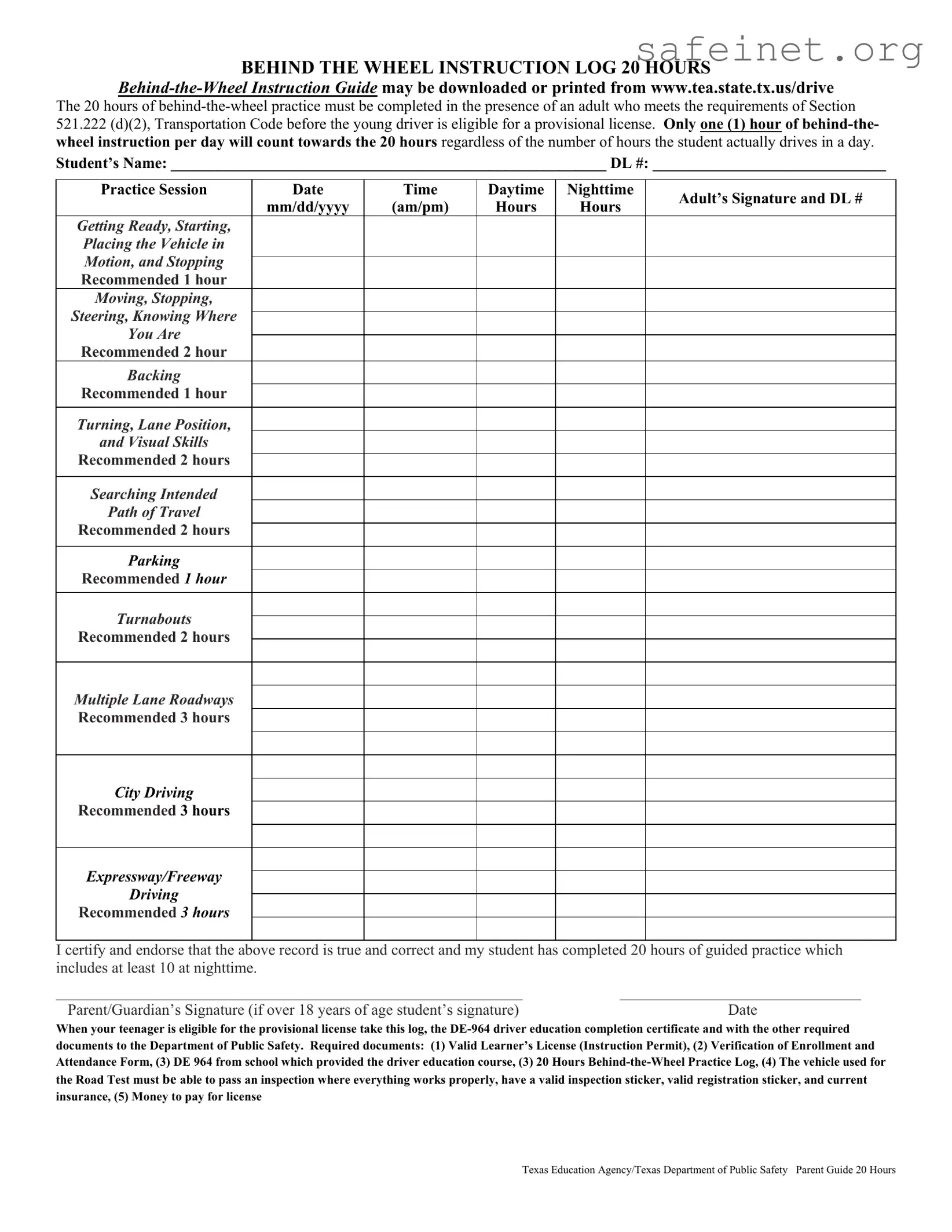
The Texas DPS Driving Log form is a vital tool for young drivers and their guardians, ensuring that new drivers accumulate the necessary behind-the-wheel experience before obtaining a provisional license. This form is designed to document a minimum of 20 hours of supervised driving practice, which must occur under the guidance of an adult who meets specific legal requirements. Each driving session must be recorded, detailing the date, time, and duration of practice, as well as the adult's signature. Importantly, only one hour of driving per day counts toward the total, emphasizing the quality of instruction over quantity. The log includes recommended practice areas such as getting ready to drive, moving, stopping, steering, and mastering essential skills like parking and navigating multiple lane roadways. Each section outlines suggested hours for practice, ensuring a comprehensive approach to driving education. To complete the process, this log must be submitted alongside other required documents, including the DE-964 driver education completion certificate, when applying for a provisional license at the Department of Public Safety. By following this structured approach, guardians can help young drivers build the confidence and skills necessary for safe driving.

Form Sample

BEHIND THE WHEEL INSTRUCTION LOG 20 HOURS

Behind-the-Wheel Instruction Guide may be downloaded or printed from www.tea.state.tx.us/drive

The 20 hours of behind-the-wheel practice must be completed in the presence of an adult who meets the requirements of Section 521.222 (d)(2), Transportation Code before the young driver is eligible for a provisional license. Only one (1) hour of behind-the- wheel instruction per day will count towards the 20 hours regardless of the number of hours the student actually drives in a day.

Student’s Name: ________________________________________________________ DL #: ______________________________

Practice Session

Date

Time

Daytime

Nighttime

Adult’s Signature and DL #


mm/dd/yyyy

(am/pm)

Hours

Hours


Getting Ready, Starting,


Placing the Vehicle in


Motion, and Stopping


Recommended 1 hour


Moving, Stopping,


Steering, Knowing Where


You Are


Recommended 2 hour


Backing


Recommended 1 hour


Turning, Lane Position,


and Visual Skills


Recommended 2 hours


Searching Intended


Path of Travel


Recommended 2 hours


Parking


Recommended 1 hour


Turnabouts


Recommended 2 hours


Multiple Lane Roadways


Recommended 3 hours


City Driving


Recommended 3 hours


Expressway/Freeway


Driving


Recommended 3 hours


I certify and endorse that the above record is true and correct and my student has completed 20 hours of guided practice which includes at least 10 at nighttime.

____________________________________________________________

_______________________________

Parent/Guardian’s Signature (if over 18 years of age student’s signature)

Date

When your teenager is eligible for the provisional license take this log, the DE-964 driver education completion certificate and with the other required documents to the Department of Public Safety. Required documents: (1) Valid Learner’s License (Instruction Permit), (2) Verification of Enrollment and Attendance Form, (3) DE 964 from school which provided the driver education course, (3) 20 Hours Behind-the-Wheel Practice Log, (4) The vehicle used for the Road Test must be able to pass an inspection where everything works properly, have a valid inspection sticker, valid registration sticker, and current insurance, (5) Money to pay for license

Texas Education Agency/Texas Department of Public Safety Parent Guide 20 Hours

BEHIND THE WHEEL INSTRUCTION LOG 20 HOURS

Behind-the-Wheel Instruction Guide may be downloaded or printed from www.tea.state.tx.us/drive

The 20 hours of behind-the-wheel practice must be completed in the presence of an adult who meets the requirements of Section 521.222 (d)(2), Transportation Code before the young driver is eligible for a provisional license. Only one (1) hour of behind-the- wheel instruction per day will count towards the 20 hours regardless of the number of hours the student actually drives in a day.

Getting Ready, Starting, Placing the Vehicle in Motion, and Stopping (p. 14) Recommended 1 hour -- These practice sessions introduce your teenager to the instrument panel, vehicle controls, and mirror blind spots. The young driver should get ready to drive, start the vehicle, place the vehicle in motion, stop, and secure the vehicle. Please review the vehicle owner’s manual before and during these practice sessions.

Moving, Stopping, Steering, Knowing Where You Are (p. 15) Recommended 2 hours -- Focus on learning the correct procedures for moving, stopping, using reference points, and steering the vehicle at different speeds. Begin in a large, level parking lot that is free of obstacles. The teenager should practice driving around the perimeter of the lot at 10 and 15 mph. Using commentary driving, have your teenager focus on smooth push-pull-slide hand-to-hand steering and stops. Your teenager should be taught to ease off the accelerator or use the brake to reduce speed before entering a curve and use slight acceleration to overcome inertia and pull the vehicle out of the curve. Ask the teenager to move the vehicle to specified targets in the parking lot at 10 and 15 mph. The target is a fixed object that is located 12-20 seconds ahead of the vehicle, in the center of the path of travel, and is what the driver steers toward. It can be a car a block ahead, a traffic signal, the crest of a hill, etc. Having a target helps the new driver to: visualize the space the vehicle will be occupying; look far ahead of the vehicle and begin a search to identify risks; improve steering accuracy. Focus on smooth acceleration, proper speed, and smooth stops. Explain to your teenager that “curling” the toes back to ease pressure off the brake just before stopping results in smoother stops. Practice normal smooth stops and hard smooth stops which are done at a slightly higher speed.

Backing (p. 16) Recommended 1 hour -- Repeat the tasks listed in sessions Moving, Stopping, Steering, Knowing Where You Are with the vehicle in reverse gear at idle or slow speeds. Backing from one target to another allows your teenager to practice seeing, steering, and speed control skills with the vehicle in reverse gear.

Turning, Lane Position, and Visual Skills (p. 16) Recommended 2 hours -- During the next practice sessions practice 10-15 right and left turns from stopped and moving positions in a parking lot. Left turns should be “squared” and right turns should be “rounded.” Emphasize proper signals, mirror checks, side- position reference points, speed and steering control, and the need to look ahead of the vehicle at a selected target in the center of the path of travel. Warn young drivers not to fixate on any one thing. Prior to progressing to driving in a quiet neighborhood, your teenager should be able to demonstrate the ability to move and stop the car smoothly, maintain a given speed, and steer with reasonable precision. If your teenager is ready, practice right and left turns in a residential area.

Searching Intended Path of Travel (p. 18) Recommended 2 hours -- In a residential area, or, if ready, on roads with light traffic, continue working on basic visual skills, negotiating curves, and right and left turns. Practice judging space in seconds, identifying a target, and searching the target area and target path. Ask your teenager to comment prior to changing speed or position. Young drivers have the tendency to monitor the road immediately in front of the vehicle.

Parking (p. 19) Recommended 1 hour -- Angle Parking, Perpendicular Parking, Parallel Parking, Curb Parking, Parking Uphill, Parking Downhill

Turnabouts (p. 21) Recommended 2 hours -- Focus on recognizing the different types of turnabouts and selecting the appropriate type of turnabout for a given situation. Begin in a large, level parking lot free of obstacles. Practice 2-point, 3-point, and U-turns in a parking lot. Progress to a lightly traveled residential area, and practice visual search skills, turns, and each turnabout at least 10 times. The easiest and safest way to change directions is to drive around the block.

Multiple Lane Roadways (p. 22) Recommended 3 hours -- Focus on lane position, lane changing, following distance, and mirror blind spots. If possible, choose a time when the four-lane roadway on which you select to practice has minimal traffic, such as during early morning hours on Saturday or Sunday. There are several lane position choices a driver can make without changing lanes. Practice driving in lane position 1, 2, and 3 for several miles during each session.

City Driving (p. 24) Recommended 3 hours -- Focus on driving on crowded urban roadways. During these practice sessions have your teenager examine the importance of scanning ahead, lane position, covering the brake, and the hazards associated with parked cars, traffic congestion, and distractions. Decision- making is the most important skill used in driving. A driver operating in city traffic flow makes 50-60 decisions per mile. Drivers need visibility, space, time, and adequate traction to perform all maneuvers in city traffic whether crossing, turning, passing, or adjusting speed and/or position. During these sessions ask your teenager to focus on controlling space to the front and speed to enhance visibility, space, time, and traction. Driving on congested roadways allows a very small margin for driver error. Effective searching skills and driver alertness are both essential. Every second counts in this driving environment.

Expressway/Freeway Driving (p. 25) Recommended 3 hours -- Focus on complex risk driving environments at speeds up to 70 mph. Traffic flow on expressways can be heavy and at times unpredictable. They are called limited access highways because there are only certain locations, called interchanges, where a driver can enter and exit the expressway. Expressways have a low frequency of collisions, but often have high injury severity rates when a collision does occur because of the higher speeds. Review the expressway information in the Texas Driver Handbook. Make sure your teenager understands the different kinds of expressway interchanges, expressway signs, signals, lane markings, speed limits, and the importance of maintaining a 20-30 second visual lead.

Texas Education Agency/Texas Department of Public Safety Parent Guide 20 Hours

Document Specifications

Fact Name Fact Description
Purpose of the Log The Texas DPS Driving Log is used to track 20 hours of behind-the-wheel practice for new drivers.
Adult Supervision Requirement Practice must occur in the presence of an adult who meets the requirements outlined in Section 521.222 (d)(2) of the Transportation Code.
Daily Hour Limitation Only one hour of behind-the-wheel instruction per day counts towards the total 20 hours, regardless of actual driving time.
Nighttime Driving Requirement At least 10 of the 20 hours must be completed during nighttime driving sessions.
Required Documents When applying for a provisional license, the log must be submitted along with a DE-964 certificate and other necessary documents.
Practice Session Recommendations The log includes recommended practice times for various skills, such as turning, backing, and city driving.

Steps to Filling Out Texas Dps Driving Log

Completing the Texas DPS Driving Log form is an important step for young drivers seeking to obtain their provisional license. This form tracks the required 20 hours of behind-the-wheel practice, ensuring that the young driver has received adequate instruction under the supervision of a qualified adult. After filling out this log, it will be necessary to gather additional documents for submission to the Department of Public Safety.

  1. Download or print the Texas DPS Driving Log form from the Texas Education Agency website.
  2. Fill in the Student’s Name and DL # (Driver’s License Number) at the top of the form.
  3. For each practice session, record the Practice Session Date using the mm/dd/yyyy format.
  4. Indicate the time of the practice session in am/pm format.
  5. Document the number of hours spent on Daytime and Nighttime driving.
  6. Complete the recommended practice categories, noting the hours spent on each:
    • Getting Ready, Starting, Placing the Vehicle in Motion, and Stopping (1 hour)
    • Moving, Stopping, Steering, Knowing Where You Are (2 hours)
    • Backing (1 hour)
    • Turning, Lane Position, and Visual Skills (2 hours)
    • Searching Intended Path of Travel (2 hours)
    • Parking (1 hour)
    • Turnabouts (2 hours)
    • Multiple Lane Roadways (3 hours)
    • City Driving (3 hours)
    • Expressway/Freeway Driving (3 hours)
  7. Once all practice sessions are recorded, obtain the Adult’s Signature and their DL #.
  8. If the student is over 18, have them sign the form. Otherwise, a parent or guardian must sign.
  9. Write the Date of the signature at the bottom of the form.

After completing the log, ensure that all required documents are ready for submission to the Department of Public Safety when your teenager is eligible for their provisional license. These documents include the DE-964 driver education completion certificate and proof of enrollment, among others.

More About Texas Dps Driving Log

What is the Texas DPS Driving Log form?

The Texas DPS Driving Log form is a document that records the required 20 hours of behind-the-wheel practice a young driver must complete before obtaining a provisional license. It serves as a verification tool to ensure that the student has received adequate driving instruction under the supervision of a qualified adult.

Who can supervise the driving practice?

The supervising adult must meet the requirements outlined in Section 521.222 (d)(2) of the Transportation Code. Generally, this means the adult must be a licensed driver who is at least 21 years old and has held their license for at least a year.

How should the driving hours be logged?

Each driving session should be documented on the form, including the date, time, and duration of both daytime and nighttime driving. Only one hour of instruction per day counts towards the total 20 hours, regardless of how many hours are actually driven in a single day.

What are the recommended practice sessions included in the log?

The log outlines specific recommended practice sessions, such as getting ready to drive, moving and stopping, turning, and city driving. Each session has a suggested duration to help ensure comprehensive training. For example, backing should take about 1 hour, while expressway driving is recommended for 3 hours.

What documents are required when applying for a provisional license?

When the young driver is ready to apply for a provisional license, they must bring several documents to the Department of Public Safety. These include a valid learner’s license, a Verification of Enrollment and Attendance Form, the DE-964 driver education completion certificate, the completed 20 Hours Behind-the-Wheel Practice Log, and proof that the vehicle used for the road test is properly registered and insured.

Is there a specific order for completing the practice sessions?

While there is no strict order required, it is advisable to follow the recommended sessions as they build upon each other. Starting with basic skills and gradually progressing to more complex driving environments will help ensure the young driver develops the necessary competencies effectively.

How can parents ensure the log is completed accurately?

Parents should actively participate in the driving practice and regularly review the log. They need to sign the log to certify that the information recorded is accurate. Keeping a consistent schedule for practice sessions can also help track progress and ensure that all requirements are met.

What should be done if the young driver does not complete the required hours?

If the young driver fails to complete the required 20 hours of practice, they will not be eligible for a provisional license. It is essential to plan driving sessions effectively to meet this requirement before the application process begins.

Common mistakes

  1. Incomplete Information: Failing to fill out all required fields, such as the student’s name or driver's license number, can lead to delays in processing the log.

  2. Incorrect Dates: Entering the wrong practice session dates can create confusion. It is essential to accurately record each session's date.

  3. Misreporting Hours: Only one hour of behind-the-wheel instruction per day counts towards the 20 hours. Misunderstanding this rule may lead to inaccurate total hours reported.

  4. Missing Adult Signature: Not obtaining the adult’s signature or driver's license number can invalidate the log. This step is crucial for verification.

  5. Neglecting Nighttime Hours: The log requires at least 10 hours of nighttime driving. Failing to meet this requirement can affect eligibility for a provisional license.

  6. Inaccurate Session Descriptions: Providing vague or incorrect descriptions of practice sessions can lead to questions about the quality of instruction received.

  7. Forgetting Required Documents: When applying for the provisional license, it’s important to bring the completed log along with other required documents. Forgetting any of these can delay the process.

Documents used along the form

When preparing for a young driver to obtain a provisional license in Texas, several important documents accompany the Texas DPS Driving Log form. Each of these documents plays a crucial role in ensuring that the young driver has met all necessary requirements and is ready for the responsibilities of driving. Here’s a brief overview of these essential forms and documents:

  • Valid Learner’s License (Instruction Permit) - This permit allows a young driver to practice driving under the supervision of a qualified adult. It is a prerequisite for logging behind-the-wheel hours.
  • Verification of Enrollment and Attendance Form - This form confirms that the student is enrolled in school and attending classes regularly, which is often a requirement for obtaining a provisional license.
  • DE-964 Driver Education Completion Certificate - Issued by the driving school, this certificate verifies that the student has successfully completed the required driver education course.
  • 20 Hours Behind-the-Wheel Practice Log - This log details the driving practice hours completed under adult supervision, ensuring that the student has met the 20-hour requirement, including nighttime driving.
  • Vehicle Inspection Documentation - Before taking the road test, the vehicle must pass an inspection, demonstrating that all necessary components, such as lights and brakes, are functioning properly.
  • Valid Registration Sticker - This document proves that the vehicle is legally registered with the state, which is essential for driving on public roads.
  • Current Insurance Information - Proof of insurance is required to ensure that the vehicle is covered in case of an accident, providing protection for both the driver and others on the road.
  • Payment for License Fees - A fee is typically required when applying for a provisional license, which must be paid at the time of application.

Gathering these documents is an important step in the process of obtaining a provisional license. Each form serves to confirm that the young driver has received the necessary education and practice to drive safely and responsibly. Proper preparation can help make the transition to independent driving a smoother experience.

Similar forms

The Texas DPS Driving Log form is similar to the Learner’s Permit application. Both documents are essential for young drivers in Texas. The Learner’s Permit application requires proof of identity, residency, and completion of a driver education course. Like the Driving Log, it emphasizes the importance of supervised driving hours. The application process ensures that young drivers have the necessary guidance and support before they can drive independently.

Another document comparable to the Texas DPS Driving Log is the Driver Education Completion Certificate (DE-964). This certificate serves as proof that a student has successfully completed a driver education program. Similar to the Driving Log, the DE-964 is required when applying for a provisional license. Both documents work together to confirm that the young driver has met the educational and practical requirements set forth by the state.

The Parent/Guardian Certification form is also akin to the Driving Log. This form requires a parent or guardian to verify that the student has completed the necessary driving practice hours. Just like the Driving Log, it holds the adult accountable for supervising the young driver. Both documents ensure that parents play an active role in their teenager's driving education, reinforcing the importance of responsible driving habits.

The Verification of Enrollment and Attendance (VOE) form is another important document related to the Driving Log. The VOE confirms that the student is enrolled in school and attending classes regularly. This form is required for the provisional license application, just like the Driving Log. Both documents emphasize the connection between education and driving privileges, ensuring that young drivers are committed to their studies while learning to drive.

The Vehicle Inspection Certificate is also similar to the Driving Log in that it is a prerequisite for obtaining a provisional license. This certificate proves that the vehicle used for the driving test meets safety standards. Just as the Driving Log tracks the hours and types of driving practice, the Vehicle Inspection Certificate ensures that the vehicle is roadworthy. Both documents contribute to the overall safety of young drivers on the road.

Lastly, the Road Test Appointment Confirmation is comparable to the Driving Log. This document confirms that a young driver has scheduled their road test with the Department of Public Safety. Similar to the Driving Log, it signifies that the driver has completed the required practice hours and is ready to demonstrate their skills. Both documents mark significant milestones in the journey toward becoming a licensed driver.

Dos and Don'ts

When filling out the Texas DPS Driving Log form, it's important to follow some guidelines to ensure accuracy and compliance. Here are four things you should and shouldn't do:

  • Do ensure all information is filled out completely and accurately. Missing details can delay processing.
  • Don't forget to have the supervising adult sign the log. Their signature is essential for validation.
  • Do keep track of practice hours carefully. Only one hour per day counts towards the total.
  • Don't submit the log without double-checking for errors. Mistakes can lead to complications when applying for the provisional license.

Misconceptions

Misconceptions about the Texas DPS Driving Log form can lead to confusion for both parents and young drivers. Here are ten common misunderstandings and clarifications to help ensure a smooth learning process.

  1. All driving hours count towards the 20-hour requirement. Only one hour of behind-the-wheel instruction per day is counted, regardless of how many hours the student actually drives.
  2. Nighttime driving is optional. At least 10 of the 20 hours must be completed during nighttime driving to fulfill the requirements for a provisional license.
  3. Any adult can supervise the driving practice. The supervising adult must meet specific requirements outlined in Section 521.222 (d)(2) of the Transportation Code.
  4. The log form is not necessary. The completed Driving Log form is required when applying for a provisional license, alongside other documents.
  5. Driving practice can be done anywhere. It's recommended to practice in safe environments, such as empty parking lots or quiet residential streets, especially for beginners.
  6. All practice sessions must last a full hour. While each session should be meaningful, the focus is on the quality of instruction rather than just the time spent driving.
  7. Parents can sign the log without supervision. The supervising adult must sign the log, confirming their presence during the practice sessions.
  8. Drivers can skip certain recommended practice areas. Each recommended practice area is essential for developing specific driving skills, and skipping them may hinder the young driver’s readiness.
  9. Expressway driving is not important for new drivers. Learning to drive on expressways is crucial, as it exposes young drivers to complex traffic situations and higher speeds.
  10. The log can be filled out after the driving sessions. It’s best to fill out the log immediately after each session to ensure accuracy and completeness.

Understanding these misconceptions can help parents and young drivers navigate the requirements more effectively. Proper preparation not only aids in obtaining a provisional license but also contributes to developing safe driving habits for the future.

Key takeaways

Here are some key takeaways about filling out and using the Texas DPS Driving Log form:

  • Completion Requirement: A total of 20 hours of behind-the-wheel practice is mandatory before obtaining a provisional license.
  • Adult Supervision: The practice must be completed in the presence of an adult who meets specific requirements outlined in the Texas Transportation Code.
  • Daily Limit: Only one hour of behind-the-wheel instruction per day will count towards the 20-hour requirement, regardless of how long the student drives.
  • Practice Sessions: The log includes recommended practice hours for various skills such as starting, stopping, and navigating different driving environments.
  • Certification: A parent or guardian must sign the log to certify that the student has completed the required practice hours.
  • Required Documents: When applying for a provisional license, bring the log along with other necessary documents like the DE-964 completion certificate and a valid learner's license.
  • Vehicle Condition: The vehicle used for the road test must pass inspection and have valid registration and insurance.
  • Preparation Resources: The Behind-the-Wheel Instruction Guide can be downloaded or printed from the Texas Education Agency website for additional guidance.