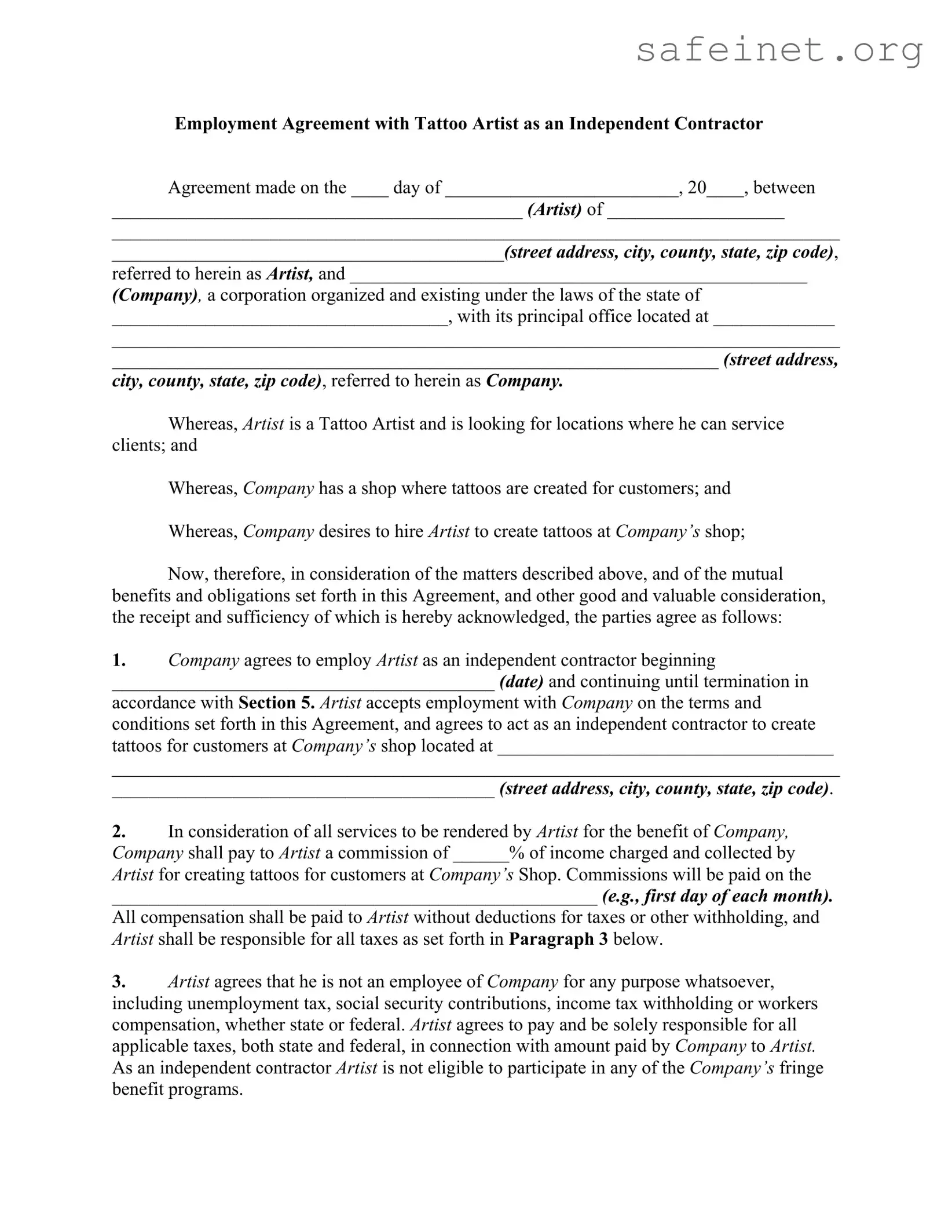
When entering the world of tattoo artistry, a clear understanding of the working relationship between the artist and the shop is essential. The Tattoo Shop Artist Agreement form serves as a crucial document that outlines the terms under which a tattoo artist operates as an independent contractor within a tattoo shop. This agreement establishes the framework for the artist's employment, detailing the commission structure based on the income generated from their tattoo services. It also clarifies the artist's responsibilities regarding taxes and expenses, emphasizing their independent contractor status, which excludes them from employee benefits. Additionally, the agreement addresses the process for termination, ensuring both parties understand their rights and obligations. With provisions for indemnification and dispute resolution through arbitration, this document aims to protect both the artist and the shop. By laying out these terms, the Tattoo Shop Artist Agreement not only fosters a professional relationship but also helps prevent misunderstandings that could arise during the course of their collaboration.
Employment Agreement with Tattoo Artist as an Independent Contractor
Agreement made on the ____ day of _________________________, 20____, between
____________________________________________ (Artist) of ___________________
______________________________________________________________________________
__________________________________________(street address, city, county, state, zip code),
referred to herein as Artist, and _________________________________________________
(Company), a corporation organized and existing under the laws of the state of
____________________________________, with its principal office located at _____________
______________________________________________________________________________
_________________________________________________________________ (street address,
city, county, state, zip code), referred to herein as Company.
Whereas, Artist is a Tattoo Artist and is looking for locations where he can service clients; and
Whereas, Company has a shop where tattoos are created for customers; and
Whereas, Company desires to hire Artist to create tattoos at Company’s shop;
Now, therefore, in consideration of the matters described above, and of the mutual benefits and obligations set forth in this Agreement, and other good and valuable consideration, the receipt and sufficiency of which is hereby acknowledged, the parties agree as follows:
1.Company agrees to employ Artist as an independent contractor beginning
_________________________________________ (date) and continuing until termination in accordance with Section 5. Artist accepts employment with Company on the terms and conditions set forth in this Agreement, and agrees to act as an independent contractor to create tattoos for customers at Company’s shop located at ____________________________________
______________________________________________________________________________
_________________________________________ (street address, city, county, state, zip code).
2.In consideration of all services to be rendered by Artist for the benefit of Company, Company shall pay to Artist a commission of ______% of income charged and collected by Artist for creating tattoos for customers at Company’s Shop. Commissions will be paid on the
____________________________________________________ (e.g., first day of each month). All compensation shall be paid to Artist without deductions for taxes or other withholding, and Artist shall be responsible for all taxes as set forth in Paragraph 3 below.
3.Artist agrees that he is not an employee of Company for any purpose whatsoever, including unemployment tax, social security contributions, income tax withholding or workers compensation, whether state or federal. Artist agrees to pay and be solely responsible for all applicable taxes, both state and federal, in connection with amount paid by Company to Artist. As an independent contractor Artist is not eligible to participate in any of the Company’s fringe benefit programs.
4.Artist shall pay all of his own expenses in connection with this Agreement. The only obligation of Company is to pay the applicable commission specified in this Agreement. This Agreement shall become effective on the date stated above, and shall remain in effect for a period of ___________________________________ (e.g., number of weeks, months, or years) unless terminated for breach or as provided in this Agreement.
5.This Agreement may be terminated by mutual agreement of Company and Artist or by written notice of either of the parties to the other party of an intention to terminate the Agreement. Any such written notice shall serve automatically to terminate this Agreement
__________ (number) days after the date such notice is sent to the other party via certified or registered mail.
6.Artist agrees to indemnify and hold harmless Company, its agents and employees, from and against any and all claims, damages, losses, and expenses, including reasonable attorneys' fees arising out of performance of the obligations of Artist under this Agreement that are caused in whole or in part by Artist’s negligent act or omission.
7.Assignment of Contract
Neither of the parties may assign this Agreement or any rights under the Agreement
without the prior written consent of the other party.
8.Governing Law
The parties agree that this agreement shall be governed by and construed pursuant to the
laws of _______________________________________________ (state).
9.Entire Agreement
This Agreement is the complete and exclusive statement of the mutual understanding of
the parties. This Agreement supersedes and cancels all previous written and oral agreements and communications between the parties relating to the subject matter of this Agreement.
10.Amendment
The parties agree that they may amend this Agreement only by a written agreement duly
executed by persons authorized to execute agreements on behalf of the parties.
11.Mandatory Arbitration
Any dispute under this Agreement shall be required to be resolved by binding arbitration of the parties hereto. If the parties cannot agree on an arbitrator, each party shall select one arbitrator and both arbitrators shall then select a third. The third arbitrator so selected shall arbitrate said dispute. The arbitration shall be governed by the rules of the American Arbitration Association then in force and effect.
WITNESS our signatures as of the day and date first above stated.
____________________________________
COMPANY
_______________________________________ |
By_________________________________ |
OWNER |
____________________________________ |
|
(Name and Office in Corporation) |
| Fact Name | Details |
|---|---|
| Type of Agreement | This is an Employment Agreement with a Tattoo Artist as an Independent Contractor. |
| Compensation Structure | The Artist receives a commission of a specified percentage of the income charged and collected for tattoos. |
| Tax Responsibilities | The Artist is responsible for all applicable taxes, both state and federal, as they are not considered an employee. |
| Termination Conditions | The Agreement can be terminated by mutual consent or with written notice from either party. |
| Governing Law | The Agreement is governed by the laws of the state specified in the document. |
Completing the Tattoo Shop Artist Agreement form is a straightforward process that requires attention to detail. Each section of the form must be filled out accurately to ensure a clear understanding between the artist and the company. Follow the steps below to complete the form correctly.
What is the purpose of the Tattoo Shop Artist Agreement form?
The Tattoo Shop Artist Agreement form establishes a formal relationship between a tattoo artist and a tattoo shop. It outlines the terms of employment, responsibilities, and compensation for the artist, who is classified as an independent contractor. This ensures both parties understand their obligations and rights within the working arrangement.
How is the artist compensated under this agreement?
The artist receives a commission based on a percentage of the income generated from the tattoos they create for customers at the shop. The specific percentage is detailed in the agreement, and commissions are typically paid on a set schedule, such as the first day of each month.
What does it mean to be an independent contractor?
As an independent contractor, the artist is not considered an employee of the tattoo shop. This distinction means that the artist is responsible for their own taxes and does not qualify for employee benefits like health insurance or retirement plans. The shop is only obligated to pay the agreed commission.
Can either party terminate the agreement?
Yes, the agreement can be terminated by mutual consent or through written notice from either party. The notice must be sent via certified or registered mail and will take effect a specified number of days after it is sent. This provides a clear process for ending the working relationship.
What happens if there are disputes under the agreement?
Any disputes arising from the agreement must be resolved through binding arbitration. If the parties cannot agree on an arbitrator, each party selects one, and those two arbitrators will choose a third. This process is governed by the rules of the American Arbitration Association, ensuring a structured resolution method.
What are the artist's responsibilities regarding expenses?
The artist is responsible for all expenses incurred while fulfilling their duties under the agreement. This includes costs related to supplies, equipment, and any other expenses necessary for their work. The tattoo shop's only obligation is to pay the agreed commission.
Can the agreement be amended?
Yes, the agreement can be amended, but only through a written document that is signed by authorized representatives of both parties. This ensures that any changes are formally recognized and agreed upon.
What laws govern this agreement?
The agreement specifies that it will be governed by the laws of a particular state, which is indicated in the document. This means that any legal interpretations or disputes will be handled according to the laws of that state.
What is included in the entire agreement clause?
The entire agreement clause states that this document represents the complete understanding between the artist and the shop. It supersedes any previous agreements or discussions, ensuring that only the terms outlined in this document are legally binding.
What does indemnification mean in this context?
Indemnification in this agreement means that the artist agrees to protect the tattoo shop from any claims or damages that arise from their work. If the artist's actions lead to legal issues, they are responsible for covering those costs, including legal fees, thereby shielding the shop from liability.
Incomplete Date Entry: One common mistake is failing to fill in the date at the beginning of the agreement. This date is crucial as it marks the official start of the agreement.
Missing Artist Information: Artists often forget to provide their full name and address. This information is necessary to clearly identify the parties involved in the agreement.
Incorrect Commission Percentage: It’s important to specify the correct commission percentage. Leaving this blank or entering an incorrect figure can lead to misunderstandings regarding payment.
Vague Duration of Agreement: Not specifying the duration of the agreement can create confusion. Clearly stating the time frame helps both parties understand their commitments.
Ignoring Tax Responsibilities: Artists sometimes overlook the section regarding tax responsibilities. Understanding that they are responsible for their own taxes is essential to avoid future liabilities.
Failure to Review Termination Clause: Not paying attention to the termination clause can lead to complications. Artists should understand how to properly terminate the agreement if necessary.
Neglecting Governing Law: It’s a mistake to leave the governing law section blank. Specifying the state law that governs the agreement provides clarity and legal framework for any disputes.
The Tattoo Shop Artist Agreement is a crucial document for establishing the relationship between a tattoo artist and a tattoo shop. However, several other forms and documents often accompany this agreement to ensure clarity and compliance in the working relationship. Below is a list of these additional documents, each briefly described.
These documents collectively enhance the working relationship between tattoo artists and tattoo shops. They provide necessary legal protections, outline expectations, and ensure a smooth operational process. Proper documentation is essential for both parties to maintain a professional and compliant environment.
The Freelance Artist Agreement is akin to the Tattoo Shop Artist Agreement, as both documents establish a relationship between a service provider and a business. In this case, the freelance artist is contracted to provide their creative services, much like the tattoo artist. Both agreements outline the terms of compensation, responsibilities, and the independent nature of the contractor's work. They emphasize that the artist is not an employee, which means they are responsible for their own taxes and expenses, fostering a clear understanding of the working relationship.
The Independent Contractor Agreement serves a similar purpose, detailing the arrangement between a contractor and a company. Like the Tattoo Shop Artist Agreement, it specifies the scope of work, payment structure, and the independent status of the contractor. Both documents protect the interests of the business while ensuring that the contractor understands their responsibilities, including tax obligations. This clarity helps prevent misunderstandings and sets the stage for a professional working relationship.
The Service Agreement is another document that shares similarities with the Tattoo Shop Artist Agreement. It outlines the terms under which a service provider will deliver specific services to a client. Both agreements highlight the importance of mutual understanding regarding compensation, duration of service, and termination clauses. This ensures that both parties are aligned on expectations and responsibilities, fostering a cooperative environment.
The Consulting Agreement also resembles the Tattoo Shop Artist Agreement in that it formalizes a relationship between a consultant and a client. Both documents detail the services to be rendered, payment terms, and the independent status of the consultant. Just like the tattoo artist, the consultant is responsible for their own expenses and taxes, which helps to maintain transparency and clarity in the professional relationship.
The Commission Agreement is particularly relevant, as it specifically outlines the commission structure for services rendered. Similar to the Tattoo Shop Artist Agreement, this document details how and when the artist will be compensated based on their performance. Both agreements emphasize the importance of understanding commission rates and payment schedules, ensuring that both parties are clear on financial expectations.
The Partnership Agreement may also draw parallels with the Tattoo Shop Artist Agreement, especially when multiple artists collaborate within a single shop. Both documents outline the roles, responsibilities, and profit-sharing arrangements among the parties involved. This ensures that each artist understands their position within the partnership, fostering collaboration and mutual support in a shared business environment.
The Non-Disclosure Agreement (NDA) can be related to the Tattoo Shop Artist Agreement in terms of protecting sensitive information. While the Tattoo Shop Artist Agreement focuses on the working relationship, an NDA ensures that any proprietary information shared during the collaboration remains confidential. Both documents emphasize the importance of trust and respect in a professional setting.
The Employment Contract, while typically more comprehensive, shares similarities with the Tattoo Shop Artist Agreement. It outlines the terms of employment, including duties, compensation, and termination. However, the key distinction lies in the independent contractor status of the tattoo artist, which is not present in a traditional employment contract. Both documents aim to create a clear understanding of the working relationship, albeit in different contexts.
The Licensing Agreement is another relevant document, particularly in creative fields. It allows one party to use another's intellectual property under specified conditions. Similar to the Tattoo Shop Artist Agreement, it defines the terms of use, payment, and the responsibilities of both parties. This ensures that the rights of the creator are protected while allowing for collaboration and creative expression.
Finally, the Venue Rental Agreement can be compared to the Tattoo Shop Artist Agreement, especially when an artist rents space within a shop to provide services. Both documents detail the terms of use, payment, and duration of the agreement. They establish a clear framework for the relationship between the artist and the business, ensuring that both parties understand their rights and obligations in the arrangement.
When filling out the Tattoo Shop Artist Agreement form, there are important dos and don'ts to keep in mind. Following these guidelines can help ensure a smooth process.
Understanding the Tattoo Shop Artist Agreement form is crucial for both artists and companies. However, several misconceptions often arise regarding its content and implications. Below is a list of common misconceptions, along with explanations to clarify the facts.
This agreement explicitly states that the artist is an independent contractor. This means the artist is not entitled to employee benefits or protections, such as unemployment insurance or workers' compensation.
In reality, the artist is responsible for paying their own taxes. The agreement specifies that all compensation is paid without deductions for taxes, placing the tax burden solely on the artist.
Both parties must provide written consent for any assignment of the agreement. This ensures that the company retains control over who operates in their shop.
The agreement includes specific provisions for termination. Either party can terminate the agreement with written notice, ensuring both parties have a clear exit strategy.
Contrary to this belief, the artist is required to cover all their own expenses related to the agreement. The company only pays the agreed commission, leaving the artist responsible for their operational costs.
The agreement includes a mandatory arbitration clause. This means that any disputes must be resolved through arbitration, rather than through the court system, providing a structured method for conflict resolution.
Any amendments to the agreement must be made in writing and executed by authorized individuals from both parties. This protects both parties by ensuring that all changes are documented and agreed upon.
The agreement specifies that it is governed by the laws of a particular state. This is important, as it determines how the agreement is interpreted and enforced, which can vary significantly from one jurisdiction to another.
Filling out and using the Tattoo Shop Artist Agreement form is a crucial step for both tattoo artists and shop owners. Here are some key takeaways to consider:
Understanding these key points will help both tattoo artists and shop owners navigate their professional relationship effectively. A well-drafted agreement is essential for protecting the interests of both parties.