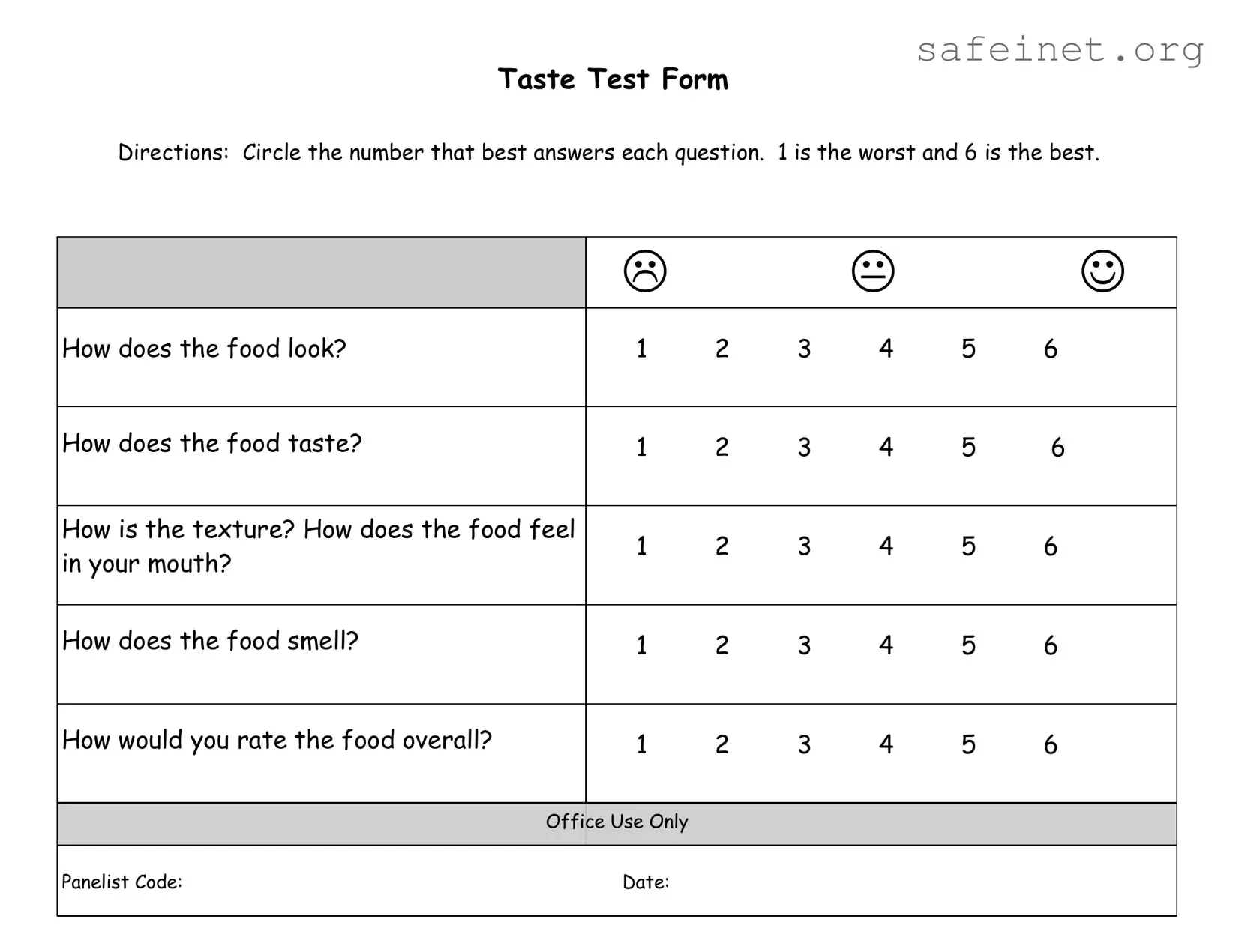
The Taste Test form serves as a practical tool for gathering feedback on food items, allowing participants to evaluate various aspects of their experience. Designed with simplicity in mind, the form features a straightforward rating system that ranges from 1 to 6, where 1 indicates a poor experience and 6 signifies an excellent one. Participants are encouraged to circle the number that best represents their opinions on several key factors, including the appearance, taste, texture, and aroma of the food. Additionally, there is a section for an overall rating, providing a comprehensive overview of the food's appeal. For organizational purposes, a designated area for office use includes a panelist code and date, ensuring that each submission can be tracked and analyzed effectively. This structured approach not only streamlines the feedback process but also helps food developers and researchers understand consumer preferences better.
TASTE TEST FORM
Directions: Circle the number that best answers each question. 1 is the worst and 6 is the best.
|
|
|
|
|
|
|
|
How does the food look? |
|
1 |
2 |
3 |
4 |
5 |
6 |
|
|
|
|
|
|
|
|
How does the food taste? |
|
1 |
2 |
3 |
4 |
5 |
6 |
|
|
|
|
|
|
|
|
How is the texture? How does the food feel |
1 |
2 |
3 |
4 |
5 |
6 |
|
in your mouth? |
|
||||||
|
|
|
|
|
|
|
|
|
|
|
|
|
|
|
|
How does the food smell? |
|
1 |
2 |
3 |
4 |
5 |
6 |
|
|
|
|
|
|
|
|
How would you rate the food overall? |
|
1 |
2 |
3 |
4 |
5 |
6 |
|
|
|
|
|
|
|
|
|
Office Use Only |
|
|
|
|
|
|
|
|
|
|
|
|
|
|
Panelist Code: |
|
Date: |
|
|
|
|
|
|
|
|
|
|
|
|
|
| Fact Name | Description |
|---|---|
| Purpose | The Taste Test form is designed to gather feedback on food items based on appearance, taste, texture, smell, and overall rating. |
| Rating Scale | Participants rate each aspect of the food on a scale from 1 to 6, with 1 being the worst and 6 being the best. |
| Questions Included | The form includes five questions focusing on look, taste, texture, smell, and overall impression. |
| Panelist Code | Each submission includes a unique panelist code to ensure anonymity and track individual feedback. |
| Office Use Only | A section is reserved for office use, allowing for the recording of the date and panelist code for internal tracking. |
Once you have the Taste Test form in front of you, it’s time to provide your feedback on the food items. Your responses will help in evaluating the overall quality and experience of the food. Follow the steps below to complete the form accurately.
What is the purpose of the Taste Test form?
The Taste Test form is designed to gather feedback on food items from panelists. It allows individuals to rate various aspects of the food, including appearance, taste, texture, smell, and overall satisfaction. This feedback can be used to improve food products and enhance consumer experiences.
How should I complete the Taste Test form?
To complete the form, circle the number that best represents your evaluation for each question. The scale ranges from 1 to 6, with 1 indicating the worst experience and 6 indicating the best. Take a moment to consider each aspect before making your selection.
What aspects of the food are evaluated on the form?
The form evaluates five key aspects of the food: appearance, taste, texture, smell, and overall rating. Each aspect is critical in determining the overall quality of the food and contributes to the panelists' overall impression.
What does each number on the scale represent?
The scale is straightforward. A score of 1 signifies a very poor experience, while a score of 6 indicates an excellent experience. Scores of 2, 3, 4, and 5 represent varying degrees of satisfaction in between these two extremes.
Is there a section for additional comments?
The current version of the Taste Test form does not include a section for additional comments. However, panelists are encouraged to provide feedback verbally if they have specific thoughts or suggestions regarding the food being tested.
What should I do if I forget to rate one of the aspects?
If you forget to rate any aspect of the food, it is advisable to return to that question and provide a rating before submitting the form. Incomplete forms may not yield accurate data for analysis.
How is the data from the Taste Test form used?
The data collected from the Taste Test forms is analyzed to identify trends and preferences among panelists. This information can help food developers and manufacturers improve their products and better meet consumer needs.
Who will see my responses on the Taste Test form?
Your responses will typically be reviewed by the research team or the organization conducting the taste test. Personal identifiers, such as the panelist code, may be used to track responses, but individual feedback is usually kept confidential.
What is the significance of the 'Office Use Only' section?
The 'Office Use Only' section is meant for administrative purposes. It allows the research team to track responses and manage data collection efficiently. The panelist code and date help in organizing and analyzing the collected information.
Can I participate in multiple taste tests?
Participation in multiple taste tests may be permitted, depending on the guidelines set by the organizing body. It is advisable to check with the coordinators to understand any limitations or requirements for participating in additional tests.
When filling out the Taste Test form, individuals often encounter challenges that can lead to inaccurate or unhelpful feedback. Here are four common mistakes to avoid:
Inconsistent Rating Scale Usage: Some participants may not fully grasp the scale from 1 to 6. It is essential to remember that 1 represents the worst experience and 6 signifies the best. Misunderstanding this can lead to skewed results.
Neglecting to Consider All Aspects: Participants sometimes focus solely on taste, overlooking other important factors such as appearance, texture, and smell. A comprehensive evaluation is crucial for providing balanced feedback.
Rushing Through the Form: In the eagerness to finish, individuals may hastily complete the form without giving thoughtful consideration to each question. Taking the time to reflect can yield more accurate ratings.
Failing to Provide Overall Impressions: Some testers may forget to rate the food overall. This final rating encapsulates the entire experience and is vital for summarizing their opinion effectively.
By being mindful of these common pitfalls, participants can enhance the quality of their feedback, ultimately contributing to a more effective taste testing process.
The Taste Test form is a valuable tool for gathering feedback on food products. However, it often works in conjunction with several other documents that help streamline the testing process and ensure comprehensive data collection. Below are some of the key forms and documents commonly used alongside the Taste Test form.
Using these documents alongside the Taste Test form enhances the overall testing process. Together, they provide a clearer picture of consumer preferences and help in refining food products for the market.
The Customer Feedback Form serves a similar purpose to the Taste Test Form by gathering opinions on products or services. It typically includes questions about various aspects of the customer experience, such as satisfaction, quality, and likelihood of recommendation. Like the Taste Test Form, it often uses a rating scale, allowing respondents to express their views in a structured manner. This format helps businesses identify areas for improvement and gauge overall customer sentiment.
The Product Review Form is another document that shares similarities with the Taste Test Form. It focuses on obtaining detailed feedback about a specific product. Reviewers rate aspects like usability, performance, and design, much like how tasters evaluate food items. The structured feedback provided through a rating system helps manufacturers understand consumer preferences and enhance future product offerings.
The Employee Satisfaction Survey also resembles the Taste Test Form in its approach to collecting feedback. This survey typically asks employees to rate their work environment, management, and job satisfaction. By using a similar rating scale, organizations can assess employee morale and identify areas that may require attention. The insights gained can be crucial for improving workplace culture and retention rates.
The Event Feedback Form is akin to the Taste Test Form in that it gathers participants' opinions after an event. Attendees may rate aspects like organization, content, and overall enjoyment. This feedback is essential for organizers to understand what worked well and what did not. The structured format allows for easy analysis of responses, helping to shape future events based on participant experiences.
The Survey for Market Research often mirrors the Taste Test Form by collecting consumer opinions on products or trends. It usually includes a variety of questions that require ratings on different attributes. This method provides businesses with valuable insights into consumer preferences and market dynamics. By analyzing the data, companies can make informed decisions about product development and marketing strategies.
When filling out the Taste Test form, it's important to ensure your feedback is clear and helpful. Here are some guidelines to follow:
Following these tips will help ensure that your feedback is both accurate and useful for the taste testing process.
Understanding the Taste Test form is crucial for gathering accurate feedback on food products. However, several misconceptions often arise regarding its use and purpose. Here are five common misunderstandings:
Clarifying these misconceptions can enhance participation and improve the quality of feedback received. Engaging a diverse group of tasters ensures a well-rounded evaluation of the food products being tested.
Filling out the Taste Test form can provide valuable feedback on food products. Understanding how to use the form effectively enhances the quality of the evaluation process. Here are some key takeaways:
By keeping these points in mind, individuals can contribute meaningful insights through the Taste Test form, ultimately enhancing food quality and enjoyment.