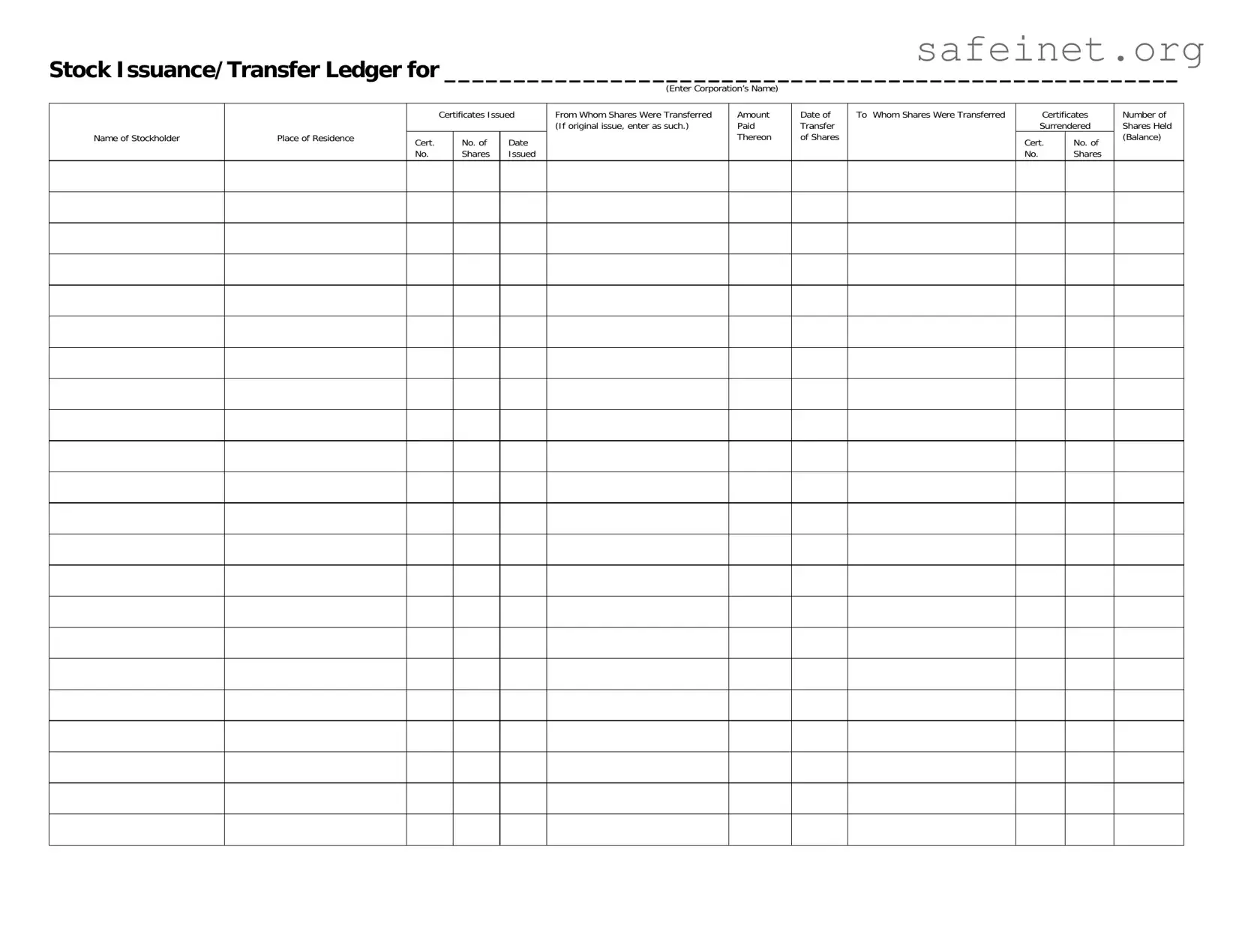
The Stock Transfer Ledger form serves as a crucial tool for tracking the issuance and transfer of shares within a corporation. This document is designed to capture essential information about stockholders and their transactions, ensuring a clear record of ownership changes. Key components of the form include the corporation's name, which identifies the entity involved, and details of the stockholder, such as their place of residence. Each entry must specify the certificates issued, including certificate numbers and the date of issuance, providing a historical context for the shares. Additionally, the form requires information about the transfer process, including the amount paid for the shares, the date of transfer, and the identity of the parties involved in the transaction. It also accounts for certificates surrendered and maintains a balance of shares held, ensuring that all changes in ownership are accurately documented. By meticulously recording this information, the Stock Transfer Ledger helps maintain transparency and accountability within corporate share management.

Stock Issuance/Transfer Ledger for _____________________________________________________
(Enter Corporation’s Name)
Name of Stockholder
Place of Residence
Certificates Issued
Cert. |
No. of |
Date |
No. |
Shares |
Issued |
From Whom Shares Were Transferred (If original issue, enter as such.)
Amount
Paid
Thereon
Date of
Transfer
of Shares
To Whom Shares Were Transferred
Certificates
Surrendered
Cert. |
No. of |
No. |
Shares |
Number of Shares Held (Balance)
| Fact Name | Description |
|---|---|
| Form Purpose | The Stock Transfer Ledger form is used to document the issuance and transfer of shares in a corporation. |
| Required Information | The form requires the corporation’s name, stockholder details, certificate information, and transfer specifics. |
| Certificate Tracking | Each share certificate issued must have a unique certificate number for tracking purposes. |
| Transfer Documentation | Details regarding the transfer, including the date and parties involved, must be clearly recorded. |
| State-Specific Forms | Some states may have specific requirements for stock transfer documentation governed by state corporate laws. |
| Balance Calculation | The form includes a section to calculate the number of shares held by the stockholder after transfers. |
| Legal Compliance | Filing the Stock Transfer Ledger is essential for compliance with corporate governance and state regulations. |
After completing the Stock Transfer Ledger form, it is essential to ensure that all information is accurate and clearly legible. This form serves to document the transfer of stock ownership and will be used for record-keeping and compliance purposes.
What is a Stock Transfer Ledger form?
The Stock Transfer Ledger form is a record-keeping document used by corporations to track the issuance and transfer of stock shares. It helps maintain an accurate account of who owns shares, how many shares have been issued, and any transfers that occur between stockholders.
Why is it important to maintain a Stock Transfer Ledger?
Maintaining a Stock Transfer Ledger is crucial for several reasons. It ensures that the corporation has an accurate record of ownership, which is necessary for voting rights, dividends, and compliance with legal requirements. It also helps prevent disputes over share ownership and provides a clear history of stock transactions.
Who is responsible for completing the Stock Transfer Ledger?
The responsibility for completing the Stock Transfer Ledger typically falls on the corporation's secretary or designated officer. However, it can also be managed by a third-party service provider specializing in corporate record-keeping. Accuracy is key, so whoever is in charge must ensure all entries are correct and up-to-date.
What information do I need to fill out the Stock Transfer Ledger?
To complete the Stock Transfer Ledger, you will need the corporation's name, the name and place of residence of each stockholder, details of the stock certificates issued (including certificate numbers and dates), the number of shares transferred, the amount paid for those shares, and the dates of transfers. This information is essential for accurate record-keeping.
Can the Stock Transfer Ledger be updated after shares are transferred?
Yes, the Stock Transfer Ledger can and should be updated whenever shares are transferred. Each time a transfer occurs, the ledger must reflect the new ownership, including the date of transfer and any relevant details about the transaction. Keeping the ledger current is vital for maintaining accurate records.
What happens if a stockholder loses their certificate?
If a stockholder loses their certificate, they should notify the corporation immediately. The corporation may require the stockholder to complete a lost certificate affidavit and possibly issue a new certificate. The Stock Transfer Ledger should then be updated to reflect this change, ensuring that the records remain accurate.
Is there a specific format for the Stock Transfer Ledger?
While there is no one-size-fits-all format for the Stock Transfer Ledger, it should include key fields such as the corporation's name, stockholder details, certificate information, and transfer details. The layout should be clear and organized to facilitate easy tracking of stock transactions. Many corporations use a standard template to ensure consistency.
How often should the Stock Transfer Ledger be reviewed?
The Stock Transfer Ledger should be reviewed regularly, ideally after every stock transaction or at least quarterly. Regular reviews help catch any discrepancies early and ensure that all records are accurate. This practice supports good corporate governance and helps maintain trust among stockholders.
What should I do if I find an error in the Stock Transfer Ledger?
If you find an error in the Stock Transfer Ledger, it’s important to correct it promptly. Document the mistake and the correct information, and make the necessary adjustments in the ledger. Depending on the nature of the error, it may also be wise to notify other relevant parties, such as the stockholder involved, to maintain transparency.
Failing to enter the corporation's name correctly can lead to confusion. Always double-check the spelling and ensure it matches official documents.
Leaving the place of residence blank is a common oversight. This information is essential for record-keeping and communication purposes.
Incorrectly filling out the certificates issued section can cause discrepancies. Ensure that the number of shares matches the certificates you have.
Not providing the date of transfer can create issues in tracking ownership. Always include this date to maintain accurate records.
Forgetting to indicate from whom shares were transferred can lead to confusion about ownership history. This detail is crucial for transparency.
Neglecting to note the amount paid for the shares can result in misunderstandings. This information is important for financial records.
Omitting the certificates surrendered section can create problems in tracking shares. Always indicate which certificates are being surrendered.
Failing to update the number of shares held after a transfer can lead to inaccurate records. This balance should reflect the current ownership accurately.
The Stock Transfer Ledger form serves as a vital record for tracking the issuance and transfer of shares within a corporation. Alongside this form, several other documents play significant roles in maintaining accurate records and ensuring compliance with legal requirements. Below is a list of these essential forms and documents.
Each of these documents plays a critical role in the lifecycle of corporate shares, ensuring that ownership is properly documented and that all parties involved are aware of their rights and obligations. Understanding these forms can help shareholders navigate the complexities of corporate governance and ownership effectively.
The Stock Transfer Ledger form shares similarities with the Shareholder Register. Both documents track the ownership of shares within a corporation. The Shareholder Register lists all current shareholders, their addresses, and the number of shares they own. Like the Stock Transfer Ledger, it records any changes in ownership, ensuring that the corporation maintains an accurate account of who holds its shares at any given time.
Another document akin to the Stock Transfer Ledger is the Stock Certificate. While the Ledger records the transfer of shares, the Stock Certificate serves as tangible proof of ownership for the shareholder. Each certificate includes details such as the shareholder's name, the number of shares owned, and the corporation's name. Both documents are essential for establishing and verifying ownership rights in a company.
The Bill of Sale is also comparable to the Stock Transfer Ledger. This document is used to transfer ownership of tangible assets, including stocks. Just as the Stock Transfer Ledger records the transfer of shares from one person to another, a Bill of Sale provides a formal record of the transaction, detailing the buyer, seller, and the item sold. Both documents serve to protect the interests of the parties involved by providing a clear record of ownership transfer.
Additionally, the Corporate Bylaws can be seen as related to the Stock Transfer Ledger. Bylaws outline the rules and procedures governing the management of a corporation, including how shares can be issued and transferred. While the Ledger records specific transactions, the Bylaws provide the framework within which those transactions occur, establishing the rights and responsibilities of shareholders.
Lastly, the Annual Report is another document that parallels the Stock Transfer Ledger. The Annual Report provides a comprehensive overview of a corporation’s financial performance and ownership structure over the past year. While the Stock Transfer Ledger focuses on individual share transactions, the Annual Report summarizes the overall state of ownership, including any significant changes in stockholder status, making it a valuable tool for stakeholders.
When filling out the Stock Transfer Ledger form, it's essential to be careful and precise. Here are some important dos and don'ts to keep in mind:
Misconceptions about the Stock Transfer Ledger form can lead to confusion regarding its purpose and usage. Below are seven common misconceptions explained.
Filling out and using the Stock Transfer Ledger form is essential for managing stock ownership accurately. Here are some key takeaways to keep in mind:
By following these key points, you can effectively manage your Stock Transfer Ledger and ensure compliance with corporate governance requirements.