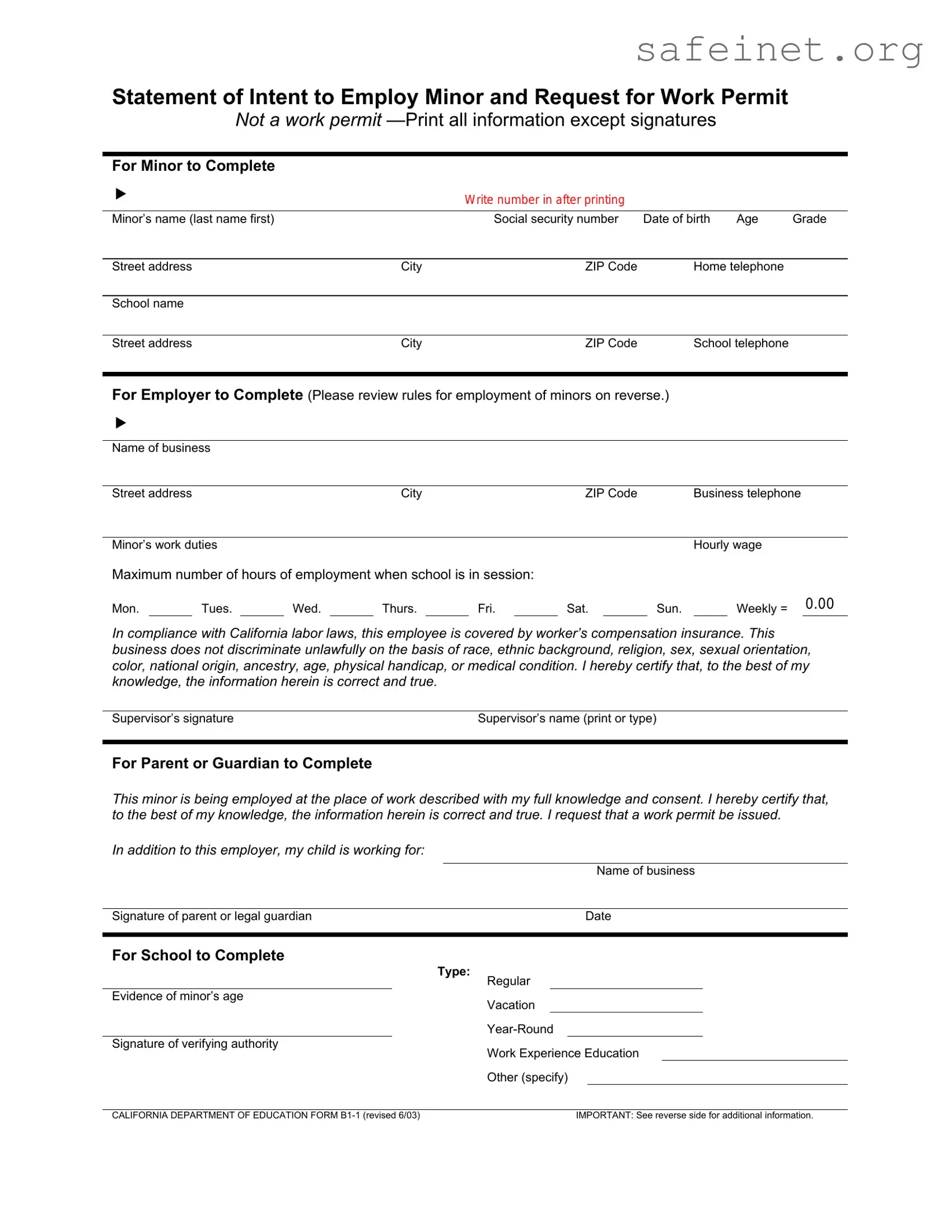
For many young individuals eager to enter the workforce, the Statement of Intent to Employ Minor and Request for Work Permit form serves as a crucial stepping stone. This form is designed to ensure that minors can work legally while also protecting their rights and well-being. It requires the employer to outline the job details, including the nature of the work, hours, and conditions, which helps safeguard against exploitation. Additionally, parental consent is a key component, as it ensures that parents or guardians are aware of and approve their child's employment. The form also includes provisions for compliance with state and federal labor laws, emphasizing the importance of a safe working environment. By understanding the components of this form, both employers and minors can navigate the complexities of youth employment more effectively, ensuring a positive and lawful work experience for young workers.

Statement of Intent to Employ Minor and Request for Work Permit
Not a work permit
For Minor to Complete
• |
|
Write number in after printing |
|
|
|
|
|
|
|
|
|
Minor’s name (last name first) |
|
Social security number |
Date of birth |
Age |
Grade |
|
|
|
|
|
|
Street address |
City |
ZIP Code |
Home telephone |
|
|
|
|
|
|
|
|
School name |
|
|
|
|
|
|
|
|
|
|
|
Street address |
City |
ZIP Code |
School telephone |
|
|
For Employer to Complete (Please review rules for employment of minors on reverse.)
•
Name of business
Street address |
City |
ZIP Code |
Business telephone |
|
|
|
|
Minor’s work duties |
|
|
Hourly wage |
Maximum number of hours of employment when school is in session:
Mon. |
|
Tues. |
|
Wed. |
|
Thurs. |
|
Fri. |
|
Sat. |
|
Sun. |
|
Weekly = 0.00 |
|
|
|
|
|
|
|
|
|
|
|
|
|
|
|
|
|
In compliance with California labor laws, this employee is covered by worker’s compensation insurance. This business does not discriminate unlawfully on the basis of race, ethnic background, religion, sex, sexual orientation, color, national origin, ancestry, age, physical handicap, or medical condition. I hereby certify that, to the best of my knowledge, the information herein is correct and true.
Supervisor’s signature |
Supervisor’s name (print or type) |
For Parent or Guardian to Complete
This minor is being employed at the place of work described with my full knowledge and consent. I hereby certify that, to the best of my knowledge, the information herein is correct and true. I request that a work permit be issued.
In addition to this employer, my child is working for:
Name of business
Signature of parent or legal guardian |
Date |
|
|
For School to Complete
Type: Regular
Evidence of minor’s age
Vacation
Signature of verifying authority
Work Experience Education
Other (specify)
CALIFORNIA DEPARTMENT OF EDUCATION FORM |
IMPORTANT: See reverse side for additional information. |

General Summary of Minors’ Work Regulations
•If federal laws, state laws and school district policies conflict, the more restrictive law (the one most protective of the employee) prevails.
•Generally, minors must attend school until age 18 unless they are 16 years or older and have graduated from high school or received a state Certificate of Proficiency.
•Employers of minors required to attend school must complete a “Statement of Intent to Employ Minor and Request for Work Permit” (form
•Employers must retain a “Permit to Employ and Work” (form
•Work permits
•A work permit
Minors under the age of 18 may not work in environments declared hazardous or dangerous for young workers as listed below:
1.Explosive exposure
2.Motor vehicle driving/outside helper
3.Coal mining
4.Logging and sawmilling
5.
6.Radiation exposure
7.
8.
9.Other mining
10.
11.
12.
13.Manufacturing brick, tile products
14.Power saws and shears
15.Wrecking, demolition
16.Roofing
17.Excavation operation
For more complete information about hazardous occupations, contact the U.S. Department of Labor (Child Labor Bulletins 101 and 102) and the California Department of Industrial Relations, Division of Labor Standards Enforcement. Regional offices are located in several California cities. They are listed in the “Government Listings” sections of telephone directories.
•Minors younger than 16 years are allowed to work only in limited, specified occupations that exclude baking, manufacturing, processing, construction, warehouse, and transportation occupations.
•In addition to safety regulations, labor laws applicable to adult employees also generally apply to minor employees, including workers’ compensation insurance requirements.
•Child labor laws do not generally apply to minors who deliver newspapers or work at odd jobs, such as yard
work and
•A day of rest from work is required if the total hours worked per week exceed 30 or if more than 6 hours are worked on any one day during the week.
Ages |
Hours of Work |
16 – 17 When school is in session: Daily maximum of 4 hours, Monday through Thursday. May work up to 8 hours on any
When school not in session: May work up to 48 hours per week but no more than 8 hours in any one day.
Work must be performed no earlier than 5 a.m. or later than 10 p.m. except that work may extend to 12:30 a.m. on nights preceding non- school days. Students in Work Experience Education or cooperative vocational education programs may be authorized to work until 12:30 a.m. on nights preceding school days with specified written permission.
14 – 15 When school is in session: On school days daily maximum 3 hours. On
When school is not in session: Daily maximum 8 hours and weekly maximum 40 hours.
May not work during public school hours except students in Work Experience Education or career exploration programs.
Work must be performed no earlier than 7 a.m. nor later than 7 p.m. any day of the week. From June 1 to Labor Day work hours may be extended to 9 p.m.
Younger Labor laws generally prohibit nonfarm than 14 employment of children younger than 14.
Special rules apply to agricultural work, domestic work and the entertainment industry.
| Fact Name | Description |
|---|---|
| Purpose | The Statement of Intent to Employ Minor and Request for Work Permit form is used to obtain permission for a minor to work legally. |
| Eligibility | Minors typically must be at least 14 years old to apply for a work permit, although this can vary by state. |
| Parental Consent | Most states require parental or guardian consent for minors to obtain a work permit. |
| Governing Laws | Each state has specific labor laws that govern the employment of minors, such as hours worked and types of jobs allowed. |
| Submission Process | The completed form usually needs to be submitted to a local school district or labor department for approval. |
Once you have the Statement of Intent to Employ Minor and Request for Work Permit form, you will need to fill it out carefully. This form is essential for ensuring that a minor can work legally, and it requires specific information about both the employer and the minor. Below are the steps to complete the form accurately.
After completing the form, you will need to submit it to the appropriate authority for approval. Ensure that you keep a copy for your records, as you may need it for future reference or follow-up.
What is the Statement of Intent to Employ Minor and Request for Work Permit form?
This form is a legal document that employers must complete when they intend to hire a minor. It serves two main purposes: to notify the relevant authorities of the employer's intent to employ a minor and to request the necessary work permit for the minor to work legally. The form helps ensure that the employment complies with labor laws designed to protect young workers.
Who needs to fill out this form?
Employers who wish to hire individuals under the age of 18 must fill out this form. Additionally, the minor's parent or guardian may also need to provide their consent as part of the application process. It's important for both parties to understand the regulations surrounding minor employment.
What information is required on the form?
The form typically requires details such as the employer's name, address, and contact information, as well as the minor's name, age, and the type of work they will be doing. It may also ask for the hours the minor will work and any other relevant employment conditions. This information helps authorities assess whether the employment meets legal standards.
How do I submit the form?
What happens after I submit the form?
After submission, the relevant authorities will review the form to ensure all information is accurate and complies with state labor laws. If everything is in order, they will issue a work permit for the minor, allowing them to begin employment. This process can vary in length depending on the state and the volume of applications being processed.
Are there any restrictions on the type of work a minor can do?
Yes, there are restrictions. Minors are generally prohibited from working in hazardous occupations or performing tasks that may be detrimental to their health, safety, or well-being. Each state has specific guidelines outlining which jobs are permissible for minors, so it's crucial to review these regulations before hiring.
What are the penalties for not complying with the work permit requirements?
Employers who fail to comply with work permit requirements may face significant penalties, including fines and potential legal action. Additionally, employing a minor without the necessary permits can lead to the revocation of the employer's ability to hire minors in the future. Compliance is essential for protecting both the employer and the young worker.
Can a minor work without a work permit?
No, minors typically cannot work legally without a work permit. The work permit serves as proof that the minor is allowed to work and that their employment complies with applicable labor laws. Employers should always ensure that the necessary permits are obtained before allowing a minor to start working.
How long is the work permit valid?
The validity of a work permit can vary by state and may depend on the minor's age and the nature of the job. Generally, work permits are valid for a specific period, often tied to the minor's employment or until they reach a certain age. It's essential to keep track of the permit's expiration and renew it as necessary to ensure continued compliance.
Not providing accurate personal information. It is essential to fill in the minor's full name, address, and date of birth correctly. Any discrepancies can delay the processing of the work permit.
Failing to include the employer's details. The employer's name, address, and contact information must be clearly stated. Omitting this information can lead to confusion and potential rejection of the application.
Neglecting to specify the job duties. Clearly outline what the minor will be doing. Vague descriptions may raise concerns about the nature of the work and its appropriateness for a minor.
Incorrectly stating the hours of work. Be precise about the number of hours and days the minor will work. Inaccurate hours can violate labor laws and result in penalties.
Not obtaining the required signatures. Ensure that both the employer and the minor's parent or guardian sign the form. Missing signatures can render the application invalid.
Submitting the form without supporting documents. Include any necessary documentation, such as proof of age or school enrollment. Failure to do so may lead to delays or denial.
Ignoring deadlines. Be aware of any submission deadlines for the work permit application. Late submissions can result in missed opportunities for employment.
The Statement of Intent to Employ Minor and Request for Work Permit form is an important document for employers looking to hire minors. However, several other forms and documents may be necessary to ensure compliance with labor laws and regulations. Below is a list of common documents that often accompany this form.
Having these documents in place not only helps protect the rights of the minor but also ensures that the employer complies with legal requirements. Being thorough in this process contributes to a positive working experience for everyone involved.
The Employment Application is a document that potential employees fill out when seeking a job. Similar to the Statement of Intent to Employ Minor and Request for Work Permit form, it requires personal information, including name, address, and contact details. Both documents aim to establish a formal relationship between the employer and the employee, ensuring that the necessary legal requirements are met before employment begins.
The I-9 Employment Eligibility Verification form is another document that serves a similar purpose. Employers use the I-9 to verify the identity and employment authorization of individuals hired for employment in the United States. Like the Statement of Intent to Employ Minor, the I-9 helps ensure compliance with labor laws, particularly concerning the eligibility of minors and their right to work.
The W-4 form, or Employee’s Withholding Certificate, is also relevant. This document allows employees to indicate their tax withholding preferences. While it does not specifically pertain to minors, it is crucial for all employees, including those under 18, to complete it to ensure proper tax deductions. Both the W-4 and the Statement of Intent to Employ Minor facilitate the employment process by addressing financial and legal responsibilities.
The Child Labor Law Compliance Certificate is a document that employers may need to obtain when hiring minors. It ensures that the employer adheres to state and federal regulations regarding the employment of minors. This certificate is similar to the Statement of Intent to Employ Minor because both documents focus on protecting the rights and well-being of young workers.
The Job Offer Letter is another important document in the employment process. It outlines the terms of employment, including job responsibilities, salary, and start date. Like the Statement of Intent to Employ Minor, the Job Offer Letter formalizes the employment relationship and ensures that both parties understand their obligations and rights.
The Parental Consent Form is often required when a minor is seeking employment. This document provides legal permission from a parent or guardian, ensuring that the minor has the support of an adult in their employment endeavors. It parallels the Statement of Intent to Employ Minor by emphasizing the need for adult oversight in the employment of young individuals.
The Employment Contract is a more detailed document that outlines the terms and conditions of employment. It includes information about job duties, compensation, and termination conditions. While not specific to minors, it serves a similar function to the Statement of Intent to Employ Minor by clarifying the expectations and responsibilities of both the employer and the employee.
The Social Security Number (SSN) Application is relevant for minors who are entering the workforce. Obtaining an SSN is essential for tax purposes and to ensure proper record-keeping by employers. This application aligns with the Statement of Intent to Employ Minor in that both documents are part of the process of legally employing a young worker.
The Workers' Compensation Insurance Policy is a document that employers must have to protect their employees in case of work-related injuries. While it may not directly involve minors, it is a critical aspect of the overall employment framework. Like the Statement of Intent to Employ Minor, it underscores the importance of safety and legal compliance in the workplace.
Lastly, the Tax Identification Number (TIN) Application is necessary for businesses and self-employed individuals. This document allows for proper tax reporting and compliance. Although it primarily pertains to employers, it relates to the Statement of Intent to Employ Minor by ensuring that all employment-related documents are in order for tax purposes.
When filling out the Statement of Intent to Employ Minor and Request for Work Permit form, it is essential to ensure accuracy and compliance with the regulations governing the employment of minors. Here are some dos and don'ts to keep in mind:
By following these guidelines, you can help facilitate a smoother process when seeking a work permit for a minor.
The Statement of Intent to Employ Minor and Request for Work Permit form is often misunderstood. Here are five common misconceptions:
Not all minors require a work permit. The need for a permit depends on the minor's age and the type of work they will be doing. Some states have specific exemptions.
While the employer plays a significant role in the process, the minor and their parent or guardian also have responsibilities. They must provide necessary information and consent.
This is not true. Work permits can be revoked if the minor violates labor laws or if there are changes in the minor's employment situation.
The requirements and forms can vary significantly from state to state. It’s essential to check local regulations for specific details.
This misconception overlooks labor laws that restrict the number of hours minors can work, especially during school days. These laws are designed to protect their education and well-being.
Understand the purpose of the form. The Statement of Intent to Employ Minor and Request for Work Permit is essential for legally employing minors. It ensures compliance with labor laws designed to protect young workers.
Gather necessary information before filling out the form. This includes the minor’s personal details, the employer’s information, and specifics about the job, such as hours and duties.
Ensure that both the employer and the minor (or their guardian) sign the form. This step confirms that both parties understand the terms and conditions of the employment.
Submit the completed form to the appropriate state agency. Each state has different requirements, so be sure to check local regulations for submission guidelines.
Keep a copy of the completed form for your records. This documentation can be crucial in case of any disputes or inspections.
Be aware of the restrictions that apply to minor workers. There are laws regarding the number of hours they can work and the types of jobs they can perform, so familiarize yourself with these regulations.