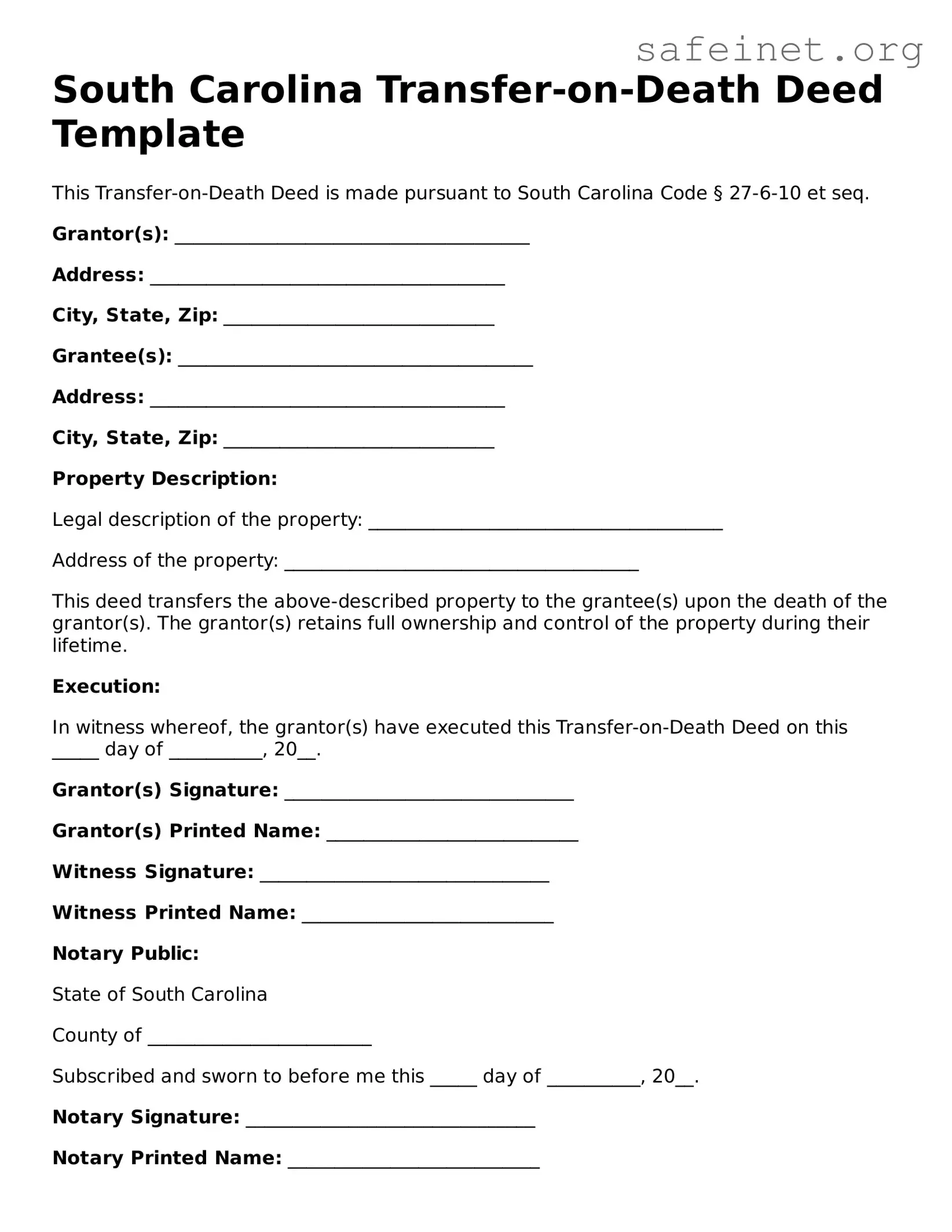
The Transfer-on-Death Deed (TOD) form in South Carolina serves as a valuable estate planning tool, allowing property owners to transfer real estate to designated beneficiaries upon their death without the need for probate. This straightforward document simplifies the process of passing on property, ensuring that loved ones receive their inheritance quickly and efficiently. By designating a beneficiary or beneficiaries, property owners can maintain control over their assets during their lifetime while ensuring a seamless transition after they pass away. The TOD deed must be executed in accordance with specific state requirements, including proper notarization and recording with the county register of deeds. Understanding the nuances of this form can empower individuals to make informed decisions about their estate planning, ultimately providing peace of mind for both the property owner and their heirs.
South Carolina Transfer-on-Death Deed Template
This Transfer-on-Death Deed is made pursuant to South Carolina Code § 27-6-10 et seq.
Grantor(s): ______________________________________
Address: ______________________________________
City, State, Zip: _____________________________
Grantee(s): ______________________________________
Address: ______________________________________
City, State, Zip: _____________________________
Property Description:
Legal description of the property: ______________________________________
Address of the property: ______________________________________
This deed transfers the above-described property to the grantee(s) upon the death of the grantor(s). The grantor(s) retains full ownership and control of the property during their lifetime.
Execution:
In witness whereof, the grantor(s) have executed this Transfer-on-Death Deed on this _____ day of __________, 20__.
Grantor(s) Signature: _______________________________
Grantor(s) Printed Name: ___________________________
Witness Signature: _______________________________
Witness Printed Name: ___________________________
Notary Public:
State of South Carolina
County of ________________________
Subscribed and sworn to before me this _____ day of __________, 20__.
Notary Signature: _______________________________
Notary Printed Name: ___________________________
My Commission Expires: ___________________________
| Fact Name | Description |
|---|---|
| Definition | A Transfer-on-Death Deed allows an individual to transfer real estate to a beneficiary upon their death without the property going through probate. |
| Governing Law | The Transfer-on-Death Deed in South Carolina is governed by the South Carolina Code of Laws, specifically Section 27-6-10 through Section 27-6-30. |
| Beneficiary Designation | Individuals can designate one or more beneficiaries in the deed, and they can also change or revoke the designation at any time during their lifetime. |
| Execution Requirements | The deed must be signed by the property owner and witnessed by two individuals who are not beneficiaries, and it must be recorded in the county where the property is located. |
| Impact on Taxes | Using a Transfer-on-Death Deed does not affect property taxes during the owner's lifetime. However, tax implications may arise for beneficiaries upon transfer. |
After obtaining the South Carolina Transfer-on-Death Deed form, you will need to complete it accurately to ensure the transfer of property upon death. Follow these steps carefully to fill out the form correctly.
Once the form is filed, it will be recorded in the public records. This ensures that your wishes regarding the property transfer are legally recognized after your passing.
What is a Transfer-on-Death Deed in South Carolina?
A Transfer-on-Death Deed (TOD Deed) is a legal document that allows property owners in South Carolina to transfer their real estate to designated beneficiaries upon their death. This deed does not require the property to go through probate, which can simplify the process of transferring ownership. The property owner retains full control of the property during their lifetime, and the beneficiaries have no rights until the owner passes away.
How do I create a Transfer-on-Death Deed in South Carolina?
To create a Transfer-on-Death Deed in South Carolina, the property owner must complete the form accurately, including the legal description of the property and the names of the beneficiaries. The deed must be signed by the property owner in the presence of a notary public. After signing, the deed should be recorded with the county register of deeds where the property is located. Recording the deed ensures that the transfer is legally recognized and provides public notice of the beneficiaries.
Can I change or revoke a Transfer-on-Death Deed after it is created?
Yes, a Transfer-on-Death Deed can be changed or revoked at any time before the property owner's death. To revoke the deed, the property owner must execute a new deed that explicitly states the revocation or file a formal revocation document with the county register of deeds. If changes are needed, a new TOD Deed can be created to replace the existing one, ensuring that the new beneficiaries are clearly identified.
Are there any limitations to using a Transfer-on-Death Deed?
While a Transfer-on-Death Deed offers many benefits, there are limitations to consider. For instance, the deed cannot be used for all types of property, such as personal property or certain types of interests in real estate. Additionally, if the property owner has outstanding debts or liens, creditors may still claim the property after the owner's death. It is important to consult with a legal professional to understand how a TOD Deed fits into your overall estate planning strategy.
Incorrect Property Description: People often fail to provide a complete and accurate description of the property. This can lead to confusion or disputes in the future.
Missing Signatures: All required parties must sign the deed. Sometimes, individuals forget to sign, which invalidates the document.
Improper Notarization: The deed must be notarized correctly. Some individuals neglect this step or choose an unqualified notary, which can render the deed unenforceable.
Failure to Name Beneficiaries: It's crucial to clearly name the beneficiaries. Leaving this section blank or using vague terms can lead to complications.
Not Following State Requirements: Each state has specific requirements for Transfer-on-Death Deeds. Failing to adhere to South Carolina's rules can invalidate the deed.
Not Recording the Deed: After completing the deed, individuals sometimes forget to record it with the county clerk. This step is essential for the deed to take effect.
Confusing Joint Ownership: When property is owned jointly, people may not understand how to properly fill out the deed. This can lead to unintended consequences for the surviving owner.
Ignoring Tax Implications: Some individuals overlook potential tax consequences of transferring property upon death. Understanding these implications is vital for proper estate planning.
When dealing with the South Carolina Transfer-on-Death Deed, several other forms and documents may be necessary to ensure a smooth transfer of property. Each of these documents plays a specific role in the process, helping to clarify intentions and protect the rights of all parties involved.
Understanding these documents is crucial for anyone considering a Transfer-on-Death Deed in South Carolina. Each plays a vital role in ensuring that property transfers smoothly and according to the owner's wishes. By being informed, individuals can navigate the process more effectively and secure their legacy for future generations.
The South Carolina Transfer-on-Death Deed (TOD) form is similar to a Last Will and Testament in that both documents allow individuals to designate beneficiaries for their assets upon their passing. A Last Will and Testament provides a comprehensive plan for the distribution of a person's estate, including personal property, real estate, and financial accounts. However, unlike a will, the TOD deed allows for the direct transfer of property without the need for probate, simplifying the process for heirs and ensuring a more immediate transfer of ownership.
Another document that shares similarities with the TOD deed is the Revocable Living Trust. Like the TOD deed, a revocable living trust allows property to be transferred outside of probate. Individuals can place their assets into the trust during their lifetime, and upon death, the assets are distributed according to the terms set forth in the trust document. This method can provide greater privacy and potentially avoid the lengthy probate process, making it an appealing option for many individuals.
The Beneficiary Designation form is also akin to the TOD deed. This document is often used for financial accounts, such as bank accounts or retirement plans, allowing account holders to name beneficiaries who will receive the assets directly upon their death. Similar to the TOD deed, this form bypasses probate and ensures a quicker transfer of assets to the designated beneficiaries, which can be particularly beneficial in preserving the deceased's financial intentions.
The Joint Tenancy with Right of Survivorship is another document that parallels the TOD deed. This form of property ownership allows two or more individuals to hold title to property together. Upon the death of one owner, the surviving owner(s) automatically inherit the deceased's share of the property without the need for probate. This arrangement simplifies the transfer of property and ensures that it passes seamlessly to the remaining owners, much like the TOD deed facilitates the transfer of real estate directly to named beneficiaries.
A Power of Attorney (POA) can also be compared to the TOD deed, although it serves a different purpose. A POA allows an individual to appoint someone else to make financial or legal decisions on their behalf while they are alive. While it does not directly transfer property upon death, it can facilitate the management of assets during an individual’s lifetime, ensuring that the person’s wishes are honored. This document can work in conjunction with a TOD deed by allowing the designated agent to manage the property before it is transferred to beneficiaries.
The Life Estate deed is another document that shares characteristics with the TOD deed. A life estate deed allows an individual to retain the right to live in or use a property during their lifetime, while designating one or more beneficiaries to inherit the property after their death. This arrangement provides the current owner with control over the property while ensuring that it passes directly to the designated beneficiaries without going through probate, similar to the TOD deed.
Another relevant document is the Transfer-on-Death Account. This type of account allows individuals to designate beneficiaries for bank or investment accounts, ensuring that the funds are transferred directly to the named individuals upon the account holder's death. Like the TOD deed, this account type bypasses the probate process, providing a straightforward and efficient way to transfer financial assets to heirs.
The Deed of Gift is also comparable to the TOD deed. This document allows an individual to transfer property as a gift to another person during their lifetime. While the TOD deed is effective upon death, the deed of gift immediately transfers ownership, which can have tax implications and considerations for both the giver and the recipient. Both documents serve to transfer property but do so at different times and under different circumstances.
Lastly, the Affidavit of Heirship serves as a useful document in conjunction with the TOD deed. This affidavit is often used to establish the identity of heirs when someone dies without a will. It can simplify the process of transferring property to heirs by providing legal recognition of their status as beneficiaries. While the TOD deed provides a clear pathway for property transfer upon death, the affidavit can help clarify and support the intentions of the deceased when there is no formal will in place.
When filling out the South Carolina Transfer-on-Death Deed form, it’s important to approach the task with care. Here are some key dos and don’ts to keep in mind:
Following these guidelines can help ensure that the process goes smoothly and that your intentions are clearly documented.
The South Carolina Transfer-on-Death Deed (TODD) form is often misunderstood. Here are five common misconceptions:
Filling out and using the South Carolina Transfer-on-Death Deed form can be a straightforward process if you keep a few key points in mind. Here are some essential takeaways to guide you:
By keeping these points in mind, you can navigate the process of using a Transfer-on-Death Deed in South Carolina with confidence.