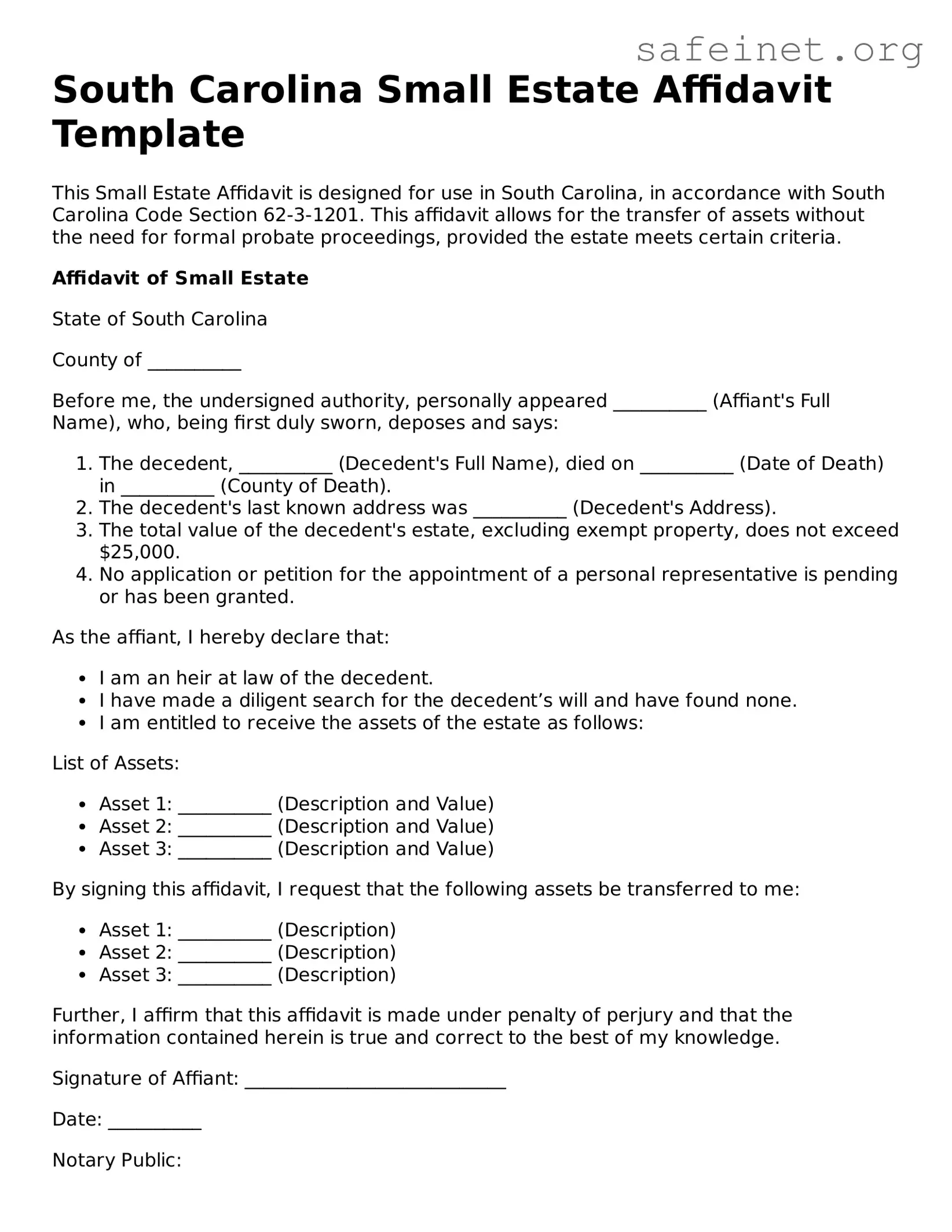
In South Carolina, managing the estate of a deceased loved one can be a complex process, but the Small Estate Affidavit form simplifies matters for certain situations. This form is designed for estates with a total value of $25,000 or less, excluding real property. It allows the heirs to claim the deceased's assets without going through the lengthy probate process. By completing this affidavit, individuals can assert their rights to the estate's assets, such as bank accounts, personal property, and other items of value. The form requires specific information, including the deceased's details, the names of the heirs, and a declaration that no other probate proceedings are pending. Additionally, it must be signed under oath, ensuring that all information provided is accurate and truthful. Understanding how to properly fill out and submit the Small Estate Affidavit can save time and reduce stress during an already challenging time.
South Carolina Small Estate Affidavit Template
This Small Estate Affidavit is designed for use in South Carolina, in accordance with South Carolina Code Section 62-3-1201. This affidavit allows for the transfer of assets without the need for formal probate proceedings, provided the estate meets certain criteria.
Affidavit of Small Estate
State of South Carolina
County of __________
Before me, the undersigned authority, personally appeared __________ (Affiant's Full Name), who, being first duly sworn, deposes and says:
As the affiant, I hereby declare that:
List of Assets:
By signing this affidavit, I request that the following assets be transferred to me:
Further, I affirm that this affidavit is made under penalty of perjury and that the information contained herein is true and correct to the best of my knowledge.
Signature of Affiant: ____________________________
Date: __________
Notary Public:
____________________________
My Commission Expires: __________
| Fact Name | Description |
|---|---|
| Purpose | The South Carolina Small Estate Affidavit allows heirs to claim property without formal probate proceedings if the estate is below a certain value. |
| Value Limit | As of 2023, the estate must not exceed $25,000 in value for a single individual, or $50,000 for a married couple. |
| Governing Law | The affidavit is governed by South Carolina Code of Laws, Section 62-3-1201. |
| Eligibility | Only heirs or beneficiaries who are entitled to the estate can use this affidavit to claim assets. |
| Required Information | The form must include details about the decedent, the heirs, and the specific assets being claimed. |
| Signature Requirement | The affidavit must be signed by the person claiming the property, affirming the truthfulness of the information provided. |
| Filing Process | No formal filing with the court is required, but the affidavit may need to be presented to financial institutions or other entities holding the assets. |
| Limitations | This process cannot be used for real estate; separate procedures are necessary for transferring real property. |
| Time Frame | The affidavit can typically be used immediately after the decedent's death, but it is advisable to wait for a short period to ensure all debts are settled. |
After gathering the necessary information and documents, you are ready to fill out the South Carolina Small Estate Affidavit form. This form allows individuals to claim assets of a deceased person without going through the full probate process. Follow these steps to complete the form accurately.
Once the form is filled out and notarized, it can be submitted to the appropriate financial institutions or agencies to claim the assets. Keep all documents organized, as you may need to provide additional information later.
What is a Small Estate Affidavit in South Carolina?
A Small Estate Affidavit is a legal document that allows heirs to claim assets of a deceased person without going through the formal probate process. In South Carolina, this option is available when the total value of the estate is below a certain threshold, making it a simpler and quicker way to settle the estate.
What is the threshold value for a Small Estate in South Carolina?
As of October 2023, the total value of the estate must not exceed $25,000, excluding certain types of property such as real estate. If the estate meets this requirement, heirs can utilize the Small Estate Affidavit to access the deceased's assets.
Who can use the Small Estate Affidavit?
The Small Estate Affidavit can be used by the heirs or beneficiaries of the deceased individual. Typically, this includes immediate family members such as spouses, children, or parents. It is essential that the person filing the affidavit is entitled to the assets according to South Carolina law.
What assets can be claimed using a Small Estate Affidavit?
Assets that can be claimed include bank accounts, personal property, and other financial assets owned by the deceased. However, real estate cannot be transferred using this affidavit. If real property is involved, a different legal process must be followed.
How do I complete a Small Estate Affidavit?
To complete a Small Estate Affidavit, you must fill out the appropriate form, which includes details about the deceased, the heirs, and the assets involved. The affidavit must be signed in front of a notary public. Ensure that all information is accurate to avoid delays.
Is there a filing fee for the Small Estate Affidavit?
No filing fee is required for submitting a Small Estate Affidavit in South Carolina. However, if you need to record the affidavit with the county clerk, there may be a nominal fee for that service.
What happens after I submit the Small Estate Affidavit?
Once the Small Estate Affidavit is completed and notarized, it can be presented to banks, financial institutions, or other entities holding the deceased's assets. They will review the affidavit and, if everything is in order, release the assets to the heirs.
Can a Small Estate Affidavit be contested?
How long does the Small Estate Affidavit process take?
The Small Estate Affidavit process can be relatively quick, often taking just a few weeks. However, this timeframe can vary based on factors such as the complexity of the estate and whether any disputes arise. Promptly gathering all necessary documentation can help expedite the process.
Where can I obtain a Small Estate Affidavit form?
A Small Estate Affidavit form can typically be obtained from the South Carolina Secretary of State's website or from local probate court offices. It is advisable to ensure that you are using the most current version of the form to avoid any issues.
Not including all required information. It’s essential to provide complete details about the deceased, including their full name, date of death, and last known address.
Failing to list all assets. People often overlook certain assets, such as bank accounts, real estate, or personal property, which can lead to complications.
Incorrectly identifying heirs. Ensure that all heirs are correctly named and that their relationship to the deceased is clearly stated.
Not signing the affidavit. An unsigned affidavit is not valid. Remember to sign and date the form before submission.
Neglecting to have the affidavit notarized. In South Carolina, a notary's signature is required to validate the affidavit.
Using outdated forms. Always check for the most current version of the Small Estate Affidavit form to avoid any issues.
Not providing supporting documentation. Attach necessary documents, such as the death certificate and proof of assets, to support your claims.
Ignoring local laws and regulations. Each county may have specific requirements or additional forms. Familiarize yourself with local rules to ensure compliance.
When dealing with the South Carolina Small Estate Affidavit, there are several other forms and documents that may be necessary to ensure a smooth process in settling an estate. Each of these documents serves a specific purpose and can help clarify the intentions of the parties involved. Below is a list of commonly used forms alongside the Small Estate Affidavit.
Gathering these documents can help streamline the estate settlement process and ensure that all legal requirements are met. Each form plays a crucial role in clarifying the situation and protecting the interests of the heirs involved.
The South Carolina Small Estate Affidavit is similar to a Last Will and Testament in that both documents serve to distribute a deceased person's assets. A Last Will outlines the wishes of the deceased regarding how their property should be divided among heirs. However, the Small Estate Affidavit is used when the estate's total value falls below a certain threshold, allowing for a simpler process without the need for probate court. This document allows heirs to claim assets directly, streamlining the transition of ownership.
Another document comparable to the Small Estate Affidavit is the Affidavit of Heirship. This document is used to establish the rightful heirs of a deceased person when no formal will exists. Like the Small Estate Affidavit, the Affidavit of Heirship can facilitate the transfer of property without going through probate. However, it typically requires additional proof of the deceased's family relationships, whereas the Small Estate Affidavit is used when a will exists or when the estate qualifies under state law.
The Small Estate Affidavit also shares similarities with a Trust. A Trust allows for the management and distribution of assets during a person's lifetime and after death. Both documents can help bypass the probate process, but a Trust is generally more complex and requires more formalities to establish. In contrast, the Small Estate Affidavit is designed for simpler cases where the estate is small and straightforward.
A Power of Attorney can be likened to the Small Estate Affidavit in terms of granting authority. While a Power of Attorney allows an individual to manage another person's affairs while they are alive, the Small Estate Affidavit allows heirs to claim assets after death. Both documents provide a means to facilitate the management of assets, but they operate in different contexts and times of life.
The Small Estate Affidavit is also similar to a Letter of Administration. This document is issued by a court when no will exists, allowing an administrator to manage and distribute the deceased's estate. While both documents aim to facilitate the distribution of assets, the Letter of Administration involves court oversight, whereas the Small Estate Affidavit is a self-executing document used outside of court when the estate qualifies.
In addition, the Small Estate Affidavit can be compared to a Deed of Distribution. This document is used to transfer property from an estate to heirs or beneficiaries. Both documents aim to achieve the same end goal of transferring ownership, but the Deed of Distribution typically follows the probate process, while the Small Estate Affidavit allows heirs to bypass probate altogether under certain conditions.
The Small Estate Affidavit is also similar to an Inventory of Assets. This document lists all the assets of a deceased person. While the Inventory is often part of the probate process, the Small Estate Affidavit serves as a means to claim those assets without formal probate. Both documents provide clarity on the assets involved, but the Inventory is more comprehensive and typically used in larger estates.
Another related document is the Claim Against Estate form. This form allows creditors to assert claims against a deceased person's estate. Similar to the Small Estate Affidavit, it is used in the context of estate management. However, the Claim Against Estate form is focused on debts owed by the estate, while the Small Estate Affidavit is used to facilitate the distribution of remaining assets to heirs.
Lastly, the Small Estate Affidavit is akin to a Waiver of Notice. This document allows heirs to waive their right to receive formal notice of probate proceedings. Both documents can simplify the estate process, but the Waiver of Notice is specifically about notifications and does not facilitate asset transfer like the Small Estate Affidavit does. Each serves a distinct purpose within the broader context of estate management.
When filling out the South Carolina Small Estate Affidavit form, attention to detail is crucial. Here are some important do's and don'ts to keep in mind:
Following these guidelines will help streamline the process and reduce the likelihood of complications. Ensure that you approach this task with care and diligence.
Misconception 1: The Small Estate Affidavit can only be used for estates under a certain dollar amount.
Many people believe that the Small Estate Affidavit is limited to estates worth less than a specific figure, such as $25,000. However, in South Carolina, the threshold is actually $25,000 for personal property and $50,000 for real property. It's important to check the current limits, as they can change over time.
Misconception 2: You need to go through probate to use a Small Estate Affidavit.
Some individuals think that a Small Estate Affidavit is just another step in the probate process. In reality, this affidavit allows heirs to bypass formal probate proceedings altogether, simplifying the transfer of assets.
Misconception 3: Only heirs can use the Small Estate Affidavit.
While it's true that heirs typically use this form, it's a misconception that only they can. Anyone who has a legal right to the deceased's property, such as a personal representative or a designated beneficiary, may also use the Small Estate Affidavit.
Misconception 4: The Small Estate Affidavit is a complicated legal document.
Many people fear that the Small Estate Affidavit is overly complex. In fact, it is designed to be straightforward and user-friendly. With the right guidance, completing this form can be a manageable task for most individuals.
When dealing with the South Carolina Small Estate Affidavit form, understanding the key aspects can simplify the process. Here are important takeaways to consider: