When renting a property in South Carolina, understanding the Residential Lease Agreement form is crucial for both landlords and tenants. This document serves as a binding contract that outlines the rights and responsibilities of each party involved in the rental process. Key components of the agreement include the rental amount, payment due dates, and the length of the lease term, which can vary from month-to-month arrangements to longer fixed terms. Additionally, the form details security deposit requirements, maintenance responsibilities, and rules regarding pets or alterations to the property. Both parties must also be aware of the conditions under which the lease can be terminated, ensuring clarity and protection for everyone involved. By comprehensively addressing these aspects, the South Carolina Residential Lease Agreement helps create a transparent and fair rental experience, fostering a positive relationship between landlords and tenants.
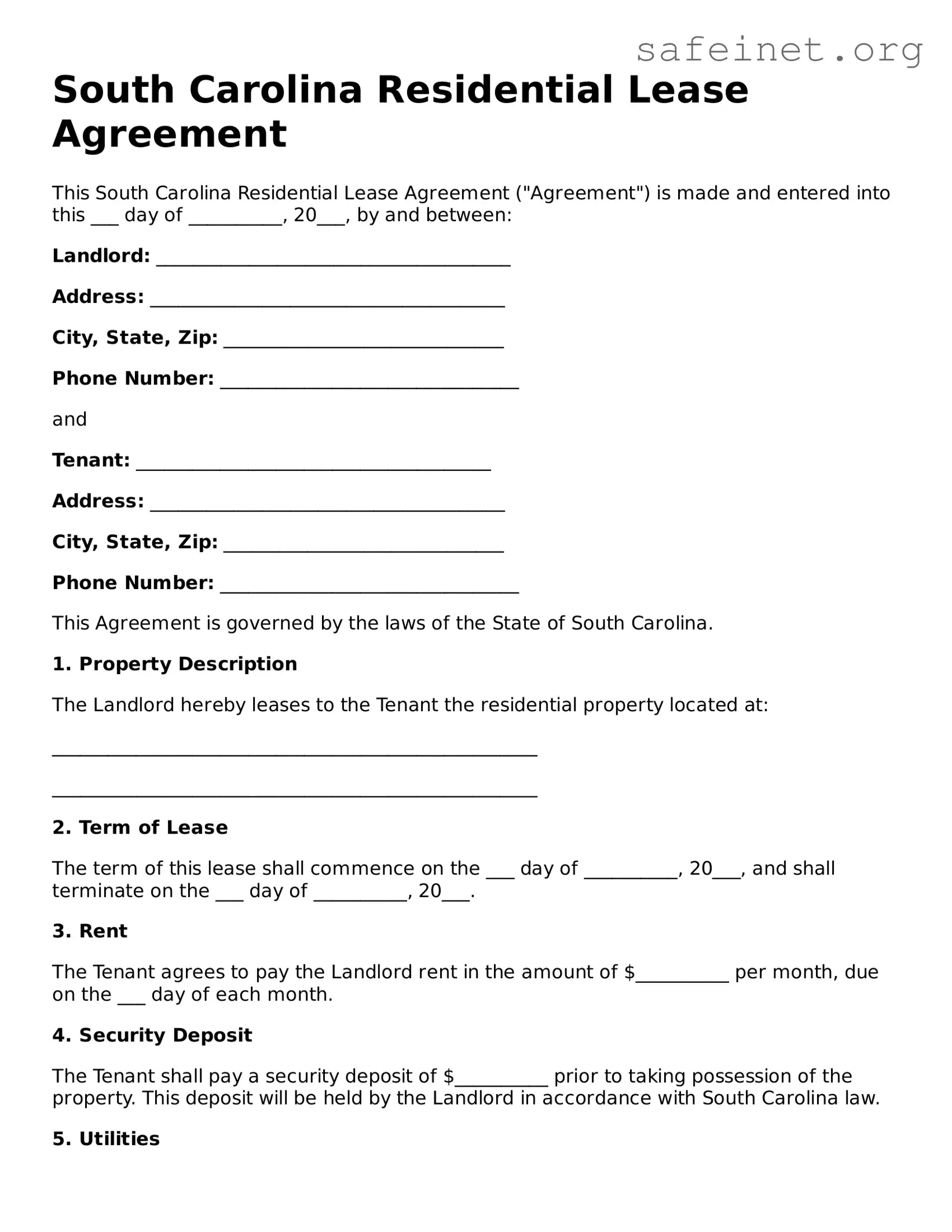
South Carolina Residential Lease Agreement
This South Carolina Residential Lease Agreement ("Agreement") is made and entered into this ___ day of __________, 20___, by and between:
Landlord: ______________________________________
Address: ______________________________________
City, State, Zip: ______________________________
Phone Number: ________________________________
and
Tenant: ______________________________________
Address: ______________________________________
City, State, Zip: ______________________________
Phone Number: ________________________________
This Agreement is governed by the laws of the State of South Carolina.
1. Property Description
The Landlord hereby leases to the Tenant the residential property located at:
____________________________________________________
____________________________________________________
2. Term of Lease
The term of this lease shall commence on the ___ day of __________, 20___, and shall terminate on the ___ day of __________, 20___.
3. Rent
The Tenant agrees to pay the Landlord rent in the amount of $__________ per month, due on the ___ day of each month.
4. Security Deposit
The Tenant shall pay a security deposit of $__________ prior to taking possession of the property. This deposit will be held by the Landlord in accordance with South Carolina law.
5. Utilities
The Tenant is responsible for the payment of the following utilities:
6. Maintenance and Repairs
The Tenant shall maintain the property in a clean and safe condition. The Tenant must promptly notify the Landlord of any necessary repairs.
7. Termination
Either party may terminate this Agreement by providing written notice of at least ___ days prior to the intended termination date.
8. Governing Law
This Agreement shall be governed by and construed in accordance with the laws of the State of South Carolina.
IN WITNESS WHEREOF, the parties hereto have executed this South Carolina Residential Lease Agreement as of the date first above written.
Landlord Signature: ____________________________
Date: ______________________________________
Tenant Signature: ____________________________
Date: ______________________________________
| Fact Name | Description |
|---|---|
| Governing Law | The South Carolina Residential Lease Agreement is governed by South Carolina state law, specifically Title 27 of the South Carolina Code of Laws. |
| Parties Involved | The agreement typically involves a landlord (lessor) and a tenant (lessee). Both parties must be clearly identified in the document. |
| Lease Term | The lease term can vary. It may be for a fixed period, such as one year, or it can be a month-to-month arrangement. |
| Rent Payment | The lease must specify the amount of rent due, the due date, and acceptable payment methods. |
| Security Deposit | A security deposit is often required. South Carolina law limits the amount to no more than one month's rent for residential leases. |
| Maintenance Responsibilities | The lease should outline who is responsible for maintenance and repairs. Generally, landlords handle major repairs, while tenants may be responsible for minor upkeep. |
| Termination Notice | Notice requirements for terminating the lease must be included. Typically, a 30-day notice is required for month-to-month leases. |
| Dispute Resolution | The agreement may include provisions for resolving disputes, such as mediation or arbitration, to avoid court proceedings. |
Filling out the South Carolina Residential Lease Agreement form is an important step in establishing a rental relationship. This document outlines the terms and conditions agreed upon by both the landlord and the tenant. Following these steps will help ensure that all necessary information is accurately provided.
Once the form is completed, both parties should keep a copy for their records. This ensures that everyone understands their rights and responsibilities throughout the lease period.
What is a South Carolina Residential Lease Agreement?
A South Carolina Residential Lease Agreement is a legal document that outlines the terms and conditions between a landlord and a tenant for renting a residential property. It typically includes details about the rental amount, duration of the lease, security deposits, and responsibilities of both parties.
What are the key components of this lease agreement?
Key components usually include the names of the landlord and tenant, property address, lease term (length of time), rent amount and payment due dates, security deposit requirements, maintenance responsibilities, and any rules or restrictions specific to the property.
How long is a typical lease term?
Lease terms can vary, but they commonly range from six months to one year. Some landlords may offer month-to-month agreements, which provide more flexibility for both parties.
What happens if the tenant wants to break the lease early?
If a tenant needs to break the lease early, they should review the lease agreement for any specific terms regarding early termination. Often, tenants may be required to provide notice and possibly pay a fee or forfeit their security deposit. It's best to communicate with the landlord to discuss options.
Is a security deposit required?
Yes, most landlords require a security deposit. This deposit serves as a financial protection for the landlord against potential damages or unpaid rent. In South Carolina, the maximum amount for a security deposit is typically equivalent to one month's rent.
Can a landlord enter the rental property without notice?
Generally, landlords must provide reasonable notice before entering a tenant's property, usually 24 hours. Exceptions may apply in emergencies. It’s important for both parties to understand their rights regarding privacy and access.
What are the tenant's responsibilities under the lease?
Tenants are typically responsible for paying rent on time, maintaining the property in good condition, and adhering to any rules outlined in the lease. This can include restrictions on pets, noise levels, and more.
What should a tenant do if repairs are needed?
If repairs are needed, tenants should promptly notify the landlord in writing. This ensures there is a record of the request. Landlords are usually responsible for making necessary repairs, but tenants should follow up if issues are not addressed in a timely manner.
Can the lease be renewed?
Yes, many leases include a renewal option. This allows the tenant to continue renting the property under the same terms or negotiate new terms. It's important to discuss renewal with the landlord well before the lease expires.
What happens if a tenant does not pay rent?
If rent is not paid, landlords typically have the right to issue a notice to the tenant. This notice may require the tenant to pay the overdue rent or face eviction proceedings. It’s crucial for tenants to communicate with their landlord if they are experiencing financial difficulties.
Failing to include the full names of all tenants. Each tenant's name must be listed to ensure everyone is legally bound by the lease.
Not specifying the lease term. Clearly state the start and end dates of the lease to avoid confusion.
Omitting the rent amount. Ensure the monthly rent is clearly indicated, along with the due date.
Ignoring the security deposit section. Include the amount and terms regarding its return.
Neglecting to outline maintenance responsibilities. Clearly define who is responsible for repairs and upkeep.
Not addressing utilities. Specify which utilities are included in the rent and which are the tenant's responsibility.
Failing to include pet policies. If pets are allowed, state any restrictions or additional fees.
Leaving out the termination clause. Clearly outline the process for ending the lease, including notice periods.
Not signing the lease. Both parties must sign and date the agreement to make it valid.
Overlooking state-specific laws. Familiarize yourself with South Carolina rental laws to ensure compliance.
When entering into a rental agreement in South Carolina, several additional forms and documents can help clarify the terms and protect the interests of both landlords and tenants. Understanding these documents can enhance the rental experience and ensure compliance with state laws.
By familiarizing yourself with these documents, both landlords and tenants can navigate the rental process more smoothly. Each form plays a vital role in establishing clear expectations and protecting the rights of everyone involved.
The South Carolina Residential Lease Agreement form shares similarities with the Commercial Lease Agreement. Both documents outline the terms and conditions under which a property is leased. However, while a residential lease focuses on living spaces, a commercial lease pertains to business premises. Each agreement includes details about the duration of the lease, payment terms, and responsibilities of both parties, ensuring clarity in the landlord-tenant relationship.
Another document akin to the Residential Lease Agreement is the Month-to-Month Rental Agreement. This agreement allows tenants to occupy a property on a flexible basis, with no fixed end date. Like the Residential Lease Agreement, it stipulates rent amount and payment due dates, but it also includes provisions for termination notice, which can be shorter compared to a traditional lease.
The Rental Application form is also similar, as it is often used in conjunction with the Residential Lease Agreement. This document collects personal information from prospective tenants, including employment history and references. It serves to evaluate the applicant's suitability for renting the property, ensuring that landlords make informed decisions before entering into a lease.
Another related document is the Lease Renewal Agreement. This form is used when both parties agree to extend the original lease. It typically reiterates the terms of the initial lease while allowing for any necessary updates. The Lease Renewal Agreement ensures that the tenant can continue their residency under clear and agreed-upon conditions.
The Sublease Agreement is another important document that resembles the Residential Lease Agreement. This form allows a tenant to lease their rented space to another individual, known as the subtenant. It outlines the responsibilities of both the original tenant and the subtenant, ensuring that the original lease terms are upheld and that the landlord is informed of the arrangement.
The Lease Termination Agreement is similar in that it provides a formal method for ending a lease. It outlines the conditions under which a lease may be terminated, such as mutual consent or breach of contract. This document protects the interests of both the landlord and tenant by clearly defining the process and obligations involved in ending the rental relationship.
The Move-In/Move-Out Checklist is another document that complements the Residential Lease Agreement. This checklist is used to document the condition of the property at the time of move-in and move-out. It helps prevent disputes over security deposits by providing a clear record of any damages or issues that existed before the tenant's occupancy.
Additionally, the Security Deposit Agreement is related to the Residential Lease Agreement. This document specifies the amount of the security deposit, the conditions for its return, and any deductions that may be made. It is crucial for both landlords and tenants to understand their rights and obligations regarding the security deposit to avoid misunderstandings.
Lastly, the Pet Agreement is similar, particularly for residential leases that allow pets. This document outlines the specific terms and conditions regarding pet ownership within the rental property. It addresses issues such as pet deposits, restrictions on pet types, and responsibilities for damages caused by pets, ensuring that both parties are aware of their obligations.
When filling out the South Carolina Residential Lease Agreement form, it’s important to approach the process with care. Here are some key do's and don'ts to keep in mind:
Being thorough and attentive can help prevent misunderstandings and protect your rights as a tenant or landlord. Always remember that a well-completed lease agreement sets the foundation for a positive rental experience.
There are several misconceptions about the South Carolina Residential Lease Agreement form that can lead to confusion for both landlords and tenants. Here are seven common misunderstandings:
Many people believe that all residential lease agreements are identical. In reality, each lease can vary significantly based on the terms negotiated between the landlord and tenant.
Some individuals think that a verbal agreement is sufficient for a lease. However, having a written lease agreement is important to protect both parties and clarify the terms of the rental arrangement.
There is a misconception that all security deposits are non-refundable. In South Carolina, if the property is returned in good condition, the tenant may receive the deposit back, minus any deductions for damages.
Some believe that landlords can change the lease terms whenever they want. Changes to the lease must be agreed upon by both parties and typically require a written amendment.
Many tenants think landlords can access the rental property at any time. In South Carolina, landlords must provide reasonable notice before entering the property, except in emergencies.
It is often assumed that landlords are responsible for all maintenance issues. While they are responsible for major repairs, tenants may also have responsibilities for minor upkeep as outlined in the lease.
Some people believe that lease agreements are only applicable for long-term rentals. However, lease agreements can be used for short-term rentals as well, depending on the terms specified.
When filling out and using the South Carolina Residential Lease Agreement form, it’s important to keep a few key points in mind. Here are some takeaways to help guide you through the process:
By following these guidelines, you can navigate the South Carolina Residential Lease Agreement form with confidence and clarity.