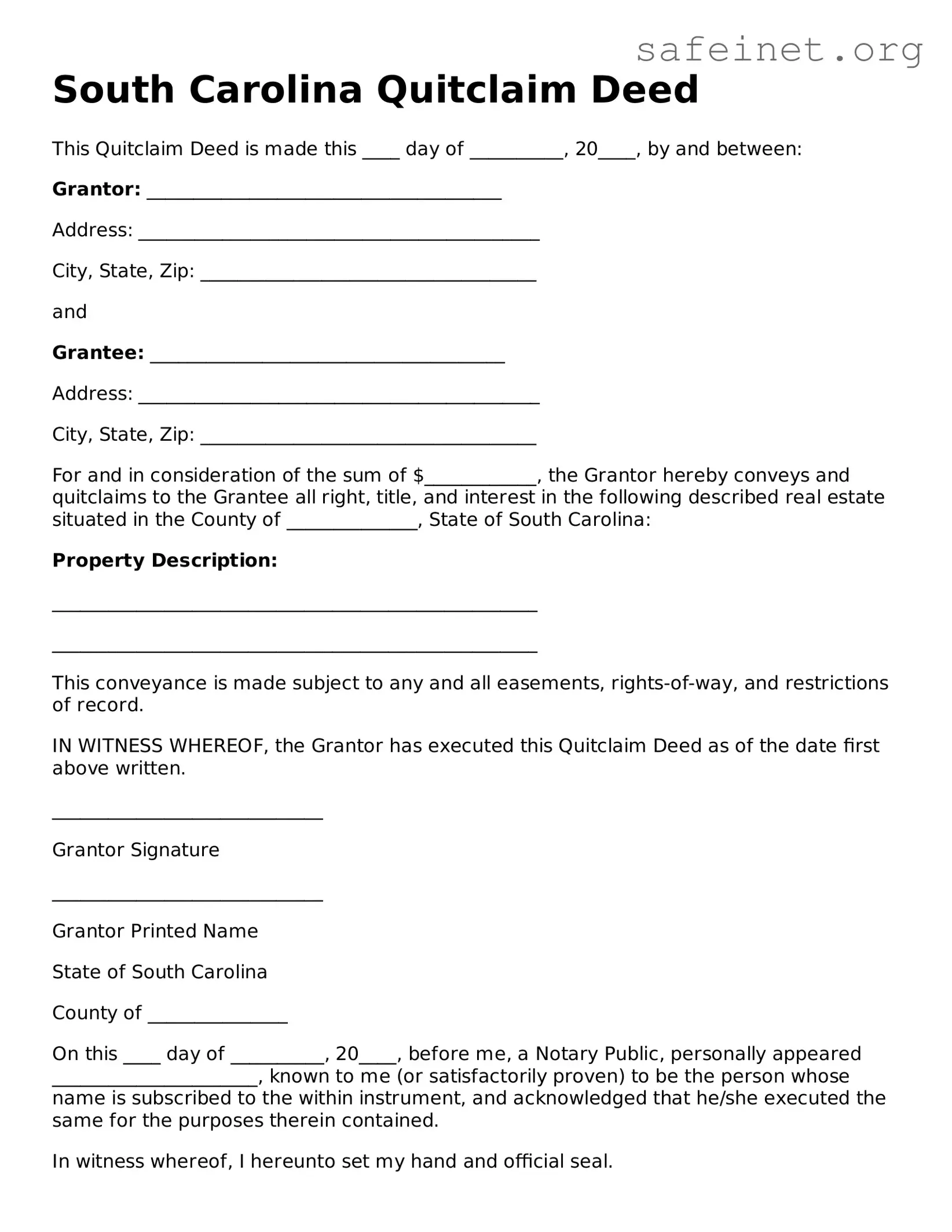
The South Carolina Quitclaim Deed is a legal instrument that facilitates the transfer of real estate ownership from one party to another, often without warranties regarding the title. This form is particularly useful in situations where the grantor, or seller, wishes to convey their interest in a property quickly and simply, such as during family transactions, divorce settlements, or when clearing up title issues. Unlike a warranty deed, which provides assurances about the title's validity, a quitclaim deed transfers whatever interest the grantor may have, if any, without guaranteeing that the title is free of defects. Essential elements of the form include the names of the parties involved, a description of the property being transferred, and the signature of the grantor. Additionally, it must be notarized and recorded with the local county clerk to be legally effective. Understanding the nuances of this deed is crucial for both grantors and grantees, as it impacts their rights and responsibilities concerning the property in question.
South Carolina Quitclaim Deed
This Quitclaim Deed is made this ____ day of __________, 20____, by and between:
Grantor: ______________________________________
Address: ___________________________________________
City, State, Zip: ____________________________________
and
Grantee: ______________________________________
Address: ___________________________________________
City, State, Zip: ____________________________________
For and in consideration of the sum of $____________, the Grantor hereby conveys and quitclaims to the Grantee all right, title, and interest in the following described real estate situated in the County of ______________, State of South Carolina:
Property Description:
____________________________________________________
____________________________________________________
This conveyance is made subject to any and all easements, rights-of-way, and restrictions of record.
IN WITNESS WHEREOF, the Grantor has executed this Quitclaim Deed as of the date first above written.
_____________________________
Grantor Signature
_____________________________
Grantor Printed Name
State of South Carolina
County of _______________
On this ____ day of __________, 20____, before me, a Notary Public, personally appeared ______________________, known to me (or satisfactorily proven) to be the person whose name is subscribed to the within instrument, and acknowledged that he/she executed the same for the purposes therein contained.
In witness whereof, I hereunto set my hand and official seal.
_____________________________
Notary Public
My commission expires: ________________
| Fact Name | Description |
|---|---|
| Definition | A Quitclaim Deed is a legal document that transfers ownership of real estate from one party to another without any guarantees about the title. |
| Governing Law | In South Carolina, Quitclaim Deeds are governed by Title 27, Chapter 7 of the South Carolina Code of Laws. |
| No Warranty | This type of deed does not provide any warranty of title, meaning the grantor does not guarantee that they own the property free and clear of liens or other claims. |
| Common Uses | Quitclaim Deeds are often used in situations such as divorce settlements, transferring property between family members, or clearing up title issues. |
| Filing Requirements | To be valid, the Quitclaim Deed must be signed by the grantor and notarized. It should then be filed with the county clerk where the property is located. |
After obtaining the South Carolina Quitclaim Deed form, you will need to fill it out accurately to ensure proper transfer of property rights. Once completed, the next step involves signing the form in the presence of a notary public and then recording it with the appropriate county office.
What is a Quitclaim Deed in South Carolina?
A Quitclaim Deed is a legal document used to transfer ownership of real estate from one party to another. Unlike other types of deeds, it does not guarantee that the property title is free from claims or liens. Essentially, the grantor conveys whatever interest they have in the property, if any, to the grantee. This type of deed is often used in situations where the parties know each other well, such as in family transfers or divorces.
When should I use a Quitclaim Deed?
Quitclaim Deeds are typically used in specific scenarios. They are ideal for transferring property between family members, such as parents to children or between siblings. They can also be used to clear up title issues, such as when a person’s name needs to be removed from a property title after a divorce. However, they should be used with caution, as they do not provide the same level of protection as warranty deeds.
How do I complete a Quitclaim Deed in South Carolina?
To complete a Quitclaim Deed in South Carolina, you will need to gather the necessary information, including the names of the grantor and grantee, a description of the property, and the county where the property is located. The form must be signed by the grantor in the presence of a notary public. After signing, it must be filed with the county Register of Deeds to be effective. It is advisable to check local requirements, as they can vary by county.
Is a Quitclaim Deed the same as a Warranty Deed?
No, a Quitclaim Deed is not the same as a Warranty Deed. A Warranty Deed provides guarantees to the grantee that the title is clear and free of encumbrances, offering legal protection. In contrast, a Quitclaim Deed offers no such assurances. The grantor simply relinquishes any claim to the property without any guarantees, making it a riskier option for the grantee.
Are there any tax implications when using a Quitclaim Deed?
Yes, there may be tax implications when using a Quitclaim Deed. While transferring property between family members often qualifies for exemptions, it is essential to consult with a tax professional. The transfer may trigger property taxes or capital gains taxes, depending on the circumstances. Understanding these implications can help avoid unexpected financial consequences.
Can a Quitclaim Deed be revoked?
A Quitclaim Deed cannot be revoked once it has been executed and recorded, as it is a final transfer of interest in the property. However, if the grantor and grantee agree, they can execute a new deed to reverse the transfer. It’s important to note that the original Quitclaim Deed remains valid unless explicitly canceled by mutual agreement or through legal action.
Do I need an attorney to prepare a Quitclaim Deed?
While it is not legally required to have an attorney prepare a Quitclaim Deed in South Carolina, it is highly advisable. An attorney can ensure that the deed is correctly drafted and that all legal requirements are met. They can also provide guidance on potential risks and implications of the transfer, which can be invaluable in protecting your interests.
Not providing accurate property descriptions. It's essential to include the correct address and legal description of the property. Missing or incorrect details can lead to complications.
Forgetting to include the names of all parties involved. All grantors and grantees should be listed. Omitting a name can invalidate the deed.
Failing to sign the document. The deed must be signed by the grantor. Without a signature, the deed is not legally effective.
Not having the deed notarized. A quitclaim deed in South Carolina needs to be notarized to be valid. Skipping this step can cause issues later.
Using outdated forms. Always ensure you are using the most current version of the Quitclaim Deed form. Old forms may not comply with current laws.
Neglecting to check for liens or other encumbrances. Before transferring property, it's wise to ensure there are no outstanding liens that could affect the new owner.
Not recording the deed after signing. The deed must be filed with the county recorder's office. If it’s not recorded, the transfer may not be recognized.
Overlooking the importance of legal advice. Consulting a lawyer can help avoid mistakes and ensure the deed is filled out correctly.
Assuming the Quitclaim Deed is the same as a Warranty Deed. They are different. A Quitclaim Deed offers no guarantees about the property title, unlike a Warranty Deed.
When transferring property in South Carolina, the Quitclaim Deed is an important document. However, several other forms and documents are often used alongside it to ensure a smooth and legally sound transaction. Below is a list of these documents, each serving a specific purpose in the property transfer process.
Each of these documents plays a vital role in the property transfer process in South Carolina. By ensuring that all necessary forms are completed and submitted, both buyers and sellers can protect their interests and facilitate a successful transaction.
The Warranty Deed is a document that conveys real estate ownership from one party to another, similar to a Quitclaim Deed. However, the key difference lies in the guarantees provided. A Warranty Deed offers a warranty that the grantor holds clear title to the property and has the right to transfer it. This means that the grantee is protected against any future claims to the property. In contrast, a Quitclaim Deed transfers whatever interest the grantor may have without any warranties, leaving the grantee exposed to potential claims.
The Bargain and Sale Deed is another document that bears resemblance to the Quitclaim Deed. This type of deed conveys property ownership but implies that the grantor has title to the property. Unlike a Quitclaim Deed, it does not guarantee that the title is free of defects. The grantee may receive some assurance of ownership, but they still assume the risk of any title issues that may arise after the transfer.
A Special Purpose Deed, often used for specific transactions such as transferring property into a trust or during a divorce, shares similarities with a Quitclaim Deed in that it typically does not provide warranties. The intent is to simplify the transfer process for unique situations. While both documents facilitate the transfer of property, a Special Purpose Deed is tailored for specific legal circumstances, whereas a Quitclaim Deed is more general.
The Grant Deed is another document that conveys real estate ownership and is somewhat akin to a Quitclaim Deed. A Grant Deed provides a guarantee that the property has not been sold to anyone else and that it is free from encumbrances, except those disclosed. While a Quitclaim Deed offers no such assurances, the Grant Deed provides a middle ground between full warranties and no warranties at all.
The Deed of Trust, while primarily used in financing transactions, has similarities to the Quitclaim Deed in that it involves the transfer of property rights. In this case, the property is transferred to a trustee who holds it as security for a loan. Both documents involve a transfer of interest, but a Deed of Trust is more complex, as it establishes a relationship between the borrower, lender, and trustee, while a Quitclaim Deed is a straightforward transfer of whatever interest the grantor possesses.
The Bargain and Sale Deed with Covenants is similar to a Quitclaim Deed in that it conveys property without extensive warranties. However, this type of deed includes specific promises regarding the title, such as the grantor's right to sell the property. While it does provide some level of assurance, it does not offer the full protection found in a Warranty Deed, making it a less secure option than a Quitclaim Deed.
Lastly, the Life Estate Deed is a unique document that grants ownership of property to one party for the duration of their life, after which it passes to another party. While it functions differently than a Quitclaim Deed, both documents facilitate the transfer of property rights. The Life Estate Deed, however, creates a more complex ownership structure that involves future interests, whereas a Quitclaim Deed simply transfers whatever interest the grantor may have at the time of the transfer.
When filling out the South Carolina Quitclaim Deed form, it's important to follow certain guidelines to ensure the document is valid and effective. Here’s a list of what you should and shouldn’t do:
By following these steps, you can help ensure a smooth property transfer process in South Carolina.
When it comes to the South Carolina Quitclaim Deed form, there are several misconceptions that can lead to confusion. Here are seven common myths, along with clarifications to help you understand this important document.
This is partially true. A Quitclaim Deed transfers whatever interest the grantor has in the property, but it does not guarantee that the grantor actually owns the property or has the right to transfer it.
While they are commonly used in family transactions, Quitclaim Deeds can be used in any situation where the parties agree to transfer property interests, regardless of their relationship.
This is false. A Warranty Deed provides a guarantee that the grantor holds clear title to the property, while a Quitclaim Deed does not offer any such assurances.
Although it is not legally required to record a Quitclaim Deed, failing to do so can create issues in establishing clear ownership and may lead to disputes in the future.
This is incorrect. A Quitclaim Deed transfers property interests but does not relieve the grantor from any existing mortgage or debt obligations associated with the property.
While this discussion focuses on South Carolina, Quitclaim Deeds are used in many states across the U.S. Each state may have its own rules and regulations regarding their use.
While it’s possible to complete a Quitclaim Deed without legal help, consulting with a professional can ensure that the document is filled out correctly and that all legal requirements are met.
Understanding these misconceptions can help you navigate property transfers more confidently. Always consider seeking professional advice to ensure that your interests are protected.
When dealing with a Quitclaim Deed in South Carolina, it's essential to understand its purpose and how to fill it out correctly. Here are some key takeaways:
Understanding these key points can help you navigate the Quitclaim Deed process in South Carolina more effectively.