In South Carolina, a prenuptial agreement serves as a vital tool for couples looking to establish clear financial boundaries and expectations before entering into marriage. This legally binding document outlines how assets and debts will be managed during the marriage and addresses their division in the event of divorce or separation. Couples can specify the rights to property acquired before and during the marriage, ensuring that both parties have a mutual understanding of their financial responsibilities. Additionally, the agreement can address issues such as spousal support and the handling of debts, providing a comprehensive framework for financial matters. By utilizing the South Carolina Prenuptial Agreement form, couples can protect their individual interests while fostering open communication about their financial future. This proactive approach not only safeguards personal assets but also helps to minimize potential conflicts, allowing couples to focus on building a strong foundation for their life together.
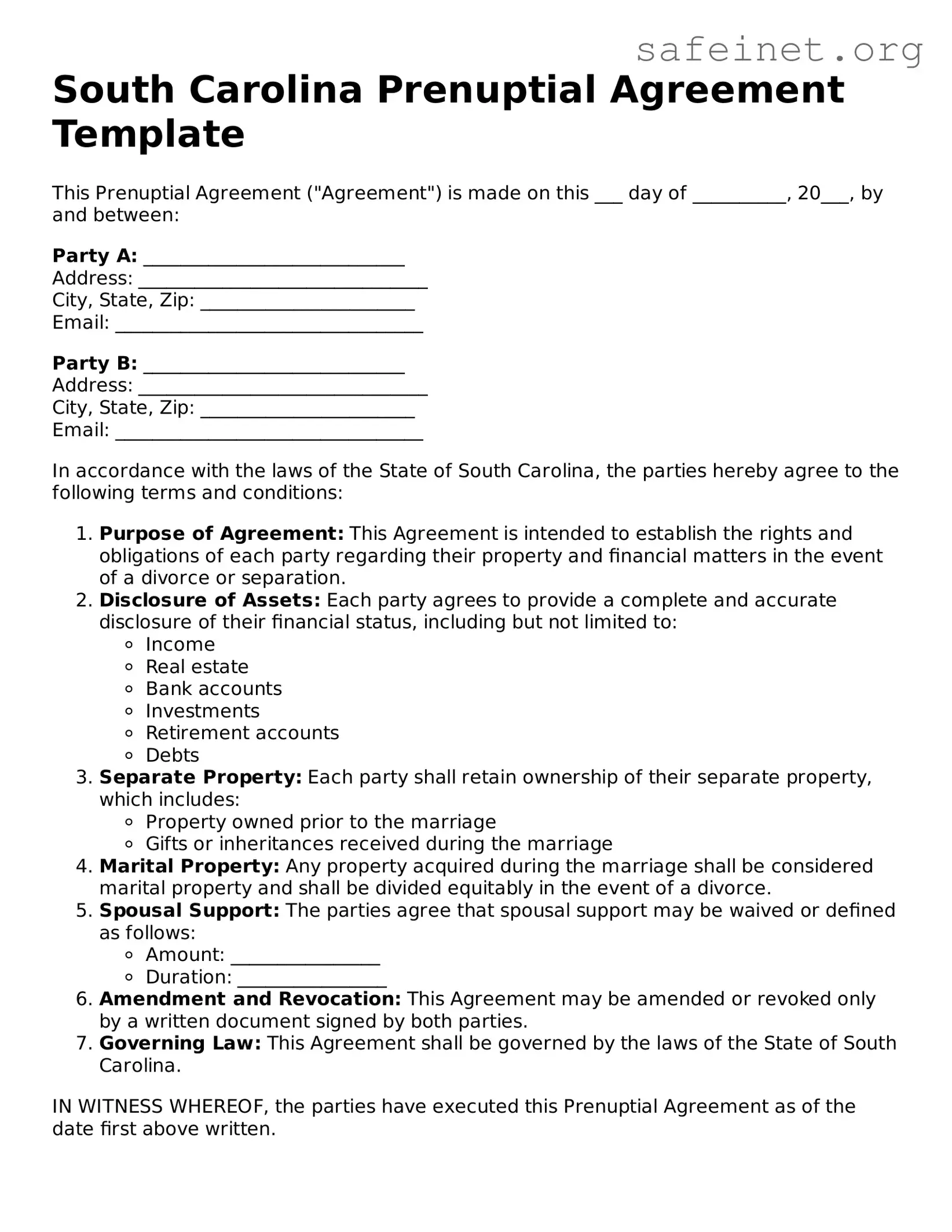
South Carolina Prenuptial Agreement Template
This Prenuptial Agreement ("Agreement") is made on this ___ day of __________, 20___, by and between:
Party A: ____________________________
Address: _______________________________
City, State, Zip: _______________________
Email: _________________________________
Party B: ____________________________
Address: _______________________________
City, State, Zip: _______________________
Email: _________________________________
In accordance with the laws of the State of South Carolina, the parties hereby agree to the following terms and conditions:
IN WITNESS WHEREOF, the parties have executed this Prenuptial Agreement as of the date first above written.
Party A Signature: ____________________________
Date: ______________________
Party B Signature: ____________________________
Date: ______________________
Witness Signature: ____________________________
Date: ______________________
Witness Signature: ____________________________
Date: ______________________
| Fact Name | Description |
|---|---|
| Definition | A prenuptial agreement is a contract between two people before marriage that outlines the distribution of assets and financial responsibilities in the event of divorce or separation. |
| Governing Law | In South Carolina, prenuptial agreements are governed by the South Carolina Uniform Premarital Agreement Act. |
| Enforceability | For a prenuptial agreement to be enforceable, it must be in writing and signed by both parties. |
| Full Disclosure | Both parties must provide a fair and reasonable disclosure of their financial situations, including assets and debts, before signing the agreement. |
| Voluntary Agreement | The agreement must be entered into voluntarily by both parties, without any coercion or undue influence. |
| Modification | A prenuptial agreement can be modified or revoked at any time, but this must also be done in writing and signed by both parties. |
| Judicial Review | South Carolina courts may review prenuptial agreements for fairness and reasonableness at the time of enforcement. |
| Legal Representation | It is advisable for both parties to seek independent legal counsel to ensure their rights and interests are protected. |
Filling out a Prenuptial Agreement form in South Carolina requires careful attention to detail. This process involves gathering relevant information about both parties and clearly outlining the terms of the agreement. Once completed, the form should be signed and dated by both parties in the presence of a notary public to ensure its validity.
What is a prenuptial agreement in South Carolina?
A prenuptial agreement, often referred to as a "prenup," is a legal document that couples create before marriage. It outlines how assets and debts will be handled in the event of a divorce or separation. In South Carolina, this agreement can help clarify financial responsibilities and protect individual interests, ensuring both parties understand their rights and obligations from the start of their marriage.
Why should I consider a prenuptial agreement?
Considering a prenuptial agreement can provide peace of mind. It allows couples to discuss and agree on financial matters openly. This proactive approach can prevent misunderstandings and disputes in the future. For individuals entering a marriage with significant assets, debts, or children from previous relationships, a prenup can safeguard those interests and clarify financial arrangements.
What should be included in a South Carolina prenuptial agreement?
A comprehensive prenuptial agreement should address various aspects, including the division of property, management of debts, and spousal support in the event of a divorce. It can also cover how future income and assets will be treated. Customizing the agreement to fit your unique circumstances is essential, ensuring that both parties feel their needs are met.
Do both parties need to have legal representation?
While it is not legally required for both parties to have their own attorneys, it is highly advisable. Having independent legal counsel ensures that both individuals understand the terms of the agreement and their rights. This can help prevent claims of coercion or unfairness later on, making the agreement more likely to be upheld in court.
Can a prenuptial agreement be modified after marriage?
Yes, a prenuptial agreement can be modified after marriage. Both parties must agree to any changes, and it is best to document these modifications in writing. Just like the original agreement, any amendments should be signed and ideally reviewed by legal counsel to ensure they are valid and enforceable.
How do I enforce a prenuptial agreement in South Carolina?
To enforce a prenuptial agreement, it must be deemed valid and fair at the time of signing. This includes ensuring that both parties fully disclosed their financial situations and entered into the agreement voluntarily. If disputes arise, the agreement can be presented in court, where a judge will review its terms and circumstances surrounding its creation.
Is a prenuptial agreement only for wealthy individuals?
No, prenuptial agreements are not just for the wealthy. They can benefit anyone entering a marriage, regardless of financial status. These agreements can protect personal assets, clarify financial expectations, and address how debts will be managed. They can be particularly valuable for individuals with significant personal property, business interests, or children from previous relationships.
What happens if we don’t have a prenuptial agreement?
If a couple does not have a prenuptial agreement, South Carolina law will determine how assets and debts are divided in the event of a divorce. This may not align with either party's wishes, leading to potential disputes and complications. Without a prenup, the division of property and responsibilities can become contentious, making it crucial to consider the benefits of having one.
How can I get started with a prenuptial agreement in South Carolina?
To get started, both parties should openly discuss their financial situations and expectations for the marriage. Consulting with a qualified attorney who specializes in family law is a wise first step. They can guide you through the process, help draft the agreement, and ensure that it meets legal requirements in South Carolina. Taking this step can lay a solid foundation for a healthy and transparent marriage.
Not Disclosing All Assets: One of the most common mistakes is failing to fully disclose all assets. Both parties must provide a complete picture of their financial situation. Hiding assets can lead to the agreement being challenged later.
Using Ambiguous Language: Clarity is key in a prenuptial agreement. Vague terms can lead to misunderstandings. Each provision should be clearly defined to avoid disputes in the future.
Forgetting to Include Debts: It's not just assets that matter. Couples often overlook their debts. Including liabilities in the agreement ensures both parties understand their financial responsibilities.
Not Seeking Legal Advice: Many individuals attempt to draft their own agreements without professional help. This can result in legal pitfalls. Consulting with a lawyer can provide valuable insights and ensure the agreement is enforceable.
Failing to Update the Agreement: Life changes, and so should your prenuptial agreement. Couples often forget to revise their agreement after significant life events, such as the birth of a child or a change in financial status. Regular updates can keep the agreement relevant and effective.
When preparing for marriage, many couples consider a prenuptial agreement to protect their individual assets and clarify financial responsibilities. Along with the South Carolina Prenuptial Agreement form, several other documents may be relevant. Each serves a unique purpose and can help ensure a smooth transition into married life.
Each of these documents plays a significant role in managing financial and legal matters during and after marriage. It’s wise to consult with a qualified professional to ensure that all necessary documents are in order and tailored to your specific needs.
A Cohabitation Agreement is similar to a prenuptial agreement in that it outlines the rights and responsibilities of two individuals living together without being married. This document can address property ownership, financial obligations, and how assets will be divided if the relationship ends. Just like a prenuptial agreement, a cohabitation agreement aims to protect both parties and clarify expectations, making it easier to navigate potential disputes in the future.
A Postnuptial Agreement shares similarities with a prenuptial agreement but is created after the couple is married. This document can be used to address changes in financial situations or to clarify asset division in case of divorce. Both agreements serve to protect individual interests and provide a clear framework for asset management, but a postnuptial agreement can also reflect the evolving dynamics of a marriage.
A Separation Agreement is another document that resembles a prenuptial agreement. This legal contract is created when a couple decides to live apart but is not yet divorced. It outlines the terms for property division, child custody, and support payments. Like a prenuptial agreement, a separation agreement aims to minimize conflict by establishing clear guidelines for both parties during a transitional period.
A Marital Settlement Agreement is closely related to a prenuptial agreement, as it is often created during the divorce process. This document details how the couple will divide their assets, debts, and responsibilities. Both agreements focus on asset protection and clarity, but a marital settlement agreement specifically addresses the dissolution of the marriage, whereas a prenuptial agreement is established before any potential issues arise.
An Estate Plan can also be compared to a prenuptial agreement, as both documents deal with the management and distribution of assets. An estate plan outlines how a person's assets will be handled after their death, while a prenuptial agreement focuses on asset division during a marriage or divorce. Both documents aim to protect individual interests and ensure that personal wishes are honored, whether in life or after passing.
When considering a prenuptial agreement in South Carolina, it's essential to approach the process with care and attention. Here are some important do's and don'ts to keep in mind while filling out the form:
When it comes to prenuptial agreements in South Carolina, there are several misconceptions that can lead to confusion. Here are seven common misunderstandings:
Understanding these misconceptions can help couples make informed decisions about their financial future together.
When considering a prenuptial agreement in South Carolina, it is essential to understand the nuances involved in filling out and utilizing the form. Below are key takeaways to guide you through the process.
Understanding these key points can help ensure that the prenuptial agreement serves its intended purpose and provides peace of mind for both parties entering into marriage.