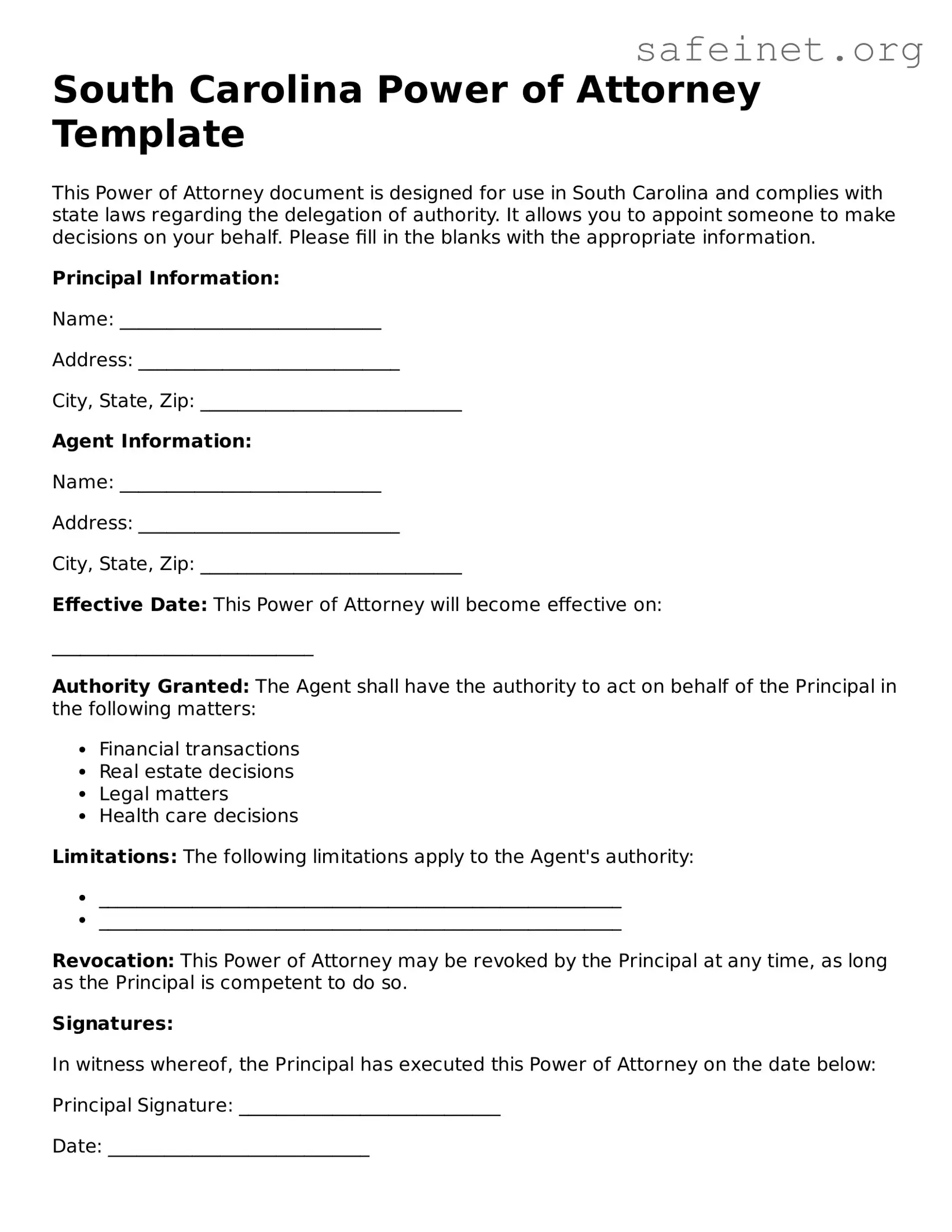
The South Carolina Power of Attorney form serves as a vital legal instrument that empowers individuals to designate someone they trust to act on their behalf in various matters, ranging from financial transactions to healthcare decisions. This form is particularly important for those who may become incapacitated or wish to ensure that their affairs are managed according to their wishes when they are unable to do so themselves. In South Carolina, the form can be tailored to meet specific needs, allowing the principal—the person granting authority—to specify the scope of powers granted to the agent. These powers can include handling bank accounts, managing real estate, and making medical decisions. Moreover, the form must be executed with particular attention to state requirements, such as notarization and witness signatures, to ensure its validity. Understanding the nuances of the South Carolina Power of Attorney form is essential for anyone looking to safeguard their interests and provide peace of mind for themselves and their loved ones.
South Carolina Power of Attorney Template
This Power of Attorney document is designed for use in South Carolina and complies with state laws regarding the delegation of authority. It allows you to appoint someone to make decisions on your behalf. Please fill in the blanks with the appropriate information.
Principal Information:
Name: ____________________________
Address: ____________________________
City, State, Zip: ____________________________
Agent Information:
Name: ____________________________
Address: ____________________________
City, State, Zip: ____________________________
Effective Date: This Power of Attorney will become effective on:
____________________________
Authority Granted: The Agent shall have the authority to act on behalf of the Principal in the following matters:
Limitations: The following limitations apply to the Agent's authority:
Revocation: This Power of Attorney may be revoked by the Principal at any time, as long as the Principal is competent to do so.
Signatures:
In witness whereof, the Principal has executed this Power of Attorney on the date below:
Principal Signature: ____________________________
Date: ____________________________
Witness Signature: ____________________________
Date: ____________________________
Witness Signature: ____________________________
Date: ____________________________
Notary Acknowledgment:
State of South Carolina
County of ____________________________
Subscribed and sworn to before me this _____ day of __________, 20__.
Notary Public Signature: ____________________________
My commission expires: ____________________________
| Fact Name | Details |
|---|---|
| Definition | A Power of Attorney (POA) in South Carolina allows one person to authorize another to act on their behalf in legal and financial matters. |
| Governing Law | The South Carolina Power of Attorney Act, found in Title 62, Chapter 8 of the South Carolina Code of Laws, governs the use and creation of POAs. |
| Types of POA | South Carolina recognizes several types of POAs, including durable, non-durable, and springing powers of attorney. |
| Durability | A durable power of attorney remains effective even if the principal becomes incapacitated, ensuring continuous authority. |
| Springing POA | A springing power of attorney only becomes effective upon a specific event, such as the principal’s incapacitation. |
| Signing Requirements | The principal must sign the POA in the presence of a notary public and at least one witness for it to be valid. |
| Revocation | The principal can revoke a Power of Attorney at any time as long as they are mentally competent to do so. |
| Agent's Duties | The agent is required to act in the best interest of the principal and manage their affairs according to the principal's wishes. |
Filling out the South Carolina Power of Attorney form is an important step in designating someone to manage your affairs. Once you have completed the form, you will need to ensure that it is properly signed and witnessed to be legally valid. Below are the steps to guide you through the process.
What is a Power of Attorney in South Carolina?
A Power of Attorney (POA) is a legal document that allows one person, known as the principal, to grant another person, called the agent or attorney-in-fact, the authority to make decisions on their behalf. In South Carolina, this can cover a variety of areas, including financial matters, healthcare decisions, and property management. It is essential to choose a trustworthy agent, as they will have significant control over your affairs.
How do I create a Power of Attorney in South Carolina?
To create a Power of Attorney in South Carolina, you need to complete the appropriate form, which can be obtained online or through legal services. The document must clearly state your intentions, identify the agent, and outline the powers granted. Once completed, the POA must be signed by the principal and witnessed by two individuals or notarized. Ensure that you keep a copy for your records and provide copies to your agent and any relevant institutions.
Can I revoke a Power of Attorney in South Carolina?
Yes, you can revoke a Power of Attorney at any time as long as you are mentally competent. To do this, you should create a written revocation document stating your intention to revoke the previous POA. It's crucial to notify your agent and any institutions that may have a copy of the original document. Additionally, you may want to destroy the original POA to prevent any confusion.
What happens if my agent cannot act on my behalf?
If your designated agent is unable or unwilling to act on your behalf, the Power of Attorney may include alternate agents. If no alternates are named, or if they are also unavailable, a court may need to appoint a guardian or conservator to manage your affairs. To avoid complications, consider naming alternate agents in your POA document.
Is a Power of Attorney valid after I become incapacitated?
In South Carolina, a Power of Attorney remains valid even if you become incapacitated, as long as it is a durable Power of Attorney. A durable POA is specifically designed to continue in effect when the principal is unable to make decisions. If you do not specify that your POA is durable, it may become invalid upon your incapacity. Always clarify this in your document to ensure your agent can act when needed.
Failing to specify the powers granted. It is important to clearly outline what authority is being given to the agent.
Not including the date of execution. The document should include the date when it is signed to ensure it is valid.
Neglecting to sign the document. The principal must sign the Power of Attorney for it to be legally binding.
Forgetting to have the document notarized. South Carolina requires notarization for the Power of Attorney to be effective.
Choosing an inappropriate agent. It is crucial to select someone trustworthy and capable of handling the responsibilities.
Leaving sections blank. All relevant sections should be completed to avoid confusion or disputes later.
Not discussing the document with the agent. Communication about the powers granted is essential for a smooth process.
Using outdated forms. Always ensure that the most current version of the Power of Attorney form is being used.
Overlooking the need for witnesses. Depending on the situation, having witnesses may be required.
Failing to keep a copy of the document. It is advisable to retain a copy for personal records and future reference.
When creating a Power of Attorney (POA) in South Carolina, there are several other documents that may be beneficial to consider. These documents can help clarify intentions, establish legal authority, or provide additional protections. Here’s a brief overview of some commonly used forms and documents that often accompany a Power of Attorney.
Understanding these documents can empower individuals to make informed decisions about their legal and healthcare needs. Each serves a unique purpose, and together they can create a comprehensive plan for managing personal and financial affairs.
The South Carolina Power of Attorney (POA) form shares similarities with a Living Will, which is a document that outlines a person's wishes regarding medical treatment in the event they become unable to communicate those wishes. Like a POA, a Living Will allows individuals to express their preferences in advance, ensuring that their healthcare decisions align with their values. Both documents serve to protect the individual's autonomy, but while a POA appoints someone to make decisions on their behalf, a Living Will specifically addresses medical care preferences.
Another document akin to the South Carolina Power of Attorney is the Healthcare Proxy. This document designates a specific person to make healthcare decisions for someone if they are unable to do so themselves. Similar to a POA, a Healthcare Proxy empowers a trusted individual to act in the best interest of the person who is incapacitated. The key difference lies in the focus: while a POA can cover a wide range of financial and legal matters, a Healthcare Proxy is strictly concerned with medical decisions.
The South Carolina Power of Attorney also resembles a Trust, which is a legal arrangement where one party holds property or assets for the benefit of another. Both documents allow for the management of an individual's affairs, but they differ in structure and purpose. A Trust can provide ongoing management of assets during a person's lifetime and after their death, while a POA is typically effective only during the individual's lifetime and ceases upon their death. Trusts can offer more comprehensive estate planning options, but both documents are essential tools for ensuring that one's wishes are honored.
Finally, the South Carolina Power of Attorney is similar to a Declaration of Guardian. This document allows an individual to appoint someone to act as their guardian in case they become incapacitated. Like a POA, it is a proactive measure to ensure that someone trusted will make decisions on behalf of the individual. However, a Declaration of Guardian is specifically focused on personal and legal decision-making regarding the individual’s welfare, while a POA can encompass financial and property matters as well.
When filling out the South Carolina Power of Attorney form, it's essential to approach the task with care. Here are some important do's and don'ts to keep in mind:
By following these guidelines, you can fill out the South Carolina Power of Attorney form confidently and effectively. Taking the time to do it right can make a significant difference in how your wishes are honored in the future.
Understanding the South Carolina Power of Attorney form can be challenging. Here are ten common misconceptions that may lead to confusion:
By clarifying these misconceptions, individuals can better understand the importance and functionality of the South Carolina Power of Attorney form.
When dealing with the South Carolina Power of Attorney form, it’s important to understand its purpose and implications. Here are some key takeaways to keep in mind:
Understanding these aspects can help you navigate the process more effectively and ensure your affairs are managed according to your preferences.