In South Carolina, the Power of Attorney for a Child form serves as a crucial legal tool for parents and guardians who need to delegate authority for their child's care to another trusted individual. This form allows a designated agent to make important decisions regarding the child's health, education, and welfare, ensuring that their needs are met even in the absence of the parent or guardian. Key aspects of the form include the specific powers granted to the agent, the duration of the authority, and the requirement for the parent or guardian's signature. Additionally, the form must be notarized to ensure its validity and enforceability. Understanding how to properly complete and utilize this form can provide peace of mind for parents, knowing that their child will be well cared for in their absence.
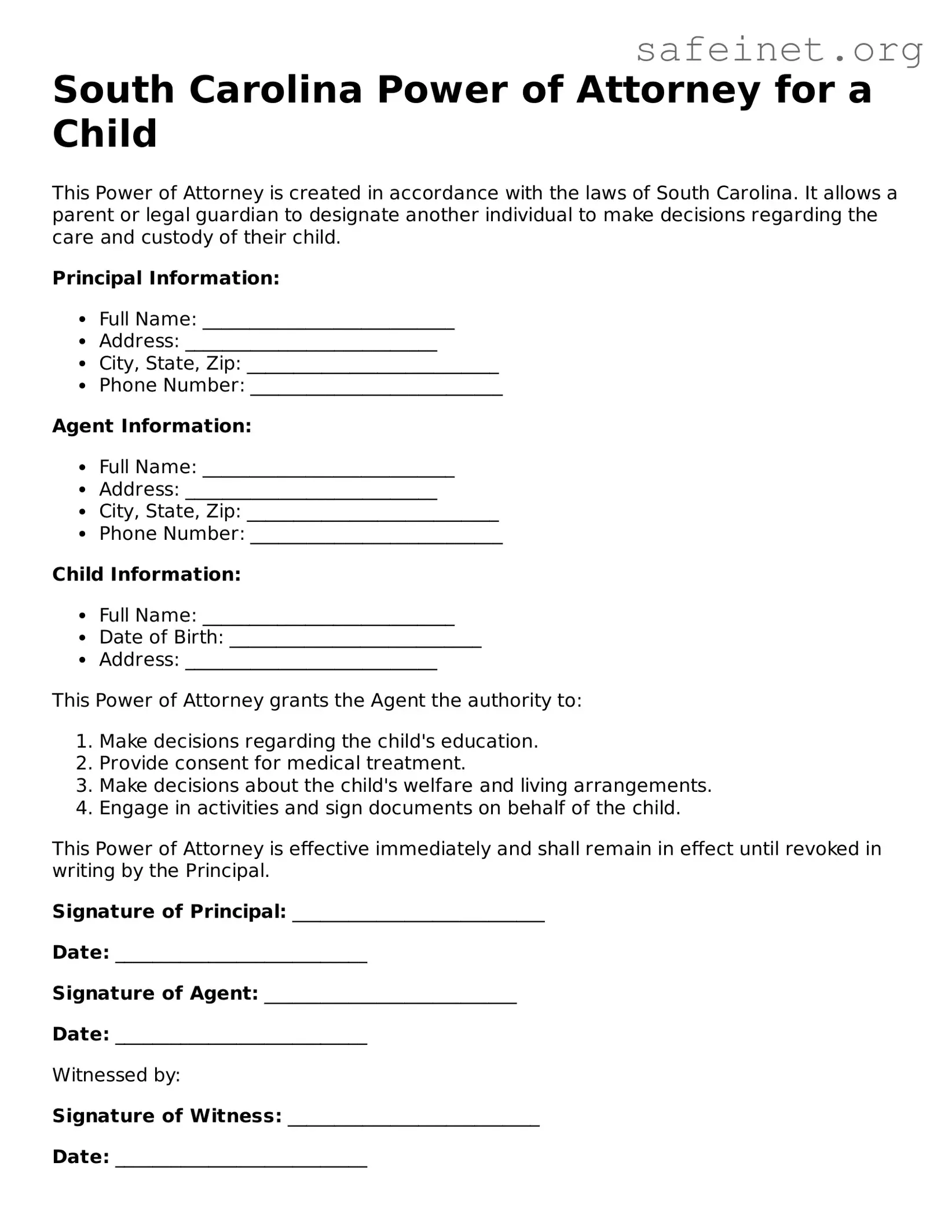
South Carolina Power of Attorney for a Child
This Power of Attorney is created in accordance with the laws of South Carolina. It allows a parent or legal guardian to designate another individual to make decisions regarding the care and custody of their child.
Principal Information:
Agent Information:
Child Information:
This Power of Attorney grants the Agent the authority to:
This Power of Attorney is effective immediately and shall remain in effect until revoked in writing by the Principal.
Signature of Principal: ___________________________
Date: ___________________________
Signature of Agent: ___________________________
Date: ___________________________
Witnessed by:
Signature of Witness: ___________________________
Date: ___________________________
| Fact Name | Description |
|---|---|
| Purpose | The South Carolina Power of Attorney for a Child form allows a parent or legal guardian to designate another individual to make decisions on behalf of their child. |
| Governing Law | This form is governed by South Carolina Code of Laws, Title 63, Chapter 5, which addresses the powers of attorney for minors. |
| Duration | The authority granted through this form can be limited to a specific time frame or event, as specified by the parent or guardian. |
| Eligibility | Only a parent or legal guardian can execute this form, ensuring that the designated individual has the authority to act on behalf of the child. |
| Revocation | The Power of Attorney can be revoked at any time by the parent or guardian, as long as proper notice is given to the designated individual. |
| Notarization | In South Carolina, the form must be notarized to be considered valid, ensuring authenticity and legal compliance. |
Filling out the South Carolina Power of Attorney for a Child form requires careful attention to detail. Once completed, this document will allow you to designate someone to make decisions on behalf of your child. It's essential to ensure that all information is accurate and clearly stated.
After completing the form, ensure that all parties involved have copies for their records. This will help maintain clarity and prevent any misunderstandings in the future.
What is a Power of Attorney for a Child in South Carolina?
A Power of Attorney for a Child is a legal document that allows a parent or legal guardian to grant another adult the authority to make decisions on behalf of their child. This can include decisions related to education, healthcare, and other important matters when the parent is unavailable or unable to do so.
Who can be appointed as an agent in the Power of Attorney for a Child?
Any responsible adult can be appointed as an agent. This can include relatives, family friends, or trusted adults. It is crucial to choose someone who has the child's best interests at heart and can act responsibly in their care.
How long is the Power of Attorney for a Child valid?
The Power of Attorney for a Child remains in effect until the specified expiration date in the document, or until the parent or guardian revokes it. If no expiration date is provided, it typically lasts until the child turns 18 years old.
Do I need to have the Power of Attorney for a Child notarized?
Yes, in South Carolina, the Power of Attorney for a Child must be signed in the presence of a notary public. This helps to ensure the document is legally binding and recognized by institutions such as schools and healthcare providers.
Can I revoke the Power of Attorney for a Child once it is created?
Absolutely. A parent or guardian can revoke the Power of Attorney at any time by providing written notice to the agent and any relevant institutions. It’s advisable to do this formally to avoid any confusion.
What happens if the agent cannot fulfill their duties?
If the appointed agent is unable to fulfill their responsibilities, it is essential to have a backup agent named in the document. If no backup is designated, the parent or guardian may need to appoint a new agent to ensure the child’s needs are met.
Can the Power of Attorney for a Child be used for medical decisions?
Yes, the Power of Attorney for a Child can grant the agent the authority to make medical decisions on behalf of the child. However, it’s important to specify this authority clearly in the document to avoid any misunderstandings.
Is there a specific form I need to use for the Power of Attorney for a Child in South Carolina?
While there isn’t a state-mandated form, it is recommended to use a form that complies with South Carolina laws. Many legal resources and websites provide templates that can be customized to fit your needs.
Can the Power of Attorney for a Child be used for educational purposes?
Yes, the Power of Attorney can include provisions for educational decisions. This allows the agent to enroll the child in school, attend parent-teacher meetings, and make other educational decisions in the absence of the parent or guardian.
What should I do if I have more questions about the Power of Attorney for a Child?
If you have further questions, it is advisable to consult with a legal professional who can provide guidance specific to your situation. They can help clarify any concerns and ensure that the document meets all legal requirements.
Not Specifying the Duration: One common mistake is failing to clearly state how long the power of attorney will be in effect. This can lead to confusion or unintended consequences.
Incomplete Information: Providing incomplete information about the child or the designated agent can invalidate the form. Ensure all names, addresses, and contact details are accurate and complete.
Missing Signatures: Both the parent or guardian and the agent must sign the document. Omitting one of these signatures can render the form ineffective.
Not Notarizing the Document: In South Carolina, a power of attorney for a child typically needs to be notarized. Failing to do so may result in the document not being recognized.
Using Outdated Forms: Always use the most current version of the form. Using outdated paperwork may lead to legal complications.
Ignoring State-Specific Requirements: Each state has its own regulations regarding powers of attorney. Not adhering to South Carolina's specific requirements can invalidate the document.
Not Reviewing the Document: After filling out the form, it is crucial to review it for accuracy. Failing to check for errors can lead to misunderstandings in the future.
When preparing a Power of Attorney for a Child in South Carolina, several additional documents may enhance clarity and ensure that the child's best interests are prioritized. These documents can help facilitate smoother transitions and provide necessary legal backing for the designated guardian or caretaker.
By considering these additional forms and documents, you can create a more comprehensive plan for the care of a child under a Power of Attorney. This proactive approach not only safeguards the child's well-being but also provides peace of mind for all parties involved.
The South Carolina Power of Attorney for a Child form shares similarities with the General Power of Attorney. Both documents allow an individual to designate another person to act on their behalf. In the case of the General Power of Attorney, the authority granted can cover a wide range of decisions, including financial and medical matters. This flexibility makes it a versatile tool for various situations, while the Power of Attorney for a Child specifically focuses on matters relating to the care and custody of a minor, ensuring that the child's best interests are prioritized.
Another document that resembles the Power of Attorney for a Child is the Medical Power of Attorney. This form specifically grants authority to an individual to make healthcare decisions on behalf of another person. While the Power of Attorney for a Child can include medical decisions, the Medical Power of Attorney is dedicated solely to health-related issues. This distinction is important for parents or guardians who want to ensure that their child's medical needs are addressed by a trusted individual when they are unable to do so themselves.
The Child Custody Agreement is also similar in that it addresses the care of a minor. This legal document outlines the terms of custody between parents or guardians, detailing where the child will live and how decisions will be made regarding their upbringing. While the Power of Attorney for a Child allows for temporary delegation of authority, a Child Custody Agreement is often more permanent and involves court approval. Both documents aim to protect the child's welfare but operate in different legal frameworks.
The Guardianship Agreement shares similarities with the Power of Attorney for a Child in that it provides for the care of a minor. A Guardianship Agreement is typically established when a parent is unable to care for their child, often due to incapacity or other circumstances. This document grants a guardian the legal authority to make decisions for the child, much like the Power of Attorney for a Child, but it usually requires court involvement and can be more difficult to revoke.
Another related document is the Temporary Custody Agreement. This form allows parents to grant temporary custody of their child to another individual, often in situations where the parents are unable to care for the child for a short period. While both the Temporary Custody Agreement and the Power of Attorney for a Child provide a framework for care, the former is typically more time-limited and may not cover all aspects of the child's needs.
The Adoption Agreement is another document that bears some resemblance to the Power of Attorney for a Child. Adoption permanently transfers parental rights from biological parents to adoptive parents. While the Power of Attorney for a Child is a temporary measure, the Adoption Agreement fundamentally alters the legal relationship between the child and their caregivers. Both documents reflect a commitment to the child's well-being, but they operate on different levels of permanence and legal authority.
The Child Care Authorization form is similar as it allows parents to designate someone to care for their child temporarily. This document is often used in situations such as daycare or school settings, where parents may need to authorize another adult to pick up their child. While the Power of Attorney for a Child provides broader authority, the Child Care Authorization is more limited in scope, focusing specifically on day-to-day care rather than long-term decision-making.
The Consent for Medical Treatment form also shares characteristics with the Power of Attorney for a Child. This document allows parents to authorize medical treatment for their child when they are unavailable. It ensures that a child receives necessary medical care without delay. While the Power of Attorney for a Child can encompass medical decisions, the Consent for Medical Treatment is focused solely on health-related authorizations and is often used in specific situations.
Lastly, the School Enrollment Authorization form can be compared to the Power of Attorney for a Child. This document allows a designated individual to enroll a child in school or make educational decisions on their behalf. Like the Power of Attorney for a Child, it ensures that the child's educational needs are met, but it is specifically tailored to the school environment. Both documents empower trusted individuals to act in the child's best interest, albeit in different contexts.
When filling out the South Carolina Power of Attorney for a Child form, it is important to follow certain guidelines to ensure the process goes smoothly. Here are some things you should and shouldn't do:
When it comes to the South Carolina Power of Attorney for a Child form, there are several misconceptions that can lead to confusion. Here are seven common misunderstandings:
Understanding these misconceptions can help ensure that the South Carolina Power of Attorney for a Child form is used effectively and appropriately.
When filling out and using the South Carolina Power of Attorney for a Child form, several important points should be kept in mind. These takeaways can help ensure that the process is smooth and effective.
Understanding these key points can help ensure that the Power of Attorney for a Child form is used correctly and effectively.