The South Carolina Operating Agreement form serves as a crucial document for limited liability companies (LLCs) operating within the state. This form outlines the internal workings of the LLC, detailing how the company will be managed and how decisions will be made. It typically includes information on ownership percentages, member roles, and the process for adding or removing members. Additionally, the agreement addresses financial matters, such as profit distribution and capital contributions, ensuring that all members understand their rights and responsibilities. By establishing clear guidelines, the Operating Agreement helps prevent disputes among members and provides a framework for resolving any conflicts that may arise. Furthermore, while South Carolina law does not require an Operating Agreement, having one in place can enhance the credibility of the LLC and protect its limited liability status. Therefore, understanding the components and importance of this form is essential for anyone looking to start or manage an LLC in South Carolina.
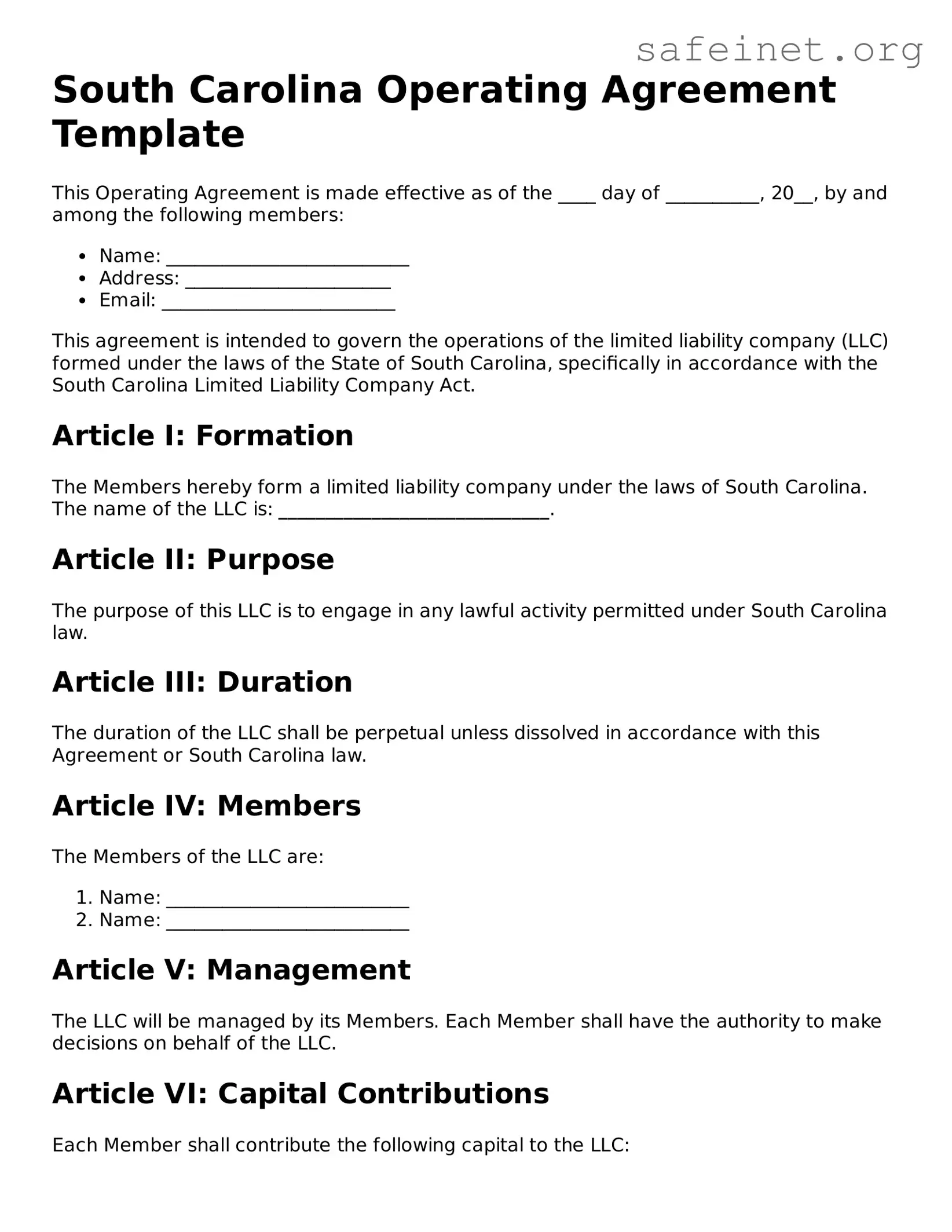
South Carolina Operating Agreement Template
This Operating Agreement is made effective as of the ____ day of __________, 20__, by and among the following members:
This agreement is intended to govern the operations of the limited liability company (LLC) formed under the laws of the State of South Carolina, specifically in accordance with the South Carolina Limited Liability Company Act.
Article I: Formation
The Members hereby form a limited liability company under the laws of South Carolina. The name of the LLC is: _____________________________.
Article II: Purpose
The purpose of this LLC is to engage in any lawful activity permitted under South Carolina law.
Article III: Duration
The duration of the LLC shall be perpetual unless dissolved in accordance with this Agreement or South Carolina law.
Article IV: Members
The Members of the LLC are:
Article V: Management
The LLC will be managed by its Members. Each Member shall have the authority to make decisions on behalf of the LLC.
Article VI: Capital Contributions
Each Member shall contribute the following capital to the LLC:
Article VII: Distributions
Distributions of profits and losses shall be allocated to the Members in proportion to their respective capital contributions.
Article VIII: Indemnification
The LLC shall indemnify any Member against any loss, liability, or damage incurred in connection with the LLC, except in cases of gross negligence or willful misconduct.
Article IX: Amendments
This Operating Agreement may be amended only by a written agreement signed by all Members.
Article X: Governing Law
This Agreement shall be governed by and construed in accordance with the laws of the State of South Carolina.
IN WITNESS WHEREOF, the Members have executed this Operating Agreement as of the date first above written.
______________________________
Member Signature
______________________________
Member Signature
| Fact Name | Description |
|---|---|
| Purpose | The South Carolina Operating Agreement outlines the management structure and operational guidelines for a limited liability company (LLC). |
| Governing Law | This agreement is governed by the South Carolina Limited Liability Company Act, specifically Title 33, Chapter 44 of the South Carolina Code of Laws. |
| Member Rights | The agreement defines the rights and responsibilities of each member, including voting rights and profit distribution. |
| Flexibility | Members have the flexibility to customize the agreement to meet their specific needs and business goals. |
| Filing Requirement | While the Operating Agreement is not required to be filed with the state, it is essential for internal governance. |
| Amendments | Members can amend the Operating Agreement as needed, provided that the process for amendments is outlined within the agreement itself. |
Filling out the South Carolina Operating Agreement form is an important step in establishing the framework for your business. This document outlines the management structure, responsibilities, and operational procedures for your company. Once completed, it will help ensure that all members are on the same page regarding their roles and the overall direction of the business.
What is a South Carolina Operating Agreement?
An Operating Agreement is a crucial document for LLCs in South Carolina. It outlines the ownership structure, management responsibilities, and operational procedures of the business. While not legally required, having one can help prevent misunderstandings among members and provide clarity on how the LLC will function.
Is an Operating Agreement required in South Carolina?
No, South Carolina does not mandate LLCs to have an Operating Agreement. However, it is highly recommended. This document can serve as a roadmap for your business, ensuring that all members are on the same page regarding their rights and responsibilities.
Who should draft the Operating Agreement?
What key elements should be included in the Operating Agreement?
Essential components of an Operating Agreement include the LLC's name and address, the purpose of the business, member details, management structure, voting rights, profit distribution, and procedures for adding or removing members. Including these elements can help establish clear guidelines for the operation of the LLC.
Can the Operating Agreement be amended?
How does the Operating Agreement affect liability?
Do I need to file the Operating Agreement with the state?
How often should the Operating Agreement be reviewed?
What happens if there is no Operating Agreement?
Not including all members: It's crucial to list every member of the LLC in the Operating Agreement. Omitting a member can lead to disputes and confusion down the line. Make sure to double-check that everyone involved is accounted for.
Vague descriptions of roles: Each member's responsibilities should be clearly defined. If roles are left vague, misunderstandings may arise about who is responsible for what. Clarity helps prevent conflicts.
Ignoring state-specific requirements: South Carolina has specific regulations regarding Operating Agreements. Failing to adhere to these can render the agreement ineffective. Research or consult resources to ensure compliance.
Not updating the agreement: As your business evolves, so should your Operating Agreement. If changes occur, such as new members joining or roles shifting, it’s important to update the document accordingly. An outdated agreement can lead to legal issues.
Failing to sign the agreement: After filling out the Operating Agreement, all members must sign it. Without signatures, the document may not hold up in legal situations. Ensure everyone involved understands the importance of this step.
The South Carolina Operating Agreement is a crucial document for limited liability companies (LLCs) in the state. It outlines the management structure, roles of members, and operational procedures of the LLC. However, several other forms and documents are often used in conjunction with the Operating Agreement to ensure comprehensive compliance and organization. Below is a list of these important documents.
Utilizing these documents alongside the South Carolina Operating Agreement can help ensure that your LLC operates smoothly and remains compliant with state regulations. It is advisable to consult with a legal professional to ensure that all documents are properly prepared and filed.
The South Carolina Operating Agreement is often compared to the Articles of Organization. Both documents are essential for forming a limited liability company (LLC). While the Articles of Organization establish the existence of the LLC with the state, the Operating Agreement outlines the internal workings and management structure of the company. This document details how decisions are made, how profits are distributed, and the roles of members, providing a comprehensive framework for the LLC's operations.
Another similar document is the Partnership Agreement. This agreement serves a similar purpose for partnerships as the Operating Agreement does for LLCs. It outlines the roles, responsibilities, and financial arrangements between partners. Just like the Operating Agreement, it helps prevent disputes by clearly defining each partner's contributions and entitlements, ensuring that all parties are on the same page from the start.
The Corporate Bylaws are also comparable to the South Carolina Operating Agreement. While Bylaws govern the internal management of a corporation, the Operating Agreement serves the same function for an LLC. Both documents establish rules for meetings, voting procedures, and the duties of officers or members. This similarity highlights the importance of having a clear set of guidelines for governance, regardless of the business structure.
The Shareholder Agreement shares similarities with the Operating Agreement as well. This document is crucial for corporations, detailing the rights and responsibilities of shareholders. Like the Operating Agreement, it addresses issues such as the transfer of shares, decision-making processes, and dispute resolution. Both agreements aim to protect the interests of the parties involved and provide a clear framework for operations.
The Employment Agreement is another document that bears resemblance to the Operating Agreement. While the Operating Agreement focuses on the structure of the LLC, the Employment Agreement outlines the relationship between the company and its employees. Both documents establish expectations and responsibilities, helping to create a clear understanding of roles within the organization.
The Non-Disclosure Agreement (NDA) is also relevant in this context. While it does not govern the internal workings of a business, it serves to protect sensitive information. An NDA can complement an Operating Agreement by ensuring that members or employees do not disclose proprietary information, thus safeguarding the company’s interests. Both documents work together to create a secure business environment.
The Buy-Sell Agreement is another important document that parallels the Operating Agreement. This agreement is particularly relevant for LLCs and partnerships, as it outlines the process for buying out a member's interest in the business. Similar to the Operating Agreement, it helps prevent conflicts and ensures a smooth transition when ownership changes occur, thereby maintaining stability within the company.
The Memorandum of Understanding (MOU) can also be likened to the Operating Agreement. An MOU outlines the intentions and expectations of parties entering into a business relationship. While it may not be legally binding, it serves as a framework for collaboration. Like the Operating Agreement, it helps clarify roles and responsibilities, fostering a clear understanding among parties involved.
Lastly, the LLC Membership Certificate can be seen as a companion document to the Operating Agreement. This certificate serves as proof of ownership in the LLC, similar to how shares represent ownership in a corporation. While the Operating Agreement details the governance and operational aspects, the Membership Certificate provides tangible evidence of a member’s stake in the business, reinforcing the connection between ownership and management.
When filling out the South Carolina Operating Agreement form, it is essential to follow certain guidelines to ensure that the document is completed accurately and effectively. Below is a list of things you should and shouldn't do during this process.
By adhering to these guidelines, you can create a clear and effective Operating Agreement that serves the needs of your business and its members.
When it comes to the South Carolina Operating Agreement form, there are several misconceptions that often arise. Understanding these can help clarify its importance and usage.
When filling out and using the South Carolina Operating Agreement form, it’s essential to keep several key points in mind. This document serves as a foundational blueprint for your business, outlining the rights and responsibilities of its members. Here are some important takeaways:
By keeping these takeaways in mind, you can create an effective Operating Agreement that serves your business well.