In South Carolina, the Notice to Quit form serves as a crucial tool for landlords seeking to regain possession of their rental properties when tenants have violated lease agreements or failed to pay rent. This document outlines the landlord's intention to terminate the tenancy and provides the tenant with a clear timeframe to vacate the premises. Typically, the notice must specify the reason for eviction, whether it be non-payment of rent or a breach of lease terms. Importantly, the form also details the number of days the tenant has to respond or remedy the situation, which is generally set by state law. Understanding the nuances of this form is essential for both landlords and tenants, as it not only initiates the eviction process but also ensures that all parties are aware of their rights and responsibilities under South Carolina law. By adhering to the proper procedures outlined in the Notice to Quit, landlords can navigate the complexities of tenant evictions while maintaining compliance with legal standards.
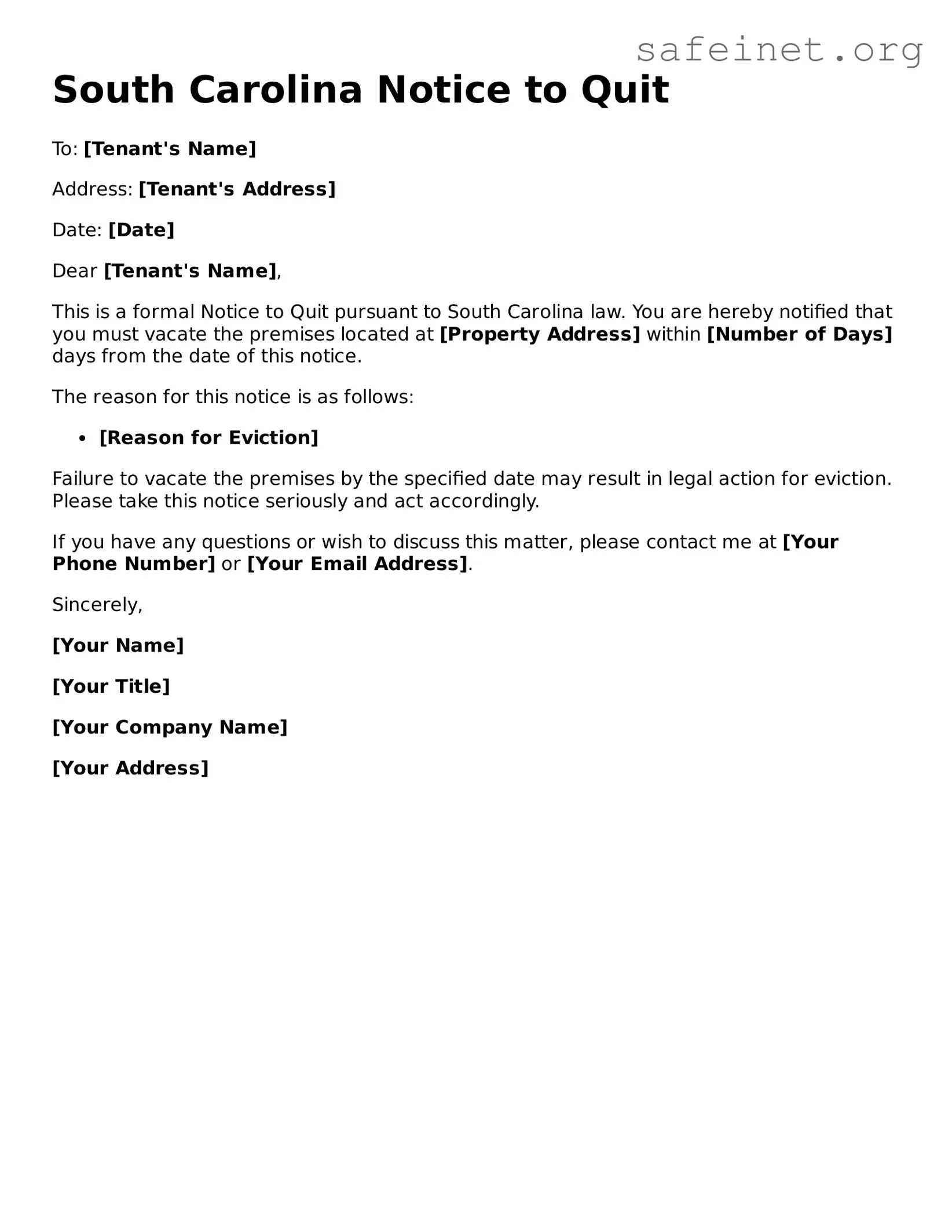
South Carolina Notice to Quit
To: [Tenant's Name]
Address: [Tenant's Address]
Date: [Date]
Dear [Tenant's Name],
This is a formal Notice to Quit pursuant to South Carolina law. You are hereby notified that you must vacate the premises located at [Property Address] within [Number of Days] days from the date of this notice.
The reason for this notice is as follows:
Failure to vacate the premises by the specified date may result in legal action for eviction. Please take this notice seriously and act accordingly.
If you have any questions or wish to discuss this matter, please contact me at [Your Phone Number] or [Your Email Address].
Sincerely,
[Your Name]
[Your Title]
[Your Company Name]
[Your Address]
| Fact Name | Description |
|---|---|
| Purpose | The South Carolina Notice to Quit form is used by landlords to notify tenants to vacate the rental property. |
| Governing Law | This form is governed by the South Carolina Code of Laws, specifically Section 27-40-710. |
| Delivery Method | The notice can be delivered in person, via certified mail, or posted on the property. |
| Time Frame | Tenants typically have 14 days to vacate the property after receiving the notice. |
| Contents Required | The notice must include the date of issuance, the tenant's name, and the address of the rental property. |
| Consequences of Non-Compliance | If the tenant fails to vacate, the landlord may initiate eviction proceedings in court. |
After you have obtained the South Carolina Notice to Quit form, you will need to complete it accurately to ensure that it serves its intended purpose. Carefully following the steps below will help you fill out the form correctly.
Once you have filled out the form, it is important to deliver it to the tenant in a manner that complies with local laws. Consider using certified mail or personal delivery to ensure proper notification.
What is the South Carolina Notice to Quit form?
The South Carolina Notice to Quit form is a legal document used by landlords to inform tenants that they must vacate the rental property. This notice is typically issued when a tenant has violated the terms of their lease or has not paid rent. It serves as a formal request for the tenant to leave the premises within a specified time frame.
How long does a tenant have to respond to a Notice to Quit?
In South Carolina, the time frame for a tenant to respond to a Notice to Quit can vary. Generally, if the notice is due to non-payment of rent, the tenant may have five days to pay the overdue rent or vacate the property. For other lease violations, the notice usually provides a 14-day period to correct the issue or move out.
Can a landlord evict a tenant without a Notice to Quit?
No, a landlord cannot legally evict a tenant without first providing a Notice to Quit. This notice is a crucial step in the eviction process. It gives the tenant an opportunity to address the issue before any legal action is taken. Skipping this step could lead to complications in court.
What should be included in a Notice to Quit?
A Notice to Quit should include several key details. It must state the reason for the notice, such as non-payment of rent or lease violations. Additionally, it should specify the date by which the tenant must vacate the property. Clear and concise language helps ensure that the tenant understands the situation.
What happens if a tenant does not comply with the Notice to Quit?
If a tenant does not comply with the Notice to Quit, the landlord can begin the eviction process. This typically involves filing a lawsuit in the local court. The court will then schedule a hearing where both parties can present their case. If the landlord wins, the court will issue an order for the tenant to vacate the property.
Is it necessary to have a lawyer to issue a Notice to Quit?
While it is not legally required to have a lawyer to issue a Notice to Quit, it can be beneficial. A lawyer can help ensure that the notice complies with state laws and is properly delivered. This can reduce the risk of errors that might complicate the eviction process later on.
Failing to Provide Accurate Tenant Information: It's essential to include the correct names of all tenants involved. Omitting a tenant's name can lead to confusion and may delay the process.
Incorrectly Stating the Reason for Termination: The form requires a clear and valid reason for the notice. Vague or incorrect reasons can render the notice ineffective.
Not Specifying the Date of Notice: A common mistake is failing to include the date the notice is served. This date is crucial for establishing timelines related to the eviction process.
Missing Required Signatures: The notice must be signed by the landlord or their authorized representative. A lack of signature can invalidate the notice.
Neglecting to Deliver the Notice Properly: Simply filling out the form is not enough. It's important to follow the correct procedure for delivering the notice to ensure it is legally recognized.
The South Carolina Notice to Quit form is an important document for landlords seeking to terminate a rental agreement. However, it is often used alongside other forms and documents that can help clarify the situation and protect the rights of both parties. Here are five commonly used forms that may accompany the Notice to Quit.
Understanding these documents can make the process smoother for both landlords and tenants. Each form plays a role in ensuring that everyone is aware of their rights and obligations. Keeping organized records can help prevent misunderstandings down the line.
The South Carolina Notice to Quit form is similar to the Eviction Notice used in many states. Both documents serve as formal notifications to tenants, indicating that they must vacate the rental property. An Eviction Notice typically outlines the reasons for the eviction, such as non-payment of rent or lease violations, and specifies a timeline for when the tenant must leave. This notice is crucial for landlords to initiate legal proceedings if the tenant does not comply.
Another comparable document is the Lease Termination Notice. This notice is often used when a landlord or tenant wishes to end a rental agreement at the conclusion of the lease term. Like the Notice to Quit, it provides a clear communication of intent to terminate the tenancy. However, the Lease Termination Notice usually applies when the lease has a set end date, while the Notice to Quit can be issued at any time, often due to lease violations or other issues.
The South Carolina Notice to Quit also bears similarities to the Pay or Quit Notice. This document is issued when a tenant has failed to pay rent and gives them a specific timeframe to either pay the overdue amount or vacate the premises. The Pay or Quit Notice is often the first step in the eviction process, similar to the Notice to Quit, but it focuses specifically on the issue of non-payment rather than broader lease violations.
Lastly, the Three-Day Notice to Pay Rent or Quit is another document that aligns closely with the Notice to Quit. This notice is specific to situations where rent has not been paid. It informs the tenant that they have three days to either pay the rent owed or leave the property. This document is often used in states with specific laws regarding rent collection and eviction processes, making it a vital tool for landlords facing non-payment issues.
When filling out the South Carolina Notice to Quit form, it is essential to follow specific guidelines to ensure clarity and compliance. Here is a list of things you should and shouldn't do:
Here are ten common misconceptions about the South Carolina Notice to Quit form, along with clarifications for each:
While both are related to the termination of a lease, a Notice to Quit simply informs the tenant that they must vacate the property. An eviction notice is a legal step taken after the tenant has failed to comply.
Landlords must have a valid reason, such as non-payment of rent or lease violations, to issue this notice. It cannot be arbitrary.
Tenants can respond to the notice and may have the right to contest it in court, depending on the circumstances.
While personal delivery is one option, landlords can also send the notice via certified mail or post it on the property, following state guidelines.
The notice must comply with South Carolina law, which requires specific timeframes depending on the reason for termination.
Ignoring the notice can lead to legal action. It’s important for tenants to address the notice promptly.
Landlords should ideally communicate with tenants about issues before issuing a Notice to Quit, although it is not legally required.
Only significant violations or failures to pay rent justify a Notice to Quit. Minor issues usually require a different approach.
It is just a preliminary step. Eviction requires further legal proceedings after the notice period has expired.
Landlords should keep records of the reasons for the notice and any prior communications with the tenant to support their case if needed.
When dealing with the South Carolina Notice to Quit form, it’s essential to understand its purpose and the steps involved in using it effectively. Here are some key takeaways to keep in mind:
By understanding these key points, landlords can navigate the eviction process more smoothly and ensure compliance with South Carolina laws.