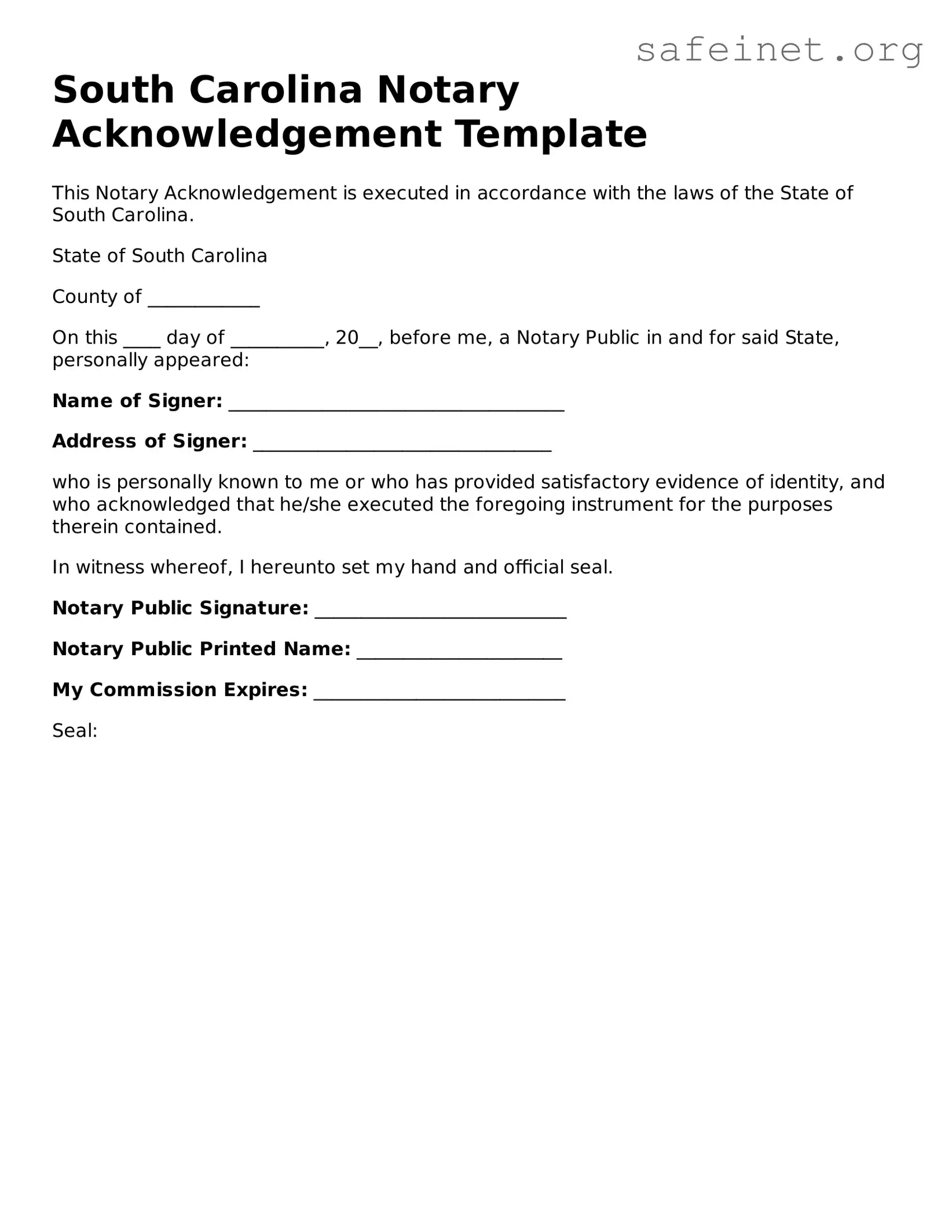
In South Carolina, the Notary Acknowledgement form plays a crucial role in the legal landscape, ensuring that important documents are properly authenticated. This form serves as a declaration that a specific individual has willingly signed a document in the presence of a notary public. By providing this acknowledgment, the notary verifies the identity of the signer and confirms their understanding of the document's contents. It’s essential for various legal transactions, such as property transfers, contracts, and affidavits, where proof of signature is necessary. Additionally, the form includes spaces for the notary's signature, seal, and other pertinent details, making it a vital tool for maintaining the integrity of legal processes. Understanding how to properly complete and utilize this form can help individuals navigate their legal responsibilities with confidence.
South Carolina Notary Acknowledgement Template
This Notary Acknowledgement is executed in accordance with the laws of the State of South Carolina.
State of South Carolina
County of ____________
On this ____ day of __________, 20__, before me, a Notary Public in and for said State, personally appeared:
Name of Signer: ____________________________________
Address of Signer: ________________________________
who is personally known to me or who has provided satisfactory evidence of identity, and who acknowledged that he/she executed the foregoing instrument for the purposes therein contained.
In witness whereof, I hereunto set my hand and official seal.
Notary Public Signature: ___________________________
Notary Public Printed Name: ______________________
My Commission Expires: ___________________________
Seal:
| Fact Name | Description |
|---|---|
| Purpose | The South Carolina Notary Acknowledgement form is used to verify the identity of a signer and confirm their willingness to sign a document. |
| Governing Law | This form is governed by South Carolina Code of Laws, Title 26, Chapter 1, which outlines the powers and duties of notaries public. |
| Required Elements | The form must include the notary's signature, seal, and the date of the acknowledgment, along with the signer's name and a statement of acknowledgment. |
| Usage | Commonly used in real estate transactions, legal documents, and other formal agreements requiring notarization. |
Once you have the South Carolina Notary Acknowledgment form in hand, you are ready to proceed with filling it out. This form is essential for verifying the identity of the person signing a document and confirming that they did so willingly. Follow these steps to complete the form accurately.
After completing the form, ensure that all information is accurate and legible. This will help prevent any issues in the future. Once finalized, the form can be attached to the document being notarized and stored appropriately.
What is a South Carolina Notary Acknowledgement form?
The South Carolina Notary Acknowledgement form is a legal document used to verify the identity of a signer and confirm that they willingly signed a document. This form is typically attached to legal documents, such as contracts or deeds, to provide proof of the signing process.
Who can act as a notary in South Carolina?
In South Carolina, a notary public must be at least 18 years old, a resident of the state, and possess a high school diploma or equivalent. They must also complete the application process and be appointed by the Governor. Notaries are authorized to perform notarial acts, including acknowledgements, oaths, and affirmations.
How do I complete a Notary Acknowledgement form?
To complete a Notary Acknowledgement form, the signer must first appear before the notary. The notary will ask the signer to provide a valid form of identification. Once verified, the signer will then acknowledge that they signed the document willingly. The notary will fill out the form, including their signature, seal, and date.
Is a Notary Acknowledgement form necessary for all documents?
No, a Notary Acknowledgement form is not required for every document. However, it is essential for documents that require proof of signature authenticity, such as real estate transactions, powers of attorney, and certain court documents. Always check the specific requirements for the document in question.
What happens if a Notary Acknowledgement is improperly completed?
If a Notary Acknowledgement is not completed correctly, the document may be considered invalid. This can lead to legal complications, including the potential for disputes or challenges regarding the authenticity of the signature. It is crucial to ensure that all steps are followed accurately to avoid these issues.
How long is a Notary Acknowledgement valid in South Carolina?
A Notary Acknowledgement does not expire on its own. However, the validity of the underlying document may depend on its specific terms. It is important to be aware of any deadlines or expiration dates related to the document that the Notary Acknowledgement supports.
Incomplete Information: One of the most common mistakes is failing to fill out all required fields. Ensure that every section is completed, including the name of the signer, the date, and the notary's information.
Incorrect Signer Name: Double-check the spelling of the signer's name. Even a small typo can cause issues later on, especially if the document needs to be verified or recorded.
Not Using the Correct Date: The date on the form should reflect when the acknowledgment takes place. Using a future date or an incorrect past date can invalidate the notarization.
Failing to Sign the Form: Notaries must sign the acknowledgment form themselves. Forgetting to do this can render the document ineffective.
Missing Notary Seal: The notary’s seal is crucial. Without it, the acknowledgment may not be recognized. Always ensure the seal is affixed properly.
Improper Identification: Notaries must verify the identity of the signer. Failing to ask for proper identification can lead to questions about the authenticity of the notarization.
Not Following State Guidelines: Each state has specific rules regarding notary acknowledgments. Ignoring these guidelines can lead to legal complications, so it's essential to be aware of South Carolina's requirements.
When dealing with the South Carolina Notary Acknowledgement form, several other documents often accompany it. These forms help ensure that transactions and agreements are properly documented and legally binding. Here’s a list of some commonly used forms:
These documents play important roles in various legal processes. Understanding their functions can help individuals navigate legal matters more effectively.
The South Carolina Notary Acknowledgment form is similar to the Affidavit. An affidavit is a written statement confirmed by oath or affirmation, often used in legal proceedings. Like the Notary Acknowledgment, it requires a notary public to witness the signing and verify the identity of the signer. Both documents serve to affirm the truthfulness of the statements contained within them, providing a layer of legal protection and credibility.
Another document akin to the Notary Acknowledgment is the Power of Attorney. This legal document allows one person to act on behalf of another in legal or financial matters. Just as with a Notary Acknowledgment, a notary public often verifies the identities of the parties involved, ensuring that the person granting authority is doing so willingly and knowingly. Both documents are crucial for establishing trust and clarity in legal transactions.
The Deed is also similar to the Notary Acknowledgment. A deed is a legal document that conveys ownership of property from one party to another. Notarization is typically required for deeds to ensure that the signatures are authentic and that the transaction is legitimate. This requirement mirrors the purpose of the Notary Acknowledgment, which is to confirm that a person has signed a document willingly and understands its contents.
In addition, the Bill of Sale shares similarities with the Notary Acknowledgment. A Bill of Sale is a document that transfers ownership of personal property from one party to another. Notarization may be used to validate this transaction, similar to how a Notary Acknowledgment confirms the authenticity of a signature. Both documents aim to protect the interests of the parties involved and provide a clear record of the transaction.
The Certification of Trust is another document that resembles the Notary Acknowledgment. This document provides evidence of the existence of a trust and outlines the powers of the trustee. Notarization is often required to confirm the identities of the individuals involved and to ensure that the trust document is legitimate. Like the Notary Acknowledgment, it serves to establish the credibility of the information presented.
The Consent form also shares common ground with the Notary Acknowledgment. A consent form is used to obtain permission for a specific action, such as medical treatment or participation in a study. Notarization may be used to validate the consent, ensuring that the signer understands what they are agreeing to. Both documents emphasize the importance of informed consent and the authenticity of the signatures involved.
The Lease Agreement is similar in purpose to the Notary Acknowledgment. A Lease Agreement outlines the terms and conditions under which one party rents property from another. While not always required, notarization can add an extra layer of security, confirming that both parties have agreed to the terms. This parallels the function of the Notary Acknowledgment, which verifies that the parties have willingly signed the document.
The Mortgage Agreement also resembles the Notary Acknowledgment. This document outlines the terms of a loan secured by real property. Notarization is typically required to ensure the authenticity of the signatures and to protect the lender's interests. Both documents play a vital role in real estate transactions, ensuring that all parties understand their rights and obligations.
The Release of Liability form is another document that is similar to the Notary Acknowledgment. This form is used to relinquish a party's right to pursue legal claims against another party. Notarization may be required to confirm that the individual signing the release understands its implications. Both documents aim to protect parties involved by clarifying intentions and ensuring that agreements are made voluntarily.
Lastly, the Wills and Testaments are akin to the Notary Acknowledgment. These documents outline a person's wishes regarding the distribution of their assets after death. While not all wills require notarization, having a notary involved can add credibility to the document. Both the Notary Acknowledgment and wills serve to affirm the intentions of the individuals involved, ensuring that their wishes are respected.
When filling out the South Carolina Notary Acknowledgement form, it is important to follow specific guidelines to ensure accuracy and compliance. Below is a list of things you should and shouldn't do during this process.
Following these guidelines will help ensure that the Notary Acknowledgement form is completed correctly and is legally valid in South Carolina.
Understanding the nuances of the South Carolina Notary Acknowledgment form can be quite challenging. Here are five common misconceptions that often arise, along with clarifications to help you navigate this important document.
In reality, the notary's role is not to witness the signing itself but to confirm the identity of the signers and ensure they are signing willingly. The acknowledgment form serves as proof that the notary verified the identity of the individual signing the document.
This is not true. Only certain documents, particularly those that require a formal acknowledgment for legal purposes, need this form. Examples include deeds, powers of attorney, and certain court documents.
This is incorrect. The signer must be present before the notary at the time of the acknowledgment. The notary must confirm the identity of the signer in person.
Notaries are prohibited from offering legal advice. Their function is strictly to verify identities and administer oaths. If legal guidance is needed, it is essential to consult a qualified attorney.
While related, these terms are not interchangeable. A notarization refers to the act of the notary performing their duties, while an acknowledgment specifically relates to the confirmation of the signer's identity and willingness to sign the document.
When filling out and using the South Carolina Notary Acknowledgement form, it’s important to keep several key points in mind. Understanding these can help ensure that the process is smooth and legally sound.
By following these guidelines, individuals can effectively use the South Carolina Notary Acknowledgement form, ensuring that their documents are properly acknowledged and legally recognized.