In the realm of business, protecting sensitive information is paramount, and the South Carolina Non-disclosure Agreement (NDA) form serves as a crucial tool in this endeavor. This legal document establishes a confidential relationship between parties, ensuring that proprietary information shared during discussions or collaborations remains protected. The NDA outlines the specific types of information deemed confidential, the obligations of the parties involved, and the duration of the confidentiality requirement. Moreover, it addresses the consequences of any breach, providing a clear framework for recourse should the need arise. By utilizing this form, individuals and organizations can foster trust and open communication while safeguarding their valuable intellectual property and trade secrets. Understanding the nuances of the South Carolina NDA is essential for anyone looking to engage in business dealings that require discretion and confidentiality.
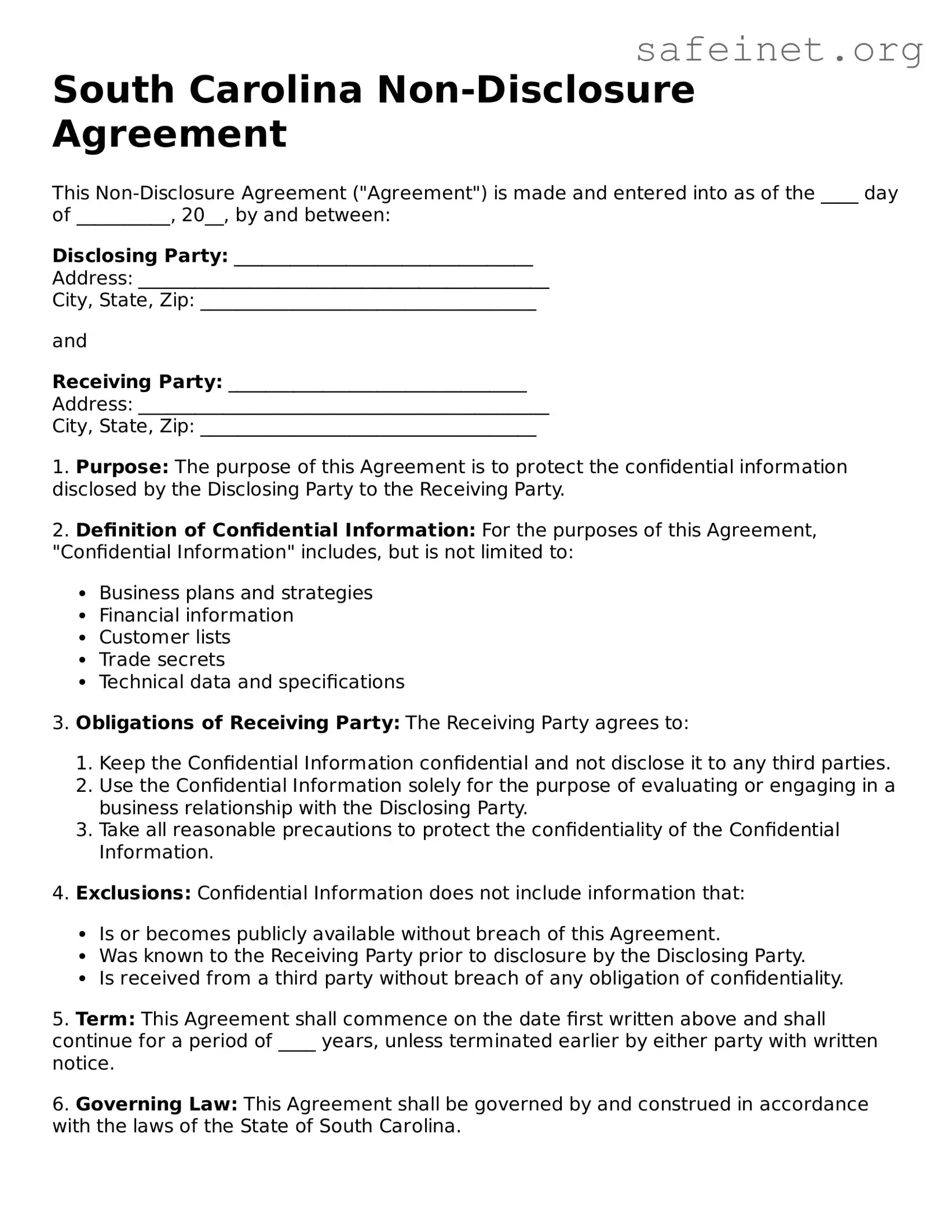
South Carolina Non-Disclosure Agreement
This Non-Disclosure Agreement ("Agreement") is made and entered into as of the ____ day of __________, 20__, by and between:
Disclosing Party: ________________________________
Address: ____________________________________________
City, State, Zip: ____________________________________
and
Receiving Party: ________________________________
Address: ____________________________________________
City, State, Zip: ____________________________________
1. Purpose: The purpose of this Agreement is to protect the confidential information disclosed by the Disclosing Party to the Receiving Party.
2. Definition of Confidential Information: For the purposes of this Agreement, "Confidential Information" includes, but is not limited to:
3. Obligations of Receiving Party: The Receiving Party agrees to:
4. Exclusions: Confidential Information does not include information that:
5. Term: This Agreement shall commence on the date first written above and shall continue for a period of ____ years, unless terminated earlier by either party with written notice.
6. Governing Law: This Agreement shall be governed by and construed in accordance with the laws of the State of South Carolina.
7. Entire Agreement: This Agreement constitutes the entire understanding between the parties regarding the subject matter herein and supersedes all prior discussions or agreements.
IN WITNESS WHEREOF, the parties hereto have executed this Non-Disclosure Agreement as of the date first above written.
Disclosing Party Signature: ____________________________
Date: ____________________
Receiving Party Signature: ____________________________
Date: ____________________
| Fact Name | Description |
|---|---|
| Purpose | The South Carolina Non-disclosure Agreement (NDA) is designed to protect confidential information shared between parties. |
| Governing Law | The NDA is governed by South Carolina state law, specifically under the Uniform Trade Secrets Act. |
| Parties Involved | Typically, the agreement involves a disclosing party and a receiving party. |
| Duration of Confidentiality | The duration for which the information remains confidential can be specified in the agreement. |
| Types of Information | Confidential information can include trade secrets, business plans, and proprietary data. |
| Exclusions | Information that is public knowledge or already known to the receiving party is usually excluded from confidentiality. |
| Legal Remedies | In case of a breach, the disclosing party may seek legal remedies, including injunctions and damages. |
| Enforceability | The NDA must be reasonable in scope and duration to be enforceable in South Carolina courts. |
| Signature Requirement | Both parties must sign the NDA for it to be legally binding. |
| Use in Business Transactions | NDAs are commonly used in business transactions, such as mergers, acquisitions, and partnerships. |
Completing the South Carolina Non-disclosure Agreement form requires attention to detail and accuracy. This process involves several steps to ensure that all necessary information is provided correctly. Following these instructions will facilitate the successful filling out of the form.
What is a Non-disclosure Agreement (NDA) in South Carolina?
A Non-disclosure Agreement (NDA) is a legal contract that protects confidential information shared between parties. In South Carolina, an NDA ensures that sensitive information, such as trade secrets or business plans, remains private. This agreement is crucial for businesses and individuals who want to safeguard their proprietary information from being disclosed to unauthorized parties.
Who should use a Non-disclosure Agreement?
Any individual or business that shares confidential information should consider using an NDA. This includes entrepreneurs sharing ideas with potential partners, companies discussing mergers, or employees receiving sensitive company information. By using an NDA, parties can establish clear boundaries regarding what information must remain confidential and what can be shared.
What are the key components of a South Carolina NDA?
A well-crafted NDA typically includes several important elements. First, it should clearly define what constitutes confidential information. Next, the agreement should outline the obligations of both parties regarding the handling of that information. Additionally, it often specifies the duration of confidentiality and any exceptions, such as information that is already public knowledge. Including these components helps ensure that both parties understand their responsibilities.
What happens if someone breaches the NDA?
If a party breaches the NDA, the other party may seek legal remedies. This can include monetary damages or injunctive relief, which is a court order to stop the breach. The specific consequences depend on the terms outlined in the NDA itself. It’s important to remember that having an NDA in place strengthens your position in case of a breach, as it provides a clear record of the agreement and the expectations of both parties.
Incomplete Information: Many individuals fail to provide all required details, such as names, addresses, or dates. This can lead to delays or invalid agreements.
Incorrect Signatures: Some people forget to sign the document or use a different name than the one listed. This inconsistency can cause issues in enforcement.
Not Specifying Confidential Information: A common mistake is not clearly defining what information is considered confidential. This lack of clarity can result in misunderstandings.
Ignoring the Duration: Failing to state how long the confidentiality obligation lasts can lead to confusion about when the agreement expires.
Overlooking Governing Law: Some individuals neglect to specify which state's laws will govern the agreement. This oversight can complicate legal proceedings if disputes arise.
Not Reviewing the Document: Skipping a thorough review before submission can result in overlooked errors or omissions. Taking the time to double-check can save significant trouble later.
When entering into a Non-disclosure Agreement (NDA) in South Carolina, it is often beneficial to consider additional forms and documents that can complement the NDA. These documents can help clarify the terms of the agreement, protect intellectual property, or outline specific business arrangements. Below is a list of commonly used forms that may accompany an NDA.
Each of these documents serves a unique purpose and can provide additional layers of protection for your business interests. It is important to carefully consider which forms may be necessary in conjunction with your Non-disclosure Agreement to ensure comprehensive protection of your confidential information.
A Non-Disclosure Agreement (NDA) is often compared to a Confidentiality Agreement. Both documents serve the primary purpose of protecting sensitive information shared between parties. A Confidentiality Agreement may be broader in scope, covering not only trade secrets but also proprietary information, business strategies, and client lists. While an NDA focuses more on preventing the disclosure of specific information, a Confidentiality Agreement can address a wider range of confidential matters, making it a versatile tool for businesses.
Another document similar to an NDA is the Non-Circumvention Agreement. This type of agreement is designed to prevent one party from bypassing the other to engage directly with clients or partners. While NDAs protect sensitive information, Non-Circumvention Agreements specifically focus on the relationships and business opportunities that may arise from shared information. Both documents are crucial in maintaining trust and ensuring that parties do not exploit each other's connections for personal gain.
A Proprietary Information Agreement shares similarities with an NDA in that it also seeks to protect confidential information. However, this agreement typically emphasizes the ownership of the information being shared. It is often used in situations where one party needs to disclose proprietary information to another, such as during a merger or acquisition. Like an NDA, a Proprietary Information Agreement outlines the obligations of the parties involved regarding the handling and safeguarding of sensitive data.
The Employee Confidentiality Agreement is another document that aligns closely with NDAs. This agreement is commonly used by employers to ensure that employees do not disclose company secrets or sensitive information learned during their employment. While NDAs can be used in various contexts, Employee Confidentiality Agreements are specifically tailored to protect a company’s interests in the employer-employee relationship. Both documents aim to create a secure environment for sharing information, but the Employee Confidentiality Agreement is more focused on the workplace context.
A Mutual Non-Disclosure Agreement is akin to a standard NDA but involves two parties sharing confidential information with each other. This type of agreement is particularly useful in negotiations where both sides need to disclose sensitive information to evaluate a potential partnership or business deal. By establishing clear terms for confidentiality, a Mutual NDA helps foster a trusting relationship, ensuring that both parties feel secure in sharing their proprietary information.
In addition, a Service Agreement often includes confidentiality clauses that resemble those found in NDAs. While a Service Agreement outlines the terms of a service relationship, it may also stipulate that both parties must keep certain information confidential. This ensures that any sensitive data shared during the service provision remains protected. Although the primary focus of a Service Agreement is on the services provided, the inclusion of confidentiality provisions highlights the importance of protecting sensitive information in business transactions.
Lastly, a Licensing Agreement can also bear similarities to an NDA. This document allows one party to use the intellectual property of another under specific terms, often requiring the recipient to keep certain information confidential. While the primary purpose of a Licensing Agreement is to outline the terms of use for intellectual property, it often incorporates confidentiality provisions to protect the interests of the intellectual property owner. This ensures that sensitive information related to the licensed material remains secure, similar to the protective measures established in an NDA.
When filling out the South Carolina Non-disclosure Agreement form, it is essential to approach the task with care and attention to detail. Here are some important guidelines to consider:
By following these guidelines, individuals can ensure that their Non-disclosure Agreement is both effective and enforceable.
When it comes to Non-disclosure Agreements (NDAs) in South Carolina, several misconceptions can lead to confusion. Understanding these common misunderstandings can help individuals and businesses navigate the process more effectively. Here are seven misconceptions about the South Carolina Non-disclosure Agreement form:
By dispelling these misconceptions, individuals and businesses can better appreciate the importance of Non-disclosure Agreements and how they can serve as valuable tools for protecting sensitive information.
When dealing with sensitive information, a Non-disclosure Agreement (NDA) can be a vital tool for protecting your interests. Here are some key takeaways about filling out and using the South Carolina Non-disclosure Agreement form: