In the competitive landscape of South Carolina's job market, protecting business interests is crucial, and the Non-compete Agreement form serves as a vital tool for employers and employees alike. This legal document outlines the terms under which an employee agrees not to engage in activities that directly compete with their employer's business after leaving their position. Key elements of the agreement include the duration of the non-compete period, the geographical area it covers, and the specific activities that are restricted. By establishing these parameters, the Non-compete Agreement aims to safeguard trade secrets, client relationships, and proprietary information. However, it’s important to note that the enforceability of such agreements can vary, depending on factors like reasonableness and public policy considerations. Understanding these aspects is essential for both parties to navigate the complexities of employment relationships and to ensure that their rights and obligations are clearly defined.
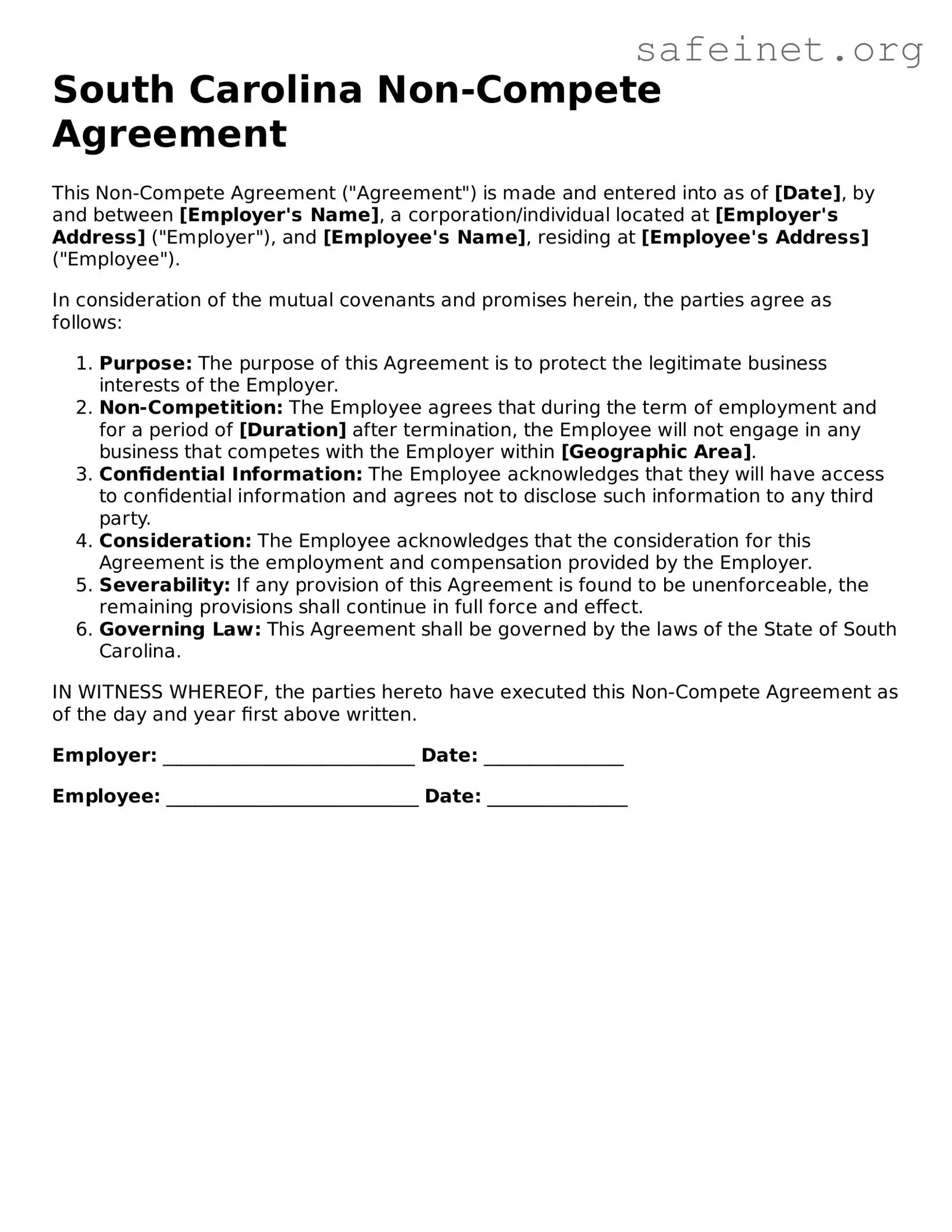
South Carolina Non-Compete Agreement
This Non-Compete Agreement ("Agreement") is made and entered into as of [Date], by and between [Employer's Name], a corporation/individual located at [Employer's Address] ("Employer"), and [Employee's Name], residing at [Employee's Address] ("Employee").
In consideration of the mutual covenants and promises herein, the parties agree as follows:
IN WITNESS WHEREOF, the parties hereto have executed this Non-Compete Agreement as of the day and year first above written.
Employer: ___________________________ Date: _______________
Employee: ___________________________ Date: _______________
| Fact Name | Description |
|---|---|
| Definition | A non-compete agreement restricts an employee from working for competitors or starting a similar business for a specified time after leaving a job. |
| Governing Law | Non-compete agreements in South Carolina are governed by state law, specifically the South Carolina Code of Laws, Title 40, Chapter 35. |
| Enforceability | For a non-compete agreement to be enforceable, it must be reasonable in scope, duration, and geographic area. |
| Consideration | In South Carolina, an employee must receive something of value in exchange for signing a non-compete agreement, such as employment or a promotion. |
| Duration | Typically, non-compete agreements should not exceed two years in duration to be considered reasonable. |
| Judicial Review | South Carolina courts will review non-compete agreements on a case-by-case basis, considering factors like the employer's legitimate business interests. |
Filling out the South Carolina Non-compete Agreement form is a straightforward process that requires careful attention to detail. Once you have the form in hand, you can proceed with the following steps to ensure that all necessary information is accurately provided.
After completing the form, you should keep a copy for your records and provide the original to the employer. This ensures both parties are clear about the terms and conditions outlined in the agreement.
What is a Non-compete Agreement in South Carolina?
A Non-compete Agreement is a contract between an employer and an employee that restricts the employee from engaging in certain competitive activities after leaving the company. In South Carolina, these agreements are generally enforceable as long as they are reasonable in scope, duration, and geographic area. The purpose of a Non-compete Agreement is to protect the employer's legitimate business interests, such as trade secrets, customer relationships, and proprietary information.
What are the key elements that make a Non-compete Agreement enforceable in South Carolina?
For a Non-compete Agreement to be enforceable in South Carolina, it must meet specific criteria. First, it should protect a legitimate business interest. Second, the restrictions must be reasonable in terms of time and geographic scope. Typically, a duration of one to two years is considered reasonable, while the geographic area should not be overly broad. Additionally, the agreement must be supported by consideration, meaning that the employee should receive something of value in exchange for signing the agreement, such as a job offer or training.
Can an employee negotiate the terms of a Non-compete Agreement?
Yes, employees can negotiate the terms of a Non-compete Agreement. Before signing, it is advisable for employees to review the agreement carefully and consider whether the terms are fair and reasonable. If any aspect of the agreement seems overly restrictive, employees should feel empowered to discuss their concerns with their employer. Negotiating can lead to a more balanced agreement that protects both the employer's interests and the employee's future opportunities.
What should an employee do if they believe their Non-compete Agreement is unfair?
If an employee believes their Non-compete Agreement is unfair or overly restrictive, they should consult with an attorney who specializes in employment law. An attorney can provide guidance on the enforceability of the agreement and discuss potential options for modification or negotiation. In some cases, it may be possible to challenge the agreement in court if it does not meet the legal standards for enforceability in South Carolina.
Not providing complete personal information. Ensure that all fields are filled out, including name, address, and contact details.
Failing to specify the duration of the non-compete period. Clearly state how long the agreement will be in effect.
Neglecting to define the geographic scope. Specify the areas where the non-compete will apply to avoid ambiguity.
Using vague language. Be clear and specific about the activities that are restricted under the agreement.
Overlooking the need for signatures. Both parties must sign the agreement for it to be valid.
Not including a consideration clause. This explains what the employee receives in exchange for agreeing to the non-compete.
Ignoring local laws. Familiarize yourself with South Carolina laws regarding non-compete agreements to ensure compliance.
Failing to review the agreement with legal counsel. Consulting with a lawyer can help clarify terms and ensure enforceability.
Assuming all non-compete agreements are the same. Each agreement should be tailored to the specific situation and parties involved.
Not keeping a copy of the signed agreement. Retain a copy for your records and future reference.
A South Carolina Non-compete Agreement is often used alongside other important documents to ensure clarity and enforceability in employment relationships. Here are four common forms that complement the Non-compete Agreement:
Using these documents together with a Non-compete Agreement helps create a comprehensive framework for protecting business interests while maintaining clear communication with employees and contractors. This approach fosters a healthy work environment built on mutual respect and understanding.
The South Carolina Non-compete Agreement is similar to a Non-disclosure Agreement (NDA). Both documents are designed to protect sensitive information and business interests. While a non-compete restricts an employee from working with competitors after leaving a company, an NDA prevents them from sharing proprietary information during and after their employment. Both agreements serve to maintain the confidentiality and competitive edge of a business, ensuring that valuable information does not fall into the hands of rivals.
Another related document is the Non-solicitation Agreement. This agreement focuses on preventing an employee from soliciting clients or employees from their former employer after leaving the company. Like the non-compete, it aims to protect the business's relationships and resources. However, it specifically addresses the act of solicitation rather than outright competition, making it a vital tool for businesses looking to safeguard their client base and workforce.
A Confidentiality Agreement shares similarities with the Non-compete Agreement in that both seek to protect proprietary information. A Confidentiality Agreement, however, is broader in scope, covering any confidential information shared between parties. This document is essential for businesses that need to disclose sensitive information to employees or partners while ensuring that such information remains protected from disclosure to outsiders.
The Employment Agreement is another document that often includes non-compete clauses. This comprehensive contract outlines the terms of employment, including job responsibilities, compensation, and any restrictions on post-employment activities. By incorporating a non-compete clause, employers can ensure that employees are aware of their obligations regarding competition and confidentiality from the outset of their employment.
A Partnership Agreement can also resemble a Non-compete Agreement in certain contexts. This document outlines the terms of a business partnership, including roles, responsibilities, and restrictions on competition between partners. In cases where partners may have access to sensitive information, the partnership agreement may include non-compete provisions to protect the business interests of all parties involved.
In addition, a Franchise Agreement often contains non-compete clauses to protect the franchisor's brand and business model. This legal document governs the relationship between the franchisor and franchisee, stipulating the rights and obligations of each party. The non-compete aspect ensures that franchisees do not operate competing businesses that could undermine the franchisor's interests, maintaining brand integrity and market position.
The License Agreement is another document that may include non-compete provisions. This agreement allows one party to use the intellectual property of another under specific conditions. To protect the interests of the licensor, a non-compete clause may be included to prevent the licensee from using the licensed material in a way that competes with the licensor's business, thereby preserving the value of the intellectual property.
Lastly, a Shareholder Agreement can incorporate non-compete clauses to protect the interests of the business and its shareholders. This document governs the relationships between shareholders and outlines their rights and obligations. Including a non-compete clause helps ensure that shareholders do not engage in activities that could harm the company’s competitive position or market share, safeguarding the investment of all shareholders.
When filling out the South Carolina Non-compete Agreement form, it is important to be mindful of certain practices. Here are six essential dos and don'ts to consider:
Non-compete agreements are often misunderstood, especially in South Carolina. Here are six common misconceptions:
Filling out and using a South Carolina Non-compete Agreement form is a crucial step for both employers and employees. Understanding the key aspects of this document can help ensure that it is enforceable and serves its intended purpose. Here are some important takeaways to keep in mind:
Taking these steps can enhance the effectiveness of your Non-compete Agreement and protect your interests. Ensure that all parties understand the terms before signing.