In South Carolina, the Motor Vehicle Power of Attorney form serves as a crucial legal tool for individuals who need to delegate authority regarding their vehicle to another person. This form allows a designated agent to handle various tasks related to motor vehicles, such as transferring title, registering the vehicle, or obtaining necessary documents on behalf of the vehicle owner. By granting this power, the vehicle owner can ensure that their interests are represented, even when they cannot be present to manage these affairs personally. The form typically requires the owner's signature and may need to be notarized to confirm its authenticity. Additionally, it is essential to specify the scope of authority granted to the agent, as this can vary based on the owner's needs. Understanding the nuances of this form can help vehicle owners navigate the complexities of vehicle management with greater ease and confidence.
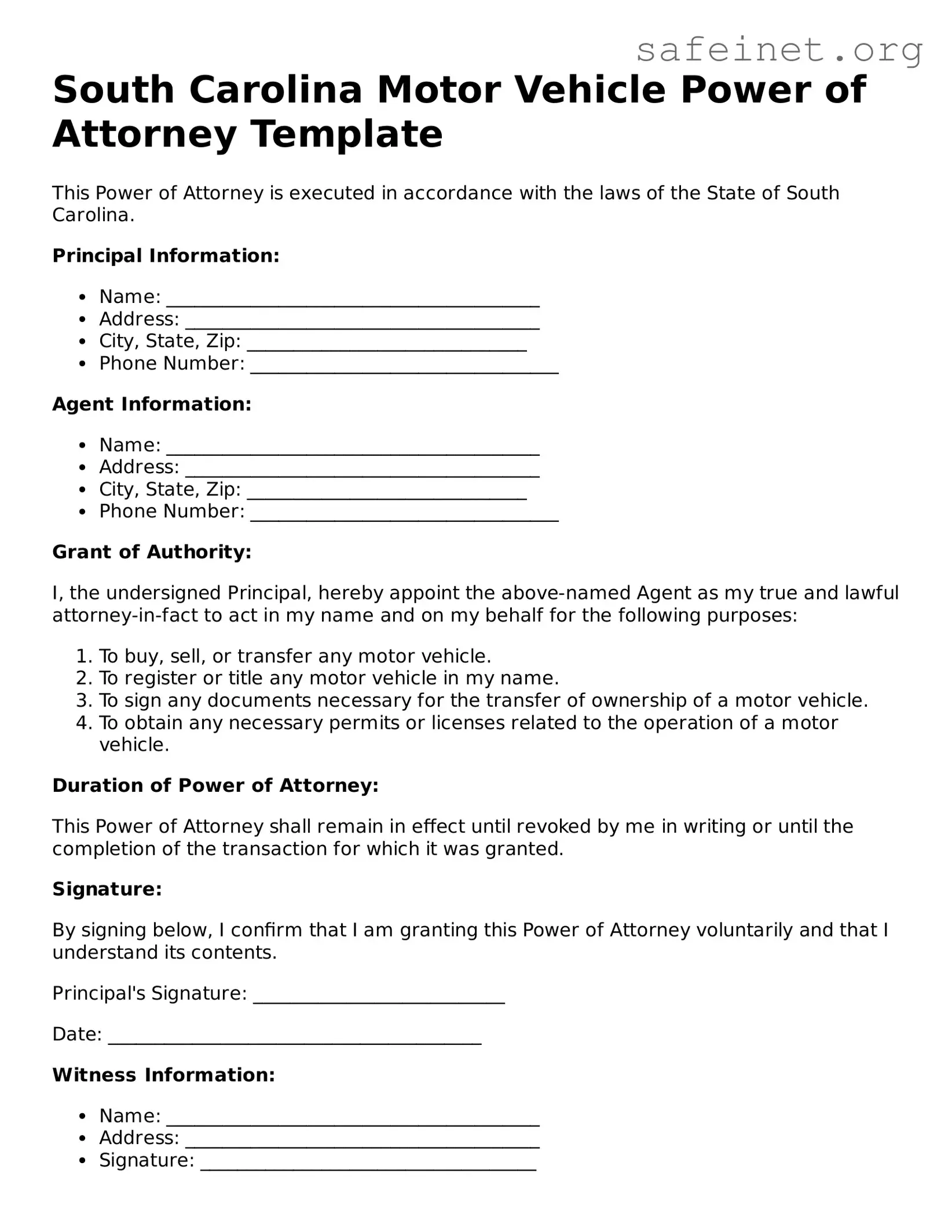
South Carolina Motor Vehicle Power of Attorney Template
This Power of Attorney is executed in accordance with the laws of the State of South Carolina.
Principal Information:
Agent Information:
Grant of Authority:
I, the undersigned Principal, hereby appoint the above-named Agent as my true and lawful attorney-in-fact to act in my name and on my behalf for the following purposes:
Duration of Power of Attorney:
This Power of Attorney shall remain in effect until revoked by me in writing or until the completion of the transaction for which it was granted.
Signature:
By signing below, I confirm that I am granting this Power of Attorney voluntarily and that I understand its contents.
Principal's Signature: ___________________________
Date: ________________________________________
Witness Information:
This document must be signed in the presence of a notary public to be valid.
| Fact Name | Description |
|---|---|
| Purpose | The South Carolina Motor Vehicle Power of Attorney form allows an individual to appoint another person to handle motor vehicle transactions on their behalf. |
| Governing Law | This form is governed by South Carolina Code of Laws, Title 56, Chapter 19. |
| Principal and Agent | The person granting authority is known as the principal, while the person receiving authority is the agent. |
| Signature Requirement | The principal must sign the form in the presence of a notary public for it to be valid. |
| Duration | The power of attorney remains effective until the principal revokes it or passes away. |
| Specific Transactions | This form can be used for various transactions, including title transfers, registration, and obtaining duplicate titles. |
| Revocation | The principal can revoke the power of attorney at any time by providing written notice to the agent. |
| Agent's Responsibilities | The agent must act in the best interest of the principal and only within the authority granted. |
| Usage | This form is commonly used when the principal cannot be present for vehicle-related transactions, such as during relocation or illness. |
Filling out the South Carolina Motor Vehicle Power of Attorney form is a straightforward process. Once completed, this document allows someone you trust to handle specific vehicle-related tasks on your behalf.
What is a South Carolina Motor Vehicle Power of Attorney form?
The South Carolina Motor Vehicle Power of Attorney form is a legal document that allows one person to authorize another person to act on their behalf regarding motor vehicle transactions. This can include tasks like signing titles, transferring ownership, or handling registration issues. It is especially useful when the vehicle owner cannot be present to complete these actions themselves.
Who can be designated as an agent in this Power of Attorney?
Any adult can be designated as an agent in the South Carolina Motor Vehicle Power of Attorney form. This includes friends, family members, or even professionals like attorneys or auto dealers. It is important to choose someone you trust, as they will have the authority to make decisions regarding your vehicle.
Do I need to have the form notarized?
Yes, the South Carolina Motor Vehicle Power of Attorney form must be notarized to be valid. This means that you will need to sign the document in front of a notary public, who will then verify your identity and witness your signature. Notarization helps ensure the authenticity of the document and protects against fraud.
Can I revoke a Power of Attorney once it is created?
Yes, you can revoke a Power of Attorney at any time as long as you are mentally competent. To do this, you should create a written revocation document and notify your agent of the change. It’s also a good idea to inform any institutions or individuals that may have relied on the original Power of Attorney.
Is there a specific format for the Motor Vehicle Power of Attorney form?
While there is no strict format mandated by South Carolina law, the form should include essential elements such as your name, the agent’s name, a clear description of the powers being granted, and your signature. Using a template that complies with state requirements can help ensure that all necessary information is included.
What powers can I grant to my agent?
You can grant your agent various powers related to your motor vehicle. These may include signing documents for the sale or transfer of the vehicle, registering the vehicle, applying for titles, and handling any necessary paperwork with the Department of Motor Vehicles (DMV). Clearly outlining these powers in the form is crucial for avoiding confusion later.
How long is the Power of Attorney valid?
The South Carolina Motor Vehicle Power of Attorney remains valid until you revoke it, the agent resigns, or the purpose of the Power of Attorney has been fulfilled. If you want the Power of Attorney to be effective for a specific time period, you should specify that duration in the document.
Failing to provide complete information about the principal. It’s essential to include the full name, address, and contact details.
Not specifying the powers granted. The form should clearly outline what authority is being given to the agent, such as buying, selling, or registering a vehicle.
Neglecting to sign the document. Both the principal and the agent must sign the form for it to be valid.
Overlooking the need for a witness or notarization. In South Carolina, having a witness or notarizing the document is often required to ensure its legality.
Using outdated forms. Always check for the latest version of the Power of Attorney form to ensure compliance with current laws.
Failing to date the document. A date is crucial as it indicates when the authority takes effect.
Not understanding the implications of granting power. It’s vital to know the responsibilities and potential risks involved in giving someone else authority over your vehicle.
Leaving out specific vehicle details. Including the make, model, and VIN of the vehicle can prevent confusion and disputes.
Assuming the form is only for one-time use. Some may not realize that the Power of Attorney can be revoked or updated as needed.
Ignoring state-specific requirements. Each state has its own rules regarding Power of Attorney forms, so it’s important to follow South Carolina’s specific guidelines.
When dealing with motor vehicle transactions in South Carolina, individuals often need additional documents to complement the Motor Vehicle Power of Attorney form. These documents can help ensure that all necessary legal requirements are met and that the process runs smoothly. Below is a list of commonly used forms and documents.
Utilizing these documents alongside the South Carolina Motor Vehicle Power of Attorney form can facilitate a smoother transaction process. Ensuring that all paperwork is correctly completed and submitted is essential for compliance with state regulations.
The South Carolina Motor Vehicle Power of Attorney form shares similarities with the General Power of Attorney. Both documents allow an individual, known as the principal, to grant authority to another person, referred to as the agent, to act on their behalf. In the case of the General Power of Attorney, the scope of authority is broader, covering various financial and legal matters, while the Motor Vehicle Power of Attorney is specifically tailored for vehicle-related transactions. This focused approach can simplify processes related to vehicle registration, title transfers, and other motor vehicle dealings.
Another document that resembles the Motor Vehicle Power of Attorney is the Durable Power of Attorney. Like the Motor Vehicle version, the Durable Power of Attorney permits someone to manage the affairs of another person. The key difference lies in its durability; it remains effective even if the principal becomes incapacitated. This feature is particularly important for long-term planning, ensuring that decisions regarding both vehicle matters and other personal affairs can continue seamlessly, regardless of the principal’s health status.
The Limited Power of Attorney also aligns closely with the Motor Vehicle Power of Attorney. This document grants specific, limited authority to an agent for designated tasks. In the context of motor vehicles, it may allow an agent to handle only the sale of a car or the registration of a vehicle. This specificity helps the principal maintain control over their affairs while ensuring that the agent can effectively manage particular responsibilities without overstepping boundaries.
Lastly, the Vehicle Title Transfer form is another document that interacts with the Motor Vehicle Power of Attorney. While the Motor Vehicle Power of Attorney empowers an agent to act on behalf of the principal, the Vehicle Title Transfer form is the actual document used to transfer ownership of a vehicle. When the Motor Vehicle Power of Attorney is in place, it can facilitate the completion of the Vehicle Title Transfer by allowing the agent to sign on behalf of the principal, thereby streamlining the process of changing ownership and ensuring compliance with state regulations.
When completing the South Carolina Motor Vehicle Power of Attorney form, it's essential to follow certain guidelines to ensure accuracy and compliance. Here are some dos and don'ts to consider:
When it comes to the South Carolina Motor Vehicle Power of Attorney form, many people have misconceptions that can lead to confusion and potential legal issues. Below are seven common misconceptions, along with explanations to clarify them.
Only lawyers can create a Power of Attorney. This is not true. While having a lawyer can be helpful, individuals can complete the Motor Vehicle Power of Attorney form on their own, as long as they understand the requirements and implications of the document.
A Power of Attorney is only for financial matters. Many people believe that Powers of Attorney are limited to financial issues. However, the Motor Vehicle Power of Attorney specifically allows someone to handle vehicle-related transactions, such as registering a vehicle or transferring title.
Once signed, a Power of Attorney cannot be revoked. This is a misconception. You can revoke a Power of Attorney at any time as long as you are mentally competent. It is crucial to notify the person you appointed and any institutions that may have relied on the document.
Only the vehicle owner can complete the form. While the vehicle owner typically completes the form, they can designate someone else to act on their behalf. This flexibility is essential for those who may be unable to manage vehicle transactions personally.
The form is only valid in South Carolina. Although the Motor Vehicle Power of Attorney form is designed for South Carolina, it can often be recognized in other states for vehicle transactions. However, it's advisable to check the specific requirements of the state in question.
All Powers of Attorney are the same. This is misleading. There are various types of Powers of Attorney, each serving different purposes. The Motor Vehicle Power of Attorney is tailored specifically for vehicle-related matters, making it distinct from general or financial Powers of Attorney.
Once the Power of Attorney is used, it becomes invalid. This is incorrect. The Power of Attorney remains valid until it is revoked or until the principal (the person who created it) passes away. Therefore, it can be used multiple times for various transactions as needed.
Understanding these misconceptions can help individuals navigate the complexities of vehicle transactions more effectively. Always consider seeking guidance if unsure about any legal document or process.
The South Carolina Motor Vehicle Power of Attorney form allows you to designate someone to act on your behalf regarding motor vehicle transactions.
It is essential to fill out the form accurately to ensure that the appointed agent can perform the necessary tasks without complications.
Both the principal (the person granting power) and the agent (the person receiving power) must be clearly identified on the form.
The form requires the inclusion of the vehicle's description, including the make, model, year, and VIN (Vehicle Identification Number).
Signature of the principal is mandatory. This signature must be notarized to validate the document.
Agents can perform a variety of tasks, such as signing titles, registering vehicles, and transferring ownership.
It’s important to specify the duration of the power granted. This can be for a specific transaction or an ongoing authority.
The form should be kept in a safe place and copies should be provided to the agent for ease of access during transactions.
Revocation of the power of attorney can be done at any time by notifying the agent and, if necessary, completing a new form.
Always consult with a legal professional if there are uncertainties regarding the completion or implications of the form.