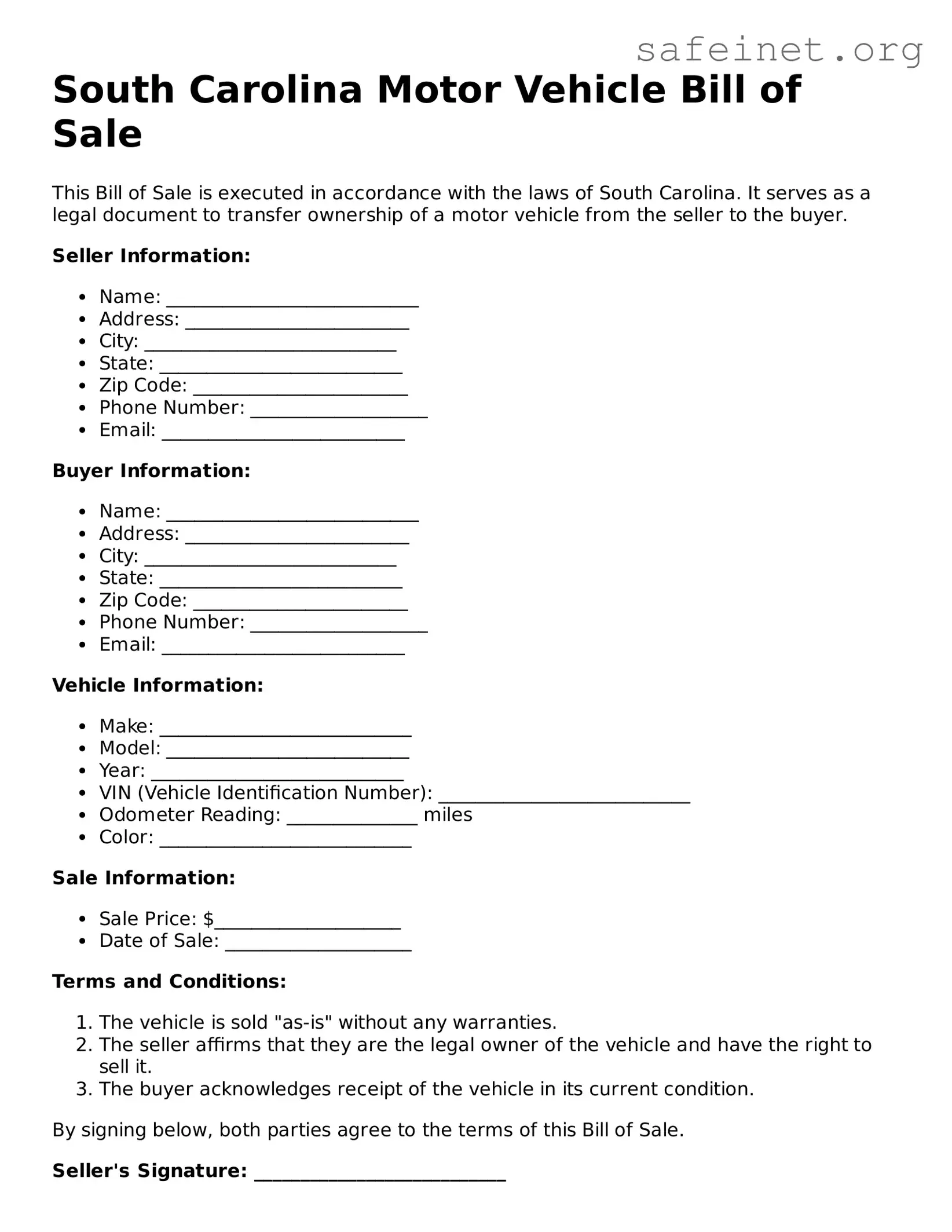
The South Carolina Motor Vehicle Bill of Sale form serves as a crucial document in the process of buying or selling a vehicle. This form not only provides proof of the transaction but also outlines essential details that protect both the buyer and the seller. It typically includes information such as the vehicle's make, model, year, and Vehicle Identification Number (VIN), ensuring clarity and accuracy in the sale. Additionally, the form captures the names and addresses of both parties involved, along with the sale price and date of the transaction. By documenting these key elements, the Bill of Sale helps to establish ownership and can be used for registration purposes with the South Carolina Department of Motor Vehicles. Understanding the importance of this form can simplify the transfer process and provide peace of mind for all parties involved.
South Carolina Motor Vehicle Bill of Sale
This Bill of Sale is executed in accordance with the laws of South Carolina. It serves as a legal document to transfer ownership of a motor vehicle from the seller to the buyer.
Seller Information:
Buyer Information:
Vehicle Information:
Sale Information:
Terms and Conditions:
By signing below, both parties agree to the terms of this Bill of Sale.
Seller's Signature: ___________________________
Date: ___________________________
Buyer's Signature: ___________________________
Date: ___________________________
| Fact Name | Description |
|---|---|
| Purpose | The South Carolina Motor Vehicle Bill of Sale form serves as a legal document to record the transfer of ownership of a vehicle from one party to another. |
| Governing Law | This form is governed by South Carolina Code of Laws, Title 56, Chapter 19, which outlines the requirements for vehicle sales and transfers. |
| Required Information | Essential details include the vehicle's make, model, year, VIN (Vehicle Identification Number), and the names and addresses of both the buyer and seller. |
| Notarization | While notarization is not mandatory for the Bill of Sale in South Carolina, it is highly recommended to provide additional legal protection and verification. |
| Usage | This form is often used when selling or buying used vehicles, and it can help prevent disputes regarding ownership and sale terms in the future. |
Once you have the South Carolina Motor Vehicle Bill of Sale form ready, it’s time to fill it out accurately. Completing this form ensures that the transfer of ownership is documented properly. Follow these steps to ensure you provide all necessary information.
After completing the form, both parties should keep a copy for their records. This documentation is important for future reference and legal purposes. If you have any questions about the next steps, consider reaching out to your local Department of Motor Vehicles for guidance on registration and title transfer.
What is a South Carolina Motor Vehicle Bill of Sale?
A South Carolina Motor Vehicle Bill of Sale is a legal document that serves as proof of the sale and transfer of ownership of a motor vehicle. This form includes important details about the vehicle, such as its make, model, year, Vehicle Identification Number (VIN), and the sale price. Both the buyer and seller should complete and sign this document to ensure a clear record of the transaction.
Is a Bill of Sale required in South Carolina?
While a Bill of Sale is not legally required to complete a vehicle sale in South Carolina, it is highly recommended. This document provides a record of the transaction, which can protect both the buyer and seller in case of disputes. It can also be helpful for the buyer when registering the vehicle with the Department of Motor Vehicles (DMV).
What information is needed to complete the Bill of Sale?
To complete a South Carolina Motor Vehicle Bill of Sale, you will need to provide the following information: the names and addresses of both the buyer and seller, the vehicle's make, model, year, VIN, odometer reading at the time of sale, sale price, and the date of the transaction. Both parties must sign the document to validate the sale.
Can I create my own Bill of Sale, or do I need to use a specific form?
You can create your own Bill of Sale as long as it includes all the necessary information. However, using a standard form can simplify the process and ensure that you do not miss any critical details. Many online resources provide templates specifically for South Carolina that you can fill out and print.
Do I need to have the Bill of Sale notarized?
In South Carolina, notarization of the Bill of Sale is not required. However, having the document notarized can add an extra layer of protection for both parties by verifying the identities of those involved in the transaction. It can also help in case of future disputes regarding the sale.
What should I do with the Bill of Sale after the sale?
After completing the Bill of Sale, both the buyer and seller should keep a copy for their records. The buyer will need to present this document when registering the vehicle with the DMV. It is advisable to store it in a safe place, as it serves as proof of ownership and the terms of the sale.
Not including the vehicle identification number (VIN). This number is crucial for identifying the vehicle and should be accurately recorded.
Failing to provide the correct odometer reading. This reading should reflect the vehicle's mileage at the time of sale to avoid future disputes.
Omitting the date of sale. This information is essential for record-keeping and legal purposes.
Not including the full names and addresses of both the buyer and seller. Accurate identification of both parties is necessary for the transaction.
Using incorrect or incomplete vehicle descriptions. Details such as make, model, year, and color should be clearly stated.
Neglecting to sign the document. Both parties must sign the Bill of Sale to validate the transaction.
Forgetting to keep a copy of the Bill of Sale. Each party should retain a signed copy for their records.
When completing a vehicle transaction in South Carolina, several additional documents may be necessary to ensure a smooth process. These forms help provide proof of ownership, facilitate registration, and meet legal requirements. Below is a list of commonly used documents that accompany the South Carolina Motor Vehicle Bill of Sale.
Having these documents ready can simplify the vehicle buying or selling process in South Carolina. Ensuring that all paperwork is completed accurately and submitted on time helps prevent delays and legal issues down the road.
The South Carolina Motor Vehicle Bill of Sale form is similar to a general Bill of Sale, which is used for the transfer of ownership of personal property. This document outlines the details of the transaction, including the buyer and seller's information, a description of the item, and the sale price. Just like the Motor Vehicle Bill of Sale, a general Bill of Sale serves as proof of the transaction and can protect both parties in case of disputes. It’s essential for any sale involving valuable items, ensuring clarity and legal standing.
Another document that shares similarities is the Vehicle Title Transfer form. This form is crucial when ownership of a vehicle changes hands. It contains information about the vehicle, such as the VIN and odometer reading, and must be signed by both the seller and the buyer. Like the Motor Vehicle Bill of Sale, the Vehicle Title Transfer serves as a legal record of the change in ownership, providing necessary details to the state’s motor vehicle department.
The Purchase Agreement is also akin to the Motor Vehicle Bill of Sale. This document outlines the terms and conditions of the sale, including payment details and any warranties. While it can be more comprehensive, it serves a similar purpose by documenting the transaction and protecting both parties’ interests. A Purchase Agreement can be particularly useful for more complex sales involving additional conditions or financing arrangements.
In addition, the Odometer Disclosure Statement is related to the Motor Vehicle Bill of Sale. This document is required by federal law when selling a vehicle, ensuring that the buyer is informed of the vehicle's mileage at the time of sale. It is typically included with the Bill of Sale in South Carolina, emphasizing transparency and honesty in the transaction, which is crucial for both buyers and sellers.
The Affidavit of Vehicle Ownership is another similar document. This form is often used when the original title is lost or unavailable. It allows the seller to declare ownership and transfer rights to the buyer without the original title. Like the Motor Vehicle Bill of Sale, it serves as a legal assertion of ownership, providing a way to complete the transaction even in less-than-ideal circumstances.
The Release of Liability form is also comparable. This document protects the seller from future liabilities related to the vehicle after the sale. By signing this form, the seller notifies the state that they are no longer responsible for the vehicle. It complements the Motor Vehicle Bill of Sale by ensuring that both parties are clear about their responsibilities following the transaction.
The Vehicle Registration form is similar in that it is necessary for the buyer to register the vehicle in their name after the purchase. This document provides the state with essential information about the new owner and the vehicle. While it does not serve as proof of sale like the Motor Vehicle Bill of Sale, it is an important step in the ownership transfer process.
The Salvage Title is another document that relates to the Motor Vehicle Bill of Sale. When a vehicle is deemed a total loss by an insurance company, it receives a salvage title. This document indicates that the vehicle has been damaged but can still be sold. Like the Motor Vehicle Bill of Sale, it is essential for ensuring that buyers are aware of the vehicle's history and condition before completing the purchase.
Lastly, the DMV Application for Title is relevant as it is often submitted alongside the Motor Vehicle Bill of Sale. This application is necessary for obtaining a new title in the buyer’s name. It requires information about the vehicle and the transaction, reinforcing the importance of proper documentation in the ownership transfer process. Both documents work together to ensure a smooth transition of ownership.
When filling out the South Carolina Motor Vehicle Bill of Sale form, there are important guidelines to follow. Adhering to these can help ensure a smooth transaction and proper documentation.
When it comes to the South Carolina Motor Vehicle Bill of Sale form, several misconceptions can lead to confusion. Here’s a list of common misunderstandings and the truths behind them.
When filling out and using the South Carolina Motor Vehicle Bill of Sale form, consider the following key takeaways: