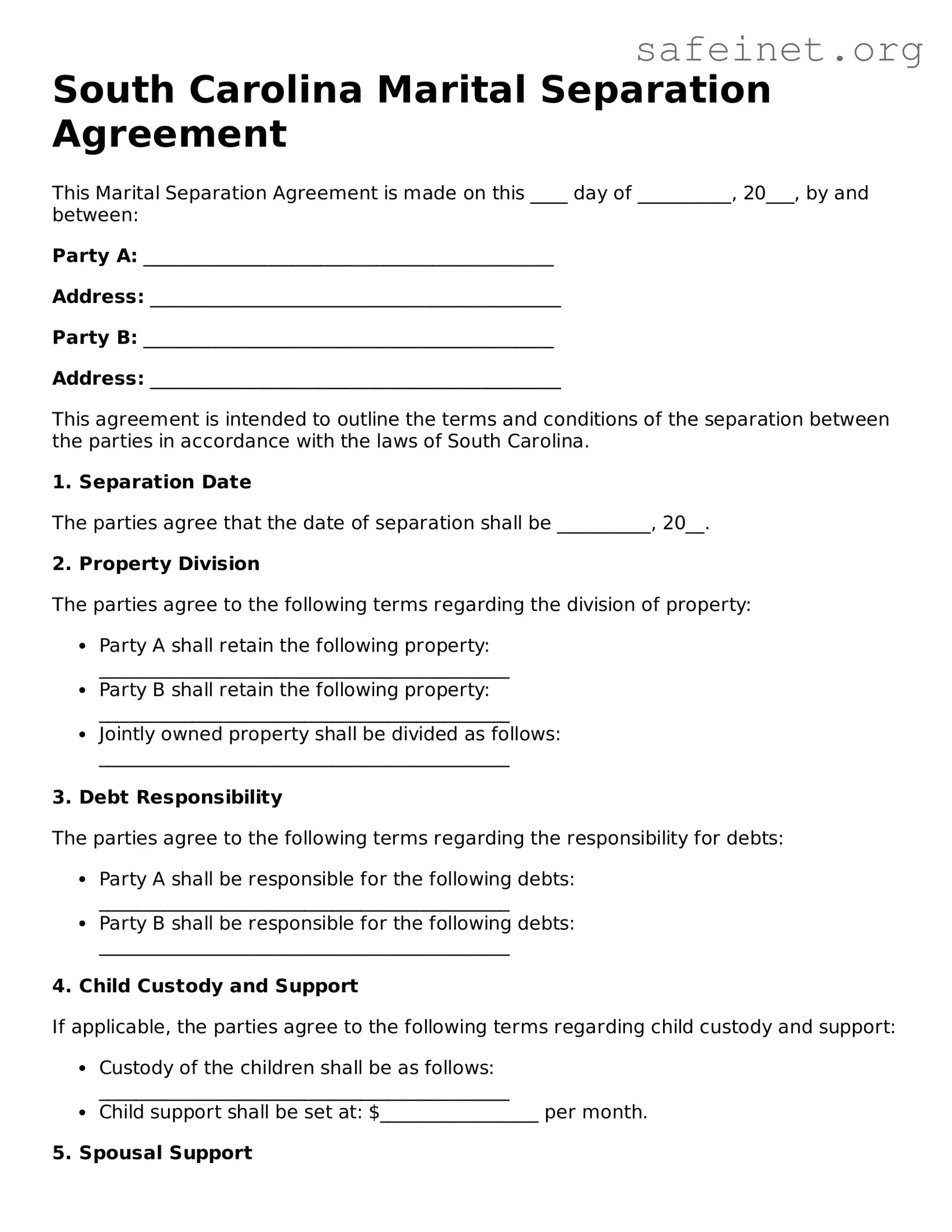
In South Carolina, navigating the complexities of marital separation requires careful consideration and clear documentation. The Marital Separation Agreement form serves as a crucial tool for couples who choose to live apart while addressing important aspects of their relationship. This form outlines agreements regarding the division of assets, spousal support, child custody, and visitation rights, ensuring that both parties have a mutual understanding of their responsibilities and entitlements. By formalizing these agreements, couples can reduce potential conflicts and provide a framework for their post-separation lives. The clarity and structure offered by this document not only protect individual interests but also promote a smoother transition for any children involved. Understanding the implications of each section of the form is essential for making informed decisions that will impact the future.
South Carolina Marital Separation Agreement
This Marital Separation Agreement is made on this ____ day of __________, 20___, by and between:
Party A: ____________________________________________
Address: ____________________________________________
Party B: ____________________________________________
Address: ____________________________________________
This agreement is intended to outline the terms and conditions of the separation between the parties in accordance with the laws of South Carolina.
1. Separation Date
The parties agree that the date of separation shall be __________, 20__.
2. Property Division
The parties agree to the following terms regarding the division of property:
3. Debt Responsibility
The parties agree to the following terms regarding the responsibility for debts:
4. Child Custody and Support
If applicable, the parties agree to the following terms regarding child custody and support:
5. Spousal Support
The parties agree to the following terms regarding spousal support:
6. Miscellaneous Provisions
IN WITNESS WHEREOF, the parties have executed this Marital Separation Agreement as of the date first above written.
Party A Signature: _______________________________ Date: ____________
Party B Signature: _______________________________ Date: ____________
Witness Signature: _______________________________ Date: ____________
| Fact Name | Description |
|---|---|
| Purpose | The South Carolina Marital Separation Agreement is designed to outline the terms of separation between spouses, including issues such as asset division, child custody, and support obligations. |
| Governing Law | This agreement is governed by the laws of South Carolina, specifically under Title 20, Chapter 3 of the South Carolina Code of Laws. |
| Voluntary Nature | Both parties must voluntarily agree to the terms of the separation agreement. It is crucial that neither party is coerced into signing. |
| Enforceability | If properly executed, the agreement can be enforced by a court. However, terms may be modified if circumstances change significantly. |
| Legal Advice | It is advisable for both parties to seek independent legal counsel before signing the agreement to ensure their rights are protected. |
Filling out the South Carolina Marital Separation Agreement form is an important step in the process of legally separating from your spouse. Once completed, this document will outline the terms of your separation, including division of assets, debts, and other responsibilities. Following these steps will help ensure that you fill out the form correctly and comprehensively.
After completing the form, it's essential to keep copies for your records. You may also need to file the agreement with the court as part of your legal separation process. Consulting with a legal professional can provide additional guidance tailored to your specific situation.
What is a Marital Separation Agreement in South Carolina?
A Marital Separation Agreement is a legal document that outlines the terms and conditions under which a couple agrees to live separately. This agreement can cover various aspects, including the division of property, child custody arrangements, and spousal support. It serves as a guideline for both parties during their separation and can help prevent misunderstandings or disputes in the future.
Is a Marital Separation Agreement legally binding?
Yes, a Marital Separation Agreement is legally binding in South Carolina, provided that both parties voluntarily sign it. This means that the terms laid out in the agreement can be enforced by the court if one party fails to comply. However, it’s important to ensure that the agreement is fair and reasonable, as courts may not uphold agreements that are deemed unconscionable.
Do I need a lawyer to create a Marital Separation Agreement?
While it is not legally required to have a lawyer draft a Marital Separation Agreement, it is highly recommended. A lawyer can help ensure that the agreement complies with South Carolina law and adequately protects your interests. Additionally, having legal representation can facilitate negotiations and clarify any complex issues that may arise.
Can a Marital Separation Agreement be modified?
Yes, a Marital Separation Agreement can be modified if both parties agree to the changes. It is essential to document any modifications in writing and have both parties sign the revised agreement. If circumstances change significantly, such as a job loss or a change in custody needs, it may be necessary to revisit the agreement.
What happens if one party violates the Marital Separation Agreement?
If one party violates the terms of the Marital Separation Agreement, the other party can seek legal remedies. This may include filing a motion in court to enforce the agreement. The court may order the violating party to comply with the terms or, in some cases, impose penalties. It’s important to keep records of any violations to support your case.
Is a Marital Separation Agreement the same as a divorce?
No, a Marital Separation Agreement is not the same as a divorce. While a separation agreement outlines the terms of living apart, a divorce legally ends the marriage. Couples may choose to separate for various reasons, and a separation agreement can help manage the transition. If a couple decides to divorce later, the terms of the separation agreement can often inform the divorce proceedings.
Not Understanding the Purpose: Many individuals fill out the South Carolina Marital Separation Agreement without fully grasping its significance. This document outlines the rights and responsibilities of each spouse during separation, making it crucial to approach it with care.
Inaccurate Personal Information: Providing incorrect names, addresses, or other personal details can lead to complications. Ensure that all information is accurate and up-to-date to avoid delays or issues in the future.
Omitting Assets and Debts: Failing to list all marital assets and debts is a common mistake. Both spouses should disclose everything, including property, bank accounts, and loans, to prevent disputes later.
Neglecting Child Custody Arrangements: If children are involved, it’s vital to detail custody arrangements clearly. Many overlook this section, which can lead to misunderstandings and legal challenges down the road.
Ignoring Spousal Support: Some individuals forget to address spousal support, also known as alimony. It’s important to specify whether support will be paid, how much, and for how long.
Not Reviewing State Laws: Each state has its own laws regarding separation agreements. Failing to understand South Carolina’s specific requirements can result in an invalid agreement.
Rushing the Process: Filling out the form too quickly can lead to errors. Take the time to carefully consider each section and consult with a legal professional if necessary.
Not Seeking Legal Advice: Many people attempt to navigate the process without professional guidance. Consulting with an attorney can provide valuable insights and help avoid common pitfalls.
A Marital Separation Agreement is an important document for couples who decide to live apart while still being legally married. Along with this agreement, several other forms and documents may be needed to address various aspects of separation. Below is a list of commonly used documents in South Carolina that complement the Marital Separation Agreement.
These documents play a crucial role in ensuring that all aspects of the separation are addressed fairly and legally. It is advisable for individuals to seek guidance when preparing these forms to ensure compliance with state laws and personal needs.
The South Carolina Marital Separation Agreement is similar to a Divorce Settlement Agreement. Both documents outline the terms of how a couple will divide their assets and responsibilities after a separation. In a Divorce Settlement Agreement, the focus is on finalizing the divorce, while a Marital Separation Agreement can serve as a temporary arrangement before the divorce is finalized. Both documents aim to protect the interests of both parties and can include provisions for child custody, support, and property division.
Another document that resembles the Marital Separation Agreement is a Cohabitation Agreement. This agreement is often used by couples who live together but are not married. Like the Marital Separation Agreement, it addresses the division of property and financial responsibilities. It serves to clarify expectations and responsibilities, which can help prevent disputes in the future. Both agreements aim to provide a clear understanding of each party's rights and obligations.
The Separation Agreement is another document that shares similarities with the Marital Separation Agreement. A Separation Agreement is often used in the context of divorce proceedings, but it can also be a standalone document for couples who are separating without the intent to divorce immediately. Both agreements cover similar topics such as asset division, support obligations, and child custody arrangements. The key difference lies in the intent and finality of the separation.
In some cases, a Property Settlement Agreement is relevant. This document specifically addresses the division of property and debts between spouses. While a Marital Separation Agreement may cover broader issues, including child custody and support, a Property Settlement Agreement focuses solely on the financial aspects. Both documents are designed to ensure that both parties have a clear understanding of their rights and responsibilities regarding their property.
The Parenting Plan is another important document that aligns with the Marital Separation Agreement, particularly when children are involved. A Parenting Plan outlines the arrangements for child custody and visitation. While the Marital Separation Agreement may include provisions for child support and responsibilities, the Parenting Plan focuses specifically on the children's needs and the co-parenting relationship. Both documents work together to ensure that the best interests of the children are prioritized.
Finally, a Non-Marital Separation Agreement can be compared to the Marital Separation Agreement. This document is used by couples who wish to separate without legally dissolving their marriage. It addresses similar issues, such as asset division and support, but is tailored for couples who may not want to pursue a divorce. Both agreements aim to clarify the terms of separation and protect the rights of each party.
When completing the South Carolina Marital Separation Agreement form, it is crucial to approach the task with care. Below is a list of things to do and avoid.
Following these guidelines will help ensure that the Marital Separation Agreement is filled out correctly and meets legal requirements.
Misconceptions about the South Carolina Marital Separation Agreement can lead to confusion and unintended consequences. Here are five common misunderstandings:
Many people believe that a marital separation agreement is equivalent to a divorce. In reality, it is a legal document that outlines the terms of separation but does not dissolve the marriage. A divorce is a separate legal process that officially ends the marriage.
Some individuals think that a marital separation agreement has no legal weight. However, when properly executed, it can be enforceable in court. This means that both parties are expected to adhere to the terms outlined in the agreement.
There is a misconception that only couples with children need a marital separation agreement. In truth, any couple considering separation can benefit from this document. It helps clarify financial responsibilities and property division, regardless of whether children are involved.
Some believe that once a marital separation agreement is signed, it cannot be changed. This is not accurate. If both parties agree, they can modify the terms of the agreement at any time, provided the changes are documented and signed.
Many assume that they can create a marital separation agreement without any legal assistance. While it is possible to draft one independently, consulting with a lawyer can ensure that the agreement is comprehensive and protects both parties' interests.
Filling out and using the South Carolina Marital Separation Agreement form is an important step for couples considering separation. Here are some key takeaways to keep in mind: