In South Carolina, the Living Will form serves as a crucial document for individuals who wish to express their healthcare preferences in advance, particularly in situations where they may be unable to communicate their wishes due to illness or injury. This form allows individuals to specify their desires regarding medical treatment, particularly life-sustaining measures, if they are diagnosed with a terminal condition or are in a state of permanent unconsciousness. By completing a Living Will, a person can ensure that their values and preferences are respected, guiding healthcare providers and loved ones during difficult decisions. The form typically includes sections for detailing specific medical interventions, such as resuscitation efforts, artificial nutrition, and hydration. Additionally, it may allow for the appointment of a healthcare proxy, someone designated to make medical decisions on the individual's behalf. Understanding the nuances of this form is essential for anyone looking to take control of their medical care and ensure their wishes are honored in critical moments.
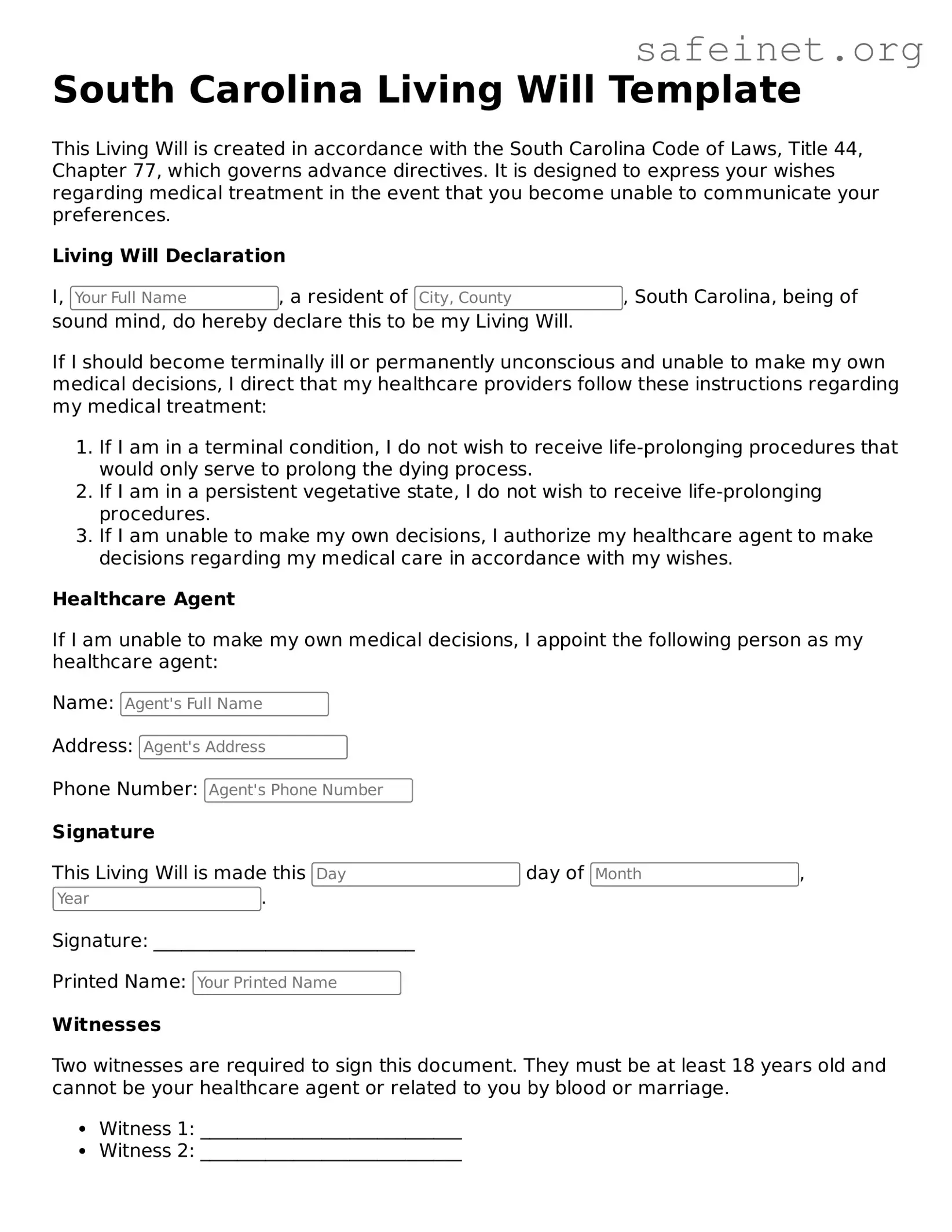
South Carolina Living Will Template
This Living Will is created in accordance with the South Carolina Code of Laws, Title 44, Chapter 77, which governs advance directives. It is designed to express your wishes regarding medical treatment in the event that you become unable to communicate your preferences.
Living Will Declaration
I, , a resident of , South Carolina, being of sound mind, do hereby declare this to be my Living Will.
If I should become terminally ill or permanently unconscious and unable to make my own medical decisions, I direct that my healthcare providers follow these instructions regarding my medical treatment:
Healthcare Agent
If I am unable to make my own medical decisions, I appoint the following person as my healthcare agent:
Name:
Address:
Phone Number:
Signature
This Living Will is made this day of , .
Signature: ____________________________
Printed Name:
Witnesses
Two witnesses are required to sign this document. They must be at least 18 years old and cannot be your healthcare agent or related to you by blood or marriage.
By signing this Living Will, I affirm that I understand its contents and that I am making this declaration voluntarily.
| Fact Name | Description |
|---|---|
| Definition | A Living Will is a legal document that outlines a person's wishes regarding medical treatment in case they become unable to communicate their decisions. |
| Governing Law | The South Carolina Living Will is governed by the South Carolina Code of Laws, Title 44, Chapter 77. |
| Eligibility | Any adult who is of sound mind can create a Living Will in South Carolina. |
| Witness Requirements | The document must be signed by the person creating it in the presence of two witnesses who are not related to the individual or beneficiaries. |
| Revocation | A Living Will can be revoked at any time by the person who created it, as long as they are of sound mind. |
| Effective Date | The Living Will becomes effective when the person is diagnosed with a terminal condition or is in a persistent vegetative state. |
| Health Care Proxy | A Living Will can be combined with a Health Care Power of Attorney, allowing someone to make decisions on behalf of the individual. |
| Storage | It is advisable to keep the Living Will in a safe place and to provide copies to family members and healthcare providers. |
Filling out the South Carolina Living Will form is an important step in expressing your healthcare preferences. After completing the form, it is advisable to keep it in a safe place and share copies with your healthcare provider and loved ones.
What is a Living Will in South Carolina?
A Living Will is a legal document that allows you to express your wishes regarding medical treatment in the event that you become unable to communicate those wishes yourself. This document specifically addresses situations where you may be terminally ill or in a persistent vegetative state. It guides your healthcare providers and loved ones on the type of medical care you wish to receive or decline under these circumstances.
Who can create a Living Will in South Carolina?
Any adult who is at least 18 years old and of sound mind can create a Living Will in South Carolina. This means you should be able to understand the nature of the document and the implications of your decisions. If you have questions about your capacity to make such decisions, it may be helpful to consult with a trusted healthcare professional or legal advisor.
How do I create a Living Will in South Carolina?
To create a Living Will, you can use a standard form provided by the state or draft your own document. It is important to clearly state your wishes regarding life-sustaining treatments. After completing the form, you must sign it in the presence of two witnesses or a notary public. Witnesses cannot be family members or anyone who stands to gain from your estate. This ensures that your decisions are respected and legally binding.
Can I change or revoke my Living Will?
Yes, you can change or revoke your Living Will at any time as long as you are mentally competent. To revoke your Living Will, you can destroy the document or create a new one that explicitly states your current wishes. It is advisable to inform your healthcare providers and family members about any changes you make to ensure they are aware of your latest decisions.
What happens if I do not have a Living Will?
If you do not have a Living Will and become unable to communicate your wishes, medical decisions will be made by your family members or legal representatives. This can sometimes lead to disagreements among family members about what you would have wanted. Having a Living Will can help avoid confusion and ensure that your preferences are honored during difficult times.
Is a Living Will the same as a Durable Power of Attorney for Healthcare?
No, a Living Will and a Durable Power of Attorney for Healthcare are different documents. A Living Will specifies your wishes about medical treatment, while a Durable Power of Attorney for Healthcare allows you to appoint someone to make healthcare decisions on your behalf if you are unable to do so. You may choose to have both documents to ensure comprehensive planning for your healthcare needs.
Not Being Specific About Medical Preferences: Many individuals fail to clearly articulate their wishes regarding specific medical treatments. It's essential to detail what types of life-sustaining measures you do or do not want.
Forgetting to Sign the Document: A common mistake is neglecting to sign the Living Will. Without a signature, the document may not be considered valid.
Not Having Witnesses: In South Carolina, a Living Will must be signed in the presence of two witnesses. Failing to have witnesses present can invalidate the document.
Choosing Inappropriate Witnesses: Witnesses must not be related to you or have any financial interest in your estate. Selecting the wrong witnesses can lead to complications.
Overlooking Updates: Life circumstances change. Many people forget to update their Living Will as their health status or personal beliefs evolve.
Not Discussing Wishes with Family: Failing to communicate your preferences to family members can lead to confusion and conflict when decisions need to be made.
Assuming the Form is Enough: Some believe that simply filling out the Living Will form is sufficient. However, it’s important to ensure that healthcare providers are aware of your wishes and have access to the document.
A Living Will is an important document that allows individuals to express their wishes regarding medical treatment in case they become unable to communicate those wishes themselves. In South Carolina, there are several other forms and documents that often accompany a Living Will, enhancing the clarity and effectiveness of one's healthcare decisions. Below is a list of these essential documents.
These documents work together to ensure that your healthcare preferences are respected and followed. By understanding and utilizing them, you can provide clear guidance to your loved ones and healthcare providers during critical times.
A Health Care Power of Attorney is a document that allows an individual to appoint someone else to make medical decisions on their behalf if they become unable to do so. Similar to a Living Will, it focuses on health care preferences, but it is broader in scope. While a Living Will specifies the types of medical treatment one wishes or does not wish to receive, a Health Care Power of Attorney grants authority to a designated person to interpret and make decisions based on the individual's values and wishes, which may not always be explicitly stated in a Living Will.
A Do Not Resuscitate (DNR) order is a specific type of medical order that instructs health care providers not to perform cardiopulmonary resuscitation (CPR) if a patient’s heart stops beating or they stop breathing. Like a Living Will, it addresses end-of-life care preferences, but it is more focused on a single medical intervention. A DNR can be part of a Living Will or can stand alone, ensuring that individuals' wishes regarding resuscitation are respected in emergency situations.
An Advance Directive is a broader term that encompasses both Living Wills and Health Care Powers of Attorney. It allows individuals to express their wishes regarding medical treatment and appoint someone to make decisions on their behalf. The Living Will portion details specific treatment preferences, while the Health Care Power of Attorney component allows for flexibility in decision-making. Thus, an Advance Directive serves as a comprehensive document that addresses various aspects of health care preferences.
A Physician Orders for Life-Sustaining Treatment (POLST) form is designed for individuals with serious illnesses or those nearing the end of life. It translates a patient’s wishes regarding life-sustaining treatments into actionable medical orders. Similar to a Living Will, it addresses specific treatments, but it is intended to be more detailed and is often used in conjunction with other documents to ensure that medical personnel understand and follow the patient’s preferences in emergency situations.
A Mental Health Advance Directive allows individuals to outline their preferences for mental health treatment in case they become unable to communicate those wishes. Like a Living Will, it provides guidance to health care providers about the individual's preferences. However, it specifically addresses mental health issues, ensuring that individuals’ rights and preferences regarding mental health care are respected, particularly during crises.
A Declaration for Mental Health Treatment is another document that focuses specifically on mental health care. It allows individuals to specify their treatment preferences and appoint an agent to make decisions if they are unable to do so. Similar to a Living Will, it is a proactive measure that ensures that individuals receive the type of mental health care they desire, reflecting their values and beliefs about treatment.
A Durable Power of Attorney for Finances is a legal document that allows someone to manage financial affairs on behalf of another person. While it does not directly address health care decisions like a Living Will, it is similar in that it grants authority to another individual to act in the best interest of the person who created the document. This can be particularly important if the individual becomes incapacitated and needs someone to handle financial matters, ensuring their wishes are honored even when they cannot express them.
When completing the South Carolina Living Will form, it is important to follow specific guidelines to ensure that your wishes are accurately represented. Below is a list of things you should and shouldn't do during this process.
Living wills are essential documents that outline an individual’s preferences regarding medical treatment in the event they become unable to communicate their wishes. However, several misconceptions often surround the South Carolina Living Will form. Understanding these misconceptions can help individuals make informed decisions about their healthcare preferences.
This is not entirely accurate. While living wills are commonly associated with end-of-life care, they can also address preferences for medical treatment in various situations where one may be incapacitated.
Many people believe that legal assistance is necessary to draft a living will. In South Carolina, individuals can create a valid living will without a lawyer, as long as they follow the state’s requirements.
While family members may have opinions on treatment, a properly executed living will expresses the individual's wishes and should be honored by healthcare providers, regardless of family input.
Although both documents deal with healthcare decisions, they serve different purposes. A living will specifies treatment preferences, while a durable power of attorney designates someone to make healthcare decisions on your behalf.
This is false. Individuals can modify or revoke their living wills at any time, as long as they follow the proper legal procedures set forth by South Carolina law.
Many people assume that living wills are only necessary for seniors. However, anyone over the age of 18 can benefit from having a living will, as accidents or sudden illnesses can happen to anyone.
This misconception undermines the importance of living wills. In South Carolina, a properly executed living will is legally binding and must be respected by healthcare providers.
When filling out and using the South Carolina Living Will form, consider the following key takeaways: