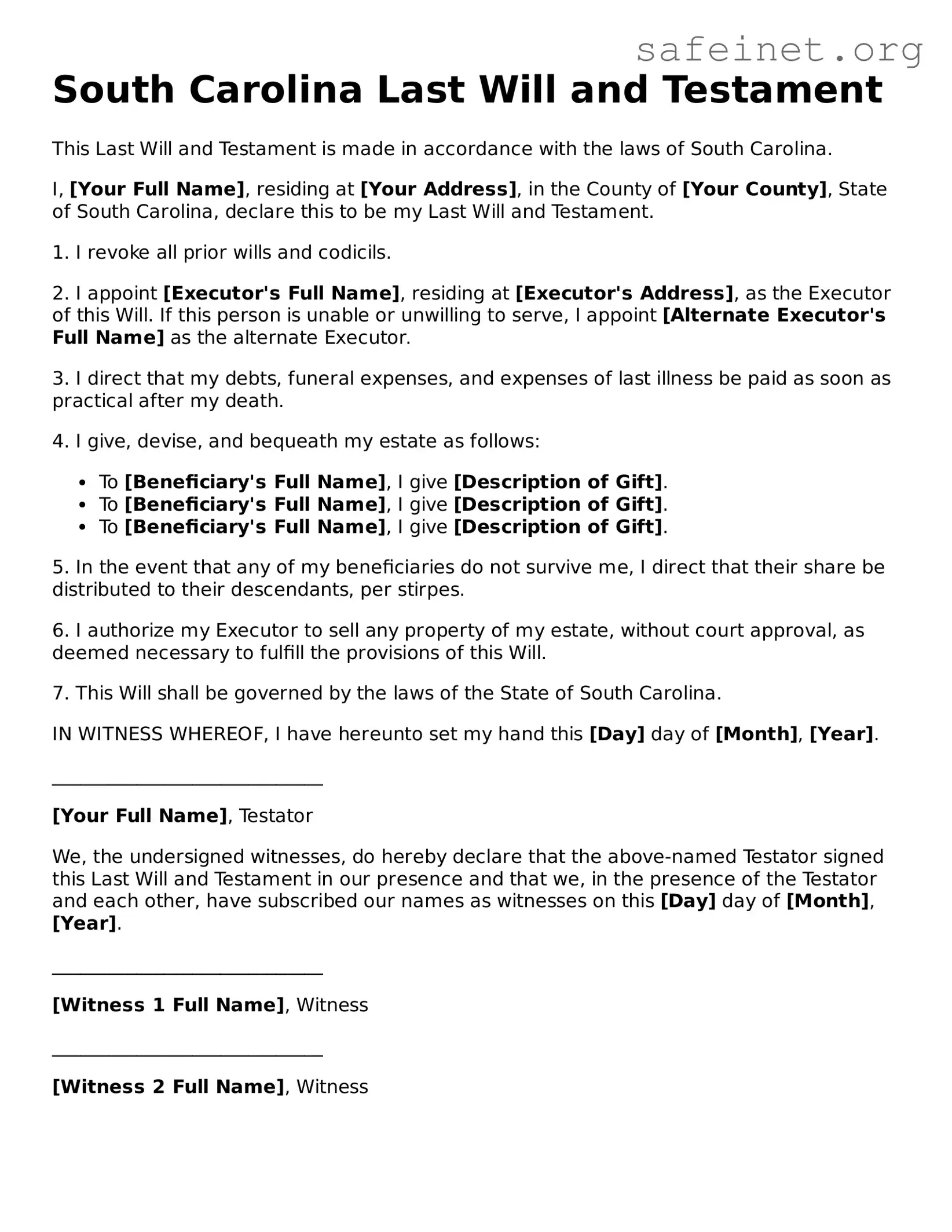
Creating a Last Will and Testament is a crucial step in ensuring that an individual's wishes are honored after their passing. In South Carolina, the Last Will and Testament form serves as a legal document that outlines how a person's assets will be distributed among beneficiaries. This form typically includes essential components such as the identification of the testator, the appointment of an executor, and specific bequests to heirs. It also addresses guardianship for minor children, should the need arise. Additionally, the form requires the signatures of witnesses to validate the testator's intentions and ensure compliance with state laws. Understanding these key elements is vital for anyone looking to create a will in South Carolina, as they lay the groundwork for a clear and enforceable estate plan.
South Carolina Last Will and Testament
This Last Will and Testament is made in accordance with the laws of South Carolina.
I, [Your Full Name], residing at [Your Address], in the County of [Your County], State of South Carolina, declare this to be my Last Will and Testament.
1. I revoke all prior wills and codicils.
2. I appoint [Executor's Full Name], residing at [Executor's Address], as the Executor of this Will. If this person is unable or unwilling to serve, I appoint [Alternate Executor's Full Name] as the alternate Executor.
3. I direct that my debts, funeral expenses, and expenses of last illness be paid as soon as practical after my death.
4. I give, devise, and bequeath my estate as follows:
5. In the event that any of my beneficiaries do not survive me, I direct that their share be distributed to their descendants, per stirpes.
6. I authorize my Executor to sell any property of my estate, without court approval, as deemed necessary to fulfill the provisions of this Will.
7. This Will shall be governed by the laws of the State of South Carolina.
IN WITNESS WHEREOF, I have hereunto set my hand this [Day] day of [Month], [Year].
_____________________________
[Your Full Name], Testator
We, the undersigned witnesses, do hereby declare that the above-named Testator signed this Last Will and Testament in our presence and that we, in the presence of the Testator and each other, have subscribed our names as witnesses on this [Day] day of [Month], [Year].
_____________________________
[Witness 1 Full Name], Witness
_____________________________
[Witness 2 Full Name], Witness
| Fact Name | Description |
|---|---|
| Governing Law | The South Carolina Last Will and Testament is governed by the South Carolina Code of Laws, Title 62, which outlines the state's probate laws. |
| Age Requirement | Individuals must be at least 18 years old to create a valid Last Will and Testament in South Carolina. |
| Witnesses | The will must be signed by the testator in the presence of at least two witnesses, who must also sign the document. |
| Revocation | A Last Will and Testament can be revoked at any time by the testator through a new will or by destroying the original document. |
| Self-Proving Affidavit | South Carolina allows for a self-proving will, which includes a notarized affidavit from the witnesses, simplifying the probate process. |
| Holographic Wills | Holographic wills, which are handwritten and signed by the testator, are recognized in South Carolina if they meet specific criteria. |
Filling out a Last Will and Testament form in South Carolina is an important step in ensuring your wishes are respected after you pass away. This process allows you to specify how your assets should be distributed, who will care for your minor children, and other important decisions. Once you complete the form, you’ll need to follow specific steps to make it legally valid.
What is a Last Will and Testament in South Carolina?
A Last Will and Testament is a legal document that outlines how a person's assets and property should be distributed after their death. In South Carolina, this document can also name guardians for minor children and appoint an executor to manage the estate. It is essential for ensuring that your wishes are honored and can help avoid disputes among family members.
Who can create a Last Will and Testament in South Carolina?
In South Carolina, any person who is at least 18 years old and of sound mind can create a Last Will and Testament. This means that the individual must understand the nature of the document and its effects. There are no specific requirements regarding the person's occupation or status; anyone meeting these criteria can draft a will.
What are the requirements for a valid Last Will and Testament in South Carolina?
To be considered valid, a Last Will and Testament in South Carolina must be in writing and signed by the testator (the person making the will). Additionally, it must be witnessed by at least two individuals who are not beneficiaries of the will. These witnesses must also sign the document in the presence of the testator. Following these steps helps ensure that the will is legally enforceable.
Can I change or revoke my Last Will and Testament?
Yes, you can change or revoke your Last Will and Testament at any time while you are alive and of sound mind. To make changes, you can create a new will or add a codicil, which is an amendment to the existing will. If you decide to revoke your will entirely, you can do so by destroying it or stating your intention to revoke it in writing. It’s important to communicate these changes clearly to avoid confusion.
What happens if I die without a Last Will and Testament in South Carolina?
If you die without a will, your estate will be distributed according to South Carolina's intestacy laws. This means that your assets will be divided among your surviving relatives based on a predetermined hierarchy. This could lead to outcomes that do not align with your wishes. To avoid this situation, it is advisable to create a will to ensure your assets are distributed as you desire.
Can I write my own Last Will and Testament in South Carolina?
Yes, you can write your own Last Will and Testament in South Carolina. However, it is crucial to follow the legal requirements to ensure it is valid. While many people choose to use templates or online services, consulting with an attorney can provide additional peace of mind. An attorney can help ensure that your will reflects your wishes and complies with state laws.
Is it necessary to have an attorney to create a Last Will and Testament in South Carolina?
No, it is not strictly necessary to have an attorney to create a Last Will and Testament in South Carolina. However, having legal assistance can be beneficial, especially if your estate is complex or if you have specific wishes that need to be clearly articulated. An attorney can help navigate the legal requirements and ensure that your will is properly executed, reducing the risk of future disputes.
Failing to properly identify the testator. It is crucial to include the full legal name and address of the person creating the will. Omitting this information can lead to confusion and potential legal challenges.
Not signing the will in the presence of witnesses. In South Carolina, the law requires that the will be signed by the testator in the presence of at least two witnesses. If this step is overlooked, the will may not be considered valid.
Choosing witnesses who are beneficiaries. Selecting individuals who stand to gain from the will as witnesses can create conflicts of interest. This may result in the will being contested or parts of it being invalidated.
Neglecting to date the will. While not a legal requirement, including the date is important for establishing the most current intentions of the testator. Without a date, it may be difficult to determine which will is valid if multiple versions exist.
Using vague language. Ambiguities in the will can lead to misinterpretations. Clear and specific terms should be used to outline the distribution of assets and any other instructions.
Failing to update the will after significant life events. Major changes such as marriage, divorce, or the birth of children should prompt a review and possible revision of the will. Ignoring these changes can result in unintended distributions.
When preparing a Last Will and Testament in South Carolina, several other documents may be necessary to ensure a comprehensive estate plan. Each of these forms serves a specific purpose and can help clarify your wishes regarding your assets and loved ones.
Gathering these documents can help create a clearer picture of your estate planning intentions. It is important to ensure that all forms are completed correctly and stored in a safe place for easy access by your loved ones.
The South Carolina Last Will and Testament form shares similarities with a Living Will, which outlines an individual's preferences regarding medical treatment in the event they become unable to communicate their wishes. While a Last Will directs how a person's assets are distributed after death, a Living Will focuses on healthcare decisions. Both documents require clear articulation of the individual's desires, ensuring that their intentions are respected during critical times. They also need to be signed and witnessed to be legally valid, providing a framework for honoring a person's wishes, whether in life or after death.
An Advance Directive is another document akin to the Last Will and Testament. It encompasses both a Living Will and a Power of Attorney for healthcare, allowing individuals to specify their medical preferences and appoint someone to make decisions on their behalf. Like a Last Will, an Advance Directive is essential for ensuring that one's wishes are followed when they cannot speak for themselves. Both documents serve to protect personal autonomy and provide peace of mind, knowing that decisions align with the individual's values and beliefs.
A Trust, particularly a Revocable Living Trust, bears resemblance to the Last Will in terms of asset distribution. Both documents can dictate how and when assets are passed on to beneficiaries. However, a Trust can take effect during the grantor's lifetime, allowing for management of assets while they are still alive. This can help avoid probate, a process that a Last Will must go through after death. Trusts offer more flexibility and privacy, as they do not become public records like Wills do, making them an attractive alternative for some individuals.
The Codicil is a legal document that modifies an existing Last Will and Testament. It allows individuals to make changes, such as updating beneficiaries or altering specific provisions without drafting an entirely new Will. This document must also be signed and witnessed to ensure its validity. Similar to a Last Will, a Codicil must clearly express the individual's intentions and be executed according to state laws to be enforceable, making it an essential tool for maintaining an up-to-date estate plan.
The Estate Plan itself encompasses a Last Will and Testament, along with other documents like Trusts, Powers of Attorney, and Advance Directives. It provides a comprehensive approach to managing an individual's assets and healthcare decisions. While the Last Will focuses specifically on post-death asset distribution, the overall Estate Plan ensures that all aspects of an individual's wishes are documented and legally binding. This holistic view helps individuals and families navigate complex legal and financial landscapes, ensuring that all bases are covered.
Finally, a Letter of Instruction is another document that complements a Last Will and Testament. While not legally binding, it serves as a guide for the executor of the estate, detailing personal wishes and providing information about assets, debts, and funeral arrangements. This document can clarify intentions and reduce confusion for loved ones during a challenging time. Like a Last Will, it reflects the individual's desires and can help ensure that their legacy is honored according to their preferences.
Creating a Last Will and Testament in South Carolina is a significant step in ensuring your wishes are honored after your passing. Here are seven important dos and don'ts to consider when filling out the form:
By following these guidelines, you can create a clear and effective Last Will and Testament that reflects your wishes and provides peace of mind for your loved ones.
Understanding the South Carolina Last Will and Testament form is essential for anyone looking to create a will. However, several misconceptions can lead to confusion. Here are six common myths about this important legal document:
Many people believe that only typed wills are acceptable. In fact, South Carolina recognizes handwritten wills, also known as holographic wills, as valid as long as they are signed by the testator and reflect their intentions.
Some think that a will can be valid without any witnesses. In South Carolina, a will must be signed by the testator in the presence of at least two witnesses who also sign the document.
It is a common belief that once a will is created, it cannot be altered without drafting a completely new document. However, South Carolina law allows for amendments through a codicil, which is a separate document that modifies the existing will.
Many assume that all assets listed in a will must go through the probate process. However, certain assets, like those held in a trust or jointly owned property, can bypass probate altogether.
Some people think that age is not a factor in creating a will. In South Carolina, individuals must be at least 18 years old and of sound mind to create a legally binding will.
This misconception suggests that only those with significant assets need a will. In reality, a will is important for anyone who wants to ensure their wishes are honored regarding the distribution of their property and care of dependents.
By addressing these misconceptions, individuals can better navigate the process of creating a Last Will and Testament in South Carolina, ensuring that their wishes are clearly articulated and legally binding.
Creating a Last Will and Testament is an essential step in ensuring that your wishes are respected after you pass away. In South Carolina, there are specific considerations to keep in mind when filling out this important document. Here are some key takeaways to help guide you through the process:
Taking the time to properly fill out your Last Will and Testament can provide peace of mind for both you and your loved ones. By understanding these key aspects, you can create a document that honors your wishes and protects your family's future.