In South Carolina, families who choose to homeschool their children must navigate a specific set of requirements to ensure compliance with state laws. A crucial step in this process is the completion of the Homeschool Letter of Intent form. This form serves as a formal notification to the local school district of a family's intention to educate their child at home. It requires essential information, such as the names and ages of the children being homeschooled, as well as the address of the primary residence. Additionally, parents must affirm that they will provide an educational program that meets the state's standards. By submitting this letter, families take the first step in establishing their homeschooling journey, signaling their commitment to providing a personalized educational experience tailored to their children's unique needs. Understanding the intricacies of this form is vital for parents to ensure they meet all legal obligations while fostering an enriching learning environment at home.
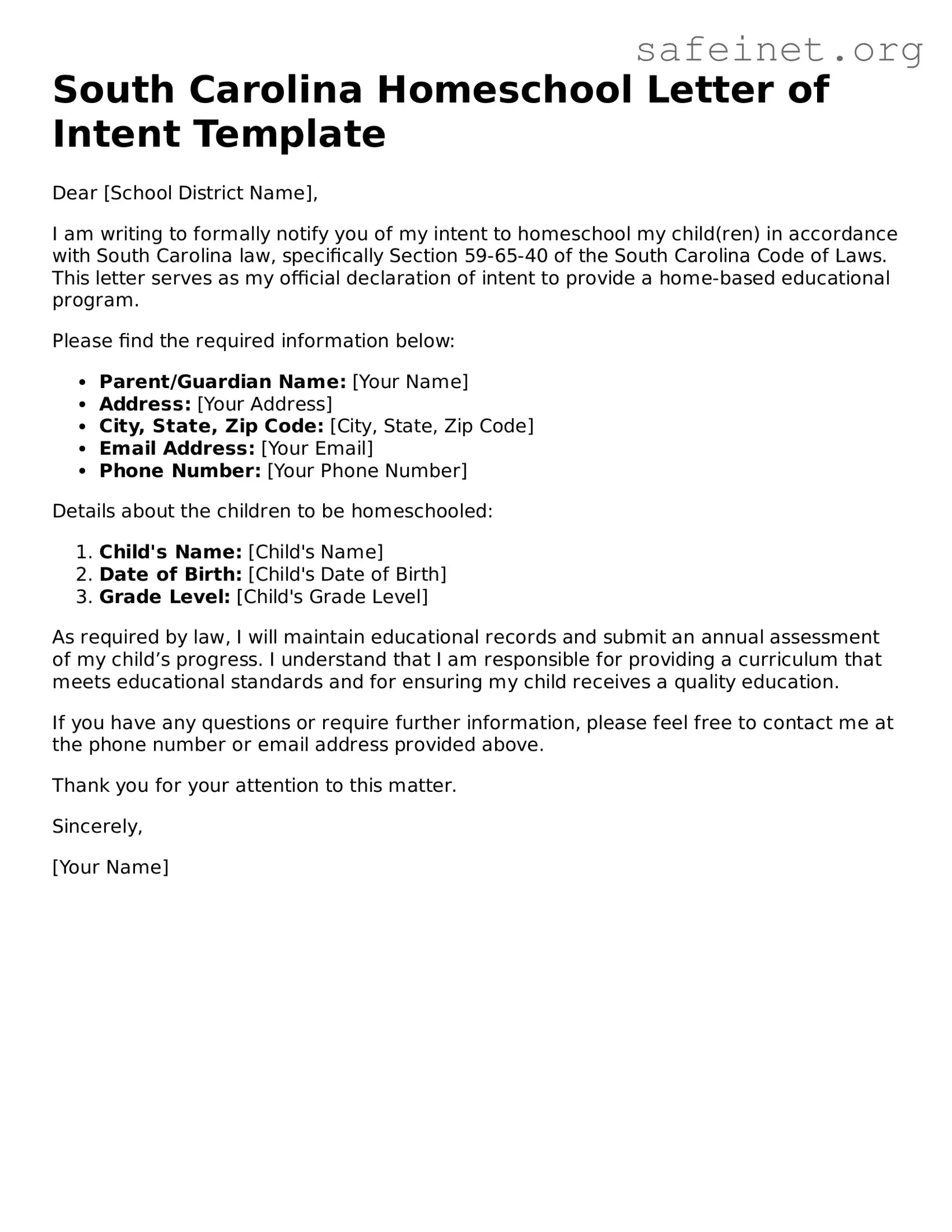
South Carolina Homeschool Letter of Intent Template
Dear [School District Name],
I am writing to formally notify you of my intent to homeschool my child(ren) in accordance with South Carolina law, specifically Section 59-65-40 of the South Carolina Code of Laws. This letter serves as my official declaration of intent to provide a home-based educational program.
Please find the required information below:
Details about the children to be homeschooled:
As required by law, I will maintain educational records and submit an annual assessment of my child’s progress. I understand that I am responsible for providing a curriculum that meets educational standards and for ensuring my child receives a quality education.
If you have any questions or require further information, please feel free to contact me at the phone number or email address provided above.
Thank you for your attention to this matter.
Sincerely,
[Your Name]
| Fact Name | Description |
|---|---|
| Purpose | The South Carolina Homeschool Letter of Intent form is used to notify the state of a family's intention to homeschool their child. |
| Governing Law | This form is governed by South Carolina Code of Laws, Title 59, Chapter 65. |
| Who Must File | Parents or guardians of children aged 5 to 17 must file this form if they choose to homeschool. |
| Filing Deadline | The form must be submitted within 30 days of beginning the homeschooling process. |
| Information Required | The form typically requires the names, addresses, and ages of the children being homeschooled. |
| Submission Method | Parents can submit the form by mail or electronically, depending on local regulations. |
| Record Keeping | It is important for parents to keep a copy of the submitted form for their records. |
After completing the South Carolina Homeschool Letter of Intent form, you will need to submit it to your local school district. This step is crucial as it officially informs the district of your intent to homeschool your child. Make sure to keep a copy for your records.
What is the South Carolina Homeschool Letter of Intent?
The South Carolina Homeschool Letter of Intent is a formal document that parents or guardians must submit to notify the local school district of their intent to homeschool their children. This letter is a requirement under South Carolina law to ensure that families are complying with educational regulations while opting for home education.
Who needs to submit the Letter of Intent?
Any parent or guardian who plans to homeschool a child in South Carolina must submit the Letter of Intent. This includes families with children who have never been enrolled in a public or private school, as well as those who are withdrawing their children from traditional schooling to begin homeschooling.
When should the Letter of Intent be submitted?
The Letter of Intent should be submitted at the beginning of the school year or as soon as the decision to homeschool is made. It is advisable to send the letter at least 14 days before starting the homeschooling process to allow for proper notification to the school district.
What information is required in the Letter of Intent?
The Letter of Intent typically requires basic information such as the names and ages of the children being homeschooled, the address of the family, and the parent or guardian's contact information. Some districts may have specific requirements, so it is important to check with the local school district for any additional information needed.
Is there a specific format for the Letter of Intent?
While there is no strict format mandated by the state, it is recommended that the letter be clear and concise. Including the required information in a straightforward manner is essential. Some families choose to use templates available online, but personalizing the letter is encouraged.
Where should the Letter of Intent be sent?
The Letter of Intent should be sent to the local school district office where the family resides. Each district may have different submission methods, such as mailing, emailing, or submitting in person, so it is important to verify the preferred method with the district.
What happens after submitting the Letter of Intent?
Once the Letter of Intent is submitted, the local school district will acknowledge receipt. There is no further action required from the district, as parents are responsible for providing an appropriate education for their children. However, families should keep a copy of the letter for their records.
Are there any consequences for not submitting the Letter of Intent?
Failure to submit the Letter of Intent may lead to complications, including the potential for the school district to consider the children truant. This could result in legal repercussions or the requirement to enroll the children in a traditional school setting. It is crucial to comply with the notification requirement to avoid such issues.
Can I change my mind after submitting the Letter of Intent?
Yes, families can change their minds after submitting the Letter of Intent. If a parent decides to enroll their child back into a traditional school, they should inform the school district of the change. It is advisable to communicate any changes promptly to ensure compliance with educational laws.
Where can I find more information about homeschooling in South Carolina?
For more information about homeschooling in South Carolina, families can visit the South Carolina Department of Education's website or contact local homeschooling organizations. These resources provide valuable guidance on the homeschooling process, including requirements, resources, and support networks.
Not providing complete information. Make sure to fill out all required fields, including the names of the parents and students.
Missing the deadline. Submit the letter of intent by the deadline to ensure compliance with state regulations.
Failing to include the correct address. Double-check that the address listed is accurate and up-to-date.
Omitting the grade level of each student. Clearly indicate the grade level for each child being homeschooled.
Not signing the form. Ensure that the form is signed by the parent or guardian before submission.
Using incorrect names. Use the full legal names of the students and parents, avoiding nicknames.
Not providing a valid reason for homeschooling. While not always required, including a brief explanation can be helpful.
Ignoring local school district requirements. Check if there are additional requirements from your local district.
Not keeping a copy of the submitted form. Always retain a copy for your records after submission.
Failing to update the form if circumstances change. If there are changes in the homeschooling situation, submit an updated letter of intent.
When families in South Carolina decide to homeschool their children, they must submit a Homeschool Letter of Intent. This document serves as a formal notification to the local school district of the family's intent to educate their children at home. In addition to this letter, several other forms and documents may be required or beneficial throughout the homeschooling process. Below is a list of these essential documents.
By understanding and preparing these documents, families can navigate the homeschooling process more effectively. Each form plays a crucial role in ensuring compliance with state regulations and supporting the educational journey of the child. It is essential to stay organized and proactive to foster a successful homeschooling experience.
The South Carolina Homeschool Letter of Intent form shares similarities with the Notice of Intent to Homeschool form used in other states. Like the South Carolina form, this document serves as a formal notification to the local school district that a parent or guardian intends to educate their child at home. Both forms typically require basic information about the student and the parent, ensuring that the educational authorities are informed of the homeschooling arrangement. This helps establish a record for compliance with state education laws.
Another document that resembles the Homeschool Letter of Intent is the Homeschool Registration Form often used in various states. This form not only notifies the school district of the homeschooling decision but also may require parents to provide additional details about their curriculum and educational philosophy. Just like the South Carolina form, it aims to ensure that parents are taking the necessary steps to provide an adequate education for their children while complying with state regulations.
The Individualized Education Program (IEP) is another document that, while more specific, shares some similarities with the Homeschool Letter of Intent. An IEP is designed for students with special needs and outlines specific educational goals and services. Parents who homeschool children with special needs may need to submit an IEP alongside their Letter of Intent to ensure that the educational needs of their child are met. Both documents serve to establish a framework for education tailored to the individual child.
In some states, the Affidavit of Intent to Homeschool is required. This document is similar to the South Carolina form in that it serves as a formal declaration of a parent's intention to homeschool. The affidavit often requires parents to affirm their commitment to provide an educational experience that meets state standards. This document, like the Letter of Intent, is a crucial step in the homeschooling process and helps maintain accountability.
The Curriculum Plan, while not a notification form, is closely related to the Homeschool Letter of Intent. Parents may be required to submit a curriculum plan that outlines the subjects and materials they intend to use for their child's education. This document ensures that parents are prepared to provide a comprehensive educational experience. Both the curriculum plan and the Letter of Intent work together to demonstrate the parent's commitment to fulfilling educational requirements.
The Withdrawal Form from Public School is another document that parallels the Homeschool Letter of Intent. When parents decide to homeschool, they often need to formally withdraw their child from public school. This form typically requires parents to indicate their intent to homeschool, similar to the Letter of Intent. Both documents serve to officially transition the child’s educational path from public schooling to homeschooling.
Lastly, the Educational Philosophy Statement is a document that some states require alongside the Homeschool Letter of Intent. This statement allows parents to express their educational beliefs and approaches to teaching their children. While the Letter of Intent serves as a notification, the Educational Philosophy Statement provides insight into the parent’s intentions and methods. Together, these documents help educational authorities understand the parent’s approach to homeschooling.
When filling out the South Carolina Homeschool Letter of Intent form, it is essential to approach the task with care and attention. Below is a list of things you should and shouldn't do to ensure a smooth submission process.
By following these guidelines, you can ensure that your Letter of Intent is submitted correctly and on time, allowing you to focus on providing a quality education for your child.
Many individuals have misunderstandings about the South Carolina Homeschool Letter of Intent form. Clarifying these misconceptions can help parents navigate the homeschooling process more effectively. Below are some common misconceptions:
While it is advisable to submit the form before the school year begins, South Carolina law allows parents to submit the Letter of Intent at any time during the year. This flexibility can accommodate families who decide to homeschool mid-year.
The Letter of Intent is just one part of the process. Parents must also comply with other regulations, such as maintaining educational records and ensuring that their children receive a suitable education.
Notarization is not a requirement for the Letter of Intent in South Carolina. Parents can submit the form without having it notarized, simplifying the process.
While submitting the form is necessary, it does not guarantee approval. The state does not review or approve the content of the Letter of Intent, but it must be submitted to comply with state law.
The Letter of Intent does not require a detailed curriculum. Parents only need to indicate their intent to homeschool and provide basic information about their educational plans.
South Carolina does not mandate a specific format for the Letter of Intent. As long as the required information is included, parents can create their own format.
Parents can submit the Letter of Intent via mail or email, depending on the local school district’s requirements. This offers convenience for families.
Parents retain the right to change their educational plans at any time. If they decide to return to public or private school, they can do so without penalties.
When filling out and using the South Carolina Homeschool Letter of Intent form, keep the following key points in mind:
Following these guidelines will help you navigate the process smoothly and ensure that your homeschooling journey begins on the right foot.