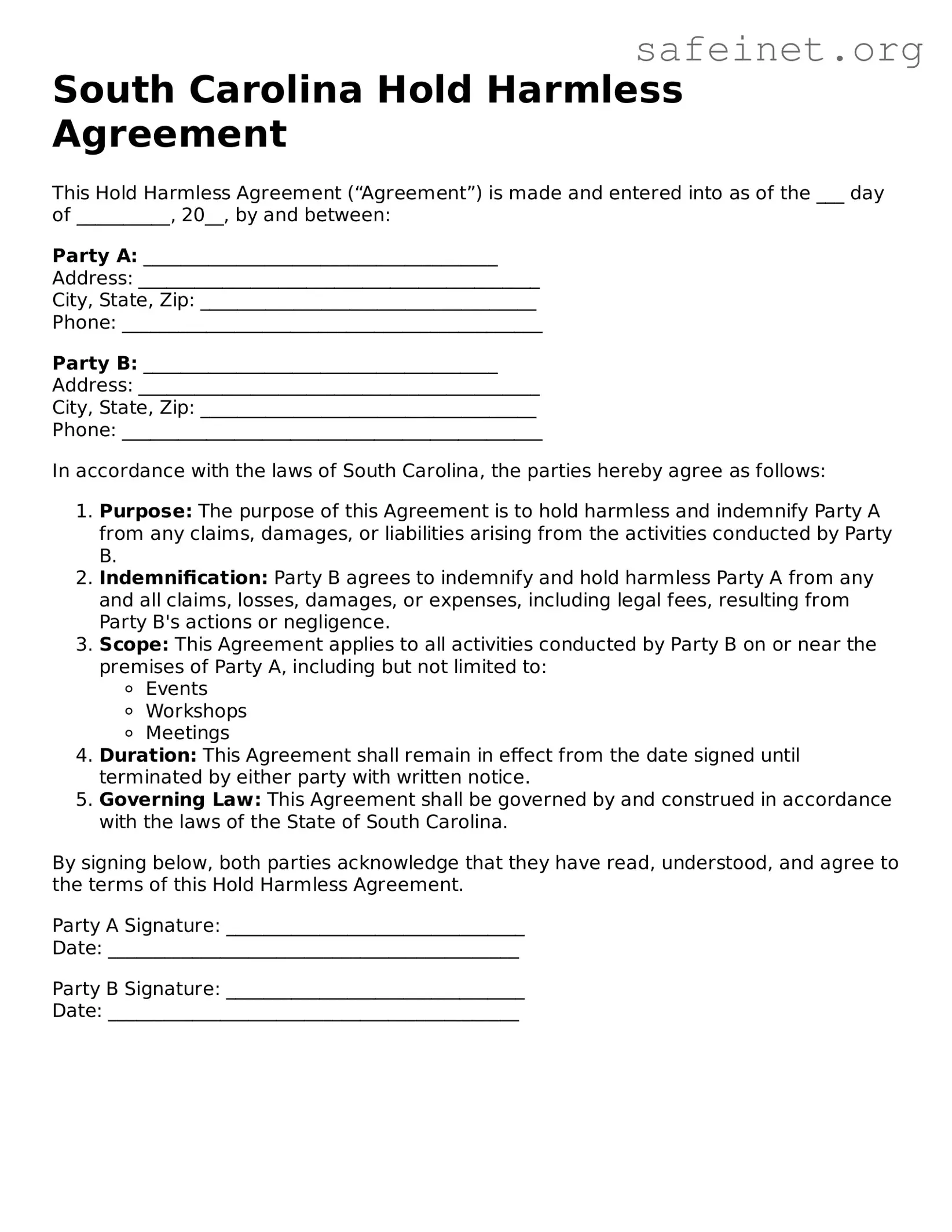
In the realm of legal agreements, the South Carolina Hold Harmless Agreement form plays a crucial role in managing risk and liability between parties involved in various activities. This document is designed to protect one party from legal claims or damages that may arise from the actions or negligence of another party. Typically utilized in contexts such as rental agreements, construction contracts, and event planning, the form outlines the responsibilities of each party while emphasizing that one party agrees to assume the risk associated with certain activities. By signing this agreement, individuals or organizations effectively waive their right to hold the other party accountable for any potential injuries or losses. Understanding the nuances of this form is essential for anyone entering into an agreement where liability could be a concern, as it helps clarify expectations and provides a layer of protection against unforeseen circumstances.
South Carolina Hold Harmless Agreement
This Hold Harmless Agreement (“Agreement”) is made and entered into as of the ___ day of __________, 20__, by and between:
Party A: ______________________________________
Address: ___________________________________________
City, State, Zip: ____________________________________
Phone: _____________________________________________
Party B: ______________________________________
Address: ___________________________________________
City, State, Zip: ____________________________________
Phone: _____________________________________________
In accordance with the laws of South Carolina, the parties hereby agree as follows:
By signing below, both parties acknowledge that they have read, understood, and agree to the terms of this Hold Harmless Agreement.
Party A Signature: ________________________________
Date: ____________________________________________
Party B Signature: ________________________________
Date: ____________________________________________
| Fact Name | Description |
|---|---|
| Purpose | The South Carolina Hold Harmless Agreement is designed to protect one party from liability for injuries or damages incurred by another party during a specific activity or event. |
| Governing Law | This agreement is governed by the laws of the State of South Carolina. |
| Parties Involved | The agreement typically involves at least two parties: the indemnitor (the party providing protection) and the indemnitee (the party being protected). |
| Scope of Protection | The agreement may cover various types of liabilities, including personal injury, property damage, and legal fees, depending on the specific terms outlined. |
| Enforceability | For the agreement to be enforceable, it must be clear, specific, and voluntarily signed by both parties. |
| Common Uses | This form is often used in contexts such as events, construction projects, and recreational activities where risk of injury or damage is present. |
Once you have the South Carolina Hold Harmless Agreement form in front of you, it’s time to start filling it out. This form is designed to clarify responsibilities and protect parties involved in various agreements. By following the steps below, you’ll be able to complete the form accurately and confidently.
After completing the form, make sure to keep a copy for your records. It’s also a good idea to provide a copy to all parties involved to ensure everyone has the same information. This helps maintain transparency and clarity moving forward.
What is a Hold Harmless Agreement in South Carolina?
A Hold Harmless Agreement is a legal document that protects one party from liability for any damages or injuries that may occur during a specific activity or event. In South Carolina, this agreement is often used in various contexts, such as construction projects, rental agreements, and events. By signing this document, one party agrees not to hold the other party responsible for certain risks, which can help mitigate potential legal disputes.
Who should use a Hold Harmless Agreement?
Individuals or businesses involved in activities where there is a risk of injury or property damage should consider using a Hold Harmless Agreement. This includes contractors, event organizers, property owners, and renters. For instance, if a contractor is hired to perform work on a property, the property owner may require the contractor to sign this agreement to protect themselves from any claims that arise from the contractor's work.
What should be included in a South Carolina Hold Harmless Agreement?
A comprehensive Hold Harmless Agreement should clearly outline the parties involved, the specific activities covered, and the scope of the liability being waived. It should also specify any limitations on liability and include a clause that addresses the governing law, which in this case would be South Carolina law. Additionally, it is crucial to ensure that both parties understand the terms and conditions before signing the agreement.
Is a Hold Harmless Agreement enforceable in South Carolina?
Yes, a Hold Harmless Agreement can be enforceable in South Carolina, provided it is drafted properly. The agreement must be clear and unambiguous, and it should not violate public policy or statutory regulations. It is advisable to have the document reviewed by a legal professional to ensure its enforceability and to address any specific concerns related to the activities involved.
Incomplete Information: One of the most common mistakes is failing to provide all necessary personal details. Individuals often leave out critical information such as their full name, address, or contact information. This can lead to delays or complications in the agreement's enforcement.
Incorrect Dates: Another frequent error involves entering the wrong dates. People may mistakenly write the wrong date for the agreement's execution or fail to indicate the duration of the hold harmless clause. Such inaccuracies can undermine the validity of the agreement.
Not Understanding the Terms: Many individuals sign the agreement without fully grasping its implications. They may overlook the scope of liability they are agreeing to. This lack of understanding can result in unintended consequences, leaving them unprotected when they thought they were secure.
Failure to Seek Legal Advice: Some people neglect to consult a legal professional before signing. This oversight can be detrimental, especially if the agreement includes complex terms or if the individual has specific concerns. Without proper guidance, they may inadvertently agree to unfavorable conditions.
When engaging in agreements that involve liability, it is often necessary to accompany the South Carolina Hold Harmless Agreement with other important documents. These forms help clarify responsibilities, protect parties involved, and ensure that all legal bases are covered. Below is a list of commonly used documents that may be relevant in conjunction with the Hold Harmless Agreement.
Each of these documents serves a unique purpose and plays a vital role in ensuring that all parties are protected and aware of their rights and responsibilities. When entering into agreements, it is wise to consider which forms best suit your specific situation to avoid potential misunderstandings or legal issues in the future.
The South Carolina Hold Harmless Agreement is similar to a Liability Waiver. A Liability Waiver is a document that individuals sign to release an organization or individual from liability for potential injuries or damages that may occur during a specific activity. Like the Hold Harmless Agreement, it aims to protect the party offering the activity from legal claims. Both documents emphasize the importance of understanding the risks involved and require the signee to acknowledge those risks, thereby limiting the liability of the party providing the service or activity.
Another document comparable to the Hold Harmless Agreement is the Indemnity Agreement. This type of agreement involves one party agreeing to compensate another for any loss or damage that may arise from a specific action or event. While the Hold Harmless Agreement focuses on protecting a party from claims, the Indemnity Agreement goes a step further by ensuring that one party will cover the costs incurred by the other due to legal actions. Both documents serve to mitigate risk and establish clear responsibilities among the parties involved.
The South Carolina Hold Harmless Agreement also shares similarities with a Release of Liability form. This document is often used in recreational activities, where participants acknowledge the risks and agree not to hold the organizers responsible for any injuries. Like the Hold Harmless Agreement, the Release of Liability form requires clear communication of potential dangers and aims to protect the organizer from future claims. Both forms reflect a mutual understanding of risk between the participant and the organization.
A further document that aligns with the Hold Harmless Agreement is a Consent to Treat form. This form is commonly used in medical settings, where patients give permission for healthcare providers to administer treatment. While it primarily focuses on consent, it often includes language that protects the healthcare provider from liability associated with the treatment. Both documents highlight the importance of informed consent and the acceptance of associated risks, thereby safeguarding the provider’s interests.
The Hold Harmless Agreement is also akin to a Risk Acknowledgment form. This document is designed to inform participants about the potential hazards associated with an activity, requiring them to acknowledge their understanding of these risks. Similar to the Hold Harmless Agreement, the Risk Acknowledgment form emphasizes the importance of awareness and acceptance of risk, ultimately protecting the organizing entity from liability claims arising from the activity.
In addition, the South Carolina Hold Harmless Agreement can be compared to a Property Damage Waiver. This document is often used in rental agreements, where one party agrees to cover any damages that occur to property during the rental period. Like the Hold Harmless Agreement, the Property Damage Waiver establishes clear responsibilities and expectations regarding potential damages, thereby minimizing disputes and protecting the property owner from financial loss.
Another related document is the Participant Agreement, commonly used in sports and recreational activities. This agreement outlines the expectations and responsibilities of participants while also addressing the inherent risks associated with the activity. Much like the Hold Harmless Agreement, the Participant Agreement seeks to ensure that all parties understand their roles and the potential dangers involved, thereby reducing the likelihood of legal claims.
Lastly, the South Carolina Hold Harmless Agreement is similar to a Non-Disclosure Agreement (NDA) in some contexts. While NDAs primarily focus on protecting confidential information, they can also include clauses that limit liability related to the disclosure of sensitive information. Both documents aim to protect parties from potential legal repercussions, emphasizing the importance of understanding the terms and conditions set forth in the agreement.
When filling out the South Carolina Hold Harmless Agreement form, it is crucial to approach the process with care. Here are some important dos and don'ts to consider:
By following these guidelines, you can navigate the process of completing the Hold Harmless Agreement form more effectively.
Many people have misunderstandings about the South Carolina Hold Harmless Agreement form. Here are seven common misconceptions, along with clarifications for each.
Understanding these misconceptions can help individuals and businesses make informed decisions about using Hold Harmless Agreements effectively.
Filling out and using the South Carolina Hold Harmless Agreement form is an important process for individuals and organizations. Here are some key takeaways to keep in mind:
By following these guidelines, individuals and organizations can effectively use the South Carolina Hold Harmless Agreement to manage risk and protect themselves legally.