The South Carolina General Power of Attorney form serves as a vital legal document that empowers an individual, known as the agent or attorney-in-fact, to act on behalf of another person, referred to as the principal, in a wide range of financial and legal matters. This form is particularly useful for individuals who may be unable to manage their affairs due to illness, travel, or other circumstances that hinder their ability to make decisions. It grants the agent the authority to handle tasks such as managing bank accounts, signing checks, buying or selling property, and making investment decisions. Importantly, the General Power of Attorney can be customized to suit the principal's specific needs, allowing for broad or limited powers as desired. The form requires careful consideration, as it involves trust and responsibility, ensuring that the agent acts in the best interest of the principal. Understanding the implications of this document is essential for anyone considering its use, as it can have significant effects on personal and financial matters.
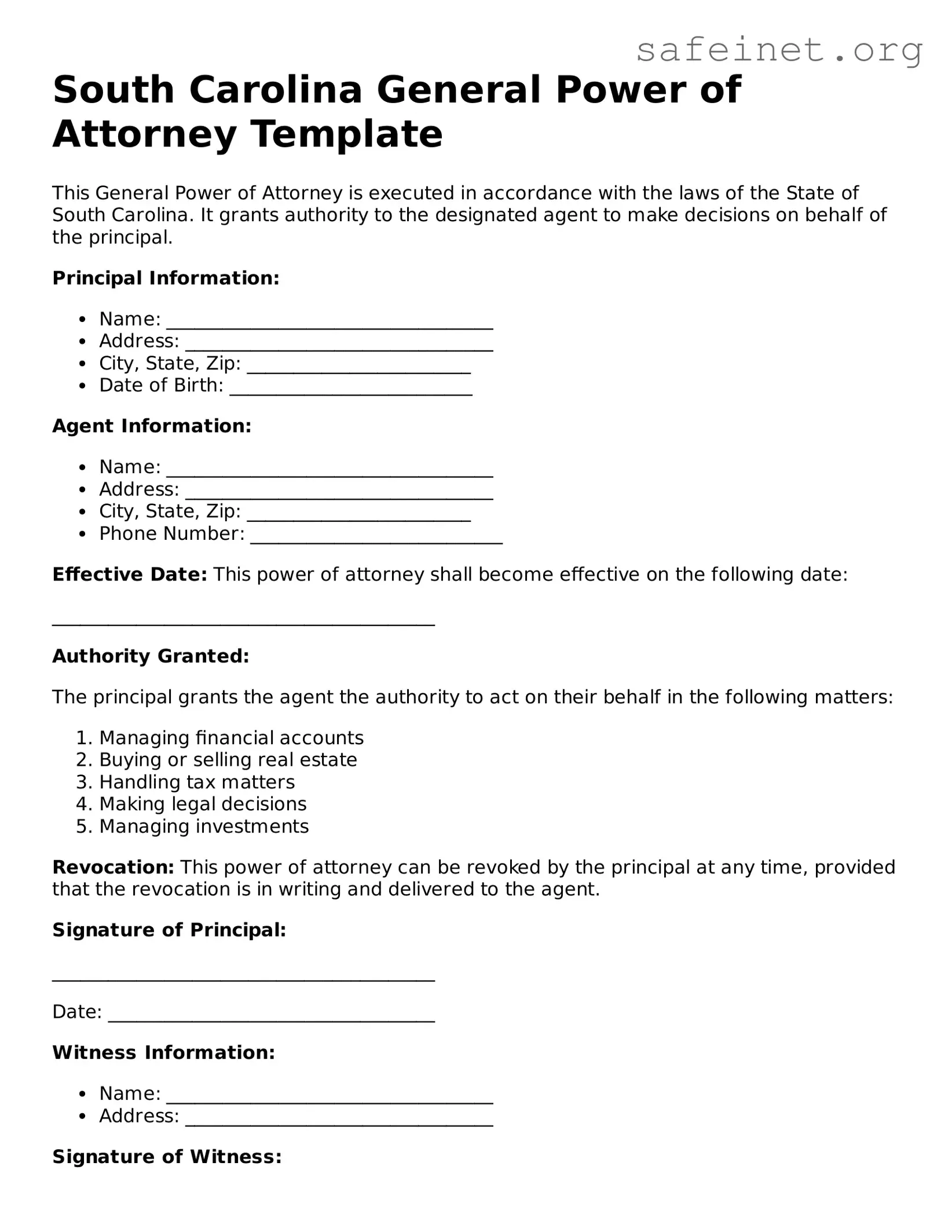
South Carolina General Power of Attorney Template
This General Power of Attorney is executed in accordance with the laws of the State of South Carolina. It grants authority to the designated agent to make decisions on behalf of the principal.
Principal Information:
Agent Information:
Effective Date: This power of attorney shall become effective on the following date:
_________________________________________
Authority Granted:
The principal grants the agent the authority to act on their behalf in the following matters:
Revocation: This power of attorney can be revoked by the principal at any time, provided that the revocation is in writing and delivered to the agent.
Signature of Principal:
_________________________________________
Date: ___________________________________
Witness Information:
Signature of Witness:
_________________________________________
Date: ___________________________________
This document is intended to be a simple and effective way to grant authority to an agent in South Carolina. It is advisable to consult with a legal professional to ensure that this document meets all necessary requirements.
| Fact Name | Details |
|---|---|
| Definition | A General Power of Attorney (GPOA) allows one person to act on behalf of another in legal or financial matters. |
| Governing Law | The GPOA in South Carolina is governed by the South Carolina Code of Laws, Title 62, Article 5. |
| Durability | A GPOA can be durable, meaning it remains effective even if the principal becomes incapacitated. |
| Principal and Agent | The person granting the power is called the principal, while the person receiving it is the agent or attorney-in-fact. |
| Execution Requirements | The form must be signed by the principal and witnessed by two individuals or notarized. |
| Scope of Authority | The agent can perform a wide range of tasks, including managing finances, selling property, and handling legal matters. |
| Revocation | The principal can revoke the GPOA at any time, as long as they are mentally competent. |
| Limitations | Some actions, like making medical decisions, may require a separate document, such as a Health Care Power of Attorney. |
| Filing Requirements | There is no requirement to file the GPOA with the court, but it may be necessary to provide copies to banks or other institutions. |
| Legal Advice | Consulting with a legal professional is recommended to ensure the GPOA meets all personal needs and complies with state laws. |
After obtaining the South Carolina General Power of Attorney form, it is essential to complete it accurately to ensure that the document serves its intended purpose. Follow the steps below to fill out the form correctly.
What is a General Power of Attorney in South Carolina?
A General Power of Attorney is a legal document that allows one person, known as the "principal," to give another person, called the "agent" or "attorney-in-fact," the authority to act on their behalf. This can include managing financial matters, making legal decisions, and handling other affairs as specified in the document. In South Carolina, this form is crucial for ensuring that your wishes are carried out when you are unable to make decisions for yourself.
What powers can be granted through a General Power of Attorney?
The powers granted can be quite broad. They often include the ability to manage bank accounts, buy or sell property, file taxes, and make healthcare decisions. However, you can specify which powers you want to grant or limit. It is essential to clearly outline these powers to avoid confusion or misuse.
How do I create a General Power of Attorney in South Carolina?
To create a General Power of Attorney, you need to fill out the appropriate form, which can typically be obtained online or from legal offices. After completing the form, it must be signed in the presence of a notary public. This notarization is crucial, as it adds a layer of authenticity and helps prevent disputes regarding the validity of the document.
Can I revoke a General Power of Attorney?
Yes, you can revoke a General Power of Attorney at any time as long as you are mentally competent. To do this, you should create a written revocation document and notify your agent and any relevant institutions or parties. It is advisable to keep a copy of the revocation for your records.
What happens if I become incapacitated and do not have a General Power of Attorney?
If you become incapacitated without a General Power of Attorney in place, your loved ones may have to go through a court process to gain authority to make decisions on your behalf. This can be time-consuming and costly. Establishing a General Power of Attorney in advance can help prevent this situation and ensure that your preferences are respected.
Is a General Power of Attorney valid if I move to another state?
A General Power of Attorney created in South Carolina may still be valid in another state, but laws can vary. It is crucial to check the specific requirements of the state you are moving to. Some states may require a new document or additional formalities to recognize your South Carolina Power of Attorney.
What should I consider when choosing an agent for my General Power of Attorney?
Choosing an agent is a significant decision. You should select someone you trust completely, as they will have considerable authority over your financial and personal matters. Consider their reliability, willingness to take on the responsibility, and understanding of your wishes. Open communication about your expectations is essential to ensure they can act in your best interest.
Failing to specify the powers granted. It is essential to clearly outline the specific powers that the agent will have. Without this clarity, the document may not serve its intended purpose.
Not signing the document in the presence of a notary. South Carolina law requires that the General Power of Attorney be notarized. Neglecting this step can render the document invalid.
Using outdated forms. Laws can change, and using an outdated version of the General Power of Attorney form may lead to complications. Always ensure you have the most current version.
Overlooking the need for witnesses. In South Carolina, while notarization is required, having additional witnesses may also be beneficial for certain situations. Failing to include them can cause issues later.
Not considering the agent's qualifications. Choosing an agent who is not trustworthy or lacks the necessary skills can lead to misuse of the powers granted. It's important to select someone reliable.
Failing to discuss the document with the agent. It is crucial to communicate with the chosen agent about their responsibilities and the powers they will hold. This conversation can prevent misunderstandings.
Not updating the document when circumstances change. Life events such as marriage, divorce, or the death of an agent can affect the validity of the Power of Attorney. Regular reviews are necessary.
Using vague language. Ambiguous terms can lead to confusion regarding the powers granted. It is important to use precise language to avoid potential legal disputes.
Failing to provide copies to relevant parties. After completing the document, it is wise to provide copies to the agent and any institutions that may need to recognize the Power of Attorney.
Not revoking previous Powers of Attorney. If an individual has previously executed a Power of Attorney, they must revoke it properly to avoid conflicts. This step is often overlooked.
When considering a General Power of Attorney in South Carolina, it’s important to know that several other documents often accompany it. These documents can help clarify your intentions and ensure that your wishes are respected. Here are four key forms that you might encounter:
Understanding these documents can empower you to make informed decisions about your legal and healthcare preferences. Each plays a unique role in ensuring your wishes are honored, so consider discussing them with a trusted advisor or attorney to create a comprehensive plan that suits your needs.
A Durable Power of Attorney is similar to the General Power of Attorney in that it allows someone to make decisions on your behalf. The key difference lies in its durability. A Durable Power of Attorney remains effective even if you become incapacitated. This means that if you are unable to make decisions for yourself due to illness or injury, the person you designate can still act on your behalf.
A Medical Power of Attorney specifically focuses on healthcare decisions. Like the General Power of Attorney, it allows you to appoint someone to act for you, but its scope is limited to medical matters. This document is crucial for ensuring that your healthcare preferences are respected when you cannot communicate them yourself.
A Limited Power of Attorney grants authority for specific tasks or time periods. This is different from the General Power of Attorney, which gives broader powers. For instance, if you need someone to handle a real estate transaction while you are away, a Limited Power of Attorney can be tailored to that particular situation.
A Financial Power of Attorney is focused on financial matters. It allows your agent to manage your finances, pay bills, and handle investments. While similar to the General Power of Attorney, it is more specialized, ensuring that your financial affairs are managed according to your wishes.
A Living Will outlines your preferences for medical treatment in situations where you are unable to communicate. While it does not appoint someone to make decisions for you, it works in conjunction with a Medical Power of Attorney. Both documents ensure that your healthcare wishes are honored, but they serve different purposes.
A Trust Agreement is another document that can manage your assets. While a General Power of Attorney allows someone to act on your behalf, a Trust Agreement places your assets into a trust managed by a trustee. This can provide more control over how your assets are distributed, especially after your passing.
A Revocable Living Trust allows you to retain control over your assets while you are alive. Similar to a General Power of Attorney, it can help in managing your estate. However, it also provides a way to avoid probate, making the transfer of your assets smoother and more private after you pass away.
When filling out the South Carolina General Power of Attorney form, it's important to follow certain guidelines to ensure the document is valid and meets your needs. Below is a list of things you should and shouldn't do.
Understanding the South Carolina General Power of Attorney form is essential for effective estate planning and decision-making. However, several misconceptions may lead to confusion. Here are six common misconceptions:
Many believe that a General Power of Attorney is limited to financial decisions. In reality, it can also cover health care decisions, depending on how it is drafted. It is important to specify the powers granted to ensure clarity.
Some people think that once a General Power of Attorney is created, it cannot be changed or revoked. This is not true. The principal can revoke the document at any time, as long as they are mentally competent.
A common belief is that the authority of the agent ends if the principal becomes incapacitated. However, a General Power of Attorney can be durable, meaning it remains in effect even if the principal loses capacity, unless otherwise stated.
While legal assistance is beneficial, it is not a requirement to create a General Power of Attorney. Individuals can complete the form themselves, provided they understand the implications of the powers they are granting.
Some people assume that all powers are automatically granted to the agent. In fact, the principal must explicitly list the powers they wish to grant, which can vary widely based on individual needs.
Many believe that a General Power of Attorney is only for seniors. However, anyone can benefit from this document, regardless of age. It is a proactive measure to ensure that personal and financial matters are handled according to one’s wishes.
Addressing these misconceptions can help individuals make informed decisions about their estate planning needs and ensure that their wishes are respected.
When considering the South Carolina General Power of Attorney form, it is essential to understand its implications and requirements. Here are key takeaways to keep in mind: