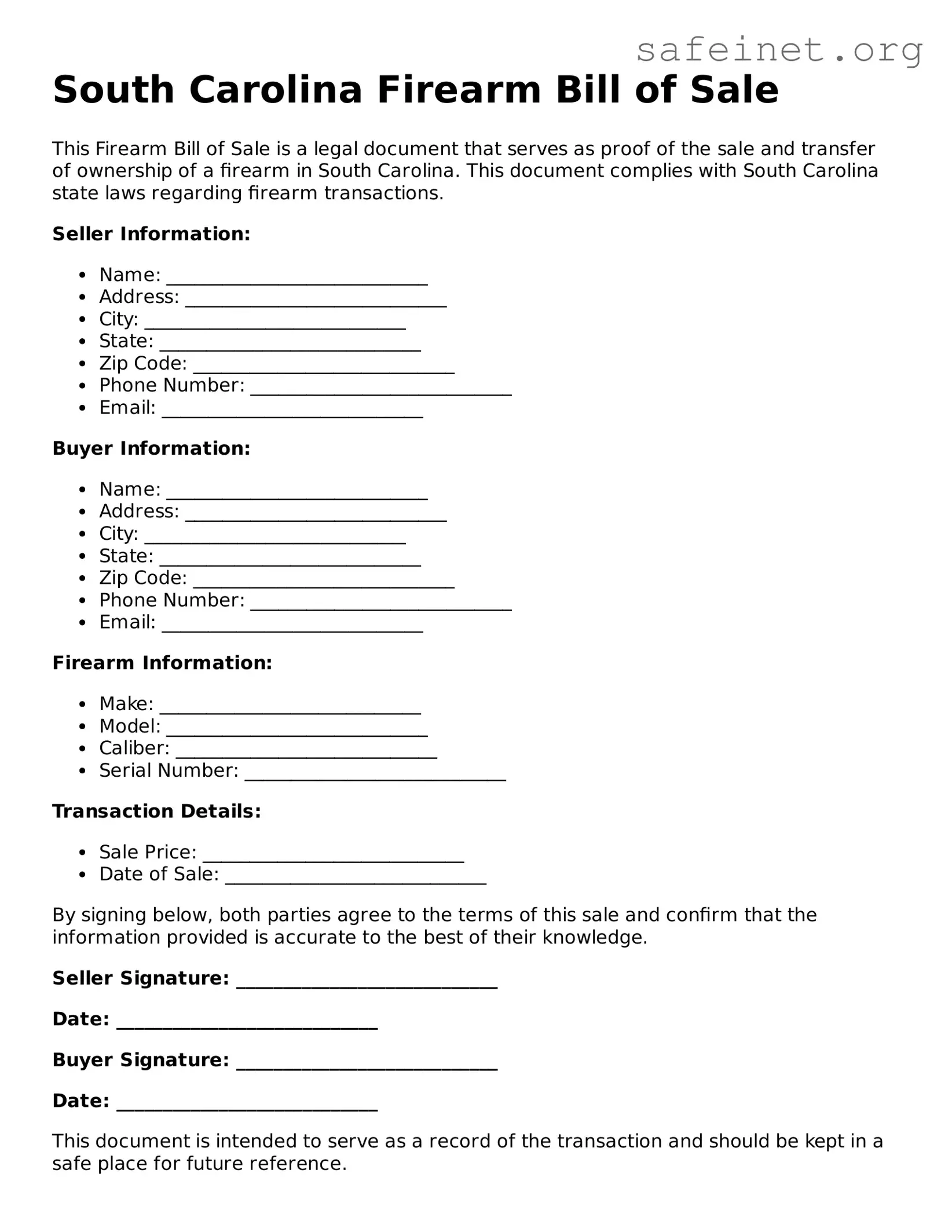
In South Carolina, the Firearm Bill of Sale form plays a crucial role in the private sale and transfer of firearms. This document serves as a written record that details the transaction between the seller and the buyer, ensuring both parties are protected under the law. Key elements typically included in the form are the names and addresses of both the buyer and seller, a description of the firearm being sold, and the date of the transaction. Additionally, it may outline the purchase price and any conditions of the sale. This form not only helps to confirm ownership but also provides a layer of accountability, as it can be used to demonstrate compliance with state laws regarding firearm sales. Understanding the importance of this document can help individuals navigate the process more smoothly and ensure that all legal requirements are met during the transfer of ownership.
South Carolina Firearm Bill of Sale
This Firearm Bill of Sale is a legal document that serves as proof of the sale and transfer of ownership of a firearm in South Carolina. This document complies with South Carolina state laws regarding firearm transactions.
Seller Information:
Buyer Information:
Firearm Information:
Transaction Details:
By signing below, both parties agree to the terms of this sale and confirm that the information provided is accurate to the best of their knowledge.
Seller Signature: ____________________________
Date: ____________________________
Buyer Signature: ____________________________
Date: ____________________________
This document is intended to serve as a record of the transaction and should be kept in a safe place for future reference.
| Fact Name | Description |
|---|---|
| Purpose | The South Carolina Firearm Bill of Sale form is used to document the sale or transfer of firearms between private parties. |
| Governing Law | This form is governed by South Carolina Code of Laws, Title 23, Chapter 31, which outlines firearm regulations. |
| Parties Involved | The form must include the names and addresses of both the seller and the buyer. |
| Firearm Details | Specific details about the firearm, including make, model, caliber, and serial number, must be provided. |
| Date of Transfer | The date when the transfer of ownership occurs must be clearly stated on the form. |
| Signatures Required | Both the seller and buyer must sign the form to validate the transaction. |
| No Registration Required | South Carolina does not require the registration of firearms, but the Bill of Sale serves as proof of ownership. |
| Legal Age | Both parties must be at least 18 years old to legally complete the transaction. |
| Record Keeping | It is advisable for both parties to keep a copy of the Bill of Sale for their records. |
After you have gathered all necessary information, you can begin filling out the South Carolina Firearm Bill of Sale form. This document will serve as proof of the sale and transfer of ownership for the firearm.
Once you have completed the form, make sure both parties keep a copy for their records. This will help ensure that all details of the transaction are documented properly.
What is a Firearm Bill of Sale in South Carolina?
A Firearm Bill of Sale is a legal document that records the sale and transfer of a firearm from one party to another in South Carolina. This form serves as proof of the transaction and includes details about the firearm, the buyer, and the seller. It is important for both parties to have a copy for their records.
Is a Firearm Bill of Sale required in South Carolina?
While South Carolina does not legally require a Bill of Sale for private firearm transactions, it is highly recommended. Having this document can help protect both the buyer and the seller by providing evidence of the transaction, which can be useful in case of disputes or legal issues in the future.
What information should be included in the Firearm Bill of Sale?
A comprehensive Firearm Bill of Sale should include the names and addresses of both the buyer and seller, the date of the transaction, a description of the firearm (including make, model, caliber, and serial number), and the purchase price. Both parties should sign the document to validate the sale.
Can I sell a firearm to someone from another state?
Yes, but there are specific regulations that must be followed. When selling a firearm to someone from another state, it is essential to comply with federal laws and the laws of both states. Generally, the buyer should conduct the transaction through a licensed firearms dealer to ensure all legal requirements are met.
Do I need to have the Firearm Bill of Sale notarized?
No, notarization is not required for a Firearm Bill of Sale in South Carolina. However, having the document notarized can add an extra layer of authenticity and may be beneficial in case of any disputes or legal inquiries in the future.
What if the buyer or seller is not a South Carolina resident?
If either party is not a resident of South Carolina, it is crucial to follow the laws of the buyer's state of residence. Each state has different regulations regarding firearm sales, and it is advisable to consult those laws before proceeding with the transaction.
Can I use a generic Bill of Sale template for firearms?
While a generic Bill of Sale template can be used, it is best to use a form specifically designed for firearm transactions. This ensures that all necessary details are included and that the document complies with South Carolina laws. Customizing the template to fit your specific transaction is also a good practice.
What should I do if I lose my Firearm Bill of Sale?
If you lose your Firearm Bill of Sale, it is advisable to create a new document that includes all the original details of the transaction. Both parties should sign this new document. Keeping a digital copy or storing the original in a safe place can help prevent future loss.
Are there any age restrictions for purchasing a firearm in South Carolina?
Yes, federal law states that individuals must be at least 18 years old to purchase a firearm from a private seller. However, for purchasing handguns from a licensed dealer, the buyer must be at least 21 years old. It is essential to verify the age of the buyer before completing the sale.
What are the consequences of not having a Firearm Bill of Sale?
Not having a Firearm Bill of Sale can lead to complications in proving ownership or the legality of the transaction. In the event of a legal dispute, lack of documentation may make it difficult to establish the details of the sale. This can result in potential legal repercussions for both the buyer and the seller.
Incomplete Information: One of the most common mistakes is failing to provide all required information. Buyers and sellers must fill out their names, addresses, and other identifying details completely. Missing even a single piece of information can lead to complications later on.
Incorrect Firearm Details: People often overlook the specifics of the firearm being sold. This includes the make, model, and serial number. Providing incorrect or vague details can create confusion and may even lead to legal issues.
Not Signing the Document: It may seem simple, but forgetting to sign the Bill of Sale is a frequent error. Both parties must sign the document for it to be valid. Without signatures, the transaction may not be legally recognized.
Failing to Keep a Copy: After completing the form, individuals often neglect to keep a copy for their records. Retaining a copy is essential for both the buyer and seller. It serves as proof of the transaction and can be helpful if any disputes arise in the future.
When engaging in the sale or transfer of a firearm in South Carolina, several documents can complement the Firearm Bill of Sale form. Each of these documents serves a specific purpose, ensuring that the transaction is conducted legally and transparently. Below are some commonly used forms and documents in conjunction with the Firearm Bill of Sale.
Using these documents alongside the Firearm Bill of Sale can help protect both the buyer and seller. They provide a clear record of the transaction and ensure that all legal requirements are met. Engaging in responsible firearm transactions is essential for the safety and well-being of the community.
The South Carolina Firearm Bill of Sale form shares similarities with a Vehicle Bill of Sale. Both documents serve as proof of a transaction between a buyer and a seller. In the case of a vehicle, the bill of sale includes details such as the vehicle identification number (VIN), make, model, and year, along with the purchase price. Similarly, the Firearm Bill of Sale includes information about the firearm, such as the make, model, and serial number. Both documents protect the interests of both parties by providing a written record of the sale, which can be useful for future reference or legal purposes.
Another document comparable to the Firearm Bill of Sale is the Personal Property Bill of Sale. This document is used for the sale of various types of personal property, including furniture, electronics, and collectibles. Like the firearm bill of sale, it outlines the details of the item being sold, including a description and the agreed-upon price. Both documents aim to establish a clear agreement between the buyer and seller, ensuring that both parties understand the terms of the sale and have a record of the transaction.
The South Carolina Firearm Bill of Sale is also similar to a Real Estate Purchase Agreement. While this agreement pertains to real property rather than personal property, both documents detail the terms of a sale. The Real Estate Purchase Agreement includes information such as the property address, purchase price, and any contingencies. Just like the firearm bill, it serves to formalize the agreement between the parties involved, providing a written record that can be referenced if disputes arise in the future.
Finally, the Firearm Bill of Sale has similarities with a Lease Agreement. While a lease typically pertains to the rental of property rather than a sale, both documents outline terms and conditions agreed upon by the parties. A Lease Agreement details the rental duration, payment amount, and responsibilities of both the landlord and tenant. In the same way, the Firearm Bill of Sale specifies the details of the firearm transaction and the obligations of the buyer and seller. Both documents help ensure clarity and protection for all parties involved in the agreement.
When filling out the South Carolina Firearm Bill of Sale form, it is crucial to ensure that the process is handled correctly. Here are five important do's and don'ts to consider:
By following these guidelines, individuals can ensure a smooth and legally compliant transaction when buying or selling firearms in South Carolina.
The South Carolina Firearm Bill of Sale form is often misunderstood. Here are six common misconceptions about this important document:
Understanding these misconceptions can help ensure that firearm transactions are conducted smoothly and legally in South Carolina.
When filling out and using the South Carolina Firearm Bill of Sale form, there are several important points to keep in mind. Here are some key takeaways:
By following these guidelines, you can help ensure a smooth and legal transaction when buying or selling a firearm in South Carolina.