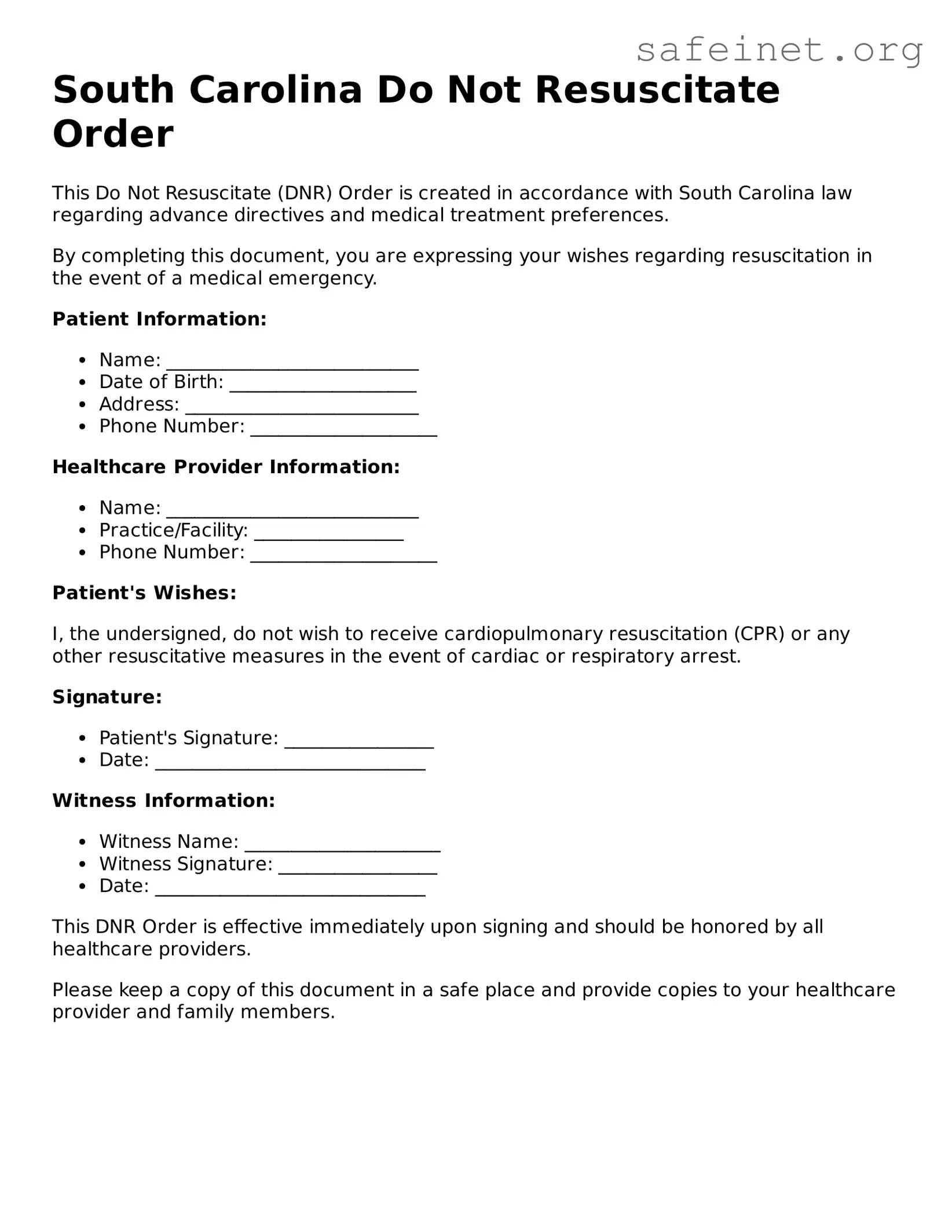
The South Carolina Do Not Resuscitate (DNR) Order form is a crucial document for individuals who wish to express their preferences regarding medical treatment in the event of a life-threatening emergency. This form allows patients to indicate that they do not want resuscitation efforts, such as CPR or advanced cardiac life support, if their heart stops beating or they stop breathing. It is essential for ensuring that a person's wishes are respected when they are unable to communicate them. The DNR Order must be signed by a physician and can be presented in both hospital and out-of-hospital settings. Additionally, it is important for individuals to discuss their decision with family members and healthcare providers to ensure everyone understands their wishes. This form is a vital part of advance care planning, providing peace of mind for patients and their loved ones by clarifying treatment preferences in critical situations.
South Carolina Do Not Resuscitate Order
This Do Not Resuscitate (DNR) Order is created in accordance with South Carolina law regarding advance directives and medical treatment preferences.
By completing this document, you are expressing your wishes regarding resuscitation in the event of a medical emergency.
Patient Information:
Healthcare Provider Information:
Patient's Wishes:
I, the undersigned, do not wish to receive cardiopulmonary resuscitation (CPR) or any other resuscitative measures in the event of cardiac or respiratory arrest.
Signature:
Witness Information:
This DNR Order is effective immediately upon signing and should be honored by all healthcare providers.
Please keep a copy of this document in a safe place and provide copies to your healthcare provider and family members.
| Fact Name | Description |
|---|---|
| What is a DNR? | A Do Not Resuscitate (DNR) order is a legal document that instructs medical personnel not to perform cardiopulmonary resuscitation (CPR) if a patient's heart stops or they stop breathing. |
| Governing Law | The South Carolina DNR order is governed by the South Carolina Code of Laws, Title 44, Chapter 77. |
| Eligibility | Any adult who is capable of making their own medical decisions can complete a DNR order. |
| Form Requirements | The DNR order must be signed by the patient and a licensed physician to be valid. |
| Where to Obtain | The DNR form can be obtained from healthcare providers, hospitals, or online through South Carolina's Department of Health and Environmental Control (DHEC) website. |
| Revocation | A DNR order can be revoked at any time by the patient or their legal representative. |
| Storage | It is essential for the DNR order to be easily accessible to medical personnel, so keep it in a visible location, such as on the refrigerator or in a medical file. |
| Emergency Services | Emergency medical services (EMS) must honor a valid DNR order presented at the scene of an emergency. |
| Impact on Care | Having a DNR order does not affect the quality of other medical care provided to the patient. |
| Advance Directives | A DNR order is part of a broader category known as advance directives, which include other documents like living wills and healthcare proxies. |
Filling out the South Carolina Do Not Resuscitate Order form is an important step in expressing your healthcare wishes. After completing the form, it should be signed and dated by you and your physician. Make sure to keep copies for your records and provide them to your healthcare providers.
What is a Do Not Resuscitate (DNR) Order in South Carolina?
A Do Not Resuscitate Order (DNR) is a legal document that allows a person to refuse cardiopulmonary resuscitation (CPR) in the event of a medical emergency where their heart stops beating or they stop breathing. In South Carolina, this order must be signed by a physician and is intended to ensure that the individual's wishes regarding resuscitation are respected by healthcare providers.
Who can request a DNR Order?
A DNR Order can be requested by any adult who is capable of making their own healthcare decisions. This includes individuals with terminal illnesses or those who are experiencing a severe decline in health. Additionally, a legal guardian or an authorized representative may request a DNR on behalf of someone who is unable to make such decisions.
How do I obtain a DNR Order in South Carolina?
To obtain a DNR Order, you must first discuss your wishes with your healthcare provider. If they agree that a DNR is appropriate, they will complete the necessary form. This form must be signed by both you and your physician. Once completed, you should keep a copy of the DNR Order in a place where it can be easily accessed by medical personnel in an emergency.
Where should I keep my DNR Order?
It is crucial to keep your DNR Order in a location that is easily accessible to emergency responders and healthcare providers. Many individuals choose to carry a copy in their wallet or purse. Additionally, placing a copy in a visible spot in your home, such as on the refrigerator or near your bedside, can help ensure that it is seen in case of an emergency.
Can I change or revoke my DNR Order?
Yes, you can change or revoke your DNR Order at any time. To do so, simply inform your healthcare provider of your decision. You may also need to complete a new DNR form if you decide to create a different set of instructions. It is important to ensure that all relevant parties, including family members and healthcare providers, are aware of any changes to your DNR status.
Not understanding the purpose of the form. Many individuals fill out the Do Not Resuscitate (DNR) Order without fully grasping its implications. This document is a legal directive that indicates a person’s wishes regarding resuscitation efforts in the event of a medical emergency.
Failing to discuss the decision with family or healthcare providers. Open conversations about end-of-life preferences are crucial. Without these discussions, family members may be unaware of the individual’s wishes, leading to confusion or conflict during critical moments.
Not signing the form correctly. A valid DNR Order requires the signature of the individual or their legal representative. Omitting a signature or not having it witnessed as required can render the document ineffective.
Neglecting to date the form. A DNR Order must be dated to be considered valid. Without a date, healthcare providers may question the form's authenticity and the individual’s current wishes.
Using outdated forms. South Carolina may update its DNR Order forms periodically. Utilizing an old version could lead to complications or misunderstandings about the individual’s current wishes.
Not keeping copies of the completed form. After filling out the DNR Order, it is essential to keep copies accessible. Without copies, healthcare providers may not have the necessary documentation readily available during emergencies.
Inadequate communication with healthcare providers. Simply filling out the form is not enough. It is vital to communicate with healthcare professionals to ensure they are aware of the DNR Order and understand its significance.
Ignoring state-specific requirements. Each state has its own regulations regarding DNR Orders. Failing to adhere to South Carolina’s specific requirements may invalidate the form.
Not reviewing the form regularly. Life circumstances and health conditions change. Regularly reviewing the DNR Order ensures it reflects current wishes and medical realities.
Overlooking the importance of clear language. The language used in the DNR Order should be straightforward and unambiguous. Confusing or vague terms may lead to misinterpretation by healthcare providers.
In South Carolina, the Do Not Resuscitate (DNR) Order form is an essential document for individuals who wish to express their preferences regarding resuscitation efforts in the event of a medical emergency. Alongside this form, several other documents may be utilized to ensure that a person's healthcare wishes are respected. Below is a list of related forms and documents commonly used in conjunction with the DNR Order.
Understanding these documents can significantly impact the quality of care received in critical situations. It is crucial for individuals to have their preferences documented clearly and to communicate them with their loved ones and healthcare providers. This proactive approach can help ensure that one's healthcare wishes are respected and honored throughout the course of treatment.
The Advance Directive is a legal document that allows individuals to outline their preferences for medical treatment in case they become unable to communicate their wishes. Like the Do Not Resuscitate Order (DNR), it provides guidance to healthcare providers about the individual's desires regarding life-sustaining measures. Both documents ensure that a person's healthcare choices are respected, particularly in critical situations where they cannot voice their preferences.
The Living Will is another important document similar to the DNR. It specifies the types of medical treatment a person wishes to receive or avoid in the event of a terminal illness or incapacitation. Both the Living Will and the DNR focus on the individual’s end-of-life care preferences, ensuring that medical interventions align with their values and wishes.
A Healthcare Power of Attorney (POA) is a legal form that designates someone to make medical decisions on behalf of another person if they are unable to do so. This document shares similarities with the DNR in that it ensures a person's healthcare preferences are honored. While the DNR specifically addresses resuscitation efforts, the Healthcare POA can cover a broader range of medical decisions, allowing for a more comprehensive approach to healthcare management.
The Physician Orders for Life-Sustaining Treatment (POLST) form is designed for individuals with serious illnesses. It translates a patient’s treatment preferences into actionable medical orders. Like the DNR, the POLST is intended to communicate a patient’s wishes to healthcare providers, ensuring that their choices about life-sustaining treatments are followed in emergencies.
The Medical Order for Life-Sustaining Treatment (MOLST) is similar to the POLST and is used in some states to document a patient's preferences regarding treatment. Both forms serve to guide medical personnel in emergency situations, ensuring that the patient’s wishes are respected. They provide clear instructions on what actions should be taken or avoided, much like the DNR.
The Do Not Intubate (DNI) order is a specific directive that indicates a patient does not wish to be placed on a ventilator or receive intubation. This document is closely related to the DNR, as both address specific life-sustaining interventions. While a DNR focuses on resuscitation efforts, a DNI emphasizes the individual’s wishes regarding mechanical breathing support.
The Comfort Care Order is a directive that prioritizes palliative care and comfort measures over aggressive treatments. It is similar to the DNR in that both documents aim to ensure a patient’s wishes are respected at the end of life. The Comfort Care Order focuses on alleviating suffering rather than prolonging life, aligning with the intent of the DNR to avoid unnecessary interventions.
When filling out the South Carolina Do Not Resuscitate (DNR) Order form, it's crucial to follow certain guidelines to ensure that your wishes are clearly communicated. Here are seven things to keep in mind:
Understanding the South Carolina Do Not Resuscitate (DNR) Order form is crucial for making informed healthcare decisions. Here are seven common misconceptions about the DNR form:
This is incorrect. A DNR specifically addresses resuscitation efforts in the event of cardiac or respiratory arrest. Other medical treatments will still be administered as needed.
This misconception overlooks the fact that anyone can request a DNR, regardless of their health status. It’s about personal choice regarding resuscitation.
While both documents relate to end-of-life care, a DNR specifically focuses on resuscitation, whereas a living will covers a broader range of healthcare decisions.
In South Carolina, a DNR form can be signed by the patient or their legal representative. A physician’s signature is not required for the document to be valid.
This is false. A DNR can be revoked or modified at any time by the patient or their representative, as long as they are competent to do so.
A DNR order is valid in various settings, including at home and in long-term care facilities. It is not limited to hospital environments.
This misconception can lead to unnecessary fear. A DNR reflects a choice about how one wants to approach end-of-life care, not a desire to end life prematurely.
Filling out and using the South Carolina Do Not Resuscitate (DNR) Order form is an important decision for individuals and their families. Here are five key takeaways to consider:
Understanding these key points can help ensure that the DNR Order serves its intended purpose while respecting the wishes of the individual involved.