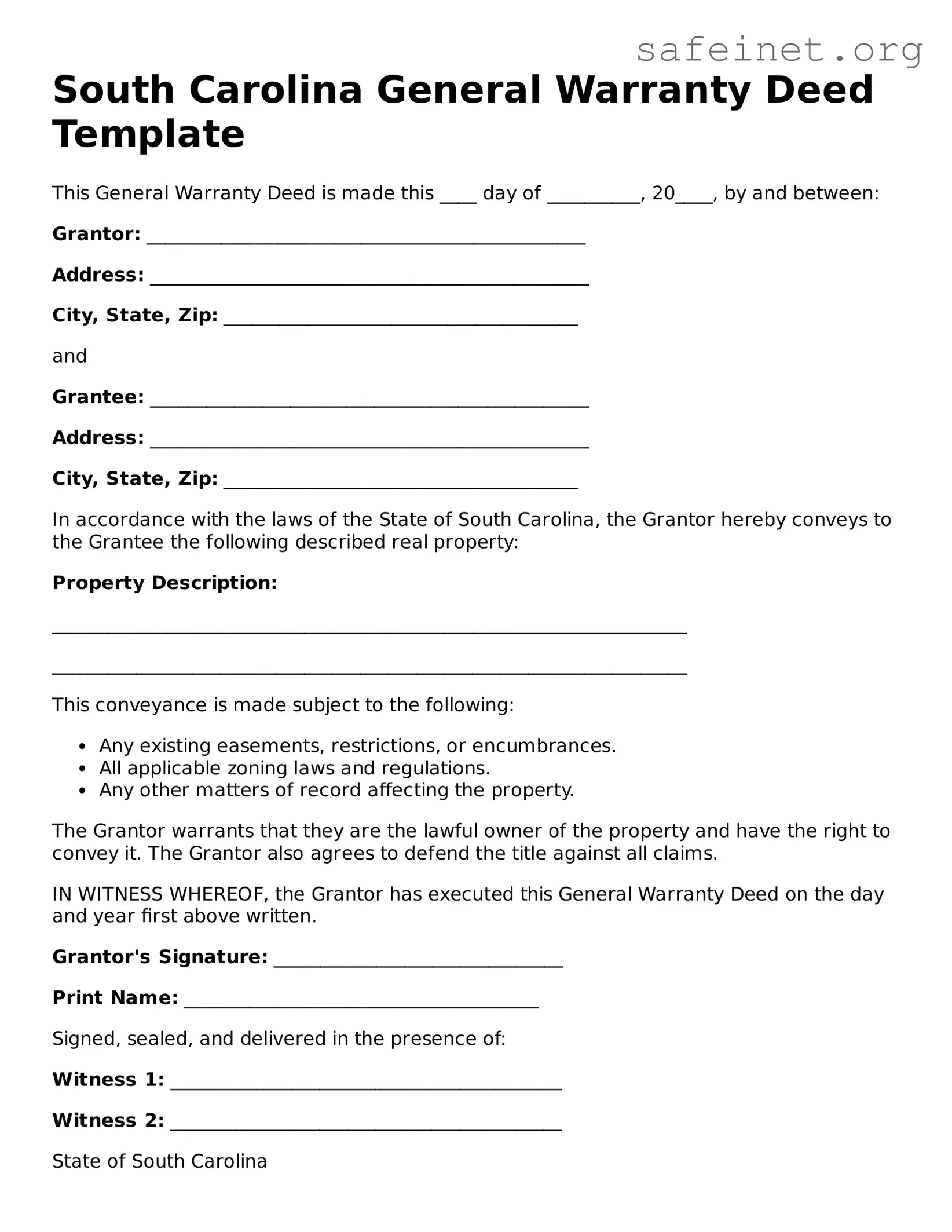
When it comes to transferring property in South Carolina, understanding the Deed form is essential for both buyers and sellers. This legal document serves as the official record of the transfer of ownership, outlining key details such as the names of the parties involved, a description of the property, and the terms of the transfer. The Deed form must be executed with precision, ensuring that it meets state requirements to be considered valid. It is important to note that different types of Deeds exist, including General Warranty Deeds and Special Warranty Deeds, each offering varying levels of protection for the buyer. Additionally, the Deed must be signed and notarized to establish its authenticity, and it must be recorded in the county where the property is located to provide public notice of the ownership change. Familiarity with these aspects can streamline the process and help avoid potential disputes down the line.
South Carolina General Warranty Deed Template
This General Warranty Deed is made this ____ day of __________, 20____, by and between:
Grantor: _______________________________________________
Address: _______________________________________________
City, State, Zip: ______________________________________
and
Grantee: _______________________________________________
Address: _______________________________________________
City, State, Zip: ______________________________________
In accordance with the laws of the State of South Carolina, the Grantor hereby conveys to the Grantee the following described real property:
Property Description:
____________________________________________________________________
____________________________________________________________________
This conveyance is made subject to the following:
The Grantor warrants that they are the lawful owner of the property and have the right to convey it. The Grantor also agrees to defend the title against all claims.
IN WITNESS WHEREOF, the Grantor has executed this General Warranty Deed on the day and year first above written.
Grantor's Signature: _______________________________
Print Name: ______________________________________
Signed, sealed, and delivered in the presence of:
Witness 1: __________________________________________
Witness 2: __________________________________________
State of South Carolina
County of ______________________
Before me, the undersigned Notary Public, personally appeared the above-named Grantor, who acknowledged the execution of this General Warranty Deed.
Notary Public: ______________________________________
My Commission Expires: ____________________________
| Fact Name | Description |
|---|---|
| Purpose of the Deed | The South Carolina Deed form is used to legally transfer ownership of real property from one party to another. |
| Types of Deeds | Common types of deeds in South Carolina include General Warranty Deeds, Special Warranty Deeds, and Quitclaim Deeds, each serving different purposes in property transfer. |
| Governing Laws | The South Carolina Code of Laws, specifically Title 27, governs the use and requirements for deeds within the state. |
| Recording Requirements | To ensure legal validity, the deed must be signed, notarized, and recorded with the appropriate county office in South Carolina. |
After completing the South Carolina Deed form, you will need to have it signed and notarized. Once this is done, you can file it with the appropriate county office to ensure it is officially recorded.
What is a South Carolina Deed form?
A South Carolina Deed form is a legal document used to transfer ownership of real property from one party to another. This form outlines the details of the transaction, including the names of the parties involved, a description of the property, and any conditions or covenants associated with the transfer. It is an essential component of real estate transactions in South Carolina and must be properly executed and recorded to be legally binding.
What types of Deeds are available in South Carolina?
In South Carolina, several types of deeds can be used, including General Warranty Deeds, Special Warranty Deeds, and Quitclaim Deeds. A General Warranty Deed provides the highest level of protection to the buyer, as it guarantees that the seller holds clear title to the property and has the right to sell it. A Special Warranty Deed offers similar assurances but only for the period during which the seller owned the property. A Quitclaim Deed, on the other hand, transfers whatever interest the seller has in the property without any guarantees regarding the title.
How do I complete a South Carolina Deed form?
To complete a South Carolina Deed form, you must provide specific information, including the names of the grantor (seller) and grantee (buyer), a legal description of the property, and the consideration (price) for the transfer. It is important to ensure that all information is accurate and that the form is signed by the grantor in the presence of a notary public. Once completed, the deed must be filed with the appropriate county register of deeds to be effective.
Is there a fee to record a Deed in South Carolina?
Yes, there is a fee associated with recording a Deed in South Carolina. The recording fees can vary by county, and it is advisable to check with the local register of deeds for the exact amount. Additionally, there may be other costs, such as transfer taxes, which can apply based on the property's value. It is wise to budget for these expenses when planning a real estate transaction.
Can I use a South Carolina Deed form for transferring property to a trust?
Yes, a South Carolina Deed form can be used to transfer property into a trust. However, it is important to ensure that the trust is properly established and that the deed includes the name of the trust as the grantee. Consulting with a legal professional can help ensure that the transfer is executed correctly and complies with all relevant laws and regulations.
Incorrect Names: People often misspell their names or use nicknames instead of their legal names. It is crucial to use the full legal name as it appears on official documents.
Missing Signatures: Forgetting to sign the deed is a common mistake. All parties involved in the transaction must sign the document for it to be valid.
Improper Notarization: Some individuals do not have the deed notarized, or they may use an unlicensed notary. A valid notarization is essential to ensure the deed is legally recognized.
Incorrect Property Description: Failing to provide an accurate description of the property can lead to confusion. It is important to include the correct address and legal description.
Omitting Consideration: The deed should state the consideration, or the amount paid for the property. Leaving this blank can create issues later on.
Filing Errors: After completing the deed, some people forget to file it with the appropriate county office. Proper filing is necessary to make the transfer official.
When preparing to transfer property in South Carolina, several important forms and documents often accompany the deed. Each of these documents serves a specific purpose in ensuring a smooth transaction and protecting the interests of all parties involved. Here’s a list of commonly used forms:
These documents play a crucial role in the property transfer process. Having them ready can help avoid delays and ensure everything is in order. Always consider consulting with a professional if you have questions about any specific forms or requirements.
The South Carolina Deed form shares similarities with a Quitclaim Deed. Both documents transfer ownership of property, but they do so in different ways. A Quitclaim Deed conveys whatever interest the grantor has in the property without any warranties. This means that if the grantor does not actually own the property, the grantee receives nothing. In contrast, the South Carolina Deed typically includes warranties that guarantee the grantor has a valid title to the property, providing more security for the buyer.
Another document comparable to the South Carolina Deed is the Warranty Deed. Like the South Carolina Deed, a Warranty Deed provides a guarantee from the seller that they hold clear title to the property and have the right to sell it. The key difference lies in the level of protection offered. A Warranty Deed ensures that the buyer is protected against any future claims to the property, while the South Carolina Deed may vary in the extent of the warranties provided, depending on the specific type of deed used.
The South Carolina Deed also resembles a Special Purpose Deed, often used in specific circumstances such as transfers between family members or in estate situations. Both documents facilitate the transfer of property ownership, but a Special Purpose Deed often includes specific language tailored to the unique situation, such as a transfer due to divorce or inheritance. While the South Carolina Deed can be used for general property transactions, a Special Purpose Deed serves more specialized needs.
Lastly, the South Carolina Deed can be compared to a Bargain and Sale Deed. This type of deed implies that the grantor has the right to sell the property but does not provide any warranties about the title. In this way, both the Bargain and Sale Deed and the South Carolina Deed facilitate the transfer of property. However, the South Carolina Deed generally offers more assurance to the buyer regarding the state of the title, which can be crucial in real estate transactions.
When filling out the South Carolina Deed form, it is essential to follow certain guidelines to ensure accuracy and compliance. Below are eight important dos and don'ts to consider:
Following these guidelines can help facilitate a smooth property transfer process in South Carolina.
Understanding the South Carolina Deed form is essential for anyone involved in real estate transactions in the state. However, several misconceptions can lead to confusion and mistakes. Here are eight common misconceptions about the South Carolina Deed form:
By dispelling these misconceptions, individuals can better navigate the complexities of property transactions in South Carolina. Understanding the specific requirements and implications of the deed form is vital for a successful real estate experience.
When filling out and using the South Carolina Deed form, keep the following key takeaways in mind: