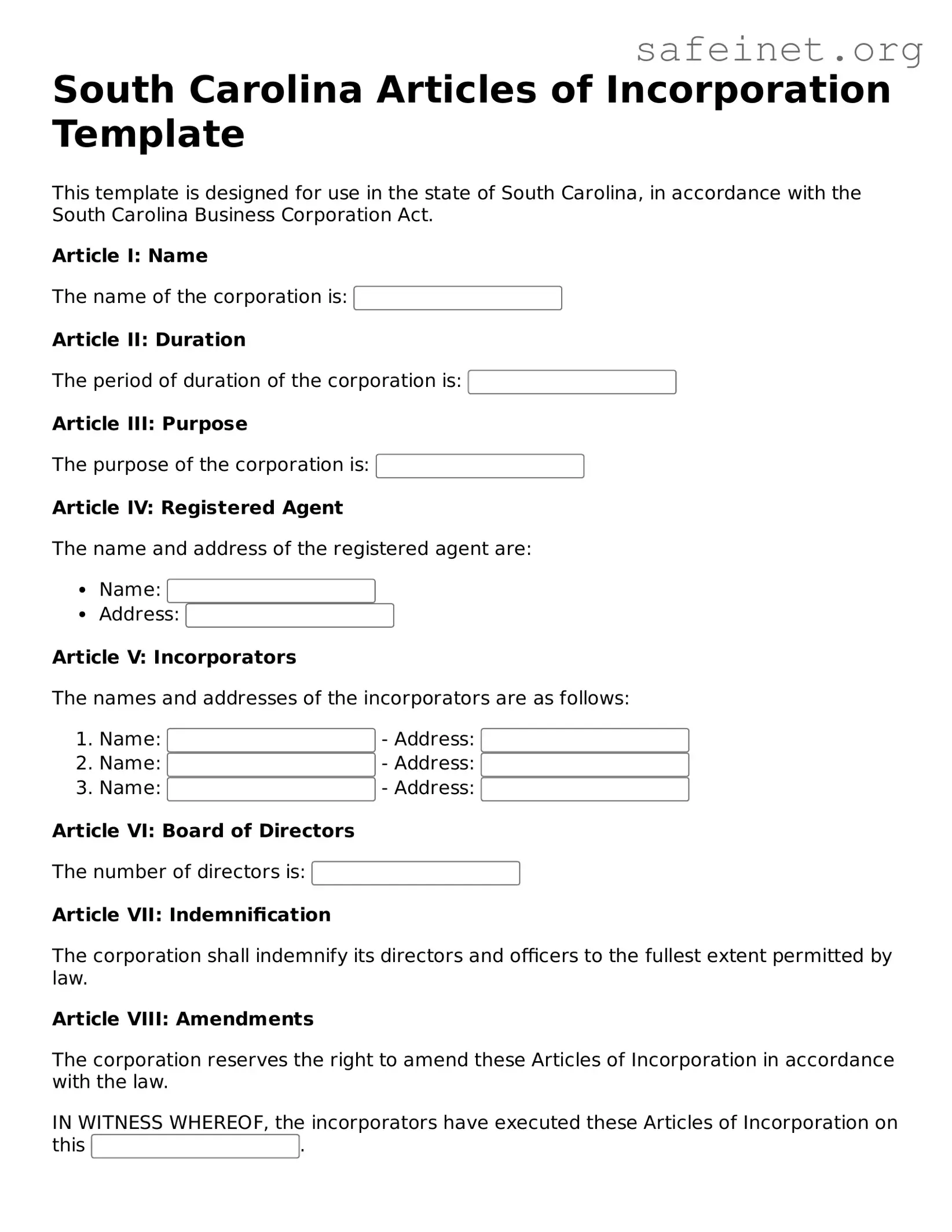
When starting a business in South Carolina, one of the essential steps is filing the Articles of Incorporation. This form serves as the foundational document that officially establishes your corporation in the state. It outlines crucial information such as the corporation's name, its purpose, and the address of its principal office. Additionally, the form requires details about the registered agent, who acts as the corporation's official point of contact. You will also need to specify the number of shares the corporation is authorized to issue, which is vital for potential investors. Understanding these key components is important for ensuring compliance with state laws and for laying the groundwork for your business's future operations. Completing the Articles of Incorporation accurately can pave the way for a smooth start to your corporate journey in South Carolina.
South Carolina Articles of Incorporation Template
This template is designed for use in the state of South Carolina, in accordance with the South Carolina Business Corporation Act.
Article I: Name
The name of the corporation is:
Article II: Duration
The period of duration of the corporation is:
Article III: Purpose
The purpose of the corporation is:
Article IV: Registered Agent
The name and address of the registered agent are:
Article V: Incorporators
The names and addresses of the incorporators are as follows:
Article VI: Board of Directors
The number of directors is:
Article VII: Indemnification
The corporation shall indemnify its directors and officers to the fullest extent permitted by law.
Article VIII: Amendments
The corporation reserves the right to amend these Articles of Incorporation in accordance with the law.
IN WITNESS WHEREOF, the incorporators have executed these Articles of Incorporation on this .
Signature of Incorporator:
| Fact Name | Description |
|---|---|
| Governing Law | The South Carolina Articles of Incorporation are governed by the South Carolina Business Corporation Act. |
| Purpose | This form is used to legally establish a corporation in South Carolina. |
| Filing Requirement | Filing the Articles of Incorporation is mandatory for all corporations in South Carolina. |
| Information Needed | Key details such as the corporation's name, address, and registered agent must be included. |
| Registered Agent | A registered agent must be designated to receive legal documents on behalf of the corporation. |
| Minimum Directors | At least one director must be listed in the Articles of Incorporation. |
| Filing Fee | A filing fee is required when submitting the Articles of Incorporation to the state. |
| Effective Date | The Articles of Incorporation can specify an effective date, or they become effective upon filing. |
| Amendments | Changes to the Articles can be made through an amendment process, as outlined in state law. |
After completing the South Carolina Articles of Incorporation form, you will be one step closer to officially establishing your business. This process involves submitting the form to the appropriate state office, along with any required fees. Following these steps carefully will help ensure that your application is processed smoothly.
Once your application is submitted, you will await confirmation from the state. This confirmation will indicate whether your Articles of Incorporation have been accepted or if any additional information is required.
What is the purpose of the Articles of Incorporation in South Carolina?
The Articles of Incorporation serve as a foundational document for a corporation in South Carolina. This form officially establishes your business as a legal entity recognized by the state. It includes essential information such as the corporation's name, its purpose, the registered agent's name and address, and the number of shares the corporation is authorized to issue. By filing this document, you create a distinct separation between your personal assets and the corporation's liabilities, which can provide protection for your personal finances.
Who needs to file the Articles of Incorporation?
Any individual or group intending to start a corporation in South Carolina must file the Articles of Incorporation. This requirement applies whether you are forming a for-profit or non-profit corporation. If you plan to operate as a corporation, you must complete this form to gain legal recognition. It's important to note that certain types of businesses, such as sole proprietorships or partnerships, do not require this document since they do not operate as separate legal entities.
What information is required on the Articles of Incorporation form?
The Articles of Incorporation form requires several key pieces of information. First, you must provide the name of the corporation, which must be unique and not already in use by another entity in South Carolina. Next, you need to state the corporation's purpose, which can be broad but should reflect the nature of your business. Additionally, the form requires details about the registered agent, who acts as the corporation's official point of contact. You will also need to indicate the number of shares the corporation is authorized to issue, along with any other pertinent information as outlined by the South Carolina Secretary of State’s office.
How do I file the Articles of Incorporation in South Carolina?
Filing the Articles of Incorporation in South Carolina can be done online or through traditional mail. If you choose to file online, you can visit the South Carolina Secretary of State's website, where you will find the necessary forms and instructions. Alternatively, you can download a paper form, complete it, and send it to the appropriate address along with the required filing fee. Be sure to check the current fee amount, as it may change. After submitting your Articles of Incorporation, the state will review your application, and upon approval, you will receive confirmation that your corporation is officially established.
Failing to provide a registered agent address. Every corporation in South Carolina must have a registered agent with a physical address in the state. Omitting this information can delay the incorporation process.
Not specifying the corporation's purpose. The Articles of Incorporation should clearly state the business purpose. A vague or incomplete description can lead to confusion or rejection.
Incorrectly listing the number of shares authorized. It's essential to accurately state how many shares the corporation is allowed to issue. Miscalculations or omissions can create issues down the line.
Neglecting to include the names and addresses of the initial directors. This information is crucial for the formation of the board of directors. Missing details can result in processing delays.
Not signing the form. All incorporators must sign the Articles of Incorporation. A missing signature can halt the entire process.
Using incorrect formatting or not following guidelines. The form must be filled out in accordance with state requirements. Deviating from these guidelines can lead to rejection.
Forgetting to pay the filing fee. Every submission requires a fee, and failing to include this payment can result in delays or denial of the application.
Not keeping a copy of the submitted form. It's important to retain a copy for your records. Without it, tracking the status of your incorporation may become challenging.
When forming a corporation in South Carolina, several important documents accompany the Articles of Incorporation. Each document plays a crucial role in establishing and maintaining the corporation's legal standing. Here are some of the key forms and documents you may encounter:
Understanding these documents is vital for anyone looking to successfully establish a corporation in South Carolina. Each document serves a specific purpose and contributes to the overall governance and compliance of the business entity.
The South Carolina Articles of Incorporation form is similar to the Certificate of Incorporation, which is used in many states to officially create a corporation. Both documents serve as the foundational legal paperwork required to establish a corporation. They typically include essential information such as the corporation's name, purpose, registered agent, and the number of shares authorized. While the terminology may vary from state to state, the underlying purpose remains consistent: to provide a legal framework for the corporation's existence.
Another document akin to the Articles of Incorporation is the Articles of Organization, which is used for limited liability companies (LLCs). Like the Articles of Incorporation, the Articles of Organization establish the entity's existence and outline key details such as the business name, address, and management structure. Both documents are filed with the state and serve as public records, ensuring transparency and legal recognition for the business entity.
The Bylaws of a corporation share similarities with the Articles of Incorporation in that they both govern the operations of the business. While the Articles of Incorporation provide the foundational structure, the Bylaws outline the internal rules and procedures for managing the corporation. This includes details on shareholder meetings, board of directors' roles, and voting processes. Together, these documents create a comprehensive framework for corporate governance.
The Partnership Agreement is another document that bears resemblance to the Articles of Incorporation, especially in terms of establishing a business entity. This agreement outlines the terms and conditions under which partners will operate a business. Like the Articles, it defines roles, responsibilities, and profit-sharing arrangements, although it is specifically tailored for partnerships rather than corporations.
Incorporation papers in other states, such as the Articles of Incorporation in California, closely mirror South Carolina's version. These documents typically require similar information, including the corporation's name, purpose, and registered agent. While there may be slight variations in requirements and forms, the overarching goal remains the same: to legally form a corporation and provide a structure for its operations.
The Certificate of Formation is another document that serves a similar purpose, particularly for LLCs. Like the Articles of Incorporation, this certificate is filed with the state to create a legal entity. It includes basic information about the business, such as its name, address, and the nature of the business. Both documents are essential for establishing a business and ensuring compliance with state regulations.
The Operating Agreement for an LLC also shares characteristics with the Articles of Incorporation. While the Articles establish the business's legal existence, the Operating Agreement outlines the management structure and operational procedures. This document details how decisions are made, how profits are distributed, and the roles of members, providing clarity and structure similar to what the Bylaws do for corporations.
Nonprofit Articles of Incorporation are another related document. These are specifically designed for nonprofit organizations and serve a similar purpose to standard Articles of Incorporation. They establish the organization’s legal status, outline its mission, and include information about its governance structure. Both documents require filing with the state and are critical for legal recognition.
The Statement of Information, often required in conjunction with the Articles of Incorporation in some states, serves to keep the state informed about key details of the corporation. This document typically includes updates on the corporation's address, officers, and registered agent. Like the Articles, it helps maintain transparency and ensures that the state has current information about the business entity.
Lastly, the Business License Application can be considered similar in that it is often required for legal operation of a business. While it does not establish the entity's legal existence, it ensures compliance with local regulations and permits the business to operate within a specific jurisdiction. Both the Articles of Incorporation and the Business License Application are essential steps in the process of legally establishing and running a business.
When filling out the South Carolina Articles of Incorporation form, attention to detail is crucial. Here’s a guide to help you navigate the process effectively. Below are nine essential dos and don’ts to consider.
By following these guidelines, you can help ensure a smoother process when establishing your corporation in South Carolina. Taking the time to understand these steps can save you from potential pitfalls and lead to a successful incorporation.
When it comes to the South Carolina Articles of Incorporation form, several misconceptions can lead to confusion. Here are six common misunderstandings:
Understanding these misconceptions can help streamline the incorporation process and set a solid foundation for your business in South Carolina.
When considering the formation of a corporation in South Carolina, understanding the Articles of Incorporation is crucial. This document serves as the foundation for your business entity. Here are some key takeaways to keep in mind:
By understanding these key aspects, you can navigate the process of incorporating your business in South Carolina with greater confidence. Properly filling out and submitting the Articles of Incorporation is a vital step toward establishing your corporation successfully.