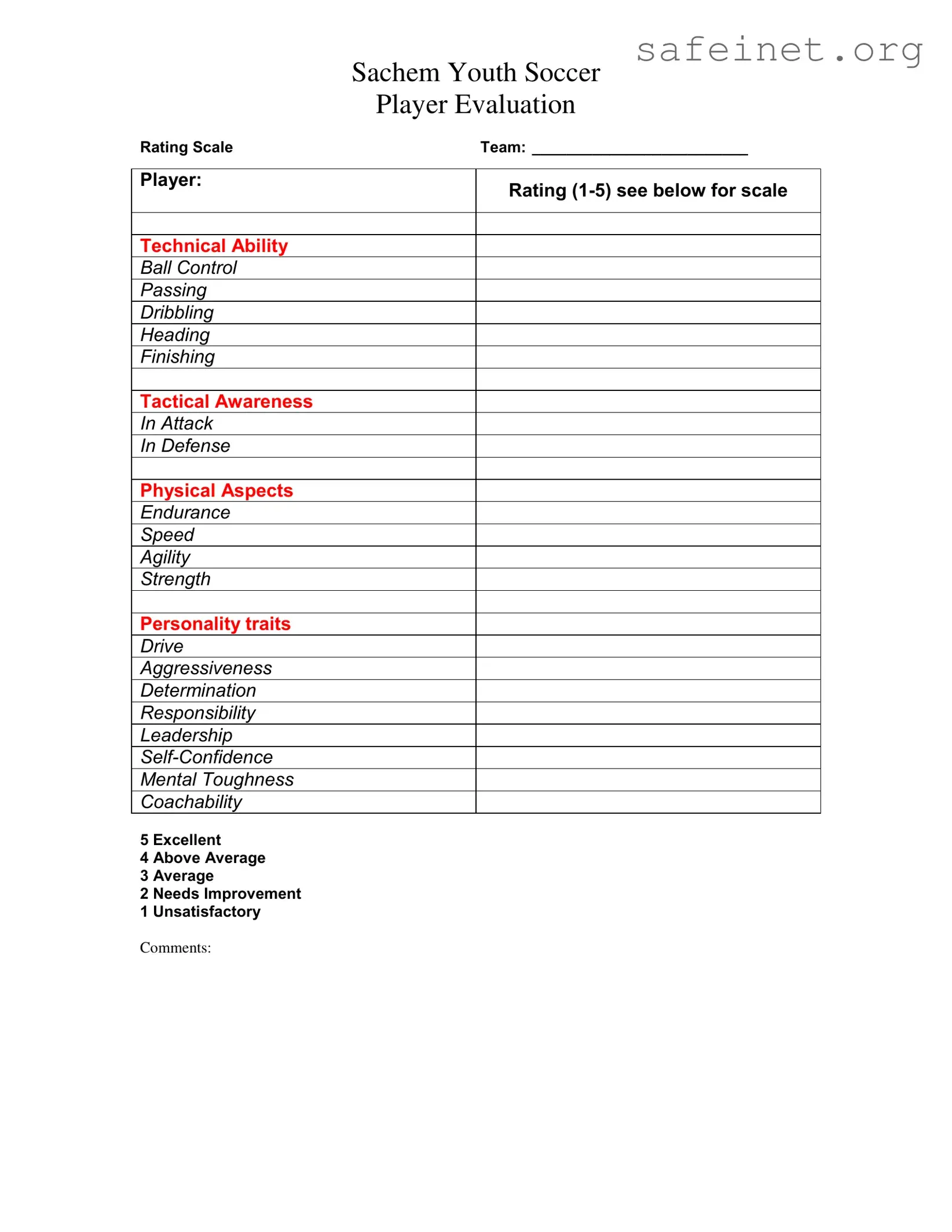
The Soccer Player Evaluation form is a comprehensive tool designed to assess various dimensions of a player's abilities and characteristics. It encompasses several critical areas, including technical skills, tactical awareness, physical attributes, and personality traits. Each player is rated on a scale from one to five, allowing coaches to provide nuanced feedback on aspects such as ball control, passing, dribbling, and finishing. The evaluation also considers a player's tactical insight both in attack and defense, highlighting their ability to read the game and make strategic decisions. Physical aspects such as endurance, speed, agility, and strength are evaluated to ensure that players can perform effectively throughout the match. Additionally, the form addresses key personality traits that contribute to a player's potential as a leader and team player, such as drive, determination, and coachability. This structured approach not only helps coaches identify areas for improvement but also fosters a supportive environment for player development.

|
Sachem Youth Soccer |
|
|
Player Evaluation |
|
Rating Scale |
|
Team: _________________________ |
|
|
|
Player: |
|
Rating |
|
|
|
|
|
|
|
|
|
Technical Ability |
|
|
Ball Control |
|
|
Passing |
|
|
Dribbling |
|
|
Heading |
|
|
Finishing |
|
|
|
|
|
Tactical Awareness |
|
|
In Attack |
|
|
In Defense |
|
|
|
|
|
Physical Aspects |
|
|
Endurance |
|
|
Speed |
|
|
Agility |
|
|
Strength |
|
|
|
|
|
Personality traits |
|
|
Drive |
|
|
Aggressiveness |
|
|
Determination |
|
|
Responsibility |
|
|
Leadership |
|
|
|
|
|
Mental Toughness |
|
|
Coachability |
|
|
5 Excellent |
|
|
4 Above Average |
|
|
3 Average |
|
|
2 Needs Improvement |
|
|
1 Unsatisfactory |
|
|
Comments:
Sachem Youth Soccer
Player Evaluation
DEFINITIONS
Technical Ability
Ball Control:
You must be able to bring a ball played to you under control instantly and smoothly. This is the ability to collect and move in a different direction without stopping the ball completely, yet still maintaining it securely. Develop the technique of receiving a pass at top speed. This means not slowing down to collect a ball coming on the ground, bouncing, or in the air. You must be able to protect the ball by shielding it and developing deception in order to get rid of your opponent.
Passing:
You must be able to successfully complete short and long range passes. This incorporates all of your ball skills, including heading, bending, chipping, and the ability to drive the ball to a partner. You will find that at a high level, it is easier to control and make quick decisions with a ball that is driven to you, rather than weakly played. Develop the skill of
Dribbling:
This is the ability to feint, burst past opponents, change directions and speed at will, and break through packed defensive lines. Can you exhibit quick feet, combined with a sense of comfort under pressure, to penetrate into space to open opportunities for yourself or a partner?
Heading:
The ability to head at goal after crosses, heading high, wide, and deep for defensive clearances, heading balls as a
shooting chances. Can you effectively demonstrate the ability to do this under the duress of the game?
Finishing:
Nothing makes more of an impression on people than the skill of goal scoring. This aspect takes in the correct technique of striking the ball in various ways; driving low balls, hitting volleys, half- volleys,
Tactical Awareness
Tactical insight incorporates the anticipation, reading, and execution of certain clues that happen during possession and
In Attack:
A. Player not in possession:
1.Makes themselves available for the ball, perhaps by a diagonal run or a crossover run.
2.Realizes when it is crucial to offer close support and when to stay away.
3.Recognizes the proper time to execute
B. Player in possession:
1.Has good peripheral vision, recognizing the correct time to switch the ball to the other side of the field.
2.Has good penetrating vision, allowing them to see and utilize players who are far down the field.
3.Recognizes the correct time to play directly, and when it is important to hold the ball (shielding
or dribbling), or when to run at top speed past players opening up passing angles for his team.
4.Sees opportunities to play
In Defense:
Sachem Youth Soccer
Player Evaluation
During the immediate pursuit, and desire to regain possession of the ball, the player should recognize:
1.When to race forward to intercept the pass.
2.When to mark the opponent tight in order to discourage the ball from being passed to them (pressure).
3.When, where, and how (posture) to tackle.
4.When to jockey the ball carrier and force them away from the goal (patience).
5.The quickest avenue of attack upon regaining the ball.
Physical Aspects
Endurance:
The ability of a player to commit themselves diligently throughout the game in attack and defense with no sign of fatigue and impaired ball control. That player must constantly be running into open spaces demanding the ball or pulling and committing opposing players to create openings. Even though this is also a tactical commitment, it will only be successful if you have the endurance capabilities to run for 60 to 90 minutes. The coach will be examining your physical exertion as you are being exposed to tactical problems you are trying to solve in the game.
Speed:
The ability to accelerate quickly and maintain that acceleration of the various lengths that player’s position demands. As an example, the forwards need acceleration with changes of speed over three to twenty yards. Elements include:
1.Pure
2.Lateral speed (changing direction).
3.Change of speed (slow to fast, fast to half speed).
4.Deceleration (“stopping on a dime”).
After these basics are attained, speed must be practiced with the ball!
Agility:
The ability to change directions quickly. Twisting, turning while dribbling, readjusting your body to control an awkwardly bouncing ball, and getting up quickly after a tackle are a few examples. This area is enhanced by flexibility exercises such as stretching, ball gymnastics, and skill training with the ball. Conditioning training must be combined with skill and tactical training!
Strength:
The ability to effectively use your body to win physical confrontations. Strength is exhibited during tackling (1 vs. 1), winning the aerial duel (heading), and changing directions effectively (explosion). It is also important to learn how to effectively use that strength to your advantage as is demonstrated in using your arms to hold a player off while running at top speed with the ball or in shooting for power. Much of your strength and power training can be combined with technique training!
Sachem Youth Soccer
Player Evaluation
Personality traits
Each coach loves to identify key players with personalities and qualities that cause them to become team leaders. The following personality traits are the most recognizable:
1.Drive: Pure will power, eager to achieve goals, a burning desire to achieve success, strong
2.Aggressiveness:
3.Determination: Seeks the direct way towards goal, no compromising, doesn’t hesitate when making decisions, willingness, fully concentrated, success oriented.
4.Responsibility: Intelligent, can read the game tactically (anticipation), conscientious, reliable, wants security, cooperative, ready for compromise, stable and skillful player.
5.Leadership: Intelligence, dedication, pride, bears responsibility for the team, influences the environment, anticipation, intuition, independent and spontaneous, convincing and dominating player, hard worker, no surrender, composed,
6.
7.Mental Toughness: Persistency, consistency, and commitment throughout the game, no surrender, tough
8.Coachability: Ready to learn and to achieve goals,
| Fact Name | Details |
|---|---|
| Rating Scale | The evaluation uses a 1-5 scale, where 5 indicates excellent performance and 1 signifies unsatisfactory performance. |
| Technical Ability | Players are assessed on skills such as ball control, passing, dribbling, heading, and finishing, which are crucial for their overall performance. |
| Tactical Awareness | Evaluation includes a player's ability to read the game, both in attack and defense, and their decision-making skills during play. |
| Physical Aspects | Endurance, speed, agility, and strength are key physical attributes evaluated to determine a player's fitness level and effectiveness on the field. |
| Personality Traits | Coaches look for traits like drive, aggressiveness, determination, and leadership, which can influence a player's impact on the team. |
| State-Specific Forms | In states like California and Texas, youth soccer evaluations must comply with local regulations regarding youth sports and safety. |
Completing the Soccer Player Evaluation form is an important step in assessing a player's skills and attributes. By following these steps, you will ensure that the evaluation is thorough and provides valuable insights into the player's abilities.
Once you have completed the form, it will be submitted to the coaching staff for further review. This evaluation will help in understanding the player's strengths and areas for development, contributing to their growth in the sport.
What is the purpose of the Soccer Player Evaluation form?
The Soccer Player Evaluation form is designed to assess a player's skills, physical abilities, and personality traits. Coaches use it to provide constructive feedback and to help players understand their strengths and areas for improvement. This evaluation aids in team selection and player development.
How is the rating scale structured?
The rating scale ranges from 1 to 5, where 5 indicates "Excellent" and 1 signifies "Unsatisfactory." Each category, such as technical ability and personality traits, is evaluated based on this scale to provide a comprehensive overview of the player's performance.
What categories are included in the evaluation?
The evaluation covers several key categories: Technical Ability (including ball control, passing, dribbling, etc.), Tactical Awareness (both in attack and defense), Physical Aspects (endurance, speed, agility, strength), and Personality Traits (drive, aggressiveness, determination, etc.). Each category contributes to a holistic view of the player's capabilities.
How can players improve their technical skills?
Players can enhance their technical skills through consistent practice. Focus on ball control, passing accuracy, and dribbling techniques. Engaging in drills that simulate game scenarios can also help players develop their skills under pressure, which is crucial during matches.
What does "tactical awareness" mean in the context of soccer?
Tactical awareness refers to a player's ability to read the game and make smart decisions during play. This includes knowing when to support teammates, recognizing opportunities to switch the ball, and understanding defensive positioning. Players with strong tactical awareness contribute significantly to their team's success.
Why are personality traits important in the evaluation?
Personality traits like drive, leadership, and mental toughness can greatly influence a player's performance and impact on the team. Coaches look for players who not only possess technical skills but also exhibit qualities that inspire and motivate their teammates, creating a positive team environment.
What should players focus on to improve their physical aspects?
To enhance physical aspects such as endurance, speed, agility, and strength, players should incorporate a balanced training regimen. This includes cardiovascular exercises, strength training, agility drills, and flexibility work. Consistency in training will lead to improved performance on the field.
How can feedback from the evaluation be used?
Feedback from the evaluation can guide players in setting personal goals for improvement. It helps identify specific areas to work on, whether that be technical skills, physical conditioning, or mental aspects of the game. Players should view feedback as a tool for growth rather than criticism.
Who completes the Soccer Player Evaluation form?
The evaluation form is typically completed by coaches who observe the players during practices and games. Their insights are based on direct observation, ensuring that the assessment reflects the player's true abilities and potential.
Can parents access the evaluation results?
Access to evaluation results may vary by organization. Generally, coaches will communicate the results to players and may discuss them with parents if appropriate. Open communication between coaches, players, and parents fosters a supportive environment for player development.
Inaccurate Ratings: Players often misjudge their abilities and assign ratings that do not reflect their true skill level. This can lead to mismatches in team placement and development opportunities.
Neglecting Comments Section: Many fail to provide specific comments that explain their ratings. This section is crucial for coaches to understand the player’s strengths and areas for improvement.
Ignoring Tactical Awareness: Players frequently overlook the importance of tactical awareness. They might focus solely on technical skills, neglecting how they perform in different game situations.
Omitting Personality Traits: Some evaluations do not address personality traits that are vital for team dynamics. Coaches need to know about traits like leadership and determination to build a cohesive team.
Failure to Update Information: Players sometimes submit outdated evaluations. Regular updates are necessary to reflect improvements or changes in skills, ensuring accurate assessments.
When evaluating a soccer player's performance, several key documents complement the Soccer Player Evaluation form. Each document serves a specific purpose in assessing skills, development, and overall contribution to the team. Here’s a brief overview of these important forms.
Utilizing these forms alongside the Soccer Player Evaluation form enhances the overall assessment process. This comprehensive approach ensures that each player's development is closely monitored and supported.
The Soccer Player Evaluation form is similar to a Student Performance Evaluation form, often used in educational settings. Both documents assess an individual’s skills and abilities, providing a rating scale that helps identify strengths and areas for improvement. Just as teachers evaluate students on various competencies, coaches use the Soccer Player Evaluation to gauge a player's technical abilities, tactical awareness, and personality traits. This comparison highlights the importance of structured feedback in fostering growth, whether in sports or academics.
Another document that shares similarities with the Soccer Player Evaluation form is the Employee Performance Review. In a workplace setting, this review assesses an employee's performance across different competencies, such as teamwork, productivity, and leadership. Both forms utilize a rating scale to quantify performance and include sections for comments and feedback. This structured approach allows both coaches and managers to provide constructive criticism and recognize achievements, fostering a culture of continuous improvement.
The Athlete Development Plan is another document akin to the Soccer Player Evaluation. This plan outlines specific goals and benchmarks for an athlete’s growth, similar to how the evaluation form identifies key skills to be developed. Both documents emphasize a holistic view of performance, considering not only technical skills but also mental and physical aspects. By mapping out a player’s journey, these tools help ensure that athletes receive the guidance needed to reach their full potential.
A Fitness Assessment form also resembles the Soccer Player Evaluation in its focus on physical capabilities. This document evaluates aspects like endurance, strength, and agility, much like the evaluation assesses a player's physical aspects. Both forms aim to provide a comprehensive understanding of an individual's fitness level, helping coaches and trainers tailor their programs to meet specific needs. This alignment ensures that athletes are physically prepared for the demands of their sport.
The Coaching Feedback Form shares similarities with the Soccer Player Evaluation by offering a structured way to provide insights on performance. Coaches use this form to evaluate their own effectiveness and the progress of their players. Both documents foster open communication and create a framework for constructive feedback, ultimately benefiting the athlete's development. The emphasis on clear communication enhances the relationship between coaches and players, promoting a positive learning environment.
The Team Assessment Form is another document that parallels the Soccer Player Evaluation. This form evaluates the overall performance of a team, considering factors such as teamwork, strategy, and execution. Similar to how the player evaluation looks at individual contributions, the team assessment provides a broader perspective on collective performance. Both documents serve to identify strengths and weaknesses, guiding future training and strategy adjustments.
A Sports Skills Inventory is also akin to the Soccer Player Evaluation form. This inventory catalogs an athlete's skills and competencies across various areas, such as technical abilities and mental toughness. Like the evaluation, it provides a structured approach to assess performance and identify areas for improvement. Both documents play a crucial role in developing personalized training plans that cater to the unique needs of each athlete.
The Talent Identification Form is similar in its purpose to the Soccer Player Evaluation. This document is used to identify potential athletes based on their skills, physical attributes, and personality traits. Both forms utilize rating scales and descriptive criteria to assess capabilities, helping coaches make informed decisions about player selection. This process is essential for building competitive teams and ensuring that talented individuals receive the opportunities they deserve.
Lastly, the Goal Setting Worksheet shares a connection with the Soccer Player Evaluation form. This worksheet helps athletes outline their objectives and track their progress, just as the evaluation form identifies specific skills to focus on. Both documents encourage athletes to take ownership of their development, fostering a proactive approach to improvement. By setting clear goals and evaluating progress, athletes can stay motivated and engaged in their training.
When filling out the Soccer Player Evaluation form, it is essential to approach the task thoughtfully. The following list outlines ten things you should and shouldn't do to ensure a comprehensive and accurate evaluation.
Misconceptions about the Soccer Player Evaluation form can lead to misunderstandings regarding its purpose and use. Here are nine common misconceptions:
Filling out and utilizing the Soccer Player Evaluation form effectively can greatly enhance the assessment process. Here are some key takeaways to consider: