When a loved one passes away, the process of settling their estate can feel overwhelming, especially during an already emotional time. For many families, the Small Estate Affidavit offers a streamlined way to manage this process without the complexities of formal probate. This form is designed for estates that fall below a certain value threshold, making it an accessible option for those with modest assets. By using the Small Estate Affidavit, heirs can claim property and settle debts more efficiently. The form typically requires information about the deceased, including their assets and liabilities, as well as details about the beneficiaries. It's important to note that each state has its own regulations regarding this affidavit, so understanding local requirements is crucial. With the right guidance, navigating the Small Estate Affidavit can provide a clearer path to honoring a loved one’s legacy while minimizing legal hurdles.
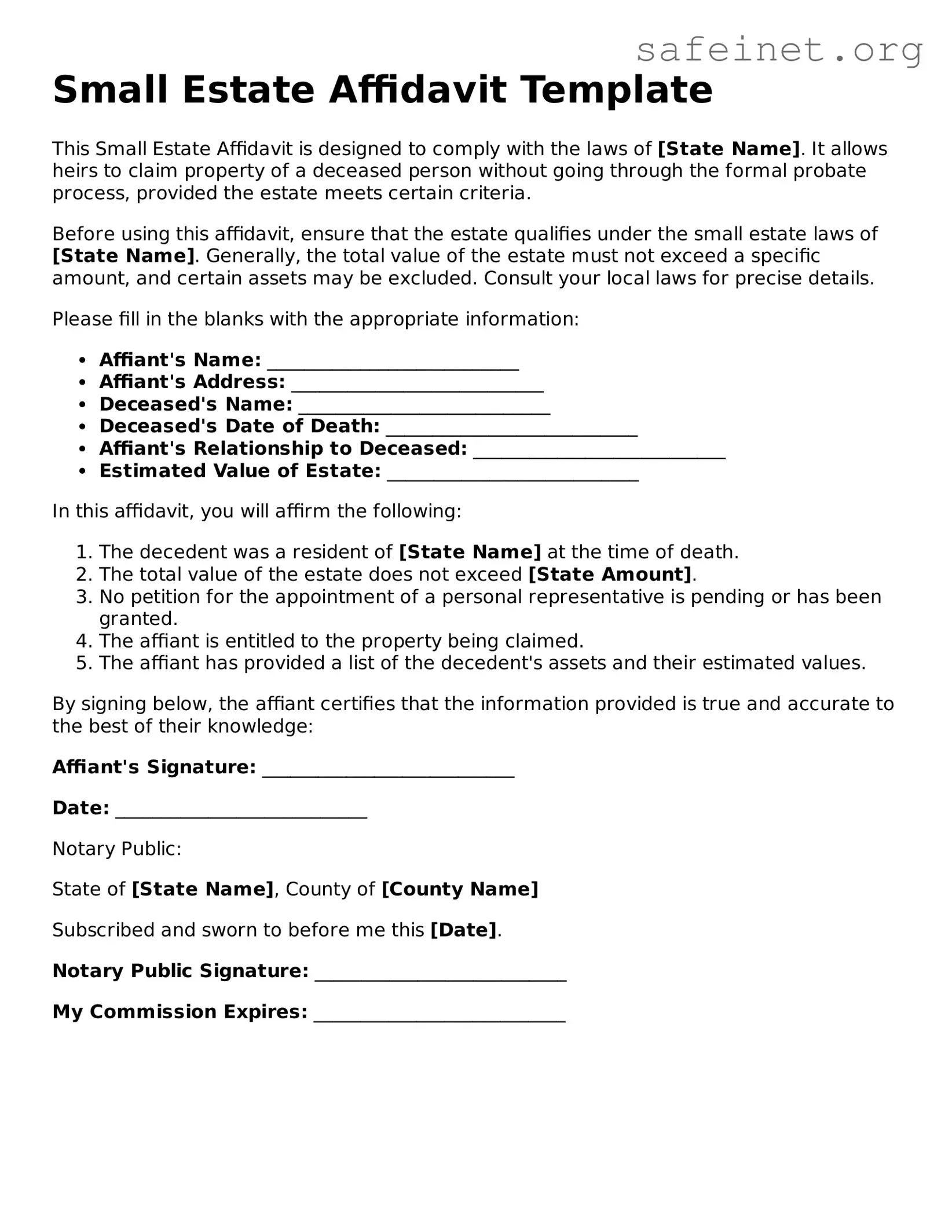
Small Estate Affidavit Template
This Small Estate Affidavit is designed to comply with the laws of [State Name]. It allows heirs to claim property of a deceased person without going through the formal probate process, provided the estate meets certain criteria.
Before using this affidavit, ensure that the estate qualifies under the small estate laws of [State Name]. Generally, the total value of the estate must not exceed a specific amount, and certain assets may be excluded. Consult your local laws for precise details.
Please fill in the blanks with the appropriate information:
In this affidavit, you will affirm the following:
By signing below, the affiant certifies that the information provided is true and accurate to the best of their knowledge:
Affiant's Signature: ___________________________
Date: ___________________________
Notary Public:
State of [State Name], County of [County Name]
Subscribed and sworn to before me this [Date].
Notary Public Signature: ___________________________
My Commission Expires: ___________________________
| Fact Name | Description |
|---|---|
| Definition | A Small Estate Affidavit is a legal document that allows heirs to claim assets of a deceased person without going through probate. |
| Eligibility | Typically, estates valued below a certain threshold can use this form. The threshold varies by state. |
| State-Specific Forms | Each state has its own version of the Small Estate Affidavit, reflecting local laws and requirements. |
| Governing Laws | In California, for example, the Small Estate Affidavit is governed by California Probate Code § 13100-13116. |
| Filing Process | Heirs must complete the affidavit and file it with the appropriate court or county office, depending on state rules. |
| Required Information | The affidavit typically requires information about the deceased, the heirs, and a list of assets. |
| Limitations | Using a Small Estate Affidavit does not apply to all types of assets, such as real estate in some jurisdictions. |
Once you have the Small Estate Affidavit form in hand, it’s time to fill it out carefully. This form is essential for settling the estate of a deceased individual who meets certain criteria. Ensure that you have all the necessary information and documents ready before you begin.
After completing the form, you will need to file it with the appropriate court or authority, along with any required supporting documents. Make sure to keep copies for your records. Following these steps will help ensure that the process moves smoothly.
What is a Small Estate Affidavit?
A Small Estate Affidavit is a legal document that allows heirs to claim assets from a deceased person's estate without going through the lengthy and expensive probate process. This form is typically used when the total value of the estate is below a certain threshold, which varies by state. It simplifies the transfer of property and ensures that heirs can access their inheritance quickly.
Who is eligible to use a Small Estate Affidavit?
Generally, any person who is an heir or beneficiary of the deceased can use a Small Estate Affidavit. However, eligibility depends on the total value of the estate and the specific laws of the state where the deceased lived. It is important to check local regulations to determine if the estate qualifies as a small estate.
What assets can be claimed using a Small Estate Affidavit?
Assets that can be claimed typically include bank accounts, personal property, and vehicles. Real estate may also be included, but this varies by state. The key requirement is that the total value of the assets must fall under the state’s small estate limit. Always verify which assets are eligible in your state.
How do I file a Small Estate Affidavit?
Filing a Small Estate Affidavit usually involves completing the form and submitting it to the appropriate court or agency. You may need to provide a copy of the death certificate and any other required documentation. Some states may require notarization. Ensure that all information is accurate to avoid delays in processing.
What happens after I file the Small Estate Affidavit?
After filing, the court will review the affidavit. If approved, the heirs can then claim the assets listed in the affidavit. It is crucial to keep copies of all documents for your records. If there are any disputes or issues, the court may need to intervene, so be prepared for potential follow-up actions.
Not verifying eligibility: Ensure that the estate qualifies as a small estate under state law. Each state has its own limits.
Incorrectly identifying heirs: Double-check that all heirs are listed accurately. Missing an heir can lead to complications.
Omitting required information: Fill in all sections completely. Incomplete forms may be rejected or delayed.
Failing to sign the affidavit: Make sure that the affidavit is signed by the appropriate parties. An unsigned form is not valid.
Not providing supporting documents: Attach necessary documents, such as death certificates or proof of ownership. These are often required for processing.
Using outdated forms: Always use the most current version of the Small Estate Affidavit form. Outdated forms may not be accepted.
Ignoring state-specific requirements: Each state may have unique rules. Familiarize yourself with your state’s specific requirements.
Neglecting to notarize: Many states require the affidavit to be notarized. Ensure this step is completed to avoid issues.
Not keeping copies: Always make copies of the completed affidavit and any attached documents for your records. This can be crucial if questions arise later.
Submitting to the wrong office: Know where to file the affidavit. Submitting it to the incorrect office can delay the process.
The Small Estate Affidavit is a valuable tool for individuals dealing with the estate of a deceased loved one. It simplifies the process of transferring assets without the need for formal probate, particularly when the estate is below a certain value threshold. However, several other forms and documents are often utilized alongside the Small Estate Affidavit to ensure a smooth transition of assets. Here are a few key documents that may be required:
Using these documents in conjunction with the Small Estate Affidavit can facilitate a more efficient and clear process for settling an estate. Understanding each of these forms can help individuals navigate the often complex landscape of estate management with greater confidence.
The Small Estate Affidavit is similar to a Will in that both documents are used to distribute a deceased person's assets. A Will outlines the wishes of the deceased regarding how their property should be handled after death. In contrast, the Small Estate Affidavit allows heirs to claim assets without going through the lengthy probate process, provided the estate meets certain criteria. Both documents serve to ensure that the deceased's intentions are honored, but the Small Estate Affidavit is typically used when the estate is small and straightforward.
Another document that bears similarity to the Small Estate Affidavit is the Letter of Administration. This document is issued by a court and grants an individual the authority to manage the estate of someone who has died without a Will. While the Small Estate Affidavit can be executed by heirs without court involvement, the Letter of Administration requires a court process. Both documents aim to facilitate the transfer of assets, but the Letter of Administration is necessary when there is no Will, whereas the Small Estate Affidavit is a simpler alternative for small estates.
The Affidavit of Heirship also shares characteristics with the Small Estate Affidavit. This document is used to establish the heirs of a deceased person when there is no Will. Similar to the Small Estate Affidavit, the Affidavit of Heirship allows heirs to claim property without going through probate. However, the Affidavit of Heirship focuses specifically on identifying heirs, while the Small Estate Affidavit is a claim for the distribution of assets. Both serve to simplify the process of asset transfer after death.
Lastly, the Declaration of Informal Probate is another document that is comparable to the Small Estate Affidavit. This declaration allows for a simplified probate process for estates that qualify. While the Small Estate Affidavit is used to bypass probate entirely for small estates, the Declaration of Informal Probate streamlines the probate process for larger estates. Both documents aim to reduce the time and complexity involved in settling an estate, but they apply to different scenarios based on the size and nature of the estate.
When filling out the Small Estate Affidavit form, it's important to approach the task with care. Here are some key do's and don'ts to keep in mind:
Many people hold misconceptions about the Small Estate Affidavit form. Understanding these can help clarify the process and ensure proper handling of small estates. Below are ten common misconceptions:
By dispelling these misconceptions, individuals can better navigate the process of handling small estates and ensure they are following the appropriate legal procedures.
Filling out and using a Small Estate Affidavit form can be a straightforward process, but it’s important to understand the key aspects involved. Here are some essential takeaways to consider:
Understanding these key points can help simplify the process of managing a small estate and ensure compliance with legal requirements.